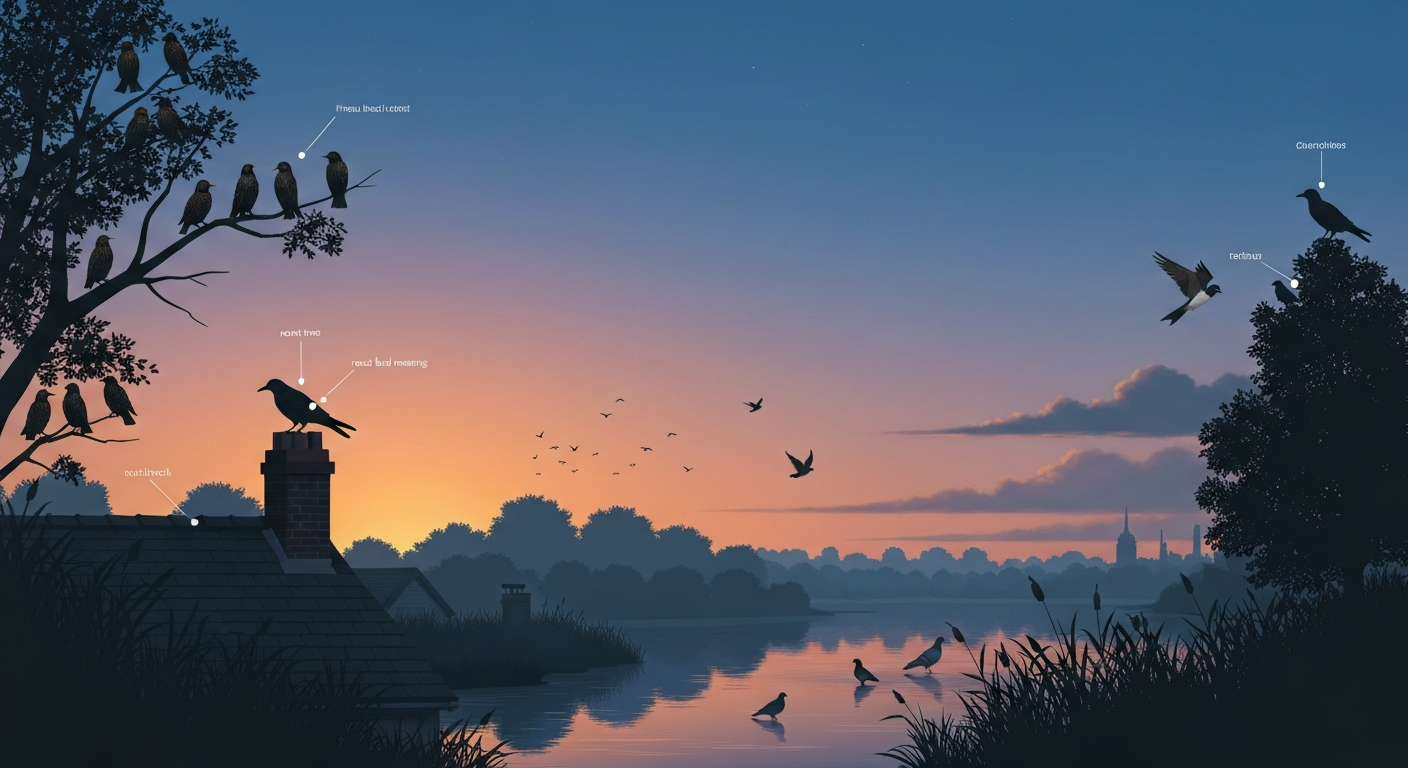
A roost bird is simply a bird at rest, settled in for sleep or inactivity at a specific site it returns to regularly. 'Roost' works as both a noun (the place where a bird sleeps) and a verb (the act of settling there), and the phrase 'roost bird' is used to describe any species in that state or associated with a particular roosting site. Beyond the biology, the word carries centuries of idiom, folklore, and literary meaning that make it worth understanding on more than one level.
Roost Bird Meaning: Definition, Biology, Culture & Usage

Marcus Whitley
8 Aug 2026
Roost as a noun and a verb: the precise definitions
Used as a noun, a roost is a place where a bird regularly rests or sleeps. It can be a bare branch, a cavity in a tree, a chimney, a cliff ledge, or a purpose-built roost box. The defining quality is that the bird returns to it for rest, not for breeding. Used as a verb, 'to roost' means for a bird to settle down and sleep, or to occupy a roosting site. Merriam-Webster's definition captures both senses cleanly: the noun denotes the structure or perch used for sleeping, and the verb denotes the act of settling there. The Cambridge English Dictionary records the same core meanings while also noting the figurative extension into human use, which we will get to in the idioms section.
In practical terms, you would say a starling flock 'comes in to roost at dusk' (verb), or that a particular stand of trees serves as 'the crow roost for the whole county' (noun). Both senses appear constantly in ornithology writing, birding guides, and everyday conversation about wildlife.
Where the word comes from: etymology of 'roost'
The word 'roost' is genuinely old. It comes from Middle English roste, meaning a chicken's perch, which itself traces back to Old English hrōst, meaning a wooden framework, perch, or roost structure. That Old English root connects to a Proto-Germanic base reconstructed as *hrōst-, making it a native Germanic word with deep roots in the language. Historical lexicons including the Dictionary of the Older Scottish Tongue record early attestations, and the Oxford English Dictionary is the authoritative source for the earliest dateable quotations in written English, though the word was in active use well before most surviving manuscripts.
The phrase 'roost bird' is not itself an ancient idiom but rather a descriptive compound that has grown more common in modern bird-watching culture, wildlife management, and pest-control contexts, where distinguishing a 'roost bird' from a nesting bird or a transient bird matters practically. It does not appear in historical phrase dictionaries the way 'rule the roost' does, but its meaning is transparent and follows directly from the noun sense.
What birds actually do when they roost
Roosting is fundamentally about rest and survival between periods of activity. When a bird roosts, it is conserving energy, reducing exposure to predators, and often regulating its body temperature. Ornithology handbooks from the Cornell Lab of Ornithology describe roosting as a behavioral state distinct from simple perching or migration stopover resting: a roost site is one a bird commits to repeatedly, not just pauses at briefly during flight.
Timing matters a lot. Most species roost at night, returning to the same site after foraging. The behavior is driven by light levels, temperature, and seasonal rhythms. In winter, roosting takes on extra physiological importance because nights are longer and colder. Some species, including certain raptors, also engage in daytime or 'day-roosting,' particularly during breeding season when nocturnal activity is minimal. The physiology involved is not trivial: birds reduce their metabolic rate during deep rest, and communal arrangements can dramatically reduce heat loss per individual bird.
Roosting vs. nesting: they are not the same thing
People mix these up constantly, and it matters. Roosting is about sleep and rest. Nesting is about reproduction. A nest is built or chosen for laying eggs, incubating them, and raising young. A roost site is chosen for safety and comfort during inactivity. The same species may use entirely different locations for each, and the same location a bird nests in during spring may be abandoned entirely as a roost site once breeding ends. Cornell Lab materials specifically note that roost boxes provided for birds serve nonbreeding shelter needs and are distinct from nest boxes, which are used during the breeding season.
| Feature | Roost | Nest |
|---|---|---|
| Primary purpose | Sleep and rest | Breeding, incubation, raising young |
| Season | Year-round, especially nonbreeding months | Breeding season |
| Built by the bird? | Rarely (uses existing sites) | Usually yes, or selected and modified |
| Occupied repeatedly? | Yes, often nightly | Yes, during breeding cycle only |
| Shared with others? | Often yes (communal roosting common) | Sometimes, but usually more private |
| Example site | Dense hedgerow, chimney, roost box | Nest cup, cavity, platform |
It is also worth separating roosting from a migration stopover. During long migratory journeys, birds stop to refuel and rest at sites they may never visit again. Ornithology literature treats these stopovers as operationally distinct from true roost sites, which imply regular return and a degree of site fidelity. A perch is different again: a bird perching on a fence post for thirty seconds while scanning for prey is not roosting. The word 'roost' carries an implication of commitment and return.
Species that show roosting behavior most dramatically
European starlings and the murmuration
European starlings (Sturnus vulgaris) are probably the most visually spectacular example of communal roosting. Before settling in for the night, flocks of hundreds of thousands, sometimes millions, perform coordinated aerial displays called murmurations. A citizen-science study published in PLOS ONE in 2017 examined these pre-roost displays and found support for predator-avoidance and recruitment hypotheses. Pre‑roost murmuration displays by European starlings Sturnus vulgaris, PLOS ONE (2017, citizen science study) reports empirical support for predator‑avoidance and recruitment hypotheses for these displays Pre‑roost murmuration displays by European starlings Sturnus vulgaris — PLOS ONE (2017, citizen science study). The communal roost itself, once the birds land, can have significant ecological effects including nutrient loading of the soil below and, as documented in a 2021 Animals review, disease transmission risks given the density of individuals.
American crows
American crows form large communal winter roosts that can number in the thousands or tens of thousands. Cornell Lab ornithologists have documented the dynamic, seasonal nature of these roosts: birds may travel considerable distances each evening to reach the roost site and disperse again at dawn. The roosts tend to grow through autumn and peak in winter, then dissolve as breeding season approaches.
Chimney swifts
Chimney swifts use chimneys and purpose-built towers as communal roost sites during migration and the nonbreeding period. Cornell Lab's All About Birds describes the remarkable sight of swifts funneling into a chimney in a tornado-like spiral at dusk, with thermal warmth inside the chimney providing a physiological benefit. Conservation groups now erect swift towers to compensate for the loss of natural and human-built chimneys.
Raptors and waterfowl
Raptors are more variable. Some, like Swainson's hawks and rough-legged hawks, form communal roosts on migration, while others are largely solitary roosters. A 2026 Journal of Animal Ecology study on a long-lived raptor found that trade-offs across life history stages and social association types shape winter communal roosting decisions, supporting the idea that costs and benefits are species-specific and season-specific. Waterfowl such as ducks and geese often roost on open water, which provides predator protection through early-warning detection across a wide surface.
Why communal roosting at all?
Ecology literature has proposed several adaptive reasons for communal roosting. The Information Centre Hypothesis, reviewed in Biological Reviews (2016), suggests that roosts serve as information-sharing hubs where less successful foragers can follow successful ones to food sources the next morning. Other documented benefits include thermoregulation through body heat sharing, predator dilution (your odds of being the one caught drop as flock size grows), and increased vigilance. Costs are real too: disease spreads more easily, and competition for warm roosting spots can be intense.
Where birds actually roost: habitats and structures
Night roosts are the most commonly documented. Dense vegetation, evergreen trees, reed beds, cliff faces, and building ledges are all typical sites. The key qualities birds look for are shelter from wind and rain, reduced visibility to predators, and proximity to food sources for the morning. Urban environments have become increasingly important roost habitats, particularly for species like starlings, crows, and pigeons that have adapted to city life.
- Night roosts: dense hedgerows, evergreen trees, reed beds, cliffs, building ledges, chimneys
- Day roosts: used by nocturnal hunters (owls) or seabirds resting between foraging bouts
- Urban roost sites: bridges, building facades, city parks, and industrial structures
- Migratory roost sites: large trees or reedbeds used by birds in transit, not with long-term site fidelity
- Purpose-built structures: roost boxes, swift towers, and bat-and-bird combined boxes installed by conservationists
The distinction between a migratory stopover site and a true roost matters both scientifically and in conservation terms. Stopover sites need protection for a different set of reasons (food availability, minimal disturbance during fuel deposition) than established winter roost sites (long-term habitat continuity, absence of light pollution and disturbance during sleep).
Roosting in folklore, religion, and literature
Across cultures, the roosting bird has long been a symbol of settlement, home, and the end of striving. The image of birds returning to their roost at dusk is one of the most universal in human experience, and it has generated a rich body of symbolic meaning. In many European folk traditions, the bird returning to roost was read as a sign of safety and completion, a daily affirmation that the world remained in order. If birds failed to return to their usual roost, it was considered an ill omen.
In literature, Charles Dickens used 'at roost' and related phrases to signal settled domesticity or its ironic opposite. Searching Dickens' works through Project Gutenberg surfaces multiple instances where characters or households are described as being 'at roost,' conveying a stillness that is either cozy or foreboding depending on context. The image works precisely because it carries the bird sense into human emotional territory so naturally.
In dream symbolism, a roosting bird is generally interpreted as a signal of rest, contentment, and coming home to what matters. Some folk interpretation traditions distinguish between a bird roosting peacefully (positive omen, stability, resolution) and a bird unable to find its roost or disturbed from roosting (anxiety, unresolved conflict, displacement). These interpretations vary by culture and bird species: a roosting raven carries different weight in Norse tradition than a roosting dove in Christian iconography.
The idioms: rule the roost, chickens come home to roost, and more
'Rule the roost' is the most widely used idiom built on this word, and its history is genuinely interesting. The phrase means to be in charge or to dominate a group, and most people assume it has always referenced a rooster dominating the chicken yard. But word historians have traced 'rule the roost' as a folk alteration of the older phrase 'rule the roast,' which was in use by the 16th century and referred to presiding over the dinner table, a position of household authority. 'Rule the roost' in its current form is attested from the 18th century and eventually displaced the older version entirely. The bird image was retrofitted to a phrase that began in the kitchen, not the henhouse.
'Chickens come home to roost' is the other major roost idiom in English. It means that past misdeeds or poor decisions eventually return to cause problems for the person responsible. The expression has antecedents reaching back to Chaucer's era in various forms, but the familiar modern phrasing is often attributed to Robert Southey's work in the early 19th century. See Chickens Coming Home to Roost, World Wide Words (lexicographic/phrase history) for discussion of Chaucer‑era antecedents and Southey's 19th‑century wording Chickens Coming Home to Roost — World Wide Words (lexicographic/phrase history). The image is intuitive: no matter how far a chicken wanders, it returns to its roost each night. Your bad choices, the proverb suggests, will find their way back to you just as reliably.
| Expression | Meaning | Approximate origin |
|---|---|---|
| Rule the roost | To be in charge or dominant | 18th century, evolved from 'rule the roast' (16th c.) |
| Chickens come home to roost | Past mistakes return to cause consequences | Modern form attributed to early 19th century (Southey); earlier antecedents in Middle English |
| At roost | Settled, quiet, at rest (often figurative for people) | Literary English, used by Dickens and others |
| Roost bird | A bird associated with a specific roosting site; also informally a bird in its resting state | Modern ornithology and birding usage |
The phrase 'mouthy bird' connects to roost-related bird language in a looser but real way: it refers to birds known for their vocalizations, particularly around roosting time when species like starlings and crows become especially noisy. That expressiveness has filtered into slang usage as well, where 'mouthy' carries over from the bird world into descriptions of talkative or outspoken people. If that intersection of bird behavior and slang usage interests you, the entry on mouthy bird meaning explores that territory in more depth. For a related exploration of how bird terms map onto slang and cultural meanings, see flightless bird american mouth meaning for a discussion of that specific phrase's background.
A note on related terms worth knowing
Readers searching 'roost bird meaning' are often also curious about the rooster, which shares the etymological root but has a separate identity as the adult male chicken specifically associated with crowing at dawn, not just roosting. The rooster's symbolism across cultures, from vigilance in Chinese tradition to solar themes in French heraldry, goes well beyond the roosting behavior both birds share. The entry on rooster bird meaning covers that cultural history in its own right. Similarly, the flightless bird categories that come up in related searches have their own distinct symbolism around groundedness, resilience, and adaptation, which is a different conversation from the one roosting behavior opens up. For another relevant comparison, see mouthy bird meaning. For readers curious about the symbolism and vocal associations of grounded species, see the entry on flightless bird roar meaning.
FAQ
What is the precise dictionary definition of 'roost' (noun and verb)?
Noun: a place where a bird rests or sleeps (a perch, branch, structure, or site used for resting). Verb: to settle down to rest or sleep (as a bird). Authoritative dictionary sources to cite: Merriam‑Webster, Cambridge Dictionary, Oxford English Dictionary (OED).
What is the etymology of 'roost'?
'Roost' comes from Middle English roste (a chicken's perch), from Old English hrōst meaning a perch or wooden framework; it is ultimately from a Proto‑Germanic root (*hrōst‑). For earliest attestations and historical quotations cite Etymonline, the OED, and historical lexica such as the Dictionary of the Older Scottish Tongue (DOST).
How is 'roosting' defined and treated in ornithology?
In ornithology, roosting is the behaviour of settling to rest or sleep (often at night) at a roost site. It serves functions including rest, thermoregulation, predator avoidance, and social information exchange. Use Cornell Lab resources (All About Birds, Handbook of Bird Biology) and peer‑reviewed ecology texts for authoritative explanations.
How does roosting differ from nesting, perching, and migration stopovers?
Roosting = nightly or periodic resting/sleeping. Nesting = breeding activity (laying, incubating, rearing young) at a nest site. Perching = brief resting or lookout posture. Migration stopovers = temporary sites for refuelling/rest during migration. Distinguish these using field guide and migration ecology sources (Handbook of Bird Biology; migration ecology studies).
What are communal roosts and why do some species form them?
Communal roosts are sites where many individuals gather to roost together. Hypothesized benefits include thermoregulation (shared warmth), anti‑predator effects (dilution, increased vigilance, confusion), and information transfer about food (Information Centre Hypothesis). Costs include disease transmission and competition. Support: peer‑reviewed ecology literature and reviews (Biological Reviews; Journal of Animal Ecology) and species‑specific studies.
What species commonly roost communally and what are notable examples?
Examples: European starlings (large murmuration pre‑roosts and communal roosts numbering thousands to millions), American crows (large seasonal roosts), Chimney Swifts (communal chimney roosts during migration/nonbreeding). Use Cornell Lab (All About Birds), PLOS ONE research on starling pre‑roosts, and species reviews/epidemiological literature for documentation.
Next Article
Mouthy Bird Meaning: Definition, Tone, Examples & Variants
Mouthy bird meaning: clear definition, origins, examples, tone advice, and how to respond in conversation.