When people search 'junco bird meaning,' they're usually asking one of two things: what exactly is a junco, and what does it mean when one shows up in your yard or crosses your path? The short answer is that juncos are small, ground-feeding winter birds whose symbolism is almost entirely rooted in their ecology. They arrive with cold weather, they travel in flocks, and they disappear in spring. That seasonal rhythm is what drives nearly every meaningful association people attach to them, from 'snowbird' nicknames in old nature writing to modern spirit-animal pages talking about adaptability and renewal. Neither interpretation is wrong, but understanding where the symbolism actually comes from makes it a lot more useful.
Junco Bird Meaning: Symbolism, Sighting Tips, and Facts

Marcus Whitley
20 Apr 2026
What a junco actually is
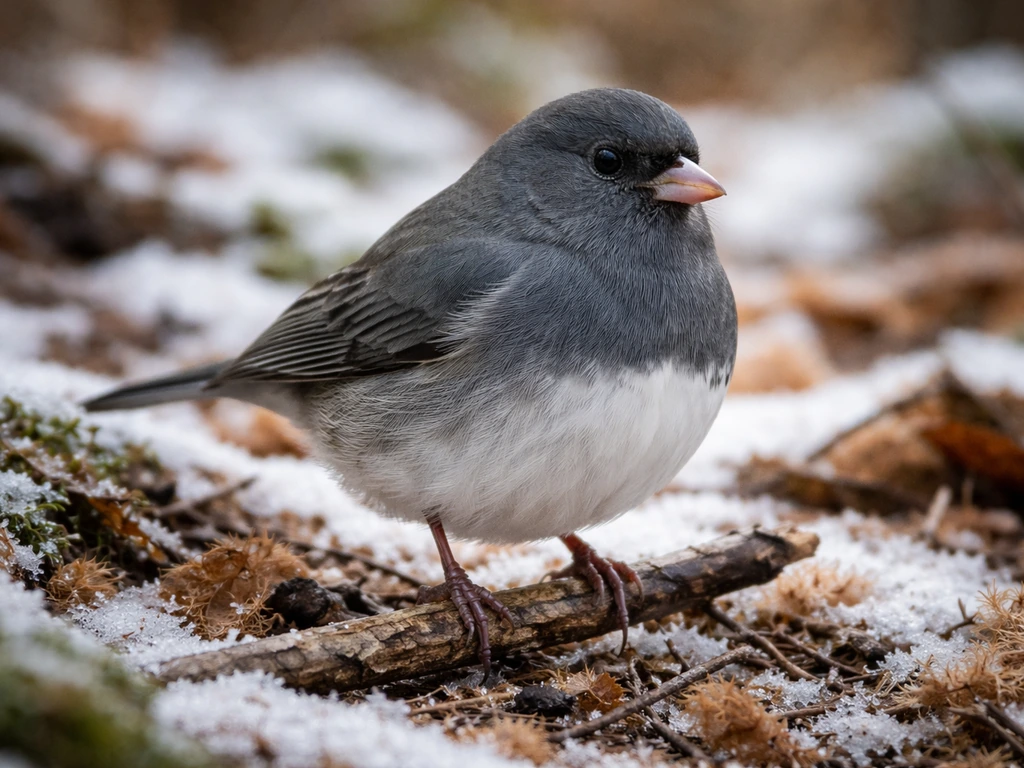
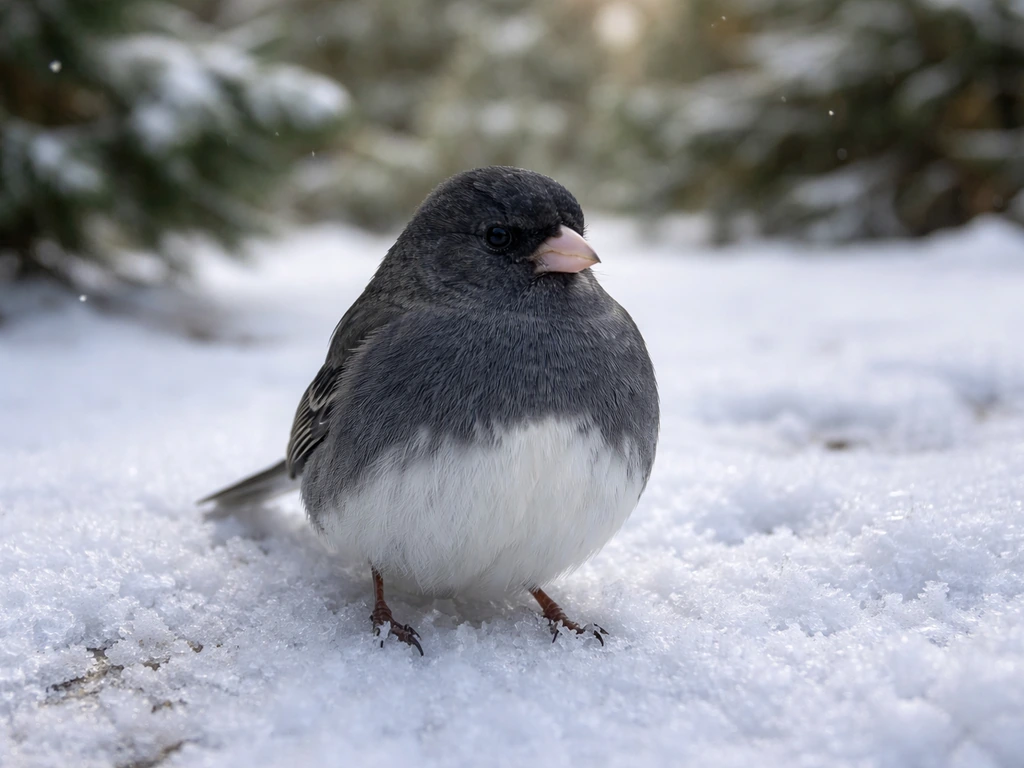
The bird you're most likely picturing when you hear 'junco' is the Dark-eyed Junco, the species that shows up across most of North America every winter. It's a small sparrow, roughly 6 inches long, with a rounded head, a short stout bill, and a noticeably long tail. The single most reliable field mark is the flash of white on the outer tail feathers, which you'll catch every time the bird hops or takes flight. That white flash is the thing that makes juncos instantly recognizable once you know to look for it.
What trips people up is that 'Dark-eyed Junco' actually covers several regional forms that look pretty different from each other. If you're in the eastern U.S. or most of Canada, you'll see the slate-colored form: smooth gray above, white below, clean and simple. In much of the western U.S., you're more likely to see the Oregon form, which has a dark hood, a warm brown back, and rufous (reddish-brown) flanks. Same species, very different appearance. Beyond the Dark-eyed Junco, there are other species in the junco genus, including the Yellow-eyed Junco, Guadalupe Junco, Baird's Junco, and Volcano Junco, but those are much more geographically limited and rarely what someone in North America is seeing in their backyard.
The name itself comes from the Latin iuncus, meaning 'rush' or 'reed,' a plant-based etymology that has no mystical weight behind it. It's simply a Latin book-name that naturalists carried into formal taxonomy.
The core symbolism people associate with juncos
If you've been reading spirit-animal or bird-meaning websites, you've probably seen juncos tied to themes like peace, humility, adaptability, simplicity, and winter renewal. These meanings aren't random, but it helps to know they're modern interpretations built on the bird's actual behavior, not documented folklore from a specific cultural tradition. The honest picture of 'what a junco means' looks something like this:
- Renewal and transition: Juncos arrive in autumn and leave in spring, so they've long been used as seasonal markers. Seeing them means winter is here or, when they leave, that spring is genuinely coming.
- Adaptability and resilience: These birds thrive in cold conditions, forage in snow, and travel in large flocks. That hardiness is the real basis for 'resilience' symbolism.
- Simplicity and humility: Juncos are not flashy birds. They're small, quiet, and spend most of their time at ground level. That understatedness has made them a natural image for groundedness and low-ego presence.
- Community and belonging: Juncos almost always appear in flocks during winter. The group behavior is a genuine visual that writers and meaning-seekers have picked up on.
- Balance between darkness and light: The contrast between a junco's dark upper plumage and white underbelly is frequently used as a visual metaphor for holding opposites together.
What you won't find is well-documented Indigenous or ancient folklore specifically about juncos the way you might find it for ravens, cranes, or owls. Much of the 'junco spiritual meaning' content online is modern spirit-animal style writing. That doesn't make it meaningless, but it's worth knowing that most of it is built from contemporary interpretation rather than centuries-old tradition.
Why season and behavior matter more than you think
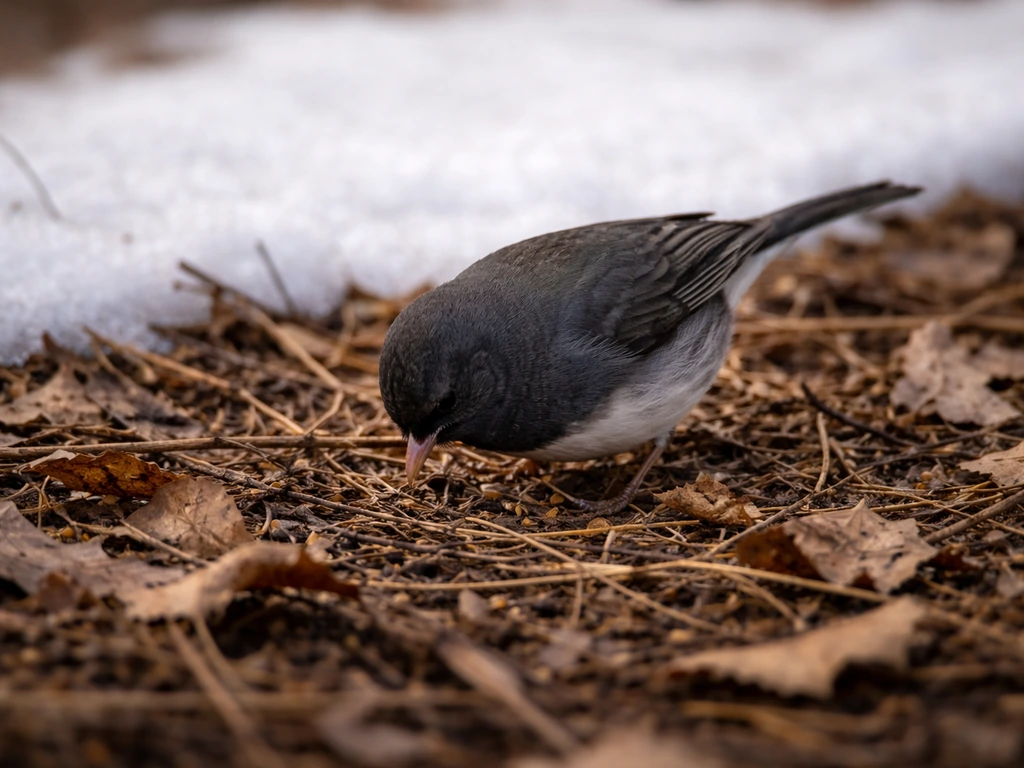
Audubon calls the Dark-eyed Junco 'the original snowbird,' and that nickname does more interpretive work than any spirit-animal label. These birds are winter visitors across most of the continental U.S. They breed further north or at higher elevations, then descend in large numbers when temperatures drop. The Illinois DNR describes their habitat as winter open woods, edges, and shrub areas, which is why you see them at backyard feeders and on the ground near brush piles from roughly October through March.
That ground-feeding behavior is significant for interpretation too. Juncos forage for seeds in winter, scratching through leaves and snow rather than perching at hanging feeders. If you see them in your yard, they're likely after scattered seed or natural seed sources on the ground, not at a tube feeder. During breeding season they shift to insects, but the winter bird you're noticing is almost certainly foraging for seeds. Understanding that doesn't deflate the meaning, it actually gives you something concrete to reflect on: this bird is adapted to find nourishment in a barren landscape. That's the real basis for the resilience symbolism.
How to interpret a junco sighting without over-reading it
Seeing a junco is genuinely meaningful in the way that paying attention to the natural world is meaningful. It's not a prophecy. Here's a practical way to process a sighting that keeps it grounded without dismissing the reflective value entirely.
- Confirm the identification: Look for the white outer tail feathers flashing when the bird moves. Note whether it's foraging on the ground. Check the plumage: in the East, expect gray and white; in the West, expect a hooded, brown-backed bird. That flash of white is your best quick confirmation.
- Note the season: If it's fall or winter, a junco sighting is ecologically normal and frequent. If you're seeing one in late spring or summer, you might be near a breeding range at higher elevation or in the northern U.S./Canada, which is a less common backyard experience worth noting.
- Notice the behavior: Is it alone or in a flock? Ground-foraging or agitated? Flocking juncos in winter are routine. A single junco in unusual circumstances stands out more.
- Reflect personally, not universally: The 'meaning' of seeing any bird is ultimately personal. The most honest use of junco symbolism is asking what the image of a small, hardy, winter-adapted creature foraging at ground level brings up for you, not consulting a lookup table for a fixed answer.
- Look up your regional species: If you want to be precise, use Cornell Lab's All About Birds to confirm whether you're seeing the slate-colored or Oregon form of the Dark-eyed Junco, or whether you might be in the range of another species entirely.
Where juncos show up in literature and metaphor
Juncos don't have the deep mythological resume of, say, a raven or a crane, but they do appear in poetry and nature writing with some regularity. The Poetry Foundation archives a poem specifically titled 'Hawk and Junco' in Poetry Magazine, and there are multiple poems with 'Junco' in the title across literary platforms. In these uses, the junco typically functions as an image of winter persistence, smallness against a cold landscape, or quiet presence amid larger forces, which maps directly onto the symbolic themes listed above.
Older natural history writing used 'snowbird or junco' as a paired term, treating the bird as a reliable marker of the winter calendar rather than an omen. You can find references in 19th and early 20th century nature literature to the 'slate-colored snowbird' arriving with the first frosts, which shows that the seasonal-marker reading is genuinely old, even if the spirit-animal framing is modern. One particularly evocative phrase that shows up in contemporary nature writing is 'winter's winged emissary,' which is poetic but ecology-first: the bird signals winter, it doesn't cause or predict anything beyond that.
Compared to other birds explored in this kind of symbolic and cultural context, juncos sit at an interesting point on the spectrum. Where the quetzal bird carries elaborate pre-Columbian cosmological meaning or the bennu bird anchors entire mythologies around solar renewal, the junco's cultural footprint is quieter and more tied to everyday seasonal observation. The bennu bird meaning is another example of how some birds gain powerful symbolic associations through mythic traditions rather than everyday ecology.
If you are also curious about the quetzal bird meaning, its symbolism is shaped by different mythic and cultural traditions than the junco’s more ecology-based associations. That's not a weakness; it makes junco symbolism more accessible and personally applicable, even if it doesn't come with the same ancient narrative weight.
Common mix-ups: snowbirds, sparrows, and species confusion
The biggest source of confusion around juncos comes from the 'snowbird' nickname. 'Snowbird' is widely used as an alternative name for the Dark-eyed Junco, especially in older literature and Audubon materials. But 'snowbird' also gets applied to the Snow Bunting in some regional contexts, particularly in Canada and the northern U.S., which creates real search confusion when someone is trying to figure out what bird they saw. If you're in a northern area and the bird in question is white with black wing patches rather than dark-hooded with white tail flashes, you're probably looking at a Snow Bunting, not a junco.
Within the junco genus itself, casual use of 'junco' almost always means Dark-eyed Junco in North America, but the species isn't one clean type. The Oregon and slate-colored forms look different enough that beginners sometimes think they've found a new bird. The universal field mark, white outer tail feathers, applies to all Dark-eyed Junco forms, so that's your anchor point regardless of which regional variety you're seeing.
Juncos also get confused with other small, brownish ground-feeding sparrows, particularly by newer birders. The combination of the tail flash, the clean white belly, and the behavior of scratching at the ground usually separates a junco from a House Sparrow or Song Sparrow, but in dim winter light it takes a moment. Using a field guide app or Cornell's photo-based ID tool on a quick phone search is the fastest way to settle it.
| Bird | Key visual mark | Season/habitat | Common confusion point |
|---|---|---|---|
| Dark-eyed Junco (slate-colored) | White outer tail feathers, smooth gray above, white below | Winter visitor across most of U.S. | Can look like a generic gray sparrow at a glance |
| Dark-eyed Junco (Oregon form) | White outer tail feathers, dark hood, rufous flanks | Common in western U.S. in winter | Looks different enough from slate-colored that people think it's another species |
| Snow Bunting | Mostly white with black wing patches | Winter, far northern/open fields | Also called 'snowbird' in some regions |
| House Sparrow | Streaked brown, no tail flash | Year-round, urban and suburban | Similar size, same ground-feeding habit |
Your junco meaning checklist and what to do next
If you saw a junco and want to make something useful of it, here's the practical breakdown. If you’re looking up Zazu bird meaning, it’s also worth connecting the interpretation back to the bird’s real behavior and habitat. If you’re specifically looking for Zimbabwean bird meaning, use the same approach by tying any symbolism claims back to the bird’s behavior and habitat Zazu bird meaning. Check these things off in order and you'll have a grounded, honest interpretation rather than a vague spiritual label.
- Did you see white outer tail feathers flashing? If yes, you almost certainly have a junco. If no, check the Snow Bunting or sparrow options above.
- What's the season? Fall or winter sighting is routine and ecologically expected. Summer sighting is unusual and worth noting, since it suggests you're near a breeding area.
- Was the bird on the ground or near it? Ground foraging is junco behavior. A bird doing this in cold or snowy weather is doing exactly what juncos do; the 'meaning' is persistence and adaptation in a lean season.
- Was it alone or in a flock? Flocking in winter is normal. A solo junco in spring can feel more notable.
- Which form did you see? Gray and white puts you in the slate-colored East; hooded with rufous flanks puts you in the Oregon-form West. This helps you use the right field guide or Cornell page for more detail.
- What did the sighting stir up for you? This is the honest symbolic question. Juncos mean winter endurance, quiet persistence, and the reassurance that small things can navigate hard seasons. If that resonates with something in your life right now, that's the meaning.
For the next step on identification, Cornell Lab's All About Birds is the most reliable free resource: search 'Dark-eyed Junco' and filter by your region and season. For the symbolism side, treat the modern spirit-animal interpretations as personal prompts rather than fixed meanings, and hold the Indigenous or ancient folklore claims loosely unless a specific tribe or historical source is named. The most durable junco meaning is the one grounded in what you actually watched the bird do: a small, hardy creature, moving through a cold landscape, finding exactly what it needs at ground level.
FAQ
How can I tell whether “snowbird” I saw was a junco or a Snow Bunting?
Use what you actually see, not just the name. Dark-eyed Juncos show a flash of white on the outer tail feathers and have a short, stout bill. If the bird is mostly white (especially with black wing patches) in the far north, Snow Bunting is a more likely match than a junco, even though both can be called “snowbird.”
If juncos look different where I live, what one trait should I trust for identification?
Juncos can look different by region, but the white outer tail feathers are the quickest universal check for Dark-eyed Junco forms. If you never get a clear view of the tail flash, focus on the ground-foraging behavior (scratching at leaves or snow) combined with the bird’s overall sparrow size and posture.
Why do I sometimes see juncos around feeders but not consistently at the feeder itself?
A junco at a feeder is usually using the ground or the feeder spillover, not perching constantly. If you regularly see it dropping to the ground to scratch under feeders or near brush piles, that lines up with winter seed foraging rather than feeding on hanging suet or nectar.
What are the most common misidentifications people make when they look up junco bird meaning?
Before adopting symbolism, confirm you saw the right species. Common look-alikes include other small ground-feeding sparrows, and in dim winter light it’s easy to confuse them. Your best confirmation is combination ID, white tail flash (if visible), clean belly, and the scratching ground behavior rather than only color.
If I keep seeing a junco every winter, does that mean something special or is it just timing?
Yes, but keep it realistic: juncos arrive in large numbers with cold weather, then many leave as conditions warm. So repeating sightings often reflect normal seasonal timing and local food availability, which can still be meaningful as a “pay attention to the season” prompt.
How can I use junco meaning in a practical way instead of treating it as a vague omen?
If you want the meaning to be actionable, turn the sighting into a short reflection tied to behavior. For example, ask what “ground-level nourishment” looks like in your life right now (simple routines, conserving energy, eating consistently), since the ecological basis is seed foraging in harsh conditions.
What should I write down during a junco sighting to make the meaning more accurate?
It helps to record two details: where it was (open woods edge, shrub area, ground near cover) and what it was doing (seed foraging, scratching, hopping between brush). Those notes make any interpretation feel grounded and also help you verify you actually had a junco rather than a similar sparrow.
How should I interpret online claims that juncos have ancient spiritual meanings?
Many “junco spiritual meaning” posts are modern, not documented traditional folklore. If you want a more historically cautious approach, treat symbolism as personal interpretation, not as evidence of an ancient cultural message, unless a specific named tradition and historical source is provided.
What’s the fastest way to confirm a junco if I only saw it briefly?
If you need the bird ID quickly, use a photo-based ID tool or a local bird guide workflow after you capture key angles. The fastest strategy is to photograph the tail when it fans or hops, then compare to region-specific Dark-eyed Junco forms.
Next Article
Quetzal Bird Meaning: Symbolism, Spiritual Significance, Tattoos
Quetzal bird meaning explained with Mesoamerican symbolism and how to choose a tattoo design for your message.