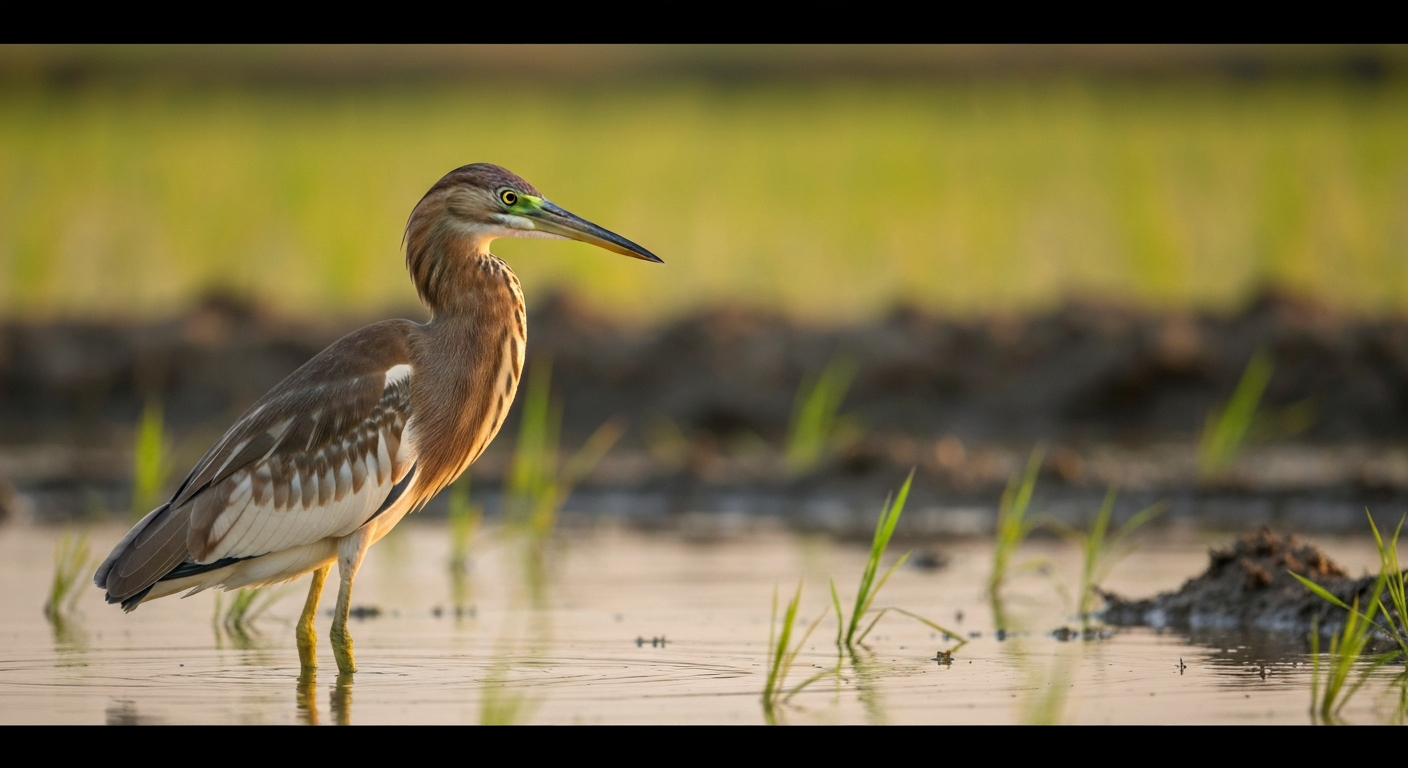
Kokku (கொக்கு in Tamil, കൊക്ക് in Malayalam) most commonly translates to 'heron' or 'crane' in English, though depending on the region and context it can also mean 'stork' or 'egret.' In everyday South Indian and Sri Lankan usage, kokku is a catch-all vernacular label for the tall, long-legged waterbirds you see standing motionless in paddy fields and along riverbanks, the kind that spear fish with a single strike. The closest single English equivalent is heron, but the word stretches wide enough to cover the whole Ardeidae family in casual speech.
Kokku Bird Meaning in English: Translation, Species, Symbolism

Marcus Whitley
25 Jul 2026
At a glance: what kokku means in English
The core English translations for kokku are heron, crane, stork, and egret, listed roughly in order of how often each applies. In formal Tamil lexicography, the University of Madras Tamil Lexicon records கொக்கு with the senses 'paddy-bird,' 'crane,' and 'heron.' Wiktionary's Tamil entry adds 'stork' as a fourth gloss. In practice, speakers reach for kokku whenever they see any large, wading, long-necked bird near water, so the English rendering depends heavily on which species is actually in front of them.
| English word | Scientific family / genus | How often kokku maps to it | Notes |
|---|---|---|---|
| Heron | Ardeidae (general) | Very common | Default translation in most Tamil and Malayalam dictionaries |
| Egret | Egretta / Ardea (white species) | Common | Kula Kokku, Chinna Kokku used for specific egret species |
| Crane | Gruidae | Common (older texts) | Tamil Lexicon lists 'crane'; biologically distinct from herons |
| Stork | Ciconiidae | Occasional | Wiktionary Tamil gloss; less precise in field use |
| Paddy-bird | Ardeola grayii | Regional | Classical Tamil and old colonial English usage; Indian Pond-Heron |
Source languages and literal translations
Kokku is primarily a Dravidian word. It appears in Tamil, Malayalam, Kannada, and Telugu, all four major Dravidian languages of South India, making it one of the most geographically widespread bird names in the region. The literal meaning in each language stays remarkably consistent: a large wading waterbird. Malayalam கൊക്ക് (kokkŭ) is recorded by Wiktionary with the senses 'egret' and, interestingly, also 'beak' or 'bill', that second sense hints at how the bird's distinctive pointed bill became almost synonymous with the creature itself. Malayalam lexical resources equate കൊക്ക് (kokku / kokkŭ) with 'heron' or 'egret' (blank" rel="noopener noreferrer">Malayalam–English dictionary (Jenson) / Wiktionary (ml:കൊക്ക്)). Wiktionary's Malayalam entry for 'കൊക്ക്' gives IPA /kokkɨ/ and lists senses 'egret' and 'beak', and includes a native-pronunciation audio file Wiktionary's Malayalam entry for 'കൊക്ക്' gives IPA /kokkɨ/ and lists senses 'egret' and 'beak', and includes a native-pronunciation audio file.. Kannada ಕೊಕ್ಕು (kokku) shows the same crane/heron meaning with occasional 'beak' polysemy noted in sources like Shabdkosh. Telugu uses the cognate form కొక్కెర (kokkera or kokkarāyi) meaning 'crane' or 'heron,' attested in classical Telugu lexica.
Which bird is kokku, exactly? Regional species breakdown
This is where things get genuinely interesting, because kokku does not lock onto a single species the way, say, 'robin' does in British English. Instead, it functions as a family-level vernacular name that local speakers then qualify with modifiers to specify the exact bird. Here is how that plays out across regions.
Tamil Nadu and Kerala: compound kokku names
Regional biodiversity reports and bird surveys from Kerala and Tamil Nadu record several kokku compounds tied to specific species. 'Kula Kokku' (pond kokku) is consistently mapped to the Indian Pond-Heron (Ardeola grayii), a stocky, brown-streaked bird that turns brilliantly white in breeding plumage and is arguably the most familiar waterbird of South Indian rice paddies. 'Chinna Kokku' (small kokku) or 'Chinnamundi' refers to the Little Egret (Egretta garzetta), the slim all-white bird with black legs and yellow feet. 'Pathira Kokku' (night kokku) maps to the Black-crowned Night-Heron (Nycticorax nycticorax), which becomes active at dusk. Kerala's Onmanorama and local NGO environmental reports use these compound forms consistently, which makes them reliable reference points even if no single pan-Indian authority has standardized them.
Sri Lanka: kokku and kokka across Tamil and Sinhala
In Sri Lanka, the kokku/kokka family of names crosses the Tamil-Sinhala language boundary. Sri Lanka's National Red List and biodiversity documents list vernaculars like 'Sinna kokku' (small heron) and 'Kana kokka' alongside scientific names for pond-herons and related Ardeidae species. The Sinhala form 'kokā' appears in place names and old colonial glossaries, confirming that the word embedded itself deeply enough in local usage to shape the landscape's toponymy. This cross-linguistic presence reflects centuries of contact between Tamil and Sinhala speakers in the island's wetland communities.
When identification is uncertain
If you encounter kokku in a text without a qualifying adjective and without geographic context, the safest English translation is 'heron.' That captures the most frequently intended species group without over-specifying. If the text mentions a paddy field setting, 'Indian Pond-Heron' is a reasonable educated guess for South India and Sri Lanka. If the context is classical or poetic Tamil, 'crane' is historically appropriate since older Tamil literature used kokku in a broadly ornamental sense for elegant wading birds that may or may not correspond to true cranes (Gruidae) in the biological sense.
Cultural meanings, symbolism, and proverbs
The kokku carries a rich symbolic life in Tamil and Malayalam culture, and understanding it requires sitting with a bit of ambiguity, because the bird is simultaneously admired and gently mocked.
The patience paradox
In South Indian folk wisdom, the kokku is a symbol of patience and focused stillness. It stands motionless in water for long stretches, watching, waiting, then strikes with precision. This gave rise to Tamil proverbs and idiomatic expressions praising someone who waits quietly before acting decisively. The image of the kokku standing in a paddy field is a common reference point in classical Tamil Sangam poetry, where waterbirds including the kokku often appear in the 'marutham' tinai (the agricultural landscape setting), signaling themes of waiting, longing, and reunion.
The hypocrite's bird
Here is the flip side: in Tamil proverb tradition, the kokku's very stillness is also read as deception. The bird looks meditative, even devotional, like a hermit in contemplation, but it is actually hunting. This gave rise to the well-known Tamil saying 'கொக்கு தவம் செய்வதுபோல்' (kokku tavam seyvathupol), which roughly translates as 'like a kokku doing penance.' It describes someone who pretends to be pious, calm, or disinterested while actually scheming or waiting for personal gain. The English equivalent would be something like 'a wolf in sheep's clothing' or acting sanctimonious. This is one of the most culturally loaded uses of kokku, and it appears in literature, cinema dialogue, and everyday speech across Tamil-speaking communities.
Kokku in place names and folk songs
Villages, tanks (reservoirs), and wetland areas across Tamil Nadu, Kerala, and Sri Lanka carry kokku in their names, reflecting how central the bird was to communities that lived alongside seasonal waterbodies. Folk songs from coastal and delta communities often use kokku as a metaphor for a person who waits faithfully, a lover waiting by the water, or a fisherman reading the water's surface. The bird's white plumage also makes it a symbol of purity and auspiciousness in some regional folk traditions, particularly when large flocks of egrets (chinna kokku) descend on fields after rain.
Etymology and word history
Kokku descends from a reconstructed Proto-Dravidian root recorded in the Dravidian Etymological Dictionary (DEDR) as entry #2125, reconstructed as *kor-Vnk, meaning 'stork' or 'crane.' This root is considered one of the well-established Proto-Dravidian bird names because it surfaces with minimal sound change across all four major Dravidian literary languages: Tamil kokku, Malayalam kokku/kokkan, Kannada kokku, and Telugu kokkera/kokkarāyi. The Tulu language (spoken in coastal Karnataka) has the cognate form korṅgu. The consistency of the root across a geographically wide and linguistically diverse family suggests the word is ancient, likely predating the historical separation of the Dravidian branch languages, placing its origin well over two millennia ago. There is no credible Sanskrit or Indo-Aryan etymology for kokku; it is a genuinely Dravidian coinage, which is part of what makes it culturally significant as a marker of South Indian linguistic identity.
How to say it: pronunciation and transliteration
The word is short, emphatic, and easy to say once you know the doubled consonant is real, it is not a typo. Both k sounds are fully pronounced, giving the word a crisp, clipped feel.
- Tamil: கொக்கு — romanized as kokku — IPA: /kokːʊ/ (the double k indicates a geminate, a held stop before release)
- Malayalam: കൊക്ക് — romanized as kokkŭ — IPA: /kokkɨ/ (short, neutralized final vowel; native audio available via Wikimedia Commons)
- Kannada: ಕೊಕ್ಕು — romanized as kokku — pronounced similarly to Tamil
- Telugu cognate: కొక్కెర — romanized as kokkera — two syllables: KOK-ke-ra
- Stress: falls on the first syllable in all forms; the geminate k is the defining phonetic feature
- English approximation: say 'COKE-koo' but keep both k sounds tight and close together
Kokku vs. kokila, kadai, konga, and moor: what's the difference?
If you landed here after searching for one of several similar-sounding South Indian bird terms, this breakdown should help you navigate between them. These words come up together often because people search for them in similar ways, but they refer to completely different birds with different symbolic lives.
| Term | Script (Tamil) | English meaning | Bird species | Primary symbolic association |
|---|---|---|---|---|
| Kokku | கொக்கு | Heron / crane / egret | Ardeidae family (herons, egrets) | Patience, stillness, also hypocrisy |
| Kokila | கோகிலம் | Cuckoo / Indian Cuckoo | Cuculus canorus / Eudynamys scolopaceus (koel) | Sweet voice, spring, longing, love poetry |
| Kadai | (varies by language) | Hen / domestic fowl (context-dependent) | Gallus gallus domesticus or quail | Mundane, domestic; different bird class entirely |
| Konga | (varies by region) | Crane / stork (regional usage) | Gruidae or Ciconiidae species | Grace, auspiciousness in some regional traditions |
| Moor (bird) | (English context) | Moorhen / waterhen | Gallinula chloropus | Wetland bird; English-language term, not Dravidian |
The most important distinction to hold onto is kokku vs. kokila. Both are common search terms, both appear in classical South Indian poetry, and both are associated with waterbodies and seasonal imagery, but they are completely different birds with nearly opposite symbolic meanings. Kokila (also spelled kokil or koel) refers to the Indian cuckoo or koel, celebrated for its beautiful call and strongly associated with spring, romantic longing, and poetic inspiration. Kokku, the heron, carries the more ambivalent symbolism of patience-as-deception. If you are reading a Tamil or Sanskrit poem and the bird sings beautifully, it is almost certainly the kokila. If it stands silently at the water's edge, it is the kokku.
Usage examples: literal, translated, and idiomatic
Here are concrete examples of how kokku appears across different types of contexts, from everyday speech to literary usage. The goal is to show you not just what the word means but what it sounds like in actual use.
- Literal (Tamil): 'வயலில் ஒரு கொக்கு நின்றது.' — Translation: 'A heron was standing in the field.' (Straightforward description, most common everyday use.)
- Compound species name (Malayalam): 'Kula Kokku paadi nilam thedunnu.' — Translation: 'The pond-heron is searching the rice field.' (Refers specifically to Ardeola grayii in Kerala regional speech.)
- Idiomatic / proverbial (Tamil): 'அவன் கொக்கு தவம் செய்வதுபோல் இருக்கிறான்.' — Translation: 'He is sitting like a kokku doing penance.' (Meaning: He is pretending to be calm and disinterested but is actually scheming or waiting for an opportunity.)
- Poetic / classical (Tamil literature): Kokku appears in Sangam-era marutham tinai poems as a visual marker of the agricultural wetland landscape, often used to set a scene of waiting or longing beside a tank or paddy field.
- Place-name reference: 'Kokku' appears in village and tank names across Tamil Nadu and Sri Lanka, pointing to sites historically known for heron colonies near water.
- Translated into English: When a Tamil film subtitle reads 'Look at that crane by the water,' the original Tamil likely used kokku — and the subtitler chose 'crane' as the most neutral English equivalent.
Tips for translators, students, and writers
If you are translating a Tamil or Malayalam text and need to render kokku in English, here is how I would approach it depending on context. For scientific or field-guide contexts, do not use 'kokku' at all, identify the species and use its correct English name (Indian Pond-Heron, Little Egret, etc.). For literary or poetic contexts, 'heron' is almost always the right choice: it carries the visual elegance and stillness that the Tamil original intends, and it is more evocative in English than 'stork' or 'crane.' For the proverb 'kokku tavam seyvathupol,' a note is genuinely needed, no single English bird idiom maps cleanly onto it. You could translate the meaning ('like someone pretending to meditate while actually scheming') or offer a loose equivalent ('playing possum' captures the deception, though it loses the dignity of the image). Always flag when you are generalizing: if your source text says only 'kokku' without a qualifier, a footnote acknowledging the species ambiguity respects your reader. For students writing about South Indian literature, knowing that kokku belongs to the marutham tinai landscape category in Sangam poetics will help you place it correctly in an analytical essay.
Suggested images for field identification
Two open-license photographs on Wikimedia Commons are especially useful for illustrating what kokku looks like in the field. The first is 'Ardeola grayii, Indian pond heron 4.jpg' (author: Renjusplace, CC BY-SA), showing the Indian Pond-Heron in its characteristic hunched, camouflaged posture in a paddy field, exactly the bird most South Indians would call 'Kula Kokku.' The second is 'Indian Pond Heron Ardeola grayii JEG8955.jpg' (author: PJeganathan, CC BY-SA), a cleaner portrait shot showing the bird's distinctive brown-streaked plumage and yellow-green facial skin. For a broader family illustration, any freely licensed image of a grey heron (Ardea cinerea) standing in shallow water captures the stillness and upright posture that makes the kokku metaphor immediately legible to a non-South-Asian reader.
Suggested image captions
- Caption option 1: 'Indian Pond-Heron (Ardeola grayii), known as Kula Kokku in Kerala and Tamil Nadu — the species most commonly intended when South Indians say kokku in a paddy-field context. Photo: Renjusplace / Wikimedia Commons (CC BY-SA).'
- Caption option 2: 'The Indian Pond-Heron's motionless hunting posture is the visual basis for the Tamil proverb about kokku tavam — the bird that looks like it is meditating but is actually waiting to strike. Photo: PJeganathan / Wikimedia Commons (CC BY-SA).'
- Caption option 3 (for a generic heron shot): 'A grey heron standing at the water's edge — the English image closest to the kokku of classical Tamil and Malayalam poetry, symbolizing patience, stillness, and watchful waiting.'
Notes on evidence and regional uncertainty
Most of the core translation and etymology claims here rest on solid, well-attested sources: the University of Madras Tamil Lexicon, Wiktionary's Tamil and Malayalam entries (last updated November 2025), the Dravidian Etymological Dictionary (DEDR #2125), and digitized classical Telugu lexica. The species-level compounds like 'Kula Kokku = Indian Pond-Heron' come from Kerala and Tamil Nadu biodiversity reports and NGO field lists, which are reliable for regional usage but are not standardized pan-Indian nomenclature, meaning a speaker from a different district might use the same compound for a slightly different species. The Sinhala/Tamil cross-linguistic data draws on Sri Lanka's National Red List and historical colonial glossaries (Clough). The proverb 'kokku tavam seyvathupol' is widely cited in Tamil cultural writing but varies slightly in wording across sources; the meaning, however, is consistent. Where scientific identification is genuinely uncertain, for example, whether a classical Tamil poem's kokku means a true crane (Gruidae) or a heron (Ardeidae), I have flagged that uncertainty in the text rather than asserting a false precision.
Related bird terms worth exploring
If kokku brought you here, a few related pages on this site will give you the full picture of how South Indian bird names work as a system. The kokila is the most symbolically distinct neighbor: where kokku represents silent patience (or deception), the kokila is all about voice and longing, understanding both terms side by side reveals a lot about how Sangam poets used bird imagery to map emotional landscapes. The kadai is another South Indian bird term worth looking up if you have encountered it in a culinary or folk context. For a direct explanation, see the page on 'kadai bird meaning in english' which covers that term's English equivalents and cultural usage. Konga covers a regional crane or stork usage that sometimes overlaps with kokku but carries its own geographic distribution and symbolic register. For a fuller explanation of the konga bird meaning in English, see the Konga entry (e425a7fb-c722-410c-965a-1005fc1331e3). And if you have seen 'moor bird' in an English-language text about South Asian wildlife, that page explains how an English habitat term maps (imperfectly) onto South Asian wetland birds. For an explanation of 'moor bird' in English-language texts about South Asian wetlands, see moor bird meaning in english. Each of these entries explores how a single bird name can do surprisingly heavy cultural and linguistic work, which is exactly what makes kokku so worth understanding beyond its dictionary gloss.
FAQ
SEO title + meta description (≤160 chars) — concise answer up front
Kokku — English meaning: a Dravidian word for crane/heron/egret (general ‘paddy‑bird’); specific species vary regionally (e.g., Indian Pond‑Heron).
What languages does the word 'kokku' come from and what are its literal translations?
Likely source languages: Tamil (கொக்கு), Malayalam (കൊക്ക്), Kannada (ಕೊಕ್ಕು), Telugu cognates (కొక్కెర / కొక్కర), and other Dravidian tongues. Literal translations in English used across sources are 'crane', 'heron', 'egret' or more generally 'paddy‑bird' (a water/ marsh bird). Sources: Tamil Lexicon (Chennai Univ.) entry 'கொக்கு'; Wiktionary Tamil and Malayalam entries; DEDR #2125 (Proto‑Dravidian root) (Tamil Lexicon; Wiktionary; DEDR mirror).
Which bird species does 'kokku' denote in different regions — can it be identified to species?
Regional usage is variable and often family‑level (Ardeidae) rather than a single species: - Kerala/Tamil Nadu/Sri Lanka: 'kokku' compounds commonly refer to pond‑herons and egrets (e.g., 'Kula Kokku' = Indian Pond‑Heron Ardeola grayii; 'Chinna kokku' / 'Little kokku' often = Little Egret Egretta garzetta). See regional biodiversity reports and Sri Lanka Red List mappings. - In broader Dravidian lexica the glosses list 'crane / stork / heron' as senses (Tamil Lexicon; DEDR). When identification is uncertain, alternatives to consider: herons (Ardea spp.), egrets (Egretta spp.), pond‑herons (Ardeola spp.), and in some folk usage 'crane' (family Gruidae) as a loose translation. Sources: Chennai Univ. Tamil Lexicon; TIES regional bird lists; Sri Lanka National Red List; Onmanorama reporting; Wiktionary Malayalam/Tamil entries.
How confident can readers be about species‑level identification when a local speaker says 'kokku'?
Confidence depends on context: if the speaker uses a compound name (e.g., 'Kula Kokku', 'Pathira Kokku') you can often map to a specific species (pond‑heron, night‑heron, etc.) per local checklists. If the single lemma 'kokku' is used without qualifiers, treat it as a general term for a heron/egret/‘paddy‑bird’ (family Ardeidae). Always verify with regional field guides or ask for a photo. Sources: regional NGO/government checklists and Sri Lanka Red List vernacular mappings.
What cultural, symbolic, and idiomatic uses of 'kokku' exist?
Cultural/symbolic notes (regionally attested): - In Tamil and Malayalam oral tradition 'kokku' (stork/ heron) features in folk imagery as a wetland bird associated with monsoon fields and paddy—hence the English notion 'paddy‑bird'. - Place names and toponyms in Tamil/Sinhalese areas include kokku/kokā forms, reflecting local bird presence. - Proverbs and idioms: specific proverbs vary regionally; in many Dravidian languages heron‑type birds symbolize watchfulness or solitude in folk speech (regional/uncertain usages should be checked in local proverb collections). Sources: TamilNet place‑name discussions; ethnographic references to Dravidian bird symbolism (regional reporting). Note: explicit, widely‑documented proverbs using 'kokku' are regionally variable; cite local proverb collections for area‑specific sayings.
What is the etymology and pronunciation (transliteration + IPA) of 'kokku'?
Etymology: Inherited from Proto‑Dravidian root reconstructed as *kor‑Vnk (DEDR #2125) with widespread cognates across Dravidian languages (Tamil, Malayalam, Kannada, Telugu, Tulu). Pronunciations and transliterations: - Tamil: கொக்கு — translit 'kokku' — IPA (Wiktionary): /kokːʊ/ - Malayalam: കൊക്ക് — translit 'kokkŭ'/'kokku' — IPA (Wiktionary): /kokkɨ/ (audio available on Wikimedia Commons) - Kannada: ಕೊಕ್ಕು — translit 'kokku' — regional pronunciation similar to Tamil/Malayalam. Sources: DEDR #2125; Wiktionary Tamil and Malayalam entries; Wikimedia Commons audio.
Next Article
Preen Meaning in Birds: What It Looks Like and Why
Learn preen meaning bird behavior: feather cleaning, oiling, and alignment, plus cues, differences, and when to worry.