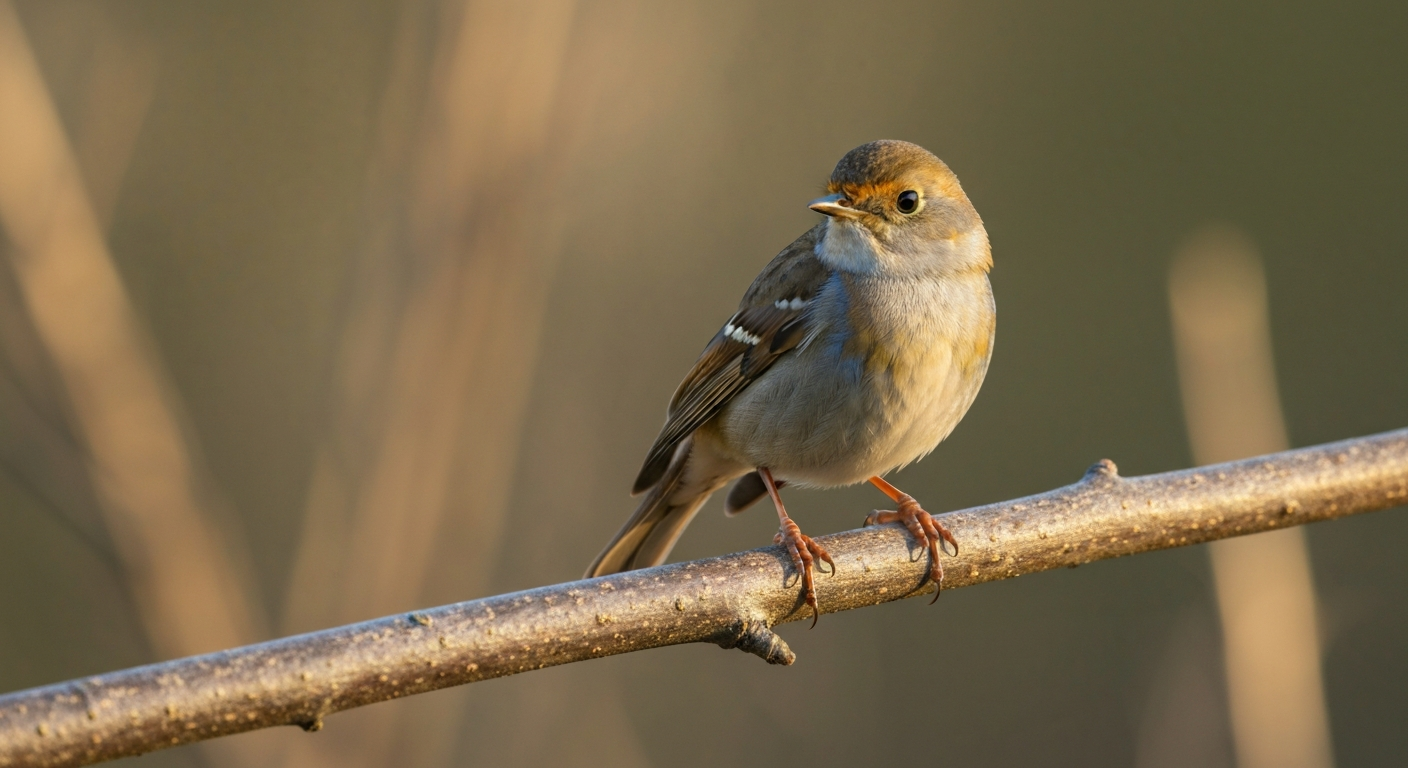
When Filipinos say 'maya,' they are almost always talking about a small, seed-eating bird, but which one depends heavily on where they live and what they grew up seeing. In cities, 'maya' usually means the Eurasian Tree Sparrow (Passer montanus), the little chestnut-capped sparrow you find hopping around church steps and sidewalk cafes. In the rice-farming provinces, it more often means one of the munias: the Chestnut Munia (Lonchura atricapilla), historically called mayang pula, or the Scaly-breasted Munia (Lonchura punctulata), called mayang paking. The word itself is ancient, rooted in Austronesian Philippine languages as a general term for small rice-field birds, and it carries real cultural weight, one of these 'mayas' was even the Philippines' national bird before the Philippine Eagle took that title in 1995.
Maya Bird Philippines Meaning: Species, Culture & Usage

What 'maya' actually means in the Philippines
This guide is for anyone who has searched 'maya bird Philippines meaning' and found themselves knee-deep in conflicting results, some pages say it's a sparrow, others say it's a munia, a few mention a former national bird. For a broader look at how bird names carry different meanings in context, see mine that bird meaning. If you meant 'mavis bird meaning', that phrase commonly refers to the song thrush (Turdus philomelos) in English usage and is a different concept from the Filipino 'maya'. All of those answers are correct, and the confusion is the point. 'Maya' works as what linguists call a folk-taxonomic name: a single word that ordinary speakers apply to a whole cluster of similar-looking small birds rather than to one precise species. Think of how English speakers use 'sparrow' loosely for almost any small brown bird. Filipino speakers do the same with maya.
That ambiguity is worth understanding clearly before you use the word in writing or conversation, because the species behind the name differ in appearance, habitat, and cultural associations. This article walks through each one, traces where the word comes from, unpacks what these birds mean in Filipino culture and language, and gives you concrete tools for identifying and using the term accurately.
Which birds are called 'maya' in the Philippines
Tagalog dictionaries and Philippine field guides list at least five distinct birds under the maya umbrella, each with its own compound name that signals the specific type. Here are the most commonly encountered ones.
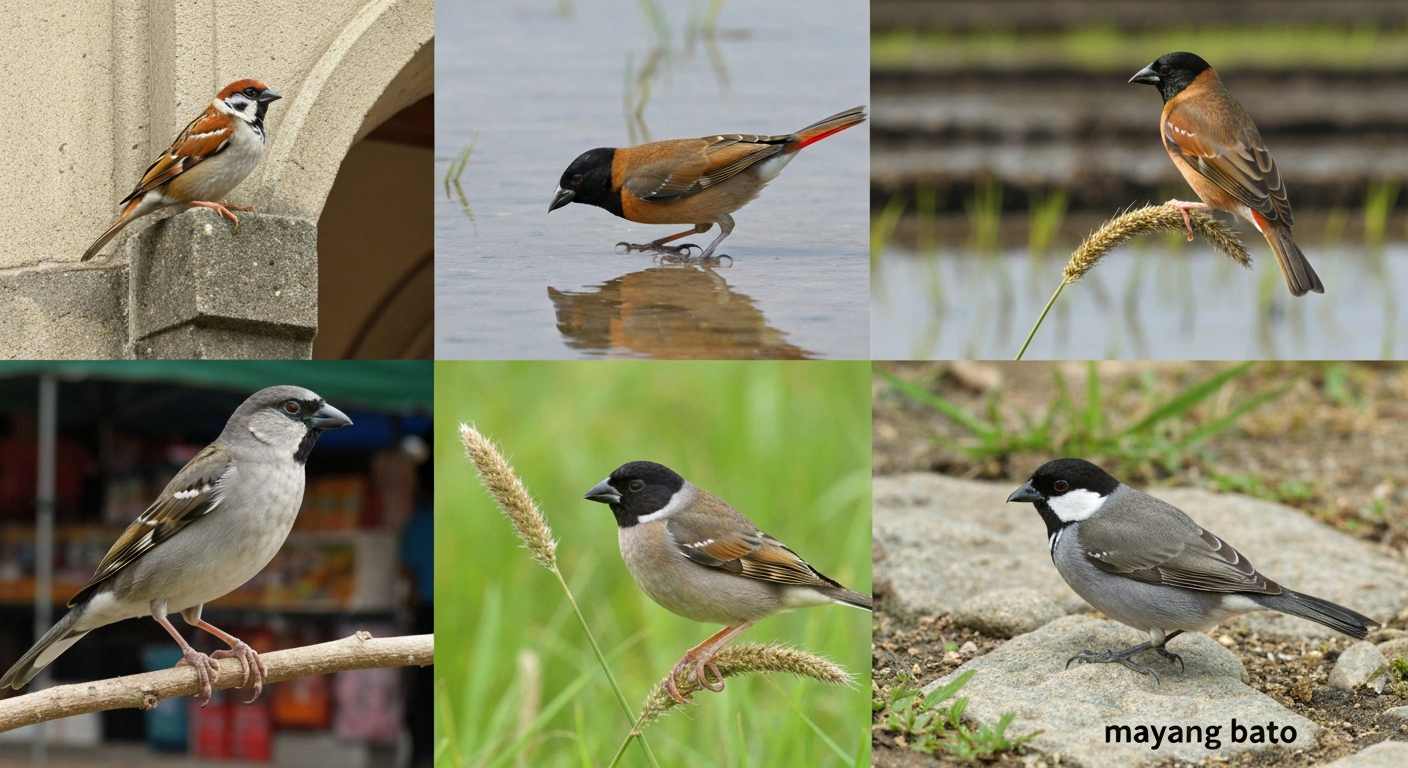
- Mayang simbahan — Eurasian Tree Sparrow (Passer montanus). Literally 'church maya.' The most common maya in urban and suburban areas across the Philippines. Introduced species, now thoroughly naturalized. Small, compact sparrow with a chestnut crown, white cheek patches, and a distinctive black ear-spot and small black bib. Found perching on church walls, rooftops, market stalls, and anywhere humans store grain.
- Mayang pula — Chestnut Munia (Lonchura atricapilla). Literally 'red maya.' The bird that served as the Philippines' national bird until 1995. Slightly smaller than the tree sparrow, with a solid black head and rich chestnut-brown body; a brick-red rump patch is visible when it flies. Common in ricefields, grasslands, and forest edges across most Philippine islands.
- Mayang paking — Scaly-breasted Munia (Lonchura punctulata). Also written mayang pakíng. Named for the distinctive scaly or barred patterning on its pale underparts. Brown above, whitish below with neat scale-like markings across the breast. A bird of open grasslands, rice paddies, and agricultural land.
- Mayang kosta — Java Sparrow (Padda oryzivora). Literally 'coastal maya' or sometimes interpreted as 'foreign maya.' Larger and more strikingly patterned than the other mayas — grey body, black head, large white cheek patch, and a thick red bill. Recorded in older Philippine field manuals and lexica under this local name.
- Mayang bato — A name applied regionally to certain other Lonchura munias or similar estrildid finches. 'Bato' means stone or rock, suggesting a bird of rocky or open terrain. Less consistently documented than the above four but appears in lexical records.
It is worth noting that agricultural and conservation literature in the Philippines, including materials from the Haribon Foundation and rice research institutions, routinely lists these as separate entries precisely because farmers, birders, and pest-management workers need to distinguish them. The bundled folk term 'maya' is fine in casual conversation, but anyone working in rice fields or writing about Philippine wildlife should know which one they mean.
Local names, etymology, and how to say it
The word 'maya' (pronounced MAH-yah, two short syllables, stress on the first) is native to Philippine languages. Austronesian comparative linguistics reconstructs a Proto-Philippine form, *máya, meaning roughly 'small rice-field bird' or 'small passerine.' This means the word predates Spanish colonization and has cognates across the Philippine archipelago's many languages. It is not a borrowing from Spanish or English; it grew from the same linguistic root as Tagalog, Ilocano, Kapampangan, and related tongues.
There is a separate etymological thread worth knowing about. In Malay and Indonesian, 'maya' carries senses derived from Sanskrit and Pali, meaning illusion or unreality (think Maya in Hindu philosophy). For a contrasting look at how a bird name carries meaning in another language area, see Maria Capra bird meaning. Some historical lexica note this contact, and Wiktionary flags the parallel. But in Philippine usage, these senses do not overlap. When a Filipino says 'maya,' they are not invoking Sanskrit cosmology; they are talking about a bird. The two words happen to sound the same but come from different roots.
One other common source of confusion: in everyday Tagalog, 'mamaya' means 'later' or 'in a little while,' and the reduplicated form 'maya-maya' means 'soon' or 'in just a moment.' These are completely different words from the bird name, same sounds, different meanings entirely. A sentence like 'Makikita mo ang maya maya' is actually ambiguous out of context: it could mean 'You'll see the maya soon' or 'You'll see the maya-maya (a fish, also called snapper in English) later.' Context almost always makes the meaning clear, but it's a quirk worth knowing.
Regional name variants
While 'maya' is the dominant form in Tagalog-speaking regions, the compound names are where the real specificity lives. 'Mayang simbahan' is widely understood across Luzon. In Visayan-speaking areas, local terms for the same birds exist alongside or instead of maya compounds. Philippine field guides and the Diksiyonaryo.ph national dictionary record the mayang-simbahan, mayang-pula, mayang-paking, mayang-kosta, and mayang-bato entries as standard Tagalog lexical items.
How to tell them apart: a practical identification guide
If you are a writer, traveler, or student who wants to know what you are actually looking at when someone points to a small brown bird and says 'maya,' here are the most reliable field markers.
Mayang simbahan (Eurasian Tree Sparrow)
Size: about 14 cm, roughly the length of your index finger. The chestnut (reddish-brown) crown and nape are distinctive. The white cheek has a bold black spot, that ear-patch is the single most reliable field mark. There is a small black bib at the throat. Sexes look alike, which is unusual among sparrows. Call: a series of short, sharp chirps, 'chip-chip' or 'tseep' notes, often heard in rapid succession in busy market areas. It nests in holes in walls, roof eaves, and yes, the crevices of old stone churches, which is exactly how it got its common name. blank" rel="noopener noreferrer">This is the bird most urban Filipinos picture when they say 'maya. GBIF: Passer montanus, occurrence and distribution data (includes Philippines records) shows numerous occurrence records from built and urban habitats across Luzon and other Philippine islands, confirming its widespread presence in towns and cities blank" rel="noopener noreferrer">GBIF: Passer montanus — occurrence and distribution data (includes Philippines records). '
Mayang pula (Chestnut Munia)
Size: about 11-12 cm, slightly smaller than the tree sparrow and noticeably more compact. The all-black head is the key mark, no white cheek patch, no bib pattern, just a solid matte black that contrasts sharply with the warm chestnut body. The rump and upper tail are a brighter, more orange-red that flashes during flight. Juveniles are plain brown and lack the adult's dramatic head pattern, which can cause confusion in the field. Call: softer and more musical than the sparrow, a series of thin, reedy notes. Habitat is open grassland, the edges of ricefields, and scrubby growth near cultivation.
Mayang paking (Scaly-breasted Munia)
Size: about 11-12 cm, similar to the Chestnut Munia. Plain brown above; the diagnostic feature is the breast, which is white or pale buff covered in neat dark scale-like markings, as if someone drew small arcs across each feather. The bill is thick and conical, adapted for cracking seeds. Found in the same rice-field and grassland habitats as mayang pula, and the two species are often seen together in mixed flocks. Agricultural extension workers dealing with rice crop damage frequently encounter both.
Quick comparison of the main 'maya' species
| Local name | Scientific name | Size | Key field mark | Typical habitat | Urban or rural |
|---|---|---|---|---|---|
| Mayang simbahan | Passer montanus | ~14 cm | Chestnut crown; black ear-spot on white cheek | Buildings, churches, markets | Urban / suburban |
| Mayang pula | Lonchura atricapilla | ~11-12 cm | Solid black head; chestnut body; red-orange rump | Ricefields, grasslands, forest edges | Rural / agricultural |
| Mayang paking | Lonchura punctulata | ~11-12 cm | Brown above; scaly/barred pale underparts | Grasslands, rice paddies, open scrub | Rural / agricultural |
| Mayang kosta | Padda oryzivora | ~16-17 cm | Grey body; black head; large white cheek patch; thick red bill | Gardens, cages, near cultivation | Varied (often captive/introduced) |
| Mayang bato | Various Lonchura spp. | ~11-13 cm | Variable; often plain brown or mottled | Rocky open areas, grasslands | Rural |
Cultural symbolism, folklore, and beliefs
The maya holds a particular place in Filipino cultural memory that goes beyond being a common small bird. For most of the 20th century, the Chestnut Munia, mayang pula, was the official national bird of the Philippines. It represented the Filipino masses: small, abundant, close to the soil, and tied to the rice culture that shaped the nation's rural life. When the Philippine Eagle replaced it as national bird in 1995, many Filipinos felt a certain nostalgia for the humble munia as a symbol precisely because it was ordinary and everywhere, not rare and spectacular.
In broader folk symbolism, the maya is generally a positive presence. It is associated with the familiar, the domestic, and the everyday. Seeing a maya near your home is not treated as an omen in the way that ravens or owls are in other cultures, it is simply part of the background of normal life. Some folk beliefs do attach meaning to unusual maya behavior: a maya that repeatedly enters a house uninvited is sometimes interpreted as a sign of coming visitors or news, echoing the widespread pan-Asian and Southeast Asian belief that birds act as messengers.
The rice connection is central. Because several maya species are seed-eaters that flock to paddy fields, they are embedded in the agricultural consciousness of farming communities. They are seen simultaneously as pests (eating the palay, or rice grains) and as part of the natural rhythm of the harvest season. Agricultural extension materials from rice research institutions explicitly list maya species among the birds that farmers must manage around planting and harvest time, a relationship that is pragmatic and sometimes frustrated, but not hostile in a mythological sense.
In children's culture and elementary education, the maya functions as the prototypical Filipino bird, the bird you draw when a teacher says 'draw a bird.' It fills the same cultural slot that the robin occupies in British childhood imagery or the robin redbreast in seasonal symbolism. It is the default bird, the baseline, the thing people mean when they say 'just a little bird.'
Idioms, songs, and literary uses
Filipino language and literature have absorbed the maya in several recurring ways. Here are the most common forms, with literal translations and what they actually mean in use.
- 'Parang maya sa simboryo' (like a maya on the church dome) — Literal: a small bird perched high on a church. Figurative: someone who is small but positioned conspicuously, often used to describe a person who acts important despite being of little consequence. The image is of the ubiquitous tree sparrow atop an imposing structure — size contrast made visible.
- 'Kahit maya-maya lang' — Here 'maya-maya' is the adverb meaning 'just a moment,' not the bird. But the phrase illustrates how the bird name and the time adverb create gentle wordplay in colloquial speech. Writers occasionally exploit this double meaning for effect.
- 'Ang maya ay hindi agila' (The maya is not an eagle) — A proverb-style comparison contrasting the common with the extraordinary. Used to tell someone to be realistic about their limitations, or conversely, to argue that ordinary people have value that eagles (symbols of power and rarity) lack.
- 'Tulad ng maya sa palay' (Like a maya in the rice field) — Describes someone who is completely in their element, at ease, doing exactly what they are made for. The image comes from the munia's natural behavior of foraging in ricefields.
- The folk song 'Magtanim ay 'Di Biro' (Planting Rice is No Joke) references birds visiting rice paddies, and while it does not always name the maya by name, its imagery of small seed-birds in paddies is inseparable from the maya in Filipino agricultural memory.
In contemporary Filipino poetry and fiction, the maya appears most often as a shorthand for ordinariness, childhood, and the provinces. A character who grew up watching mayas in a provincial church yard is immediately coded as having a rural, grounded upbringing. Urban characters who cannot identify a maya are sometimes used to signal disconnection from roots. It is, in that sense, a culturally loaded bird, not because it is rare or dramatic, but because it is so thoroughly ordinary that not knowing it marks an absence.
How Filipinos actually use 'maya' in speech and writing
Here are real usage patterns, the correct, the colloquial, and the commonly mistaken, so that writers and learners have concrete models to work from.
- Standard correct usage: 'Maraming maya sa simbahan namin.' (There are many mayas at our church.) — This refers clearly to Passer montanus, the tree sparrow, because the church context is built in. No ambiguity.
- Rural agricultural usage: 'Pinipilit naming itaboy ang mga maya sa palayan.' (We keep trying to drive the mayas away from the rice field.) — Here the speaker almost certainly means Lonchura atricapilla or L. punctulata, the munias, because those are the ricefield birds. An urban listener might picture the tree sparrow, which is technically inaccurate.
- Colloquially mistaken usage: Calling any small brown bird a 'maya' — including unrelated species like the Philippine Pygmy Woodpecker or even juvenile sunbirds — happens frequently in casual speech. This is not wrong in a social sense but can mislead in naturalist, academic, or conservation writing.
- Compound names as precision tools: 'Nakakita ako ng mayang pula sa gilid ng bukid.' (I saw a red maya at the edge of the field.) — Using the compound mayang pula removes ambiguity entirely and is the preferred form in field guides, environmental impact assessments, and nature writing.
- Literary or poetic usage: 'Lumayo na ang maya mula sa aking kamay.' (The maya has flown from my hand.) — Figuratively, this expresses loss or the fleeting nature of something once close. The maya here is a symbol of something small and free that cannot be held.
- Adverb confusion in writing: 'Babalik maya-maya.' (Will return soon / in a little while.) — This sentence has nothing to do with birds. Non-native Tagalog learners and writers sometimes read 'maya-maya' as a bird reference; it is not.
For writers in particular, the safest approach is to use the compound name when species precision matters, and to use the bare 'maya' when you want the cultural resonance, the sense of smallness, familiarity, and domestic Philippine life, without pinning it to a specific bird. For examples of the maya's cultural use in merchandise and apparel, see mama bird shirt meaning. Both uses are valid; the choice depends on what you are trying to do.
Conservation and human interaction
The Eurasian Tree Sparrow (mayang simbahan) is an introduced species in the Philippines, brought either deliberately or accidentally during colonial-era trade. It is now so thoroughly established that most urban Filipinos consider it native. Its populations are stable and it thrives on human habitation, a classic synanthrope. The munias, particularly the Chestnut Munia, are native species that have fared reasonably well but face ongoing pressure from habitat loss as grasslands and rice-farming landscapes change. The Chestnut Munia is also trapped for the cage-bird trade, which adds pressure on wild populations in some areas.
The irony of the national bird story is worth noting here. The Chestnut Munia was replaced as national bird partly because advocates felt the Philippines deserved a more dramatic, uniquely endemic symbol, the Philippine Eagle. But the mayang pula had represented something genuine about Filipino agrarian identity for decades, and its demotion is sometimes discussed in cultural and conservation circles as an undervaluing of the ordinary and the common in favor of the spectacular.
If the maya bird's story of being a humble creature with surprising cultural depth resonates with you, it shares that quality with several other bird names that carry unexpectedly rich meanings, from birds embedded in local naming traditions to those whose meanings shift depending on the language or community using them. The maya's story is, in the end, about how a very ordinary word can carry a whole country's relationship with its landscape, its rice paddies, its churches, and its childhood.
FAQ
What do Filipinos mean when they say “maya”?
In Philippine usage "maya" is a folk‑taxonomic name for several small, seed‑eating passerines (sparrows and estrildid finches/munias) rather than one scientific species. Depending on region and context, "maya" can refer to the Eurasian Tree Sparrow commonly seen in towns, or to various munias found in fields and grasslands.
Which species are most commonly called "maya" in the Philippines?
The three most frequently intended species are: (1) Eurasian Tree Sparrow (Passer montanus) — mayang simbahan: small sparrow with chestnut crown, white cheek patch and black ear‑spot; common on buildings. (2) Chestnut Munia (Lonchura atricapilla) — mayang pula: dark/black head with chestnut body and reddish rump. (3) Scaly‑breasted Munia (Lonchura punctulata) — mayang paking: brown above with scaly/whitish barred underparts, often in ricefields. Other regional maya labels may include Java/Java sparrow reflexes and additional Lonchura spp.
How can I quickly tell these "maya" species apart in the field?
Quick ID rules: Passer montanus (mayang simbahan) — small, chunky sparrow, chestnut crown, white cheek with a black ear‑patch and bib, often perched on wires and buildings. Lonchura atricapilla (mayang pula) — slimmer finch shape, black/dark head, rufous/chestnut body, seen in flocks over grassland. Lonchura punctulata (mayang paking) — streaked/scaly underparts, plain brown upperparts, common in rice paddies. Listen for high, thin chirps and short chittering notes; check habitat (urban vs. ricefield) to help decide.
What is the etymology and local‑language history of the word “maya”?
The name "maya" is entrenched across Philippine languages and reconstructs to a Proto‑Philippine/Austronesian form *máya meaning a small rice‑field bird. Local Tagalog and other Philippine languages use "maya" as a general small‑bird term and form many compounds (mayang‑simbahan, mayang‑pula, mayang‑paking). Separate Malay/Indonesian and South Asian reflexes exist, but the Philippine usage aligns with Austronesian comparative evidence.
What local names or compound names use the word "maya"?
Common compound names include: mayang simbahan (church maya — Passer montanus), mayang pula (red/Chestnut munia), mayang paking (Scaly‑breasted munia), mayang kosta (regional name sometimes for Java finch), and mayang‑bato in some local lists. Tagalog also distinguishes the adverb mamaya/maya‑maya (unrelated to the bird) meaning "later" or "soon."
How is the maya represented in Filipino culture, folklore and symbolism?
Culturally, maya are everyday, familiar birds associated with neighborhoods, fields and ordinary life. Symbolically they often represent smallness, commonness, thrift (seed‑eating), and the sounds of home or market life. Chestnut Munia formerly served as a national bird symbol (mayang pula was once treated as national bird before the Philippine eagle). Folklore may portray mayas as rice‑field birds, signs of seasonal change, or characters in children’s tales emphasizing nimbleness or modesty.
Perched Bird Meaning, Literal, Symbolic, Usage, Examples
Perched bird meaning: clear literal and symbolic definitions, usage differences, examples, and quick reference.