A paradise bird, or bird-of-paradise, is any member of the avian family Paradisaeidae: roughly 45 species of passerine birds native to New Guinea, eastern Australia, and nearby islands, almost all famous for the male's breathtakingly ornate plumage and elaborate courtship displays. Beyond the literal bird, the phrase carries layered meanings in culture, literature, symbolism, and even contemporary slang, all of which trace back to the same source: the idea of something so beautiful it seems to belong to another world.
A Paradise Bird Meaning: Literal, Cultural & Symbolic Uses

Marcus Whitley
10 Aug 2026
What 'a paradise bird' means in plain terms
In its most direct sense, a paradise bird is a member of the family Paradisaeidae, a group of tropical passerines found primarily in New Guinea and closely associated islands. Both Merriam-Webster and Cambridge define 'bird-of-paradise' first as any of these birds, and second as the ornamental plant Strelitzia reginae, whose vivid orange and blue flowers resemble a bird's head. When the phrase appears in literature, speech, or dreams, the intended meaning almost always leans on the bird family's core symbolic weight: extraordinary beauty, rarity, and a quality of the unreachable or otherworldly.
The actual birds: what ornithology tells us
The family Paradisaeidae contains approximately 45 recognized species according to the IOC World Bird List, the current taxonomic authority. They are passerines, meaning they belong to the same broad order as sparrows and finches, but you would never guess that from looking at a displaying male. The family is divided into several genera, with the most elaborate plumage concentrated in species of Paradisaea, Cicinnurus, and Pteridophora. Wilson's bird‑of‑paradise (Cicinnurus respublica), an island endemic of West Papua noted for its highly modified male plumage and courtship behaviour, is summarized in the IOC species account 'Wilson's Bird‑of‑Paradise, IOC / World Bird Names species summary' Wilson's Bird‑of‑Paradise — IOC / World Bird Names species summary. Almost all species are found in lowland and montane rainforests of New Guinea (split politically between Papua New Guinea and Indonesia's West Papua provinces), with a handful of species extending into Queensland, Australia, and the Moluccan islands.
Sexual dimorphism is the defining biological feature of the family. Males have evolved extraordinarily long plumes, colorful capes, iridescent throat shields, and in some cases modified head feathers that defy easy description, all shaped by millions of years of sexual selection. Females are typically plain brown, built for camouflage while nesting. Mating systems range from solitary arena displays (one male clearing a perch or forest floor to perform alone) to classic lek systems where multiple males display simultaneously in a shared tree. Research published in peer-reviewed journals confirms this history of sexual selection is unusually ancient within the lineage, stretching back tens of millions of years.
Key species worth knowing
A few species come up again and again in cultural references, natural history writing, and the ornithological record. Here are the ones most likely to appear when someone searches for 'a paradise bird meaning' or encounters the term in text.
| Species | Scientific name | Key feature | Range | IUCN status |
|---|---|---|---|---|
| Greater bird-of-paradise | Paradisaea apoda | Long, golden-yellow flank plumes; 'apoda' means footless, from Linnaeus's 1758 naming of legless trade skins | Aru Islands, lowland New Guinea | Least Concern |
| Raggiana bird-of-paradise | Paradisaea raggiana | Red-orange cascading plumes; national bird of Papua New Guinea; widely used in ceremonial headdresses | Eastern and southern New Guinea | Least Concern |
| Wilson's bird-of-paradise | Cicinnurus respublica | Vivid turquoise crown, crimson back, curled tail wires; one of the most visually complex of all birds | Waigeo and Batanta islands, West Papua | Near Threatened |
| King-of-Saxony bird-of-paradise | Pteridophora alberti | Two enamel-blue head plumes up to 50 cm long, used in solo display from high perches | Central New Guinea highlands | Least Concern |
| King bird-of-paradise | Cicinnurus regius | Compact body, brilliant red plumage, wire-tipped tail fans; smallest of the Paradisaea-related group | Lowland New Guinea and nearby islands | Least Concern |
The Greater bird-of-paradise has a particularly interesting name origin. When Linnaeus formally described it in 1758, the only specimens he had access to were trade skins prepared by local traders in the Moluccas: the feet and often the wings had been removed to preserve the feathers for export. Linnaeus concluded the birds must live entirely in the air, never landing, and named the species 'apoda' meaning footless. That myth, of a bird so celestial it never touched the ground, fed European imagination for two centuries and cemented 'paradise' as the natural word for these creatures. Historical and bibliographic sources confirm this preparation practice and its impact on early European natural history.
What paradise birds symbolize across cultures
Melanesian and New Guinean traditions
In New Guinea, birds-of-paradise are not metaphors: they are central to lived cultural life. Plumes from species like the Raggiana bird-of-paradise (locally called 'Vanate' in some languages) are worn in ceremonial headdresses marking male status, bridewealth negotiations, and initiation rites. A regional TEK report, Traditional Ecological Knowledge and practices associated with the Vanate (Raggiana Bird of Paradise), regional TEK report, documents local uses, rules, and meanings for Raggiana plumes in Papua New Guinea communities Traditional Ecological Knowledge and practices associated with the Vanate (Raggiana Bird of Paradise) — regional TEK report. Museum ethnographic collections, including holdings at the British Museum and Pitt Rivers Museum, document this use going back centuries. The birds represent prestige, male power, and connection to ancestral forces. Importantly, traditional ecological knowledge (TEK) studies in Papua New Guinea document community rules governing when and how birds could be taken, showing that symbolic and practical relationships with the birds were carefully managed, not purely extractive.
Indonesian and Moluccan traditions
In the Moluccas, birds-of-paradise plumes were luxury trade goods long before Europeans arrived. Local rulers used them as gifts and tribute items, and Malay traders carried them across maritime Southeast Asia. The birds were associated with royalty and divine favor. The association of these birds with the heavens was, in some regional traditions, quite literal: they were understood as birds that descended from paradise (the sky realm) and could not exist on the ordinary earth.
European and Western symbolism
When prepared skins reached Europe in the early 16th century, they triggered a wave of mythology. The 1522 expedition of Magellan brought back skins to Spain, and chronicles describe Europeans genuinely believing these were heavenly birds that never landed. By the 17th and 18th centuries, natural historians had corrected the record, but the name and the symbolism stuck. In Western culture, calling something or someone 'a bird of paradise' became a way of saying they were impossibly beautiful, rare, exotic, and perhaps out of reach. The Romantic poets and later Victorian writers used the image heavily for this reason.
The feather trade of the late 19th and early 20th centuries represents a darker chapter of this symbolism. Bird-of-paradise plumes became fashionable in European and American millinery, driving large-scale commercial hunting. Museum costume collections, including records from the Metropolitan Museum of Art, document the widespread use of these feathers on women's hats. The subsequent backlash helped fuel the early conservation movement, and in 1924 the export of bird-of-paradise feathers from Australian territories was banned. The bird became, in a new sense, a symbol of what we risk losing when we treat beauty as a commodity.
Paradise birds in literature and visual art
In literature, the bird-of-paradise functions almost exclusively as a metaphor for unattainable beauty, fleeting perfection, or a person who seems too extraordinary for ordinary life. Romantic poets used it to describe idealized loves. Victorian travel writers deployed it as proof that nature in the tropics exceeded anything European civilization could produce. In 20th-century literature, calling a character 'a bird of paradise' typically signals glamour, otherness, or tragic beauty, something dazzling that cannot be held.
In visual art, the birds appear both realistically and symbolically. Natural history illustrators from John Gould onward produced famous plate series documenting the species. In Pacific and Melanesian art, stylized bird forms appear in wood carving, body decoration, and woven objects. In European decorative arts, the plumes and silhouettes of birds-of-paradise appeared in Art Nouveau designs, on ceramics, fabrics, and architectural ornament, usually as shorthand for tropical splendor. The flowers of Strelitzia (the bird-of-paradise plant) carry similar visual associations in contemporary design contexts.
Dreams, spirituality, and how people use the phrase today
In contemporary dream interpretation and popular spirituality, a bird-of-paradise appearing in a dream is widely read as a positive omen: beauty entering your life, a period of abundance, or a reminder to pursue something rare and meaningful rather than settling. Some spiritual frameworks connect the bird to paradise in a theological sense, treating it as a messenger from a higher or purer realm. These interpretations are not anchored in any single religious tradition but draw loosely on the cross-cultural consensus that these birds represent something beyond the ordinary.
In casual modern usage, calling someone 'a bird of paradise' is still a compliment, usually implying they are strikingly beautiful, flamboyant, or uniquely themselves in a way that stands out from the crowd. The phrase turns up in song titles, fashion writing, interior design (often in reference to the Strelitzia plant), and lifestyle journalism. It has also become common in the names of hotels, spas, and cocktails, anywhere that wants to signal tropical luxury. In some Caribbean and West African English dialects, 'bird' carries its own separate slang meanings (a person, often a woman, or more neutrally just someone noteworthy), and 'paradise bird' in those contexts can mean something closer to 'an extraordinary person' without specific ornithological reference.
Related and easily confused terms
Several related phrases regularly appear alongside 'paradise bird' in searches, literature, and conversation. Knowing how to distinguish them helps you land on the right meaning quickly.
False bird-of-paradise
This term has two distinct uses that regularly cause confusion. In botany, 'false bird-of-paradise' typically refers to Heliconia species, tropical flowering plants whose bracts resemble Strelitzia flowers but belong to a different family entirely. In some ornithological or regional contexts, 'false bird-of-paradise' can also refer to birds that superficially resemble paradise birds but are not members of Paradisaeidae, for instance certain riflebirds or bowerbirds that were historically misclassified. Context is everything: if the discussion is about plants or gardens, Heliconia is almost certainly what is meant.
Parakeet
Parakeets are small to medium-sized parrots of multiple genera, completely unrelated to birds-of-paradise beyond being colorful birds. The confusion arises because both are associated with tropical color and have been kept as exotic pets. In symbolic and cultural contexts, parakeets carry their own meanings, often centered on communication, sociability, and adaptability, quite different from the rarity and unattainability of paradise bird symbolism. For a focused explanation of parakeet symbolism and usage, see the article on parakeet bird meaning.
Parliament (of birds)
'Parliament' as it relates to birds is a collective noun, specifically the traditional collective noun for a group of owls (a parliament of owls). It is not connected to paradise birds at all, but the term 'parliament bird' or 'parliament of birds' turns up in literary contexts, most famously in Chaucer's 'The Parliament of Fowls,' where birds gather to choose mates. This is a metaphorical and poetic usage with its own rich symbolic history centered on owls and collective wisdom, not tropical plumage.
Parva (in bird names)
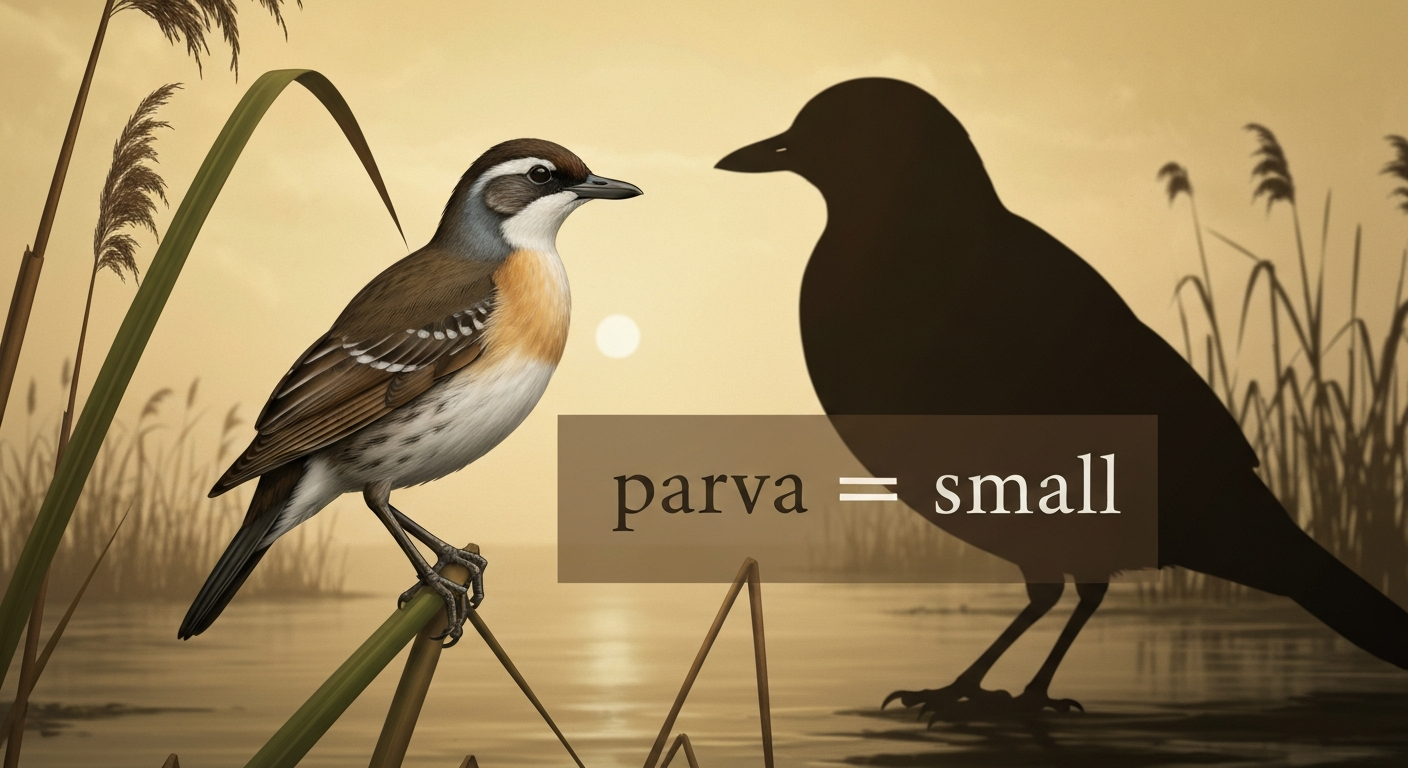
'Parva' is a Latin adjective meaning 'small' or 'little,' used in scientific bird names (for example, Parus palustris subspecies or various species epithets across families). It is purely a taxonomic descriptor, not a common name or symbolic term. If you encounter 'parva bird' in an English text, it almost certainly refers to a species whose scientific name includes 'parva,' and the meaning is simply 'the small one' or 'the lesser one' in that taxonomic context. It has no overlap with paradise bird symbolism.
Tropical bird (as a category)
'Tropical bird' is a broad informal category covering any bird species native to tropical regions, including parrots, toucans, kingfishers, hummingbirds, and thousands of others. For a focused explanation of tropical bird meaning, see the related entry on tropical bird meaning in our reference collection. Birds-of-paradise are tropical birds, but not all tropical birds are birds-of-paradise. When the phrase 'tropical bird' appears in symbolism, literature, or dream interpretation without further specification, it usually carries the general meaning of exotic beauty, warmth, and abundance rather than the specific mythological weight that 'paradise bird' carries. The distinction matters if you are trying to interpret a specific passage or dream image.
| Term | Literal meaning | Symbolic meaning | Common context |
|---|---|---|---|
| Paradise bird / bird-of-paradise | Family Paradisaeidae; also Strelitzia plant | Unattainable beauty, rarity, heavenly origin, prestige | Literature, cultural ceremony, dream interpretation, décor |
| False bird-of-paradise | Heliconia plants; or non-Paradisaeidae birds resembling them | Imitation, surface resemblance without the depth | Botany, gardening, occasional ornithology |
| Parakeet | Small parrot of various genera | Communication, sociability, adaptability | Pet culture, color symbolism, casual speech |
| Parliament (of owls/birds) | Collective noun for owls; literary assembly of birds | Collective wisdom, democratic deliberation, Chaucerian allegory | Literary analysis, collective nouns, owl symbolism |
| Parva (in bird names) | Latin for 'small'; taxonomic epithet | None as standalone; purely descriptive | Scientific nomenclature, taxonomy |
| Tropical bird | Any bird native to tropical regions | Exotic beauty, warmth, abundance (general) | Broad cultural references, décor, travel writing |
How to read the phrase in context
When you encounter 'a paradise bird' or 'bird of paradise' in a text, a few quick context checks will tell you which meaning is intended. If the text is about New Guinea, PNG culture, or Indigenous Pacific ceremony, you are almost certainly dealing with the actual birds and their cultural significance. If the context is a garden, florist, or home décor piece, Strelitzia is the likely reference. If it appears in a poem, novel, or song describing a person, the metaphorical meaning of rare, dazzling beauty is doing the work. In dream or spiritual content, the interpretation leans on that same symbolic core: paradise as a state of perfection, and the bird as a visitor from that state. The etymology always helps: 'paradise' comes from a Persian word for an enclosed garden or park, entered English through Greek and Latin, and by the medieval period had become synonymous with heaven. A bird associated with paradise is therefore, almost by definition, a bird associated with the divine or the ideal, regardless of which culture is doing the associating.
One practical note for translators and writers: in many languages, the bird family's name is a direct translation of 'paradise bird' (French: oiseau de paradis, German: Paradiesvogel, Indonesian: cendrawasih, a Malay term that itself entered trade language through Moluccan usage). The Indonesian and Papuan term 'cendrawasih' is worth knowing if you work with texts from that region, as it carries the same cultural and symbolic weight as 'bird-of-paradise' does in English, but sometimes appears in English-language texts untranslated.
FAQ
What are the authoritative taxonomic sources I must consult to define 'a paradise bird' literally (ornithological sense)?
Consult current global checklists and species accounts: IOC World Bird List (Paradisaeidae page) for accepted English and scientific names; Handbook of the Birds of the World / Birds of the World (Lynx Edicions/Cornell) for detailed species accounts; recent peer‑review phylogenetic studies for updated species delimitation and genus assignments. Cite these directly for any species list or taxonomic claims.
Which sources provide reliable natural‑history facts (distribution, sexual dimorphism, courtship) for birds‑of‑paradise?
Use HBW/BOW species accounts, peer‑reviewed review articles on sexual selection in Paradisaeidae (e.g., PNAS/PMC review), major museum species pages (Australian Museum, Animal Diversity Web) and multimedia archives (Macaulay Library) to document plumage, displays, habitats and range maps. Always cite the species account for each factual statement.
What conservation and status data should be included and where to get it?
Consult IUCN Red List assessments as presented by BirdLife International for each species' threat status, documented threats (habitat loss, hunting) and range maps. Use BirdLife/IUCN as the authoritative source; note dates of assessments if using older literature.
What historical and etymological evidence is needed for the English name 'bird‑of‑paradise'?
Research primary historical sources and scholarly reviews on early European trade and natural‑history reports (16th–18th c.), Linnaeus' original binomial Paradisaea apoda and museum/archival records showing prepared trade skins. Cite historical analyses (e.g., Journal of Southeast Asian Studies 'Flights of fancy') and original taxonomic references where relevant.
Which cultural and ethnographic sources should I use to explain symbolic meanings in New Guinea and elsewhere?
Use ethnographic studies, museum object records (British Museum, Met, Pitt Rivers), and regional Traditional Ecological Knowledge (TEK) reports documenting ceremonial uses of plumes, status meanings and local species importance (e.g., Raggiana TEK reports). Avoid overgeneralizing: attribute claims to specific cultures and cite the source.
What comparative lexical and dictionary sources are required to cover non‑ornithological meanings (plant, slang, idiom)?
Cite major dictionaries (Merriam‑Webster, Cambridge) for common‑sense definitions that include both Paradisaeidae and horticultural senses (Strelitzia). For slang or idiomatic contemporary uses, use corpus data (news, literature, Google Books Ngram, reputable usage guides) and cite examples with dates and sources.
Next Article
Parva Bird Meaning in English: What 'Parva' Signifies
What 'parva' means in bird names: Latin origin, literal 'small' translation, pronunciation and examples.