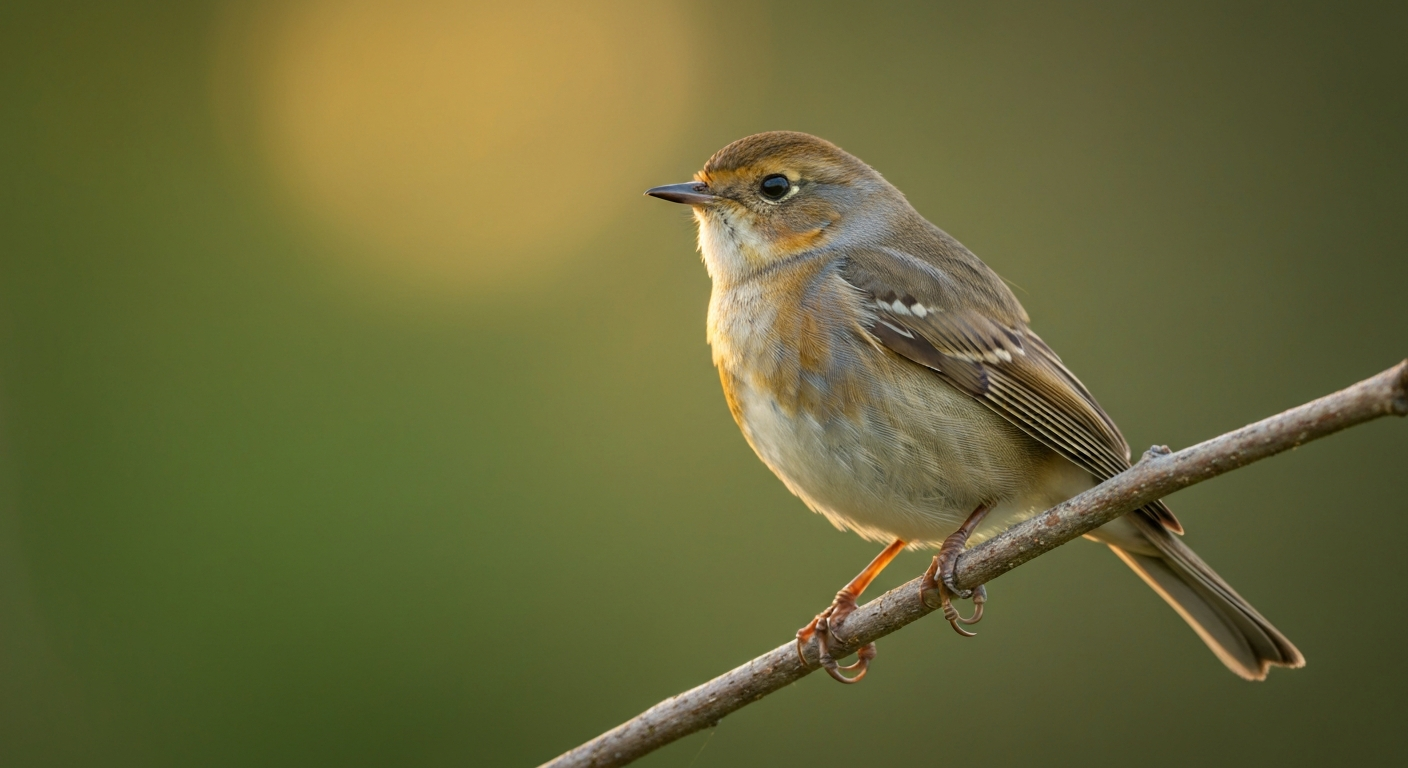
When you see 'parva' attached to a bird's scientific name, it means one thing: small. It comes directly from the Latin adjective parvus, and in its feminine form parva it simply describes the bird as being little in size. There is no hidden symbolism here, no cultural metaphor, just a straightforward Latin size label that ornithologists have been using for centuries to tell you, at a glance, that this species is on the smaller end of its group.
Parva Bird Meaning in English: What 'Parva' Signifies

Marcus Whitley
5 Aug 2026
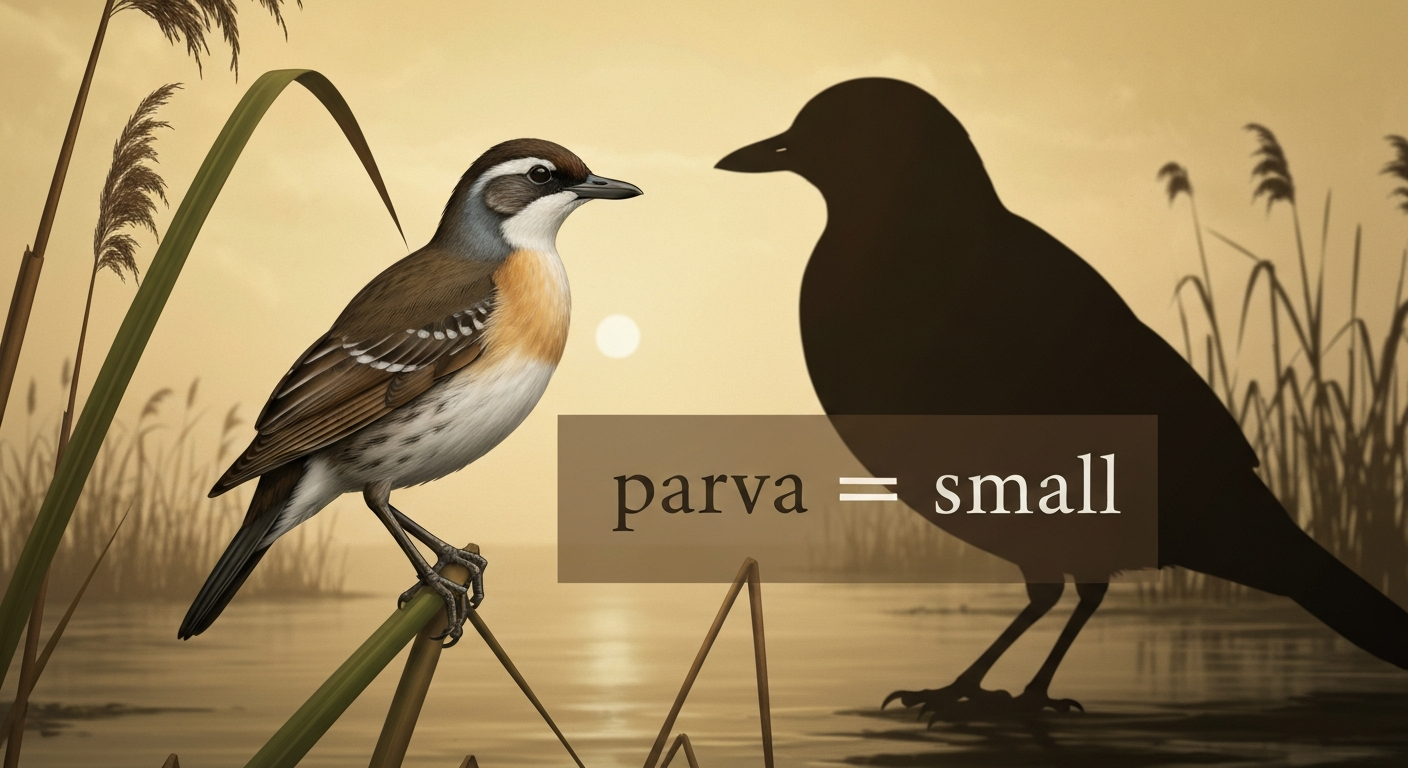
What 'parva' actually means in plain English
The word parva translates directly as 'small' or 'little.' Both English words are fair renderings, and which one a translator or field guide chooses is mostly a stylistic call. In classical Latin, parvus (the root form) was a neutral, everyday adjective, the kind Romans used the way we'd say 'that small bird over there. blank" rel="noopener noreferrer">Lewis & Short's entry for parvus records it as a common adjective meaning 'small, little,' used in classical Latin as a neutral descriptive term. ' It carries no inherently positive or negative weight, though in some literary contexts parvus could shade toward 'insignificant' or 'humble.' When it appears in bird names, though, that nuance disappears entirely, it is purely descriptive, meaning the species is physically smaller than comparable birds in its genus or family. Think of it as the ornithologist's way of writing 'the little one' in the name itself.
The Latin roots: from parvus to parva
Latin adjectives like parvus come in three gender forms: parvus for masculine nouns, parva for feminine nouns, and parvum for neuter nouns. This is standard Latin grammar, adjectives agree with the noun they describe in gender, number, and case. In scientific bird names, the adjective has to match the grammatical gender of the genus name it is paired with. So when a species is placed in a feminine genus, the epithet takes the feminine form parva. Move that same species to a masculine genus and the name officially becomes parvus. This is not optional, the International Code of Zoological Nomenclature (ICZN Article 31. The International Code of Zoological Nomenclature, Article 31 (Species‑group names) requires that species‑group adjectival names agree in gender with the generic name with which they are combined International Code of Zoological Nomenclature — Article 31 (Species‑group names). 2) requires this kind of gender agreement, and taxonomic papers routinely publish corrections when a species is reclassified and the ending needs updating.
The root traces back even further than classical Latin, connecting to Indo-European origins. Modern English has absorbed it in words like parvule (a tiny amount) and in scientific prefixes, though these are rare outside specialist writing. What matters for reading bird names is simple: parv- as a word-start or standalone epithet always signals smallness.
Why ornithologists use 'parva' in scientific bird names
Binomial nomenclature, the two-part Latin naming system standardized by Carl Linnaeus in the 18th century, uses the second part of a name (the specific epithet) to describe something distinctive about the species. Size is one of the most immediately useful descriptors. When a genus contains multiple species that look broadly similar, calling one parva tells field workers right away that this is the smaller species. It is economical and universal: a birder in Japan and a researcher in Brazil can both read parva and reach the same conclusion without a shared spoken language.
James Jobling's Helm Dictionary of Scientific Bird Names, the standard reference ornithologists reach for on etymology, confirms that parva derives from Latin parvus meaning 'small' and documents its wide use as a size-indicating epithet across many bird families. You will find it applied to flycatchers, crakes, sparrowlarks, and more, always pointing to relative smallness within a group.
How 'parva' becomes 'little' or 'small' in English common names
Not every bird with parva in its scientific name has an English common name that directly translates the epithet, the American Ornithological Society and similar bodies choose English names based on stability and established usage rather than automatically translating Latin. But when the translation does show up, you will see either 'Little' or 'Small' placed at the front of the common name. The clearest example is Zapornia parva, listed on major taxonomy databases as the Little Crake. The name parva was given to reflect the species' notably small size for a crake, and the English name simply renders that directly. Similarly, Ficedula parva is commonly called the Taiga Flycatcher or Red-breasted Flycatcher depending on the taxonomy in use, here, the English name went a different direction, describing the bird's habitat and plumage rather than its size. That is a good reminder that Latin epithets and English common names are parallel systems, not strict translations of each other.
Other examples reinforce the pattern. Conopias parva appears in major ornithological checklists as a small tyrant-flycatcher, and subspecies like Mirafra javanica parva use parva to mark a smaller geographical race within the same species. Wherever you see it, the reading is consistent: parva = the small or little form.
How to say it: pronunciation guide
There are three legitimate ways to pronounce parva, depending on which Latin tradition you follow, and none of them is wrong in context.
| Tradition | Pronunciation | IPA | When you'll hear it |
|---|---|---|---|
| Classical Latin (reconstructed) | PAR-wa | [ˈpar.wa] | Classics scholars, historical linguists |
| Ecclesiastical / Church Latin | PAR-va | [ˈpar.va] | Catholic liturgical settings, some European academics |
| Anglicized (field guide standard) | PAR-vuh | [ˈpɑːrvə] | English-speaking birders, field guides, classrooms |
For most birdwatchers and students, PAR-vuh is the pronunciation you will hear in the field and in English-language lecture rooms. The v in classical Latin was actually a semivowel closer to a w sound, which is why the reconstructed form sounds like PAR-wa, but you will not raise any eyebrows saying PAR-vuh at a bird walk. The stress always falls on the first syllable, whatever version you use.
Common mix-ups, misspellings, and search traps
Parva is short and phonetically close to several other bird-related words, which means it attracts a fair amount of confused searching. Here are the most common ones worth sorting out.
- Parva vs. paradise: If you searched 'parva bird' and were actually thinking of the Birds of Paradise — those spectacular, often extravagantly plumed birds from New Guinea — you are looking for a completely different topic. 'Paradise' comes from Old Persian and Greek, has rich symbolic and religious meaning, and is unrelated to the Latin parvus. The paradise bird entry covers that territory in full.
- Parva vs. parrot: 'Parrot' does not derive from parvus. Its etymology traces through French and possibly a personal name (Pierrot). A parrot is not a 'small bird' etymologically, though parakeets — the smaller parrots — do get described with terms like parva in some scientific names. The parakeet entry digs into that bird's naming history.
- Parva vs. parliament: A parliament of owls is a collective noun — a completely different type of bird language. It has nothing to do with Latin size adjectives. If you were looking up group names for birds, the parliament bird entry is where that conversation happens.
- Parva vs. parv- misspellings: Common search misspellings include 'parvia,' 'parvar,' and 'parba.' None of these are Latin words. If your spell-checker flags parva, it is simply because the word is not in standard English dictionaries — but it is correct as written.
- Parva as a symbol: Some readers arrive expecting parva to carry symbolic meaning the way ravens, cranes, or doves do. It does not. Unlike the rich cultural symbolism attached to tropical birds or birds of paradise, parva is a purely functional descriptor. It tells you about physical size, not mythology.
Reading real bird names that include 'parva'
Once you know what parva means, reading it in a scientific name becomes a simple pattern: Genus + parva = 'the small [whatever the genus is].' Here are a few concrete examples of how that plays out.
| Scientific name | English common name | What 'parva' signals | Family |
|---|---|---|---|
| Zapornia parva | Little Crake | Smaller than related crake species | Rallidae (rails and crakes) |
| Ficedula parva | Taiga Flycatcher / Red-breasted Flycatcher | Small size within genus Ficedula | Muscicapidae (Old World flycatchers) |
| Conopias parva | Short-crested Flycatcher | Small among tyrant-flycatchers | Tyrannidae (tyrant-flycatchers) |
| Mirafra javanica parva | (subspecies of Horsfield's Bush Lark) | Smaller race of the nominate species | Alaudidae (larks) |
Notice that the English common name does not always echo the Latin epithet. Zapornia parva hands you 'Little Crake', a clean translation. Ficedula parva skips size entirely in favour of geography (Taiga) and appearance (Red-breasted). This is normal practice: English names are chosen for usability and tradition, not as automatic literal translations. But when you see parva in the Latin, you can always read it as 'the small species in this genus' regardless of what the English name says.
Quick-reference reading tips for translators, birders, students, and editors
If you regularly work with bird names, whether you are translating ornithological texts, compiling a field guide, studying for an exam, or editing a nature article, keep these points in mind when parva comes up.
- Translate parva as 'small' or 'little' — both are correct; 'little' often sounds more natural in English common names (Little Crake, not Small Crake).
- Check gender agreement if you are writing or editing taxonomy: parva goes with feminine genus names, parvus with masculine, parvum with neuter. Getting this wrong is a nomenclatural error under ICZN rules.
- Do not assume the English name will reflect the Latin epithet — confirm the accepted English name against IOC World Bird List or a regional checklist rather than translating it yourself.
- Stress the first syllable every time: PAR-vuh, PAR-va, or PAR-wa — whichever pronunciation convention you follow.
- If you see parvulus or parvula in a name (diminutives of parvus), the meaning intensifies to 'very small' or 'tiny' — a slightly stronger size signal than plain parva.
- Do not confuse the epithet parva with common names that include the word 'little' for unrelated reasons — always check the Latin name if size information matters in your context.
- For birds with rich cultural or symbolic meanings — paradise birds, tropical birds, birds referenced in collective nouns like 'parliament' — parva is not your entry point. Those are separate topics with their own etymological and symbolic histories.
Where to look next
If parva brought you here on a detour from something more symbolic or culturally rich, there is plenty of that elsewhere on this site. The paradise bird entry covers a term with deep historical and visual symbolism, while the false bird-of-paradise meaning unpacks a plant name that borrows its glamour from those same tropical birds. If you were actually searching for parakeet and landed here through a typo or autocomplete, the parakeet bird meaning entry covers that name's separate and interesting etymology. For collective nouns, the parliament of owls kind of language, the parliament bird meaning entry handles that. See the parliament bird meaning entry for the collective noun 'parliament of owls'. And if you want broader context on how tropical birds in general carry symbolic weight across cultures, the tropical bird meaning entry is the place to go. See the tropical bird meaning entry for broader cultural symbolism of birds in warmer regions. If you meant the false bird of paradise, see the false bird of paradise meaning entry for that name’s symbolism and usage.
Parva itself, though, is refreshingly simple. It is Latin for 'small,' it tells you about size rather than myth, and once you know it you will recognize it instantly in any scientific bird name you encounter. That kind of recurring Latin vocabulary is genuinely useful, learn half a dozen of these epithets and you start reading scientific names the way ornithologists do, like a second alphabet that describes the bird before you even open a field guide.
FAQ
What does “parva” literally mean when it appears with bird names in English?
Plain-English definition: “parva” is Latin for “small” or “little.” Tone: neutral descriptive — it simply indicates small size (sometimes ‘insignificant’ in other contexts), not a symbolic or cultural meaning.
What is the Latin origin and grammar of parva?
Etymology and grammar: parva is the feminine nominative singular form of the Latin adjective parvus (masculine parvus, feminine parva, neuter parvum). Latin adjectives agree in gender, number and case with the noun they modify, so parva appears when the genus name is treated as feminine (or when the original describer used the feminine form).
How and why is parva used in scientific (binomial) bird names?
Usage in binomials: parva is an adjectival species‑group name formed from Latin parvus meaning ‘small.’ Taxonomists use it to describe a species, subspecies or population that is smaller than related taxa. It’s descriptive—part of the formal scientific name—used across bird families when size is a distinguishing feature.
How should I read or convert a scientific name that includes parva into everyday English?
Converting/reading advice: many field guides and checklists render parva in English as “small” or “little” (for example Zapornia parva → Little Crake). However, English common names are set by tradition and committees (AOS, IOC) and may not always be literal translations; use the established common name when one exists.
How do I pronounce parva?
Pronunciation guidance: accepted pronunciations include Classical Latin approximately “PAR‑wa” ([ˈpar.wa]) and Ecclesiastical/modern Latin “PAR‑va” ([ˈpar.va]). In English field guides people usually say “PAR‑vuh” (/ˈpɑːrvə/). Any of these are understood; use the anglicized form in spoken birding contexts.
Are there technical naming rules that affect the form parva in taxonomy?
ICZN gender agreement: under the International Code of Zoological Nomenclature, adjectival species‑group names must agree in gender with the genus. So parva (feminine) becomes parvus or parvum if the genus name is masculine or neuter, and the ending may change if the species is moved to a genus of different grammatical gender.
Next Article
Perching Bird Meaning in English: Definition & Examples
Perching bird meaning in English: definition, anatomy, perching vs perched, usage examples and cultural notes.