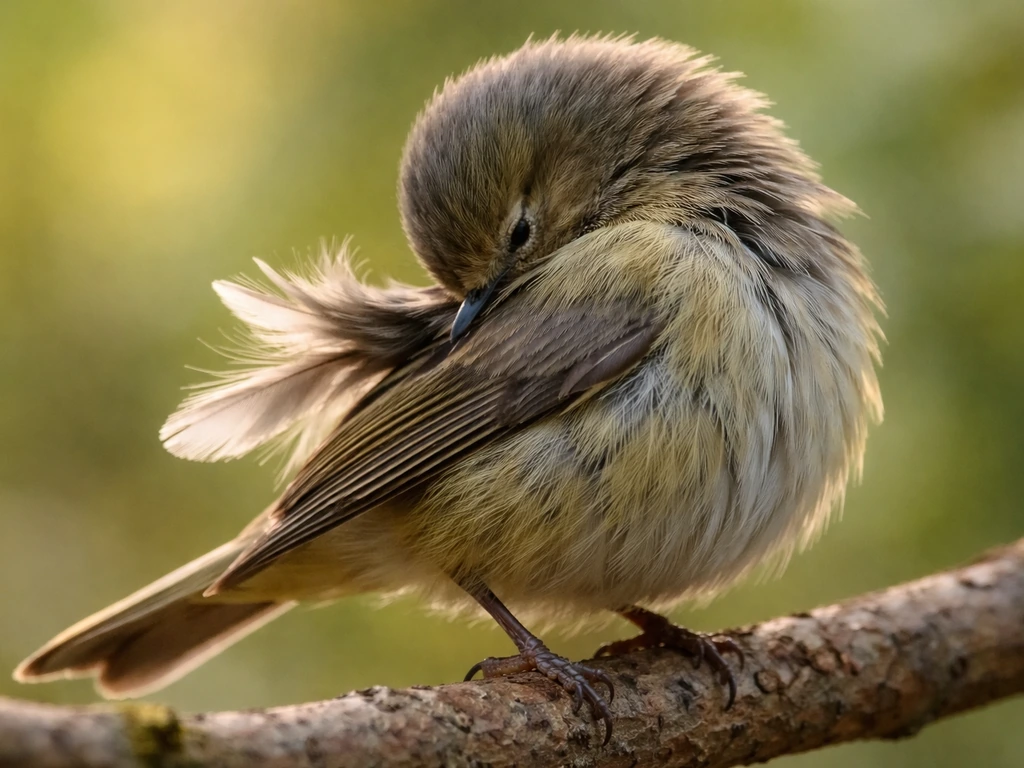
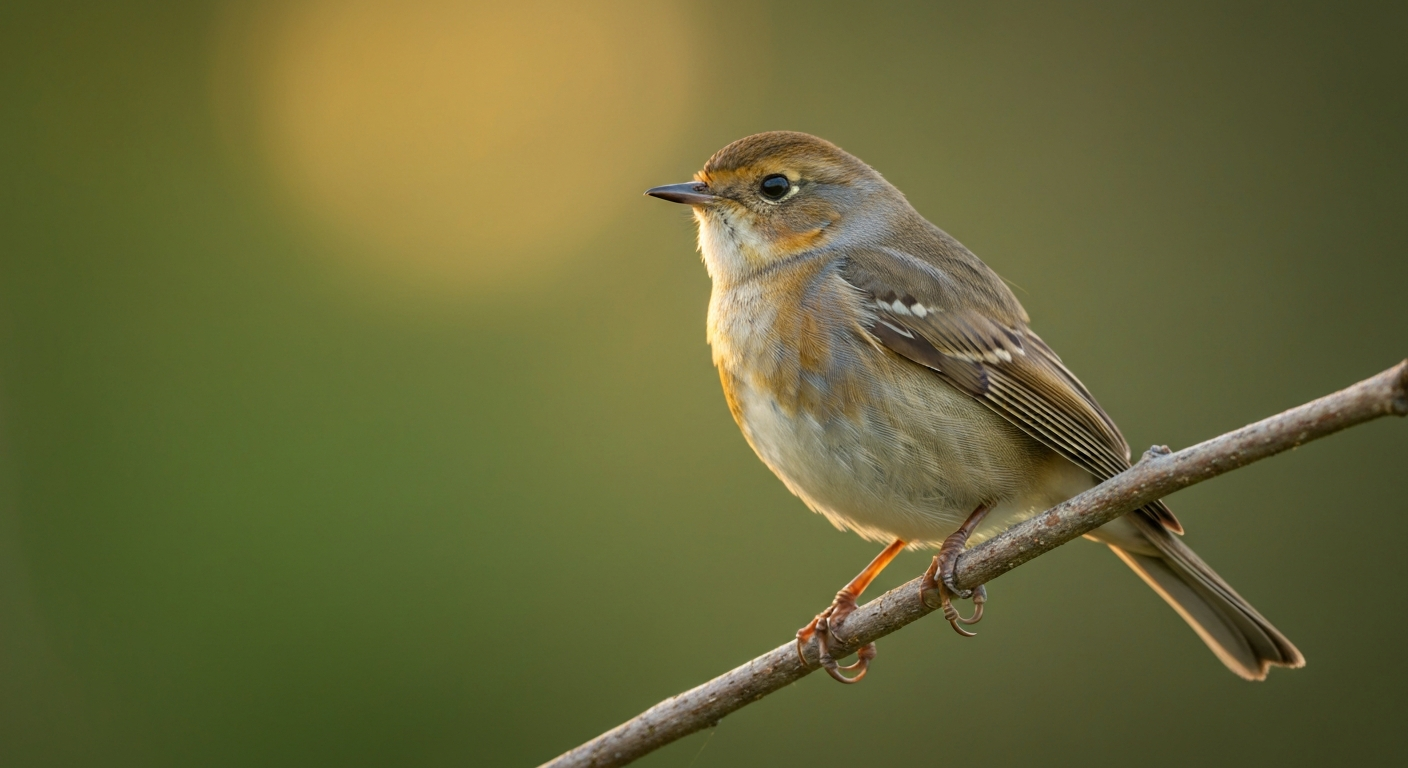
A perching bird is any bird that habitually rests on a branch, wire, or rod by gripping it with its feet. In everyday English the phrase is used loosely for any small bird you see sitting on a fence or treetop. In ornithology it carries a more precise meaning: a member of the order Passeriformes, the largest group of birds on Earth, containing more than half of all known bird species, from sparrows and robins to crows and birds-of-paradise.
Perching Bird Meaning in English: Definition & Examples

Marcus Whitley
28 Jul 2026
What 'perching bird' means at a glance
Quick answer: a perching bird is a bird whose feet are specially built for gripping a perch, and in formal ornithology the term is synonymous with passerine (order Passeriformes).
The plain-English definition
In ordinary conversation, 'perching bird' simply means a bird that perches, that is, one that alights on and rests upon something raised off the ground. Merriam-Webster records 'perch' as a verb meaning 'to alight or rest upon a perch,' so a perching bird is, straightforwardly, one doing exactly that. Collins English Dictionary lists 'perching bird' as a common synonym for 'passerine' in learner-level entries, and Merriam-Webster has a tidy one-word equivalent: 'percher,' defined as 'a bird having feet adapted for perching.' You will hear all three forms used interchangeably in casual birdwatching conversation.
The noun 'perch' itself also describes the physical object the bird rests on: a branch, a rod, a wire, a windowsill. Dictionary.com records both senses, the literal resting place and a figurative sense meaning any high or elevated position. That figurative sense feeds into a whole family of idioms covered later in this article.
The ornithological definition: passerines and what actually qualifies
In formal bird science, 'perching bird' is the plain-English label for every species in the order Passeriformes. The U.S. Fish and Wildlife Service uses exactly that label, and Cornell Lab of Ornithology's glossary treats 'passerine' and 'perching bird' as interchangeable in field-guide practice. Passeriformes is the largest order of birds by a considerable margin: estimates consistently place it at more than half of all living bird species, somewhere above 6,000 species worldwide. That means when you look at a garden bird in almost any part of the world, the odds favor it being a passerine.
The defining ornithological criterion is foot anatomy. Passerines have an anisodactyl foot arrangement: three toes pointing forward and one (the hallux) pointing backward, all meeting at the same level. This layout lets the foot wrap around a perch securely from two opposing directions simultaneously, which is why passerines can grip slender twigs that many other birds cannot. Non-passerine birds, such as woodpeckers (zygodactyl, two toes forward and two back) or ostriches (two toes forward, none back), do not qualify under the strict ornithological sense even if they occasionally rest on elevated objects.
Common perching birds: a quick ID reference
The table below covers a handful of widely recognized passerines. It is far from exhaustive, since more than 6,000 species belong to the order, but these are the ones you are most likely to encounter in everyday life or in descriptions of bird symbolism.
| Species | Family | Quick field clue | Where you'll see it |
|---|---|---|---|
| House Sparrow | Passeridae | Chunky, streaky brown; often in noisy flocks | Towns, farms, gardens worldwide |
| American Robin | Turdidae | Orange-red breast, dark back, upright posture | Lawns and parks across North America |
| Common Blackbird | Turdidae | Male all-black with yellow bill; female brown | European gardens and hedgerows |
| Barn Swallow | Hirundinidae | Deeply forked tail, blue-black above, rusty throat | Open country; perches on wires |
| European Starling | Sturnidae | Iridescent plumage, short tail, loud mimicry | Cities and farmland globally |
| Great Tit | Paridae | Black-and-white head, yellow breast, bold black stripe | Woodland and gardens, Europe and Asia |
| Common Raven | Corvidae | Large, all-black, wedge-shaped tail, deep croak | Mountains, coasts, northern forests |
The anatomy and behavior that make perching possible
Anisodactyl feet: the basic design
The anisodactyl foot (three toes forward, one back) is the foundation of everything. Collins English Dictionary defines 'anisodactylous' as having the toes arranged in that specific asymmetric pattern. In passerines, all four toes insert at essentially the same level on the tarsometatarsus, so when the bird lands on a branch, the rear toe and three front toes pinch from opposite sides. The result is a grip that feels effortless from the bird's perspective and is extremely hard to dislodge from the outside.
Tendon locking: how birds sleep on branches
The really clever engineering is what happens when a bird bends its knee and ankle to squat down onto a perch. The flexor tendons running from the leg muscles down through the toes are routed over a series of ridged tendons and bony projections that act like a ratchet. Quinn and Baumel described this 'digital tendon locking mechanism' in 1990, and it remains the canonical anatomical description of the system. When the bird's weight presses down, the ankle flexes, the tendons tighten automatically, and the toes lock closed around the perch without any continuous muscular effort. The bird can relax, even fall into deep sleep, and it will not fall off the branch. Reviews of avian sleep physiology confirm that this passive locking is what allows passerines to sleep securely on exposed roosts, including during windy conditions.
Roosting behavior
Roosting is the umbrella term for where and how birds sleep or rest. Perching birds typically roost in dense vegetation, on sheltered branches, or in cavities, always elevated above the ground where terrestrial predators have less access. Many species roost communally: European Starlings form famous murmurations before descending to a shared roost site that can hold millions of birds. The elevated position serves a dual function, safety from ground predators and an unobstructed view of approaching aerial threats, which connects directly to the cultural symbolism of vigilance and watchfulness that perching birds have accumulated across many traditions.
Etymology: where the word 'perch' comes from
The word 'perch' as a resting place is attested in English from the late 14th century. It came through Old French 'perche' from Latin 'pertica,' meaning a pole or measuring rod. That Latin root also gave English the old unit of measurement called a perch (roughly 5 metres), which is why the word carried a sense of height and elevation right from the start. By the time it embedded itself in English idiom, 'perch' had already shifted from the object (the rod) to the act of resting on it, and then to any elevated position, literal or metaphorical. Merriam-Webster and the Online Etymology Dictionary both trace this path from physical pole to figurative high station.
Idioms and common phrases built on 'perch'
Because 'perch' suggests height, observation, and a slight precariousness, it generates a rich set of idiomatic expressions in English. Here are the most common ones and what they actually mean in use.
- Knocked off your perch: losing a position of power or status you had held comfortably. 'The defending champion was finally knocked off his perch in the final round.'
- Perched on top of: occupying a high or dominant position, often physically. 'The village is perched on top of a limestone ridge with views in every direction.'
- High perch: a vantage point, either literal or metaphorical, from which someone observes and judges. Often carries a mild sense of aloofness.
- Off your perch (British informal): dead, especially of an older person. Humorous and slightly irreverent in tone.
- Perch (as a verb, figurative): to sit or position oneself on the edge of something, suggesting alertness or impermanence. 'She perched on the corner of his desk, ready to leave at any moment.'
The figurative sense of 'perched' also appears constantly in descriptive writing and journalism. A house perched on a cliff, a café perched above a busy street, a child perched on a stool: in every case the image carries the same undertone as the bird on its branch, elevated, slightly exposed, watching the world below.
Symbolism and cultural meaning of the perching bird
Across cultures, a bird perching carries a cluster of overlapping meanings: rest after flight, watchful observation, a pause between action and movement, and the tension between being free (capable of flight) and being still (choosing to stay). In Western literary tradition, a bird on a branch is almost universally a symbol of contemplation. Think of Keats's nightingale, unseen but heard from its perch in the darkness, or Edgar Allan Poe's raven, which lands on the bust above the door and will not leave. Both use the perching position to convey something fixed and unignorable, an outside force that has settled and refuses to move on.
In East Asian visual art, a bird perched on a plum blossom branch is one of the most enduring images in Chinese and Japanese painting. The bird is often a small passerine, which places it directly in the 'perching bird' category, and it symbolizes resilience, beauty, and the promise of renewal at the end of winter. The elevated, solitary perch underscores the bird's independence without cutting it off from the natural world.
In many Indigenous North American traditions, birds perching on specific trees or in specific directions carry divinatory meaning. A bird landing and staying, rather than passing through, is read as a message or omen whose meaning depends on the species. The stillness of the perch is crucial: it is the pause that makes the bird legible as a sign.
The three consistent symbolic threads across these traditions are rest (the bird has landed, the journey is paused), vigilance (it is elevated and aware), and freedom held in reserve (it can leave at any moment but chooses not to). That last quality gives perching birds a particular resonance in poetry and song lyrics, where a character who perches somewhere is present but not committed, watching but not yet decided.
Perching vs. perched: grammar and how to use each correctly
These two forms look similar but function differently, and mixing them up creates the kind of grammatical noise that editors catch immediately. 'Perching' is the present participle of 'to perch.' It describes ongoing action ('the robin was perching on the wire'), works as a gerund or verbal noun ('perching requires good balance'), and can form a participial phrase modifying a noun ('the bird perching outside the window'). 'Perched,' by contrast, is the past participle. It describes a completed or resulting state and is the form used adjectivally to describe position: 'a bird perched on a wire,' 'perched above the valley,' 'she sat perched on the edge of the chair.' Cambridge Dictionary records 'perched' specifically in this adjectival role, and that is by far its most common use in written English.
The practical difference is this: if you want to describe what a bird is currently doing (an action in progress), use 'perching.' If you want to describe where it is sitting (a position or state), use 'perched.' Both forms appear frequently in field-guide prose and in literary description, but they are not interchangeable. Writing 'a perching bird on the fence' and 'a perched bird on the fence' are both grammatically acceptable but feel slightly different: the first foregrounds the behavior, the second the position. For the ornithological category, 'perching bird' is the fixed phrase, not 'perched bird,' because it refers to the bird's behavioral and anatomical character, not to a specific moment of sitting still. The related entry on perched bird meaning explores the adjectival use in more detail.
One pitfall worth flagging for writers: dangling participial phrases. 'Perching on the branch, the binoculars caught every detail' is a classic dangling construction because the binoculars are not doing the perching. Chicago Manual of Style guidance on participial phrases consistently warns against this kind of misattachment. The fix is simple: make the subject of the participial phrase the same as the subject of the main clause. 'Perching on the branch, the sparrow was perfectly still' works because the sparrow does both things.
Preen and preening: bird grooming, not perching
Preen and preening come up constantly alongside perching bird queries, and it is easy to see why: both describe things birds do while sitting still, and beginners observing birds in a garden often see the two behaviors in quick succession. But they are completely different actions, and the words have no etymological connection to each other or to 'perch.'
Merriam-Webster defines 'preen' as to trim or dress using the bill, which is exactly what a bird does when it runs its beak along a feather to realign the microscopic barbules that zip the feather vane together. Cornell Lab of Ornithology describes preening in more detail: birds use their bill to work through each feather, removing debris, reinterlocking the barb structure, and distributing preen oil from the uropygial gland (located just above the tail) across the plumage. That oil maintains waterproofing and feather flexibility. Preening also has a social dimension: allopreening, where one bird preens another, reinforces pair bonds and flock cohesion in many species, from ravens to parrots.
In plain English, 'preen' carries a separate figurative meaning: to groom or congratulate oneself, with a slight implication of vanity. 'He preened in front of the mirror' or 'she preened herself on the award' both carry that nuance. This human figurative sense is borrowed from observing how birds look when they meticulously tend their feathers, it can appear almost self-satisfied. The dedicated entries on preening meaning bird and preen meaning bird on this site go deeper into both the behavioral biology and the figurative usage if you want the full picture.
Peering: a completely different word that often gets confused
The third word that regularly appears alongside perching bird searches is 'peering,' which comes from an entirely separate verb. Merriam-Webster defines 'peer' (verb) as 'to look closely or intently,' especially when visibility is difficult or the observer is straining to see something. 'The owl was peering through the fog' and 'she was peering at the map' both use it correctly. Peering has nothing to do with resting on a surface or grooming feathers: it is purely about the act of looking intently.
The confusion probably arises because all three words, perching, preening, and peering, are present participles ending in '-ing' that are often used to describe birds observed doing something. If you watch a bird for thirty seconds you might see it perching (sitting on a branch), preening (tidying its feathers), and peering (leaning forward to inspect something below). They describe three separate behaviors, each with its own word. The entry on peering bird meaning on this site covers the visual behavior and its figurative extensions in full.
Putting it all together: usage examples
Here are clean examples showing each term used correctly in context, the kind of sentences you would find in nature writing, field guides, or literary prose.
- Perching bird (ornithological): 'Warblers, finches, and flycatchers are all perching birds, members of the order Passeriformes, identifiable by their anisodactyl feet.'
- Perching bird (plain English): 'A small perching bird settled on the highest branch of the oak and began to sing.'
- Perched (adjectival/positional): 'Perched on the telephone wire above the road, the swallow watched the traffic without apparent concern.'
- Perching (present participle, action in progress): 'The goldfinch was perching on the thistle head, picking out seeds one by one.'
- Preening: 'After its bath, the blackbird spent several minutes preening, working oil through every flight feather before attempting to fly.'
- Peering: 'The heron stood motionless at the water's edge, peering down through the surface for the shadow of a fish.'
Keeping these four words distinct, perching (resting on an elevated surface), perched (the resulting position), preening (grooming feathers), and peering (looking intently), will sharpen any writing about birds, whether you are drafting a field note, a poem, a wildlife article, or a translation.
FAQ
Natural, search‑friendly article title and concise meta description (<=160 chars) for this topic
Title: "Perching Bird — Meaning, Ornithology, Grammar, and Related Verbs"; Meta description: "Clear definitions of ‘perching bird’ (plain & ornithological), anatomy, grammar (perching vs. perched), preen/peering, idioms, and examples."
Plain‑English definition: What does 'perching bird' mean?
In plain English, a 'perching bird' (often called a percher) is any bird that commonly rests or sits on a branch, wire, fence or other narrow support. The term emphasizes the habit of alighting and balancing on a horizontal or thin surface rather than standing on the ground.
Ornithological definition: What makes a bird a 'perching bird' scientifically?
Ornithologically, 'perching bird' usually refers to passerines (order Passeriformes)—birds with feet adapted to clasping narrow perches. Most passerines share an anisodactyl foot (three toes forward, one back) and musculotendinous adaptations that let them grip securely with little energy, so they habitually perch on branches, wires and similar supports.
Short ID table: typical perching bird examples and quick ID features
Simple illustrative table (text): - House Sparrow (Passer domesticus): small, stout, anisodactyl feet; often on wires and eaves. - American Robin (Turdus migratorius): medium size, perches on lawns’ edges and branches. - Blue Tit / Chickadee (Paridae): small, acrobatic, clings and hops on thin twigs. - Starling (Sturnus): strong feet, gregarious on wires and roofs. Note: many non‑passerines also perch (raptors, woodpeckers), but 'perching bird' as a label most often implies passerines.
Anatomy and behavior that enable perching
Key features: anisodactyl foot arrangement (3 toes forward, 1 back) that maximizes grip; a tendon‑locking/flexor mechanism in many species that holds toes closed around a perch with minimal muscular effort, allowing low‑energy roosting and even sleep; behavioral traits like hopping, bracing with tail, and choosing narrow horizontal supports. These anatomical traits explain how birds can stay on a thin branch while resting.
Grammar and usage: difference between 'perching' and 'perched'
'Perching' is the present participle or gerund of 'perch' and denotes ongoing action (The bird is perching) or functions as an adjective/noun (a perching bird). 'Perched' is the past participle or simple past and describes a completed action or a resultant state (The bird perched on the fence; The bird is perched on the gate). Editors should avoid dangling participles (e.g., "Perching on the branch, the wind blew" → ambiguous). Use participles so the subject and action match.
Next Article
Preen Meaning in Birds: What It Looks Like and Why
Learn preen meaning bird behavior: feather cleaning, oiling, and alignment, plus cues, differences, and when to worry.