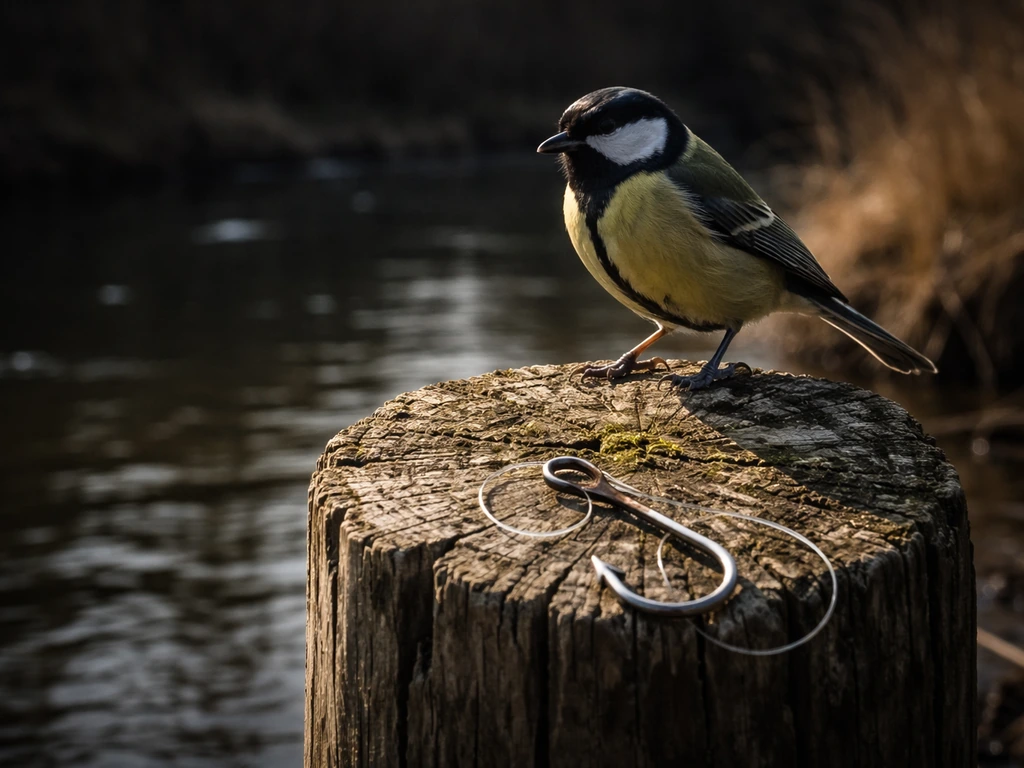
"Home bird" actually has two very different meanings depending on who's using it and why. As an idiom, it describes a person who prefers staying home over going out, essentially a homebody, especially common in British and Irish English. But when people search "home bird meaning" or "bird in home meaning," they're often asking something else entirely: what does it mean, symbolically or spiritually, when a bird shows up at or inside your house?
Home Bird Meaning: What a Bird at Your House Signals

Marcus Whitley
26 Apr 2026
If what you really want is a quick symbolism read like you would for hook bird meaning, keep going, because this guide covers the spiritual and cultural angles too. Both questions are completely valid, and this guide covers both, so you can figure out exactly what you're looking for.
What people actually mean by "home bird"

The phrase "home bird" (sometimes written as one word, "homebird") is an informal British and Irish English term for someone who is happiest staying close to home. It's equivalent to "homebody" in American English. Someone might say "she's a real home bird" to mean she doesn't travel much, prefers familiar surroundings, and probably hasn't moved far from where she grew up. Wiktionary lists it as an informal UK noun, often describing someone unwilling to leave their childhood home or local area. It's not a criticism, just a description of someone whose comfort zone is rooted in the familiar.
That idiom is about a person, not a literal bird. But the search traffic around "home bird meaning" is split between people looking for that definition and people who had an actual bird show up at their house and want to know what it means symbolically. If you’re asking specifically about winter bird meaning, the species and timing make a big difference home bird meaning. The two questions sound similar, they use the same words, but they're asking completely different things. If you're in the second group, skip ahead to the symbolism and behavior sections. If you needed the idiom definition, you have it: a home bird is a person who loves being at home.
Birds at the house: what people believe they mean
Across a huge range of cultures and time periods, birds visiting a home have been treated as omens or messages. The logic is intuitive: birds move freely between worlds (the earth, the sky, and, in many belief systems, the spiritual realm), so when one shows up at your doorstep or flies through your window, it can feel significant. That feeling has been formalized into folk traditions almost everywhere humans have lived alongside birds.
The most common symbolic frameworks around birds at the home fall into a few broad categories: messages from deceased loved ones, warnings of change or death, signs of good luck and protection, and signals of spiritual attention or new beginnings. Whether these mean anything in a literal sense is another question, and we'll get to the skeptical view later. But understanding what people believe is genuinely useful, whether you're interpreting an experience of your own or just trying to understand a phrase someone used.
- Protection and guardianship: Many traditions treat birds nesting near or on a home as a protective sign, suggesting the household is safe or blessed.
- Messages from the deceased: A widely held belief, especially in Western folk tradition, is that birds (particularly ones that arrive unexpectedly) carry messages from people who have died.
- Omens of change: A bird entering a home uninvited is frequently interpreted as a sign that something significant is about to shift in the family's life, not necessarily for better or worse.
- Death omens: This is the most dramatic interpretation and the most culturally varied. Some traditions associate specific birds with death omens; others apply this meaning broadly.
- Spiritual attention: Some frameworks treat a bird's visit as a nudge from the universe, a sign that you need to pay attention to something happening in your life.
It's worth noting that these interpretations are heavily shaped by which bird it is, what it does, and the cultural background of the person interpreting it. A sparrow means something different to someone raised in British folk tradition than to someone from East Asia. Context is everything.
What the bird is doing matters more than you'd think
The behavior of a bird near your home is the most important variable in folk interpretation. The same bird singing outside your window carries a completely different symbolic weight than that same bird flying into your living room and landing on the back of a chair. Here's a breakdown of the most commonly interpreted behaviors.
Singing near the house
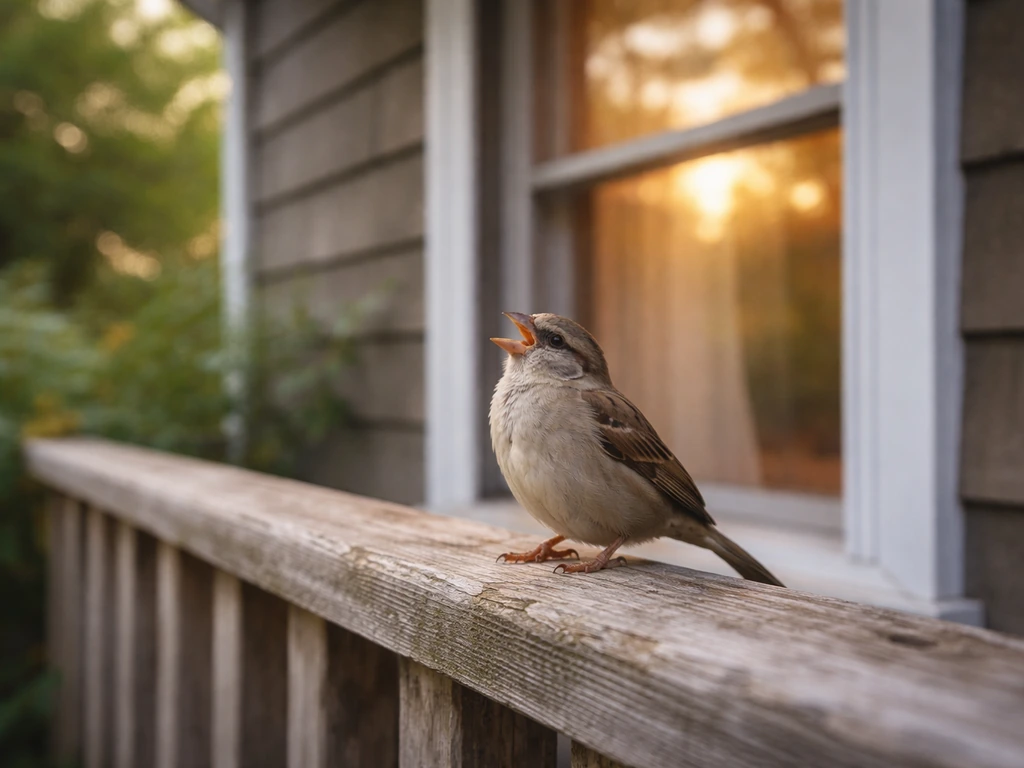
Bird song near the home is almost universally treated as a positive sign, associated with joy, good news incoming, or the arrival of spring and renewal. The exception is when the song happens at an unusual time (like in the middle of the night) or when it's from a bird typically associated with darker symbolism, like a crow. In many traditions, a robin singing near a sick person's window is considered an ill omen rather than a cheerful one, so the species matters.
Nesting on or near the home
Birds nesting on your property, under eaves, above a doorway, or in a nearby tree, are broadly considered a good sign. The symbolism ties to protection, fertility, and domestic harmony. Swallows nesting above a door in particular are treated in European and Chinese folklore as a sign of prosperity and good fortune for the household. This is one of the more consistent cross-cultural interpretations.
Flying into the home
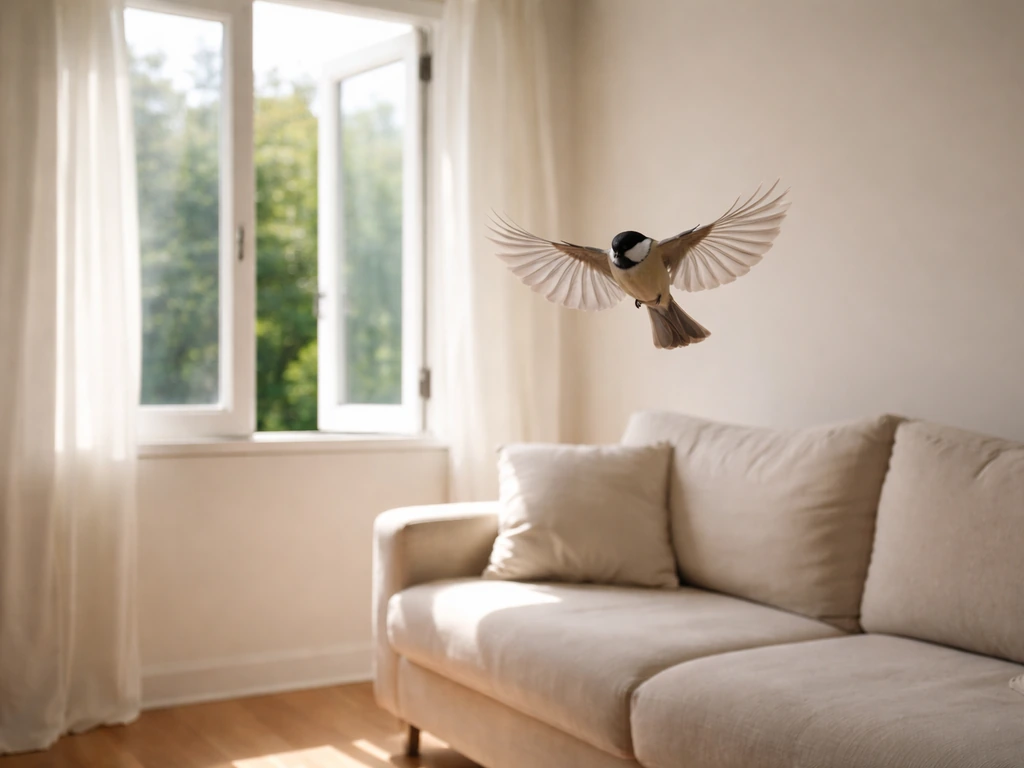
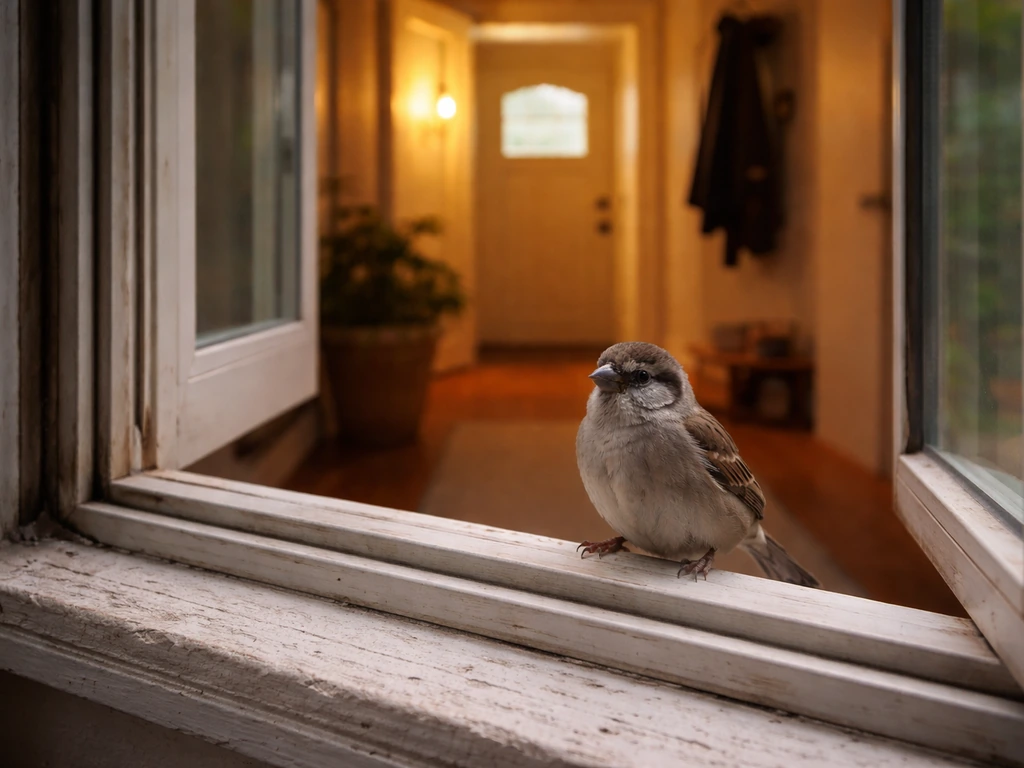
This is the one that really gets people's attention. A bird flying through an open window, circling a room, landing on furniture, and then flying back out is one of the most widely discussed omen patterns in Western folklore. Snopes has documented this specific scenario (flew in through an open window, circled the room or landed on someone's chair, then flew back out) as something people consistently frame as an omen. Traditional interpretations vary from a message of impending death in the family to a visit from a deceased loved one, to simply a sign of change. The ambiguity is built into the folklore itself.
Hitting or pecking at windows
This is where the practical and symbolic explanations diverge most sharply. From a biological standpoint, birds hit windows because they can't see glass as a barrier, and hundreds of millions of birds die from window strikes in the U. The U. S.
Geological Survey describes bird-window collisions as a major threat, with estimates of up to two billion birds killed each year in the United States. S.
alone each year according to estimates from a Smithsonian Conservation Biology Institute study. Robins and cardinals peck at windows because they see their reflection and think it's a rival. Symbolically, though, a bird repeatedly tapping at a window is interpreted in some traditions as a message demanding attention, sometimes tied to a warning or a sign of a coming death in the family, particularly when it's a robin.
The practical reality and the symbolic reading don't have to cancel each other out, but it's useful to know both exist.
Roosting or returning repeatedly
A bird that keeps coming back to a specific spot on your property, a porch railing, a window ledge, a garden corner, is often interpreted as a guardian presence or a spirit that has specifically chosen your home. In more grounded terms, it usually means your home provides something the bird needs: shelter, food, proximity to nesting material. Both readings can coexist.
Common birds and what they're said to mean around the home
Not all birds carry the same symbolic weight. Here are the ones most frequently discussed in the context of home symbolism, along with what people typically believe they represent.
| Bird | Common home symbolism | Key nuances |
|---|---|---|
| Sparrow | Companionship, community, simple joys, good luck | One of the most common birds to enter homes accidentally; often interpreted as a gentle, positive visit |
| Swallow | Good fortune, protection, return and loyalty | Nesting swallows near a home are widely seen as auspicious across European and Asian traditions |
| Dove | Peace, love, the Holy Spirit, purity | Associated in Christian tradition with divine presence; a dove entering a home is often seen as a deeply positive spiritual sign |
| Robin | Renewal, messages from the deceased, spring | Window-pecking robins are sometimes interpreted as death omens; singing robins are more positive |
| Crow | Change, warning, intelligence, spiritual messages | Crow symbolism is context-heavy; a single crow can mean a warning or advice depending on cultural framework |
| Raven | Death, transformation, mystery, prophecy | Traditional folklore frequently treats a raven near the home as an omen of death or major change |
| Wren | Good luck, protection of the home | In Celtic tradition, wrens near the home are protective; killing one was considered very bad luck |
| Owl | Wisdom, death, night-world messages | An owl near the home, especially calling at night, is treated as a serious omen in many traditions worldwide |
It's also worth mentioning the bulbul, a bird with rich symbolic meaning in Persian and South Asian traditions, often associated with love and longing, and the wren-like small garden birds that feature in British and Irish folk traditions. If you’re specifically wondering about the bulbul bird meaning, its reputation for love and longing is why it shows up often in Persian and South Asian folklore. These are less common in "bird in the home" discussions but appear frequently in broader bird symbolism conversations.
If there's actually a bird inside your home right now
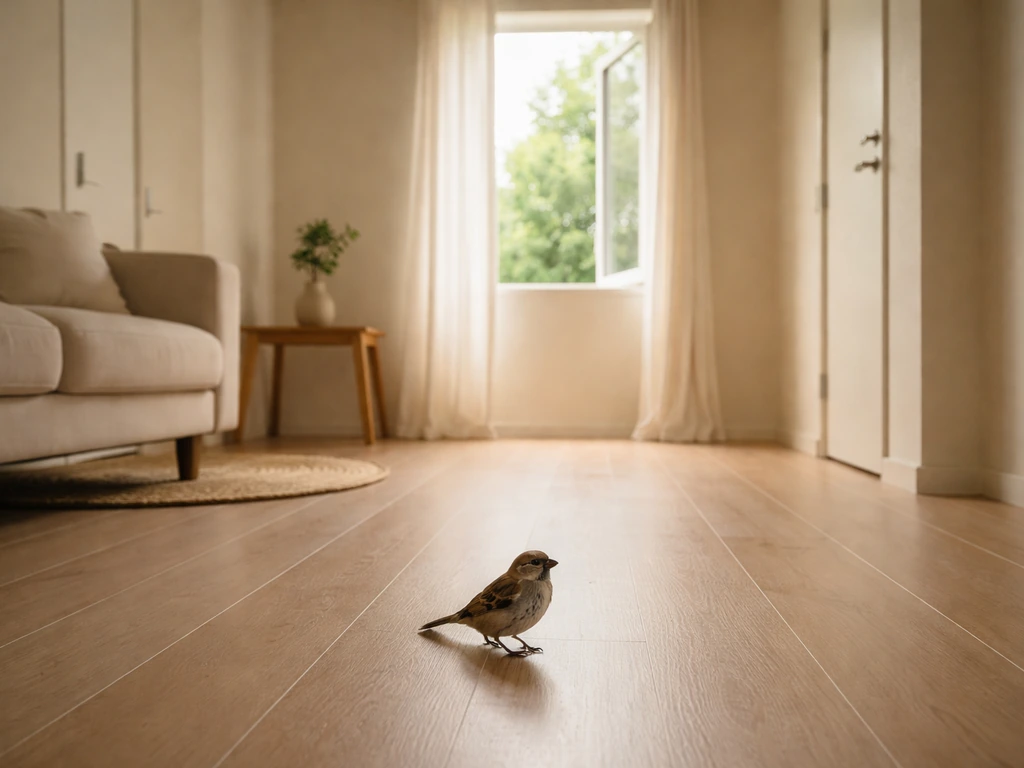
If you're here because a bird just flew into your house and you need to get it out safely, here's what to do. The goal is to make the exit the most obvious and attractive option without chasing or panicking the bird.
- Close off as much of the house as possible, confining the bird to one room near an exterior opening.
- Open one door or window wide, ideally the largest one available, and make sure it's the only obvious opening.
- Turn off all interior lights. The bird will move toward the brightest point, so your open exit should be the brightest spot in the room.
- Draw curtains or cover mirrors to reduce confusion from reflections. Glass surfaces disorient birds.
- Leave the room quietly if you can. Human presence often keeps birds agitated and prevents them from finding the exit.
- If the bird is injured (can't fly, has visible wounds), don't try to free it yourself. Secure it gently in a box with air holes and a towel, then contact a wildlife rehabilitation center.
- If the bird is a migratory species or you're dealing with nesting birds inside the building's structure, note that removal can be regulated under U.S. federal law. Contact your local wildlife authority before acting.
The RSPCA emphasizes having only one exit point available so the bird isn't confused by multiple light sources. The San Diego Humane Society and Avian Wildlife Center both stress the same core technique: darkness inside, bright exit outside. It's simple and it works.
How to figure out exactly what you're dealing with
Whether your interest is symbolic or practical, identifying the bird and noting its specific behavior will help you get a more precise answer. Here's how to think it through.
Step 1: Identify the bird
If you can see the bird, note its size, coloring, and any distinctive markings. Apps like Merlin Bird ID (from Cornell Lab of Ornithology) can identify a bird from a photo or a description in seconds. Knowing whether you're dealing with a robin, a crow, a sparrow, or something else entirely changes both the practical approach and the symbolic interpretation.
Step 2: Note exactly what it's doing
Is it singing near the house? Nesting? Inside the house? Hitting a window repeatedly? Sitting on a specific spot and returning daily? Each of these has a different symbolic framework and a different practical response. Be specific when you recall or describe the encounter, because the behavior is the main variable in every interpretation system.
Step 3: Consider your cultural context
Bird symbolism is not universal. A crow visiting the home means something very different in Native American traditions, British folklore, and Japanese culture. If you're researching what a bird visit means, anchor the search to the tradition that's most meaningful to you. "Crow in home meaning" will give you a lot of results, but the most relevant ones will match your own cultural background or spiritual framework.
Step 4: Decide what kind of answer you're actually looking for
This sounds obvious, but it's worth being honest with yourself. Are you looking for reassurance, a spiritual framework, practical removal advice, or just curious about folklore? The answer to "what does a bird in my house mean" is genuinely different depending on whether you want the symbolic reading or the wildlife management answer. Both are legitimate. Knowing which one you want saves time and gets you to the right resources faster.
Myths to watch for and how to stay grounded
Bird omens are real in the sense that they're real cultural traditions that many people find genuinely meaningful. They are not real in the sense of being evidence-based predictors of future events. Snopes treats the "bird in the house as death omen" as exactly what it is: a circulating piece of folklore with many variants, not a documented causal pattern. Knowing this matters if you're prone to anxiety, because the symbolism can feel very heavy in the moment.
A few specific things to watch for when you're reading about bird symbolism online. First, a lot of content frames interpretations as universal when they're actually culturally specific. "A crow at your window means death" is not a universal truth, it's one strand of one tradition. Second, window-pecking birds are almost always doing it because of territorial instinct or window reflection, not because they're bringing a message. The practical explanation doesn't diminish the symbolic one, but it's important to have both available. Third, the most dramatic interpretations (death omens especially) tend to be the most shared online, which makes them feel more common and authoritative than they actually are in the original folk traditions.
The most useful mindset is one that stays curious without becoming anxious. Bird visits are genuinely interesting moments of contact with the natural world. The folklore around them reflects centuries of human attention to birds and what they do. Whether you take that symbolism literally, metaphorically, or not at all is entirely up to you. What matters is that you have enough context to make that choice consciously rather than just absorbing whatever the first search result tells you.
If a bird is actually inside your home, follow the practical steps above and get it out safely. If you're exploring what a bird visit means symbolically, use the species and behavior as your starting points, anchor the interpretation in a specific cultural tradition, and stay appropriately skeptical of any reading that feels more alarming than illuminating. Bird symbolism is a rich, layered subject, and the most interesting versions of it are always more nuanced than "bad omen" or "good luck."
FAQ
Is “home bird meaning” ever used to describe the literal bird, or is it only an idiom for a homebody?
It is usually an idiom for a person (British and Irish “home bird” equals homebody), but searches often mix in the literal scenario (a bird at or in your house). When someone says it in conversation, ask whether they mean a person preferring home, or whether they’re describing an actual bird encounter.
If a bird hits my window repeatedly, should I treat it as a spiritual warning?
Window strikes are commonly driven by biology (birds see reflections or cannot perceive glass as a barrier). If you want a symbolism layer, use it as metaphor for “attention” rather than a reliable prediction, and also consider practical fixes like decals or changing outdoor lighting at night.
What’s the safest way to get a bird out if it keeps landing on furniture instead of leaving?
Keep one clear exit point, turn off interior lights near the exit, and close off other rooms so the bird does not “choose” multiple escape routes. Avoid chasing, since repeated pursuit increases stress and makes cornering more likely.
Does the meaning change if the bird is injured or behaving oddly?
Yes. If the bird is weak, stunned, or cannot fly normally, the most important “meaning” is physical, and you should focus on first aid steps and contacting local wildlife help. Symbolic interpretations can wait until the bird is safe, because an injured bird is not a normal visitation pattern.
Why do some people say a robin tapping at a window means death, while others say it’s just reflection or territory?
Those are two different interpretive systems. Practically, window pecking often comes from territorial behavior or confusion with a reflection; symbolically, some traditions assign robin window-tapping to serious news. You can hold both ideas, but don’t treat the folklore as certainty, especially if there is no other context.
If two different birds show up on the same day, how should I combine the symbolism?
Treat it as cumulative context, not a single verdict. Start with the strongest variable (species plus the behavior, like song, nesting, or window entry), then see whether the messages in your tradition would logically reinforce each other or conflict.
What if I cannot identify the bird species, but the behavior fits a known pattern?
Behavior still matters even without species. For example, a persistent presence at one spot suggests routine needs (food or nesting), while repeated room circling after entering suggests a “lost in the house” situation. For symbolic reading, you can interpret more generally (attention, change, renewal) without assigning highly specific claims to an unknown species.
Can I trust online claims that “this omen always happens” when a bird enters the home?
Be cautious. Many “always” claims are folklore variants rather than documented predictors. If you feel anxious, anchor the interpretation to observable context (time of day, species, whether a window is involved) and avoid escalating from a single event to a guaranteed outcome.
How do I avoid cultural mismatch when researching bird-at-home meanings?
Anchor the search to a tradition or region you actually relate to, because a “crow at home” interpretation can differ dramatically across cultures. If you feel pulled toward conflicting explanations, treat them as options to compare, not competing facts.
What should I do if the bird gets inside but I’m worried it will nest or get trapped under appliances?
Act quickly to guide it out while it is still mobile. If you notice it hiding in a likely cavity, block off access to high-risk areas and keep the room layout simple, one exit only. If it seems trapped or cannot be found, contact wildlife professionals rather than continuing to search aggressively.
Is “homebird” (one word) the same as “home bird”?
In meaning, yes. It is commonly written as one informal term (“homebird”) or two words (“home bird”) and still refers to the person who prefers staying close to home. The spelling difference does not usually change interpretation.
Next Article
Hook Bird Meaning: Slang, Metaphor, and Literal Contexts
Learn hook bird meaning in slang, metaphor, and literal hunting or trapping contexts, with examples to disambiguate.