
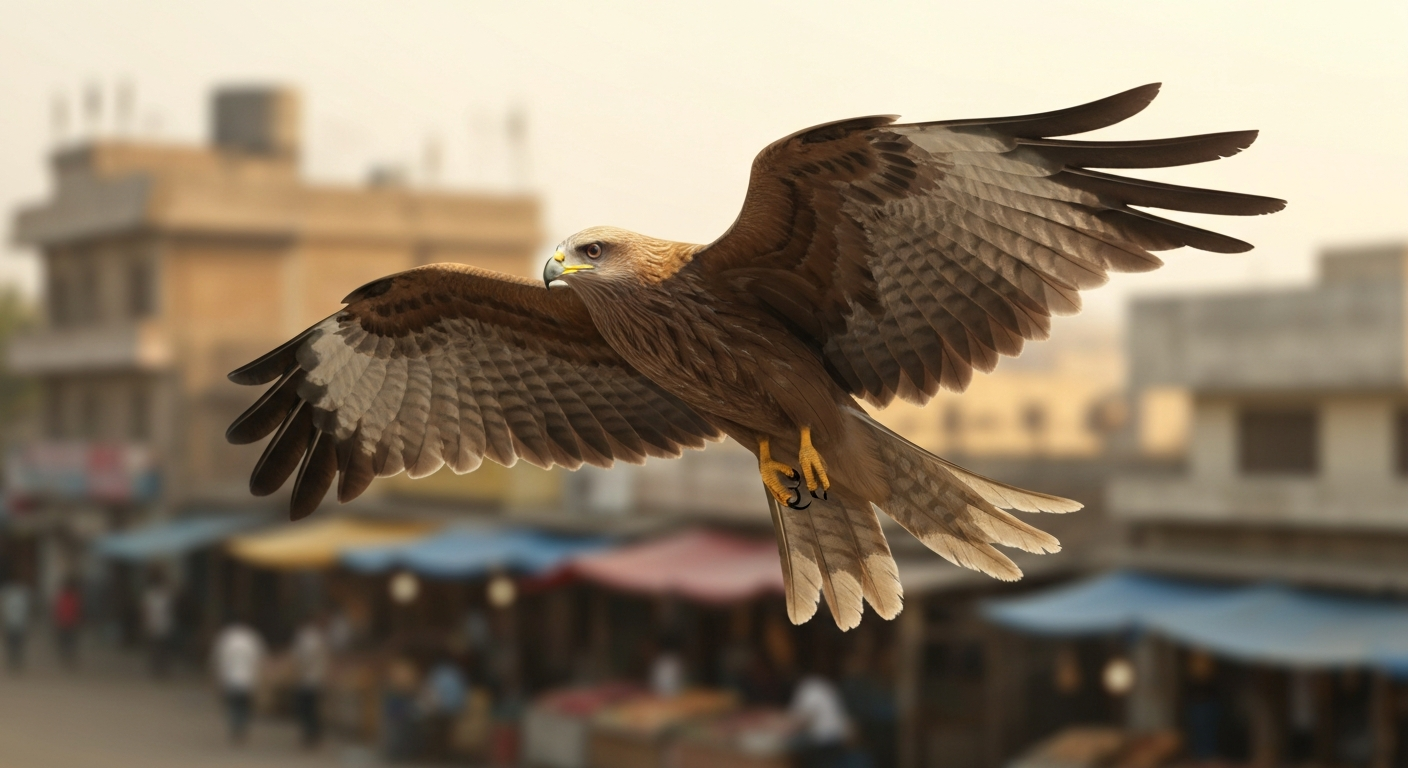
"Samdi bird" almost certainly refers to the Black Kite (Milvus migrans), the soaring urban raptor you will see circling over cities across South Asia. The word samdi (sometimes spelled samadi) is a Gujarati vernacular name for this bird, recorded in regional avifaunal checklists, Gujarati dictionaries, and educational bird guides from Gujarat, India. If you encountered the term in speech, a local bird list, or an Indian news article, that is the species being described.
Samdi Bird Meaning in English: Origins, Symbolism & ID

Marcus Whitley
20 Jul 2026
Quick definition: what "samdi bird" most likely means
The Gujarati word સમડી (romanized as samdi or samadi) translates directly into English as "kite", specifically the Black Kite, Milvus migrans. It is not a standard English bird name, not a scientific term, and not a widely used Hindi or pan-Indian name. It is a regional vernacular label used primarily within Gujarat and by Gujarati speakers. If someone points to a large, forked-tail brown raptor gliding above a marketplace and says "samdi," they are talking about that bird.
One important caveat: the word samdi (and its near-twin samadi) appears in completely unrelated contexts across South Asia and beyond. A Nepalese agricultural text mentions a finger-millet landrace called Samdi Kodo. The romanization Samadi is also a common Persian and Arabic-derived surname and shows up in Iranian village names. So if you find the word isolated in a text without Gujarati context, a bird is not automatically what is being described. Context is everything here.
Pronunciation, spelling, and translation variants
In Gujarati, the script form is સમડી. The pronunciation sits close to "SUM-dee", the first syllable rhymes with "sum," and the second is a short, clipped "dee." The retroflex consonant in the middle gives it a slightly different feel from how an English speaker might first guess, but "SUM-dee" is close enough to be understood by most Gujarati speakers.
Across dictionaries, checklists, and web sources you will run into a cluster of orthographic variants. OCR errors and inconsistent romanization conventions account for most of the variation. The table below summarizes the forms most commonly seen:
| Variant spelling | Most common context | Notes |
|---|---|---|
| samdi | Bird guides, Gujarati word lists, journalism | Most direct romanization of સમડી |
| samadi | Dictionaries, surnames, place names | Shared with Persian/Arabic personal names |
| sam-di | Hyphenated OCR output | Artifact of scanning older printed texts |
| sam di | Two-word spacing error | Common in digitized regional documents |
| samdii | Informal web/forum use | Vowel doubling for emphasis in transliteration |
| samdei | Occasional phonetic spelling | Reflects regional pronunciation variation |
| samdy | Rare | Found in informal notes and social posts |
| shiyalu samdi | Full seasonal name | Gujarati term for the wintering/seasonal kite form |
The Gujarati script form સમડ (samad, without the final vowel marker) also appears in some checklists and is considered an alternate short form. When you see સમડ or shiyalu samdi, the shiyalu part means "wintry" or "of winter" in Gujarati, hinting at seasonal associations that matter more than you might expect, more on that below.
Possible origins and etymology
The Gujarati word samdi appears to be a native Indic vernacular label rooted in the local naming tradition for raptors. Gujarati belongs to the Indo-Aryan branch of the Indo-European family, and many of its bird names were coined descriptively from behavior, appearance, or sound rather than borrowed wholesale from Sanskrit or Persian. The Black Kite's habit of circling, swooping, and snatching food in open markets made it highly visible and familiar enough to earn its own regional name.
The broader word family for kite-type birds in South Asian languages is worth knowing. Hindi speakers widely use cheel (or keel) for the Black Kite. Sanskrit records use shyena for hawk or raptor. Tamil and other Dravidian languages have their own distinct terms. The Gujarati samdi sits within this South Asian naming tradition but is specifically Gujarati, which explains why you will not find it in pan-Indian Hindi-language bird guides.
A Chinese-origin hypothesis can be effectively ruled out. Searches across major Chinese-language sources for phonetic equivalents such as 萨姆迪, 萨玛迪, or 三弟 returned no evidence linking any Chinese bird name or character combination to the romanization samdi. There is no credible Chinese etymological path here. If someone suggested the term is Chinese in origin, that appears to be a false lead.
The unrelated samadi of Persian and Arabic origin (a common surname meaning something like "one who is elevated" or derived from the root meaning "eternal/heavenly") is a complete coincidence of romanization. Similarly, the Nepalese Samdi Kodo (a millet variety name) is linguistically separate. These are homographs, not relatives.
Is samdi a real species? Identifying the Black Kite
Yes, samdi names a real, identifiable, well-documented species: the Black Kite, Milvus migrans. It is one of the most abundant raptors on Earth, with a range stretching from Western Europe and Africa through South and Southeast Asia to Australia. In India, particularly in Gujarat, it is a common sight above cities, rivers, fishing docks, and open markets. The species is so well adapted to human environments that birders sometimes call it the "urban kite."
If you are in Gujarat and want to confirm you are looking at a samdi, here are the field marks to check:
- Overall brown plumage — not jet black despite the common name; the "black" refers to a darker appearance compared to similar kites
- Forked tail, which flexes and twists constantly in flight — this is the single most reliable field mark
- Wingspan of roughly 130 to 155 cm; a large bird but notably agile
- Pale patch visible on the underside of the wings when seen from below
- Flight style: lazy, circling glides with frequent tail adjustments; rarely flaps hard
- Often seen in groups over garbage dumps, fish markets, rivers, and large open spaces
- Calls with a shrill, wavering whistle — distinctive once learned
To cross-check a sighting or confirm the species from a photograph, the eBird species page for Milvus migrans is the most practical starting point for most readers. It hosts thousands of verified photographs, audio recordings, and range maps with occurrence data from across Gujarat and the rest of South Asia. GBIF maintains occurrence records that can be filtered by location, which is useful if you are working with historical records. For a Gujarati-language confirmation of the vernacular name, Gujaratilexicon and Shabdkosh both list samdi with the gloss "kite" and link it clearly to the raptor family. The college bird guide 'A Guide to Various Birds Spotted in College Campus, Navjivan Science College (college bird guide PDF)' lists સમડી (samdi) alongside the scientific name Milvus migrans, confirming the Gujarati vernacular usage A Guide to Various Birds Spotted in College Campus — Navjivan Science College (college bird guide PDF).
Symbolic meanings: cultural, seasonal, and elemental associations
The Black Kite carries a specific symbolic weight in South Asian cultures. See the article on weather bird meaning for how kites and other birds are used as omens of weather and seasonal change. In many parts of India, kites (both the Black Kite and its close relative the Brahminy Kite) are associated with scavenging, adaptability, and survival in the urban and semi-urban world. Unlike the eagle, which occupies the elevated symbolic register of power and divine vision, the kite occupies a more grounded, street-level symbolism, clever, opportunistic, ever-present.
The seasonal name shiyalu samdi is telling. Shiyalu means "wintry" in Gujarati, and some local sources use this to distinguish the migratory population of Black Kites that arrives in Gujarat during the cooler months from resident birds. This makes the samdi a bird with genuine seasonal symbolism, a winter visitor whose arrival marks a shift in the natural calendar. For comparison, see summer bird meaning for how seasonal labels (like "shiyalu" for winter) versus summer labels shape local bird identities. Seasonal bird symbolism connects naturally to the broader themes of spring birds and summer birds, where migratory arrivals and departures mark time for communities that live close to natural cycles.
Kite-family birds also carry sun and sky associations across many cultures. Their habit of thermaling, riding invisible columns of warm air high into the sky, links them visually and symbolically to the sun's heat. In West African traditions, the kite is a solar messenger. In parts of ancient Egypt, the kite (particularly the mythological form of Isis as a kite in the Osiris myth) represents transformation and divine intervention. The samdi of Gujarat does not carry this exact mythological freight, but its constant presence in open skies does make it a sky-watcher's bird, always above and surveying. See the article sun bird meaning for a related discussion of solar symbolism in bird traditions.
Regional and Asian contexts: how bird meanings work in Gujarat and beyond
Understanding samdi properly means understanding how bird naming and symbolism function in Asian contexts more broadly. Across South and East Asia, birds carry layered meanings that move fluidly between the literal (species identification), the ceremonial (auspicious or inauspicious omens), and the poetic (metaphors in literature and song). The Black Kite in Gujarat sits mostly in the literal and folk-observational register rather than the high symbolic register that cranes, peacocks, or parrots occupy.
Gujarat's urban environments are well documented in Indian ornithology, and the Black Kite is one of the signature birds of cities like Ahmedabad and Surat. A 2023 report in the Indian Express described the samdi as "the pigeon hunter in your city," capturing exactly how the bird is perceived in contemporary urban Gujarat: not a sacred or literary bird, but a familiar, slightly fierce neighbor that keeps the pigeon population in check. That street-level familiarity is itself a form of cultural meaning.
In terms of Chinese and East Asian bird naming, no equivalent of samdi exists in Chinese-character form. The Black Kite in Chinese ornithology is called 黑鸢 (hēi yuān), with yuān being the classical Chinese character for kite-type birds (a character with its own long literary history in Chinese poetry). This is a completely separate naming tradition from the Gujarati samdi, which reinforces the point that samdi is specifically an Indo-Aryan Gujarati term with no East Asian ancestry.
Idiomatic, slang, and figurative uses
In everyday Gujarati speech, samdi is used straightforwardly as a bird name rather than as a slang term or extended metaphor. That said, kite birds do feed into figurative language across South Asian languages. In Hindi, calling someone a cheel (kite) can imply sharp-eyed opportunism or greedy swooping behavior, someone who circles waiting for a chance to grab what they want. The Gujarati samdi likely carries similar connotations in informal speech, though documented examples of samdi used as a figurative insult or compliment are harder to pin down than its ornithological use.
One context where samdi does appear figuratively is in discussions of urban scavenging behavior. Describing someone who is always hovering at social gatherings waiting for leftover food or opportunities as "acting like a samdi" is the kind of idiomatic usage that emerges naturally from a bird so visibly associated with opportunistic feeding. This is folk idiom rather than formally recorded slang, but it fits a very recognizable pattern in how bird names enter everyday speech across cultures.
Outside the Gujarati bird context, samdi or samadi also appears in the specific religious and philosophical vocabulary of certain Hindu and Buddhist traditions, where samadhi (a related but distinct Sanskrit word) refers to a state of deep meditative absorption. These are not the same word, but the phonetic similarity occasionally causes confusion in transliterated texts. If you see samadi in a spiritual or meditative context, it almost certainly refers to samadhi, not to any bird.
How to verify this meaning yourself: a practical step-by-step guide
If you have encountered the term samdi bird in a specific document, conversation, or piece of writing and want to confirm what it means in that particular context, here is a practical research sequence that works reliably:
- Establish the language context first. Where did the text or speech come from? If it is from Gujarat, India, or from a Gujarati-speaking source, samdi almost certainly means the Black Kite. If the context is unclear, proceed to the next steps before committing to a definition.
- Check Gujaratilexicon (gujaratilexicon.com) — the most comprehensive Gujarati-English dictionary available online. Search for samdi or the Gujarati script સમડી. The entry will confirm the kite/raptor meaning and may offer example sentences.
- Cross-check with Shabdkosh (shabdkosh.com), which covers multiple South Asian languages and will give you the English gloss alongside any regional variants.
- For species confirmation, search eBird for Milvus migrans and filter by Gujarat or India. The species page will show photographs, range maps, and vernacular names, allowing you to match the description in your source to the correct bird.
- Look at the Flamingo Gujarat checklist (available as a PDF from the Flamingo Gujarat bird-watching network) — this is a peer-reviewed regional avifaunal checklist that lists Gujarati vernacular names alongside scientific names, and it is the most authoritative source for confirming samdi as a regional bird name.
- If you have access to a native Gujarati speaker, ask them directly. Show them the script form સમડી if possible, as this removes any ambiguity caused by romanization variants.
- If the document appears to be from Nepal or a non-Gujarati South Asian context, run a separate check: search for Samdi Kodo to see if the agricultural millet-landrace meaning applies, or check whether the text is using samadi as a surname or place name.
- For scholarly verification, look up Milvus migrans in the GBIF occurrence database filtered by India/Gujarat — this will surface scientific records and associated vernacular name lists used by conservation organizations in the region.
- To rule out a Chinese origin, check Chinese ornithological databases using the scientific name Milvus migrans. The Chinese name 黑鸢 (hēi yuān) will appear, with no romanization matching samdi. This confirms there is no Chinese-language pathway to the term.
- Document what you find by noting your source, the date accessed, and the exact form of the word in the original text. This matters especially for translators and students who need to cite their terminology decisions.
The most reliable sources at a glance
| Source | Type | Best used for |
|---|---|---|
| Gujaratilexicon | Online dictionary | Confirming samdi as a Gujarati word with English gloss |
| Shabdkosh | Multilingual dictionary | Cross-referencing Gujarati, Hindi, and English meanings |
| Flamingo Gujarat checklist | Peer-reviewed regional checklist PDF | Authoritative Gujarati vernacular name to scientific name mapping |
| eBird (Milvus migrans page) | Citizen-science species database | Species photos, range maps, and vernacular name lists for India |
| GBIF (Milvus migrans) | Primary biodiversity database | Occurrence records for Gujarat; historical and scientific cross-check |
| Indian Express (Sep 2023) | Regional journalism | Contemporary usage of samdi in Ahmedabad urban context |
| Navjivan Science College bird guide | Educational field guide PDF | Regional educational confirmation of Gujarati bird names |
| Native Gujarati speaker | Human verification | Fastest and most reliable contextual confirmation |
Putting it all together: what samdi bird means in English
The cleanest English translation of samdi bird is simply Black Kite. The Gujarati word samdi (સમડી) is the regional vernacular name for Milvus migrans in Gujarat, India. The Flamingo Gujarat checklist records the Black Kite with Gujarati names such as સમડી / સમડ / શિયાળુ સમડ (samdi / samad / shiyalu samdi), A checklist of the birds of Gujarat, Flamingo Gujarat (regional checklist PDF) blank" rel="noopener noreferrer">A checklist of the birds of Gujarat — Flamingo Gujarat (regional checklist PDF). It is well documented in dictionaries, avifaunal checklists, academic bird guides, and contemporary journalism. The term is not standard English, not Chinese in origin, and not a pan-Indian term, but within its Gujarati context it is precise, unambiguous, and widely understood.
For anyone researching bird terms across South and East Asia, the samdi example illustrates something worth internalizing: regional vernacular bird names carry enormous specificity and cultural depth that generic English translations can flatten. The Black Kite as a name tells you the species. Samdi tells you that the bird belongs to Gujarat's urban skies, its fish markets and its winter mornings, in a way that a Latin binomial or an English field-guide entry cannot. That gap between translation and meaning is exactly what makes bird terminology across cultures worth exploring carefully.
FAQ
What does “samdi bird” mean in English — is it a species name, place name, or something else?
In many Gujarati-language sources, “samdi” (સમડી, romanized samdi or samadi) is a vernacular name for the Black Kite (Milvus migrans). However, isolated occurrences of the string “samdi” in texts may refer to non‑bird senses (place names, surnames, crop landraces). Present the primary reading as ‘samdi = Black Kite (Milvus migrans) in Gujarati’ while noting other unrelated senses where relevant.
How do you pronounce and spell “samdi”? Are there variant spellings or transliterations to watch for?
Common pronunciations/transliterations: samdi / samadi (Gujarati: સમડી). Variants seen in corpora: sam‑di, sam di, samdii, samdei, samdy, and the longer form samadi. Orthographic and OCR errors can produce further variants; confirm by matching to Gujarati script સમડી when possible.
What is the likely origin or etymology of the name “samdi”?
The safest statement is that સમડી (samdi) is a Gujarati vernacular name applied to the Black Kite in regional checklists and field guides. A direct linguistic derivation inside Gujarati is not widely documented in accessible etymological dictionaries; alternative possibilities include a local onomatopoeic or folk name, or borrowing from neighbouring Indo‑Aryan dialects. Because the same romanization appears in unrelated languages (Persian/Arabic surnames, Nepali crop names), offer multiple plausible origins and avoid asserting a single etymology without native‑language lexicon evidence.
How is “samdi” used in different contexts — literal species name, symbolic or idiomatic uses, or place/proper names?
Literal: vernacular name for the Black Kite (Milvus migrans) in Gujarat and nearby regions. Symbolic/cultural: Black Kites are common urban raptors in parts of South Asia; they are sometimes associated with scavenging, adaptability, and urban wildlife in popular writing, but specific symbolic meanings of the Gujarati word ‘samdi’ are not well documented — don’t assume cultural symbolism without local ethnographic sources. Idiomatic/slang: no widely attested idiomatic use of ‘samdi’ in major corpora as a stable expression; verify with native speakers. Other senses: ‘Samdi/Samadi’ appears as a surname, village name, and in crop/landrace names in South Asia and Iran; those uses are unrelated to the bird.
How can a reader reliably verify that “samdi” refers to the Black Kite?
Steps to verify: 1) Find the term in regional avifaunal checklists or educational guides that list vernacular names alongside scientific names (e.g., Birds of Gujarat / college or NGO bird guides). 2) Check major species pages for Milvus migrans on eBird, GBIF, or BirdLife to confirm range and photos that match local descriptions. 3) Look up the Gujarati script સમડી in Gujarati→English dictionaries or language portals. 4) Ask native Gujarati speakers (birding groups, local naturalists) or consult museum/academic publications on the regional avifauna. 5) Cross‑check photographic records from citizen‑science platforms where contributors used the Gujarati name. Use at least two independent sources (one authoritative checklist and one field/photo record) before publishing a definitive mapping.
What primary sources are best for translators or students who need to present “samdi” accurately?
Recommended sources: regional avifaunal checklists and NGO/college bird guides that showGujarati names with scientific names; national bird databases and species pages (eBird, GBIF, BirdLife) for range/ID and photos; reputable Gujarati dictionaries (Gujaratilexicon/Shabdkosh) for the script and gloss; local news or conservation articles quoting the vernacular name in context. For uncertain cases, consult a native Gujarati‑speaking ornithologist or local naturalist group.
Next Article
Chinese Name Meaning Bird: Characters, Symbolism, and How to Verify
Decode Chinese names tied to bird characters like 鳥 or 鸟, with symbolism and steps to verify the exact meaning.