
A 'skewer bird' is most literally a bird (or cut of poultry) threaded onto a skewer for cooking. But depending on context, the phrase pulls in two other meanings: the verb 'to skewer' also means to criticize someone harshly and publicly, and an impaled or skewered bird carries a surprising weight of symbolic meaning in folklore, natural history, and literature. Which meaning applies depends almost entirely on where you encounter the phrase.
Skewer Bird Meaning: Literal, Idiomatic, and Symbolic Uses

Marcus Whitley
23 Jul 2026
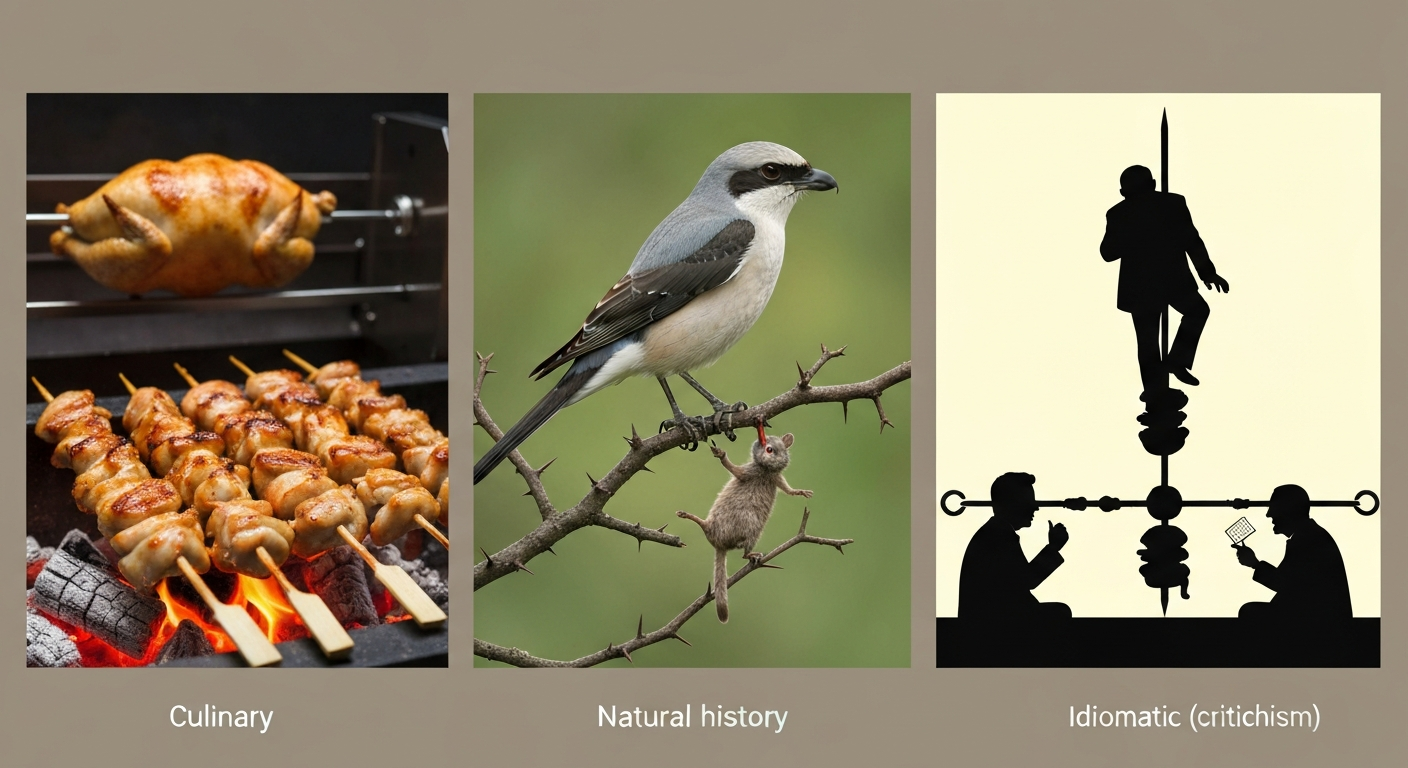
Quick definitions at a glance
- Literal (culinary): a bird or bird pieces threaded onto a metal or wooden skewer for grilling, roasting, or trussing.
- Literal (natural history): the impaling behavior of shrikes (family Laniidae), which skewer prey on thorns or barbed wire.
- Idiomatic (criticism): 'to skewer' means to criticize or ridicule someone sharply, exposing their flaws in public.
- Symbolic/metaphorical: an impaled or skewered bird appears in folklore and literature as an image of sacrifice, punishment, or powerlessness.
The three senses in brief
The word 'skewer' has been in English since the 1670s as a noun (a long pin for fastening or piercing food) and from about 1701 as a verb. Online Etymology Dictionary, “skewer” records the noun from the 1670s and the verb from about 1701, noting a figurative sense emerging by around 1850 Online Etymology Dictionary — “skewer”. The figurative sense, where to skewer means to excoriate or lampoon, appears in written English by around 1850 according to the Online Etymology Dictionary. That gives us a roughly 150-year gap between the cooking tool and the insult, which is a pretty normal arc for a word that started in the kitchen and migrated to the opinion column.
In literal use, a 'skewer bird' is shorthand for any bird prepared on a skewer: a whole chicken on a rotisserie spit, yakitori-style grilled chicken pieces, kebab-style cuts of duck or quail. In idiomatic use, saying that a politician or film 'got skewered' means they were torn apart by critics, not literally impaled. And in symbolic or metaphorical use, the image of a bird pinned or pierced carries connotations that range from sacrifice to cruelty to the eerie taxonomical habits of a particular family of birds that has fascinated naturalists for centuries.
Where you'll actually encounter the phrase
You are most likely to come across 'skewer bird' or 'skewered bird' in one of four places: a recipe or cooking tutorial (the most common context by far), a birdwatching or natural history article about shrikes, a piece of cultural criticism or journalism where someone has been sharply lampooned, or a literary or artistic work using impalement as a visual or narrative symbol. Each context leaves fairly clear footprints, which I'll walk through below.
The literal meaning: cooking, trussing, and impalement
The culinary use of 'skewer' with 'bird' goes back centuries and is thoroughly documented in Victorian household manuals. Isabella Beeton's household management guides, for example, instruct cooks to pass a skewer through a fowl when trussing it for roasting, securing the wings and legs so the bird holds its shape in the oven. 19th-century American cookbooks (several of which survive on Project Gutenberg) give near-identical step-by-step directions: 'run a skewer through the bird' was a routine sentence in a recipe, not a dramatic statement.
Modern kitchen practice follows the same logic. When a whole chicken goes onto a rotisserie, a metal spit rod (essentially a heavy-gauge skewer) passes through the bird lengthwise to secure and rotate it. Rotisserie appliance patents and user manuals describe this process in functional, clinical language: the skewer passes through the bird's cavity so it can be evenly rotated over heat. Consumer recipes and cooking outlets like Serious Eats treat skewered chicken as a normal culinary category, covering everything from Japanese yakitori to Central Asian shashlyk to simple backyard kebab preparations.
Yakitori is worth pausing on here because it is linguistically interesting. The Japanese word literally combines yaki (grill) and tori (鳥, meaning bird or chicken). So 'yakitori' is itself a 'grilled bird' concept embedded in a word, and the Japan National Tourism Organization describes yakitori as skewered grilled chicken. The dish is essentially the culinary 'skewer bird' idea compressed into a single Japanese compound noun.
Outside the kitchen, there is a biological use of 'skewer' with birds that is genuinely remarkable. Shrikes (family Laniidae) routinely impale their prey, including small birds, lizards, and insects, on thorns, barbs, or sharp twigs. This is not metaphorical. A shrike will catch a small bird and skewer it on a hawthorn thorn to return to later, essentially building a larder. Country Life and other natural history publications describe this behavior using the verb 'to skewer' quite literally. The great grey shrike is the species most often discussed in this context in European natural history writing, and the behavior has made shrikes a source of fascination and some unease for birdwatchers who encounter their thorny larders in hedgerows.
Anthropological and archaeological instances
Ethnographic and archaeological research also records skewering birds as a hunting and subsistence technique. An open-access review on Pacific and Hawaiian bird exploitation (published in MDPI) notes that birds were sometimes skewered in their burrows with barbed sticks, a technique combining capture with killing. MDPI, 'The Silent Forest: Impact of Bird Hunting...' documents that birds were sometimes skewered in their burrows with barbed sticks MDPI — 'The Silent Forest: Impact of Bird Hunting...' documents that birds were sometimes skewered in their burrows with barbed sticks.. This is distinct from ritual impalement, but it forms part of a broader historical picture where skewering a bird was a practical, sometimes urgent, physical act, not merely a cooking step.
The idiomatic meaning: to skewer as sharp criticism
Every major dictionary records the figurative sense of 'skewer.' Merriam-Webster gives the verb as 'to criticize or ridicule sharply.' Cambridge Dictionary says 'to criticize someone or something in a way that reveals the truth about them.' Collins calls it 'to criticize sharply,' and the Oxford Advanced Learner's Dictionary offers the example: 'The movie was skewered for its bad acting.' These are not fringe definitions; they appear in standard general-use dictionaries used by editors and writers every day.
In practice, you will see this sense in journalism and cultural criticism constantly. A satirist is said to have 'skewered' a politician's press conference. A food critic 'skewers' a restaurant in a review. A novelist 'skewers' middle-class pretension. The image the word carries, even in its figurative use, is pointed and thorough: a skewer goes all the way through. That is what distinguishes 'skewered' from milder synonyms like 'criticized' or 'mocked.' It suggests the criticism was penetrating, that it went clean through the subject and left them exposed.
There is no fixed 'bird' element in this idiomatic use. The phrase 'skewer bird meaning' that some readers search for is actually a compressed query: they want to know what 'skewer' means in a bird-related phrase, or they are asking about the bird sense of the word 'skewer.' The idiomatic reading applies whenever 'skewer' is used as a verb referring to a person, an institution, a film, a book, or a performance. No actual bird is required.
Other bird idioms that can get confused with this one
If you are trying to pin down what 'skewer bird' means in a specific context, it helps to know the neighboring idioms in the bird-phrase territory, because some of them overlap in tone and some are easy to mix up.
- 'Give the bird' (or 'flip the bird'): an obscene gesture of contempt, with no connection to skewering. This is the 'bird' as insult, not as criticism or cooking.
- 'Cook someone's goose': to ruin someone's plans. Culinary bird metaphor, but about defeat rather than pointed criticism.
- 'Stick it to someone': sharp punishment or criticism. Directionally similar to 'skewer' in force but without the impalement imagery.
- 'Pin down': to make something specific and definite. The physical act of pinning is related to skewering, but the idiom is neutral rather than critical.
- 'Roast' (as in a comedy roast): to mock affectionately and publicly. Culinary origin, bird-adjacent, but usually good-natured rather than devastating.
- 'Tar and feather': to subject to public humiliation. Bird-adjacent (feathers) and punishment-oriented, but a very different historical register.
The clearest distinction is this: 'to skewer' in the critical sense implies a single, precise, devastating blow that goes all the way through, while 'roast' is more of a sustained performance and 'give the bird' is a gesture of contempt rather than an act of analysis. If you are reading a review or opinion piece and the writer says someone was 'skewered,' they mean the critique was pointed and total, not that it was affectionate or gestural.
Skewered birds in literature, art, and media
The image of a bird on a skewer, or an impaled bird, shows up in literature and visual art in ways that go beyond cooking instructions. In early modern and Renaissance still-life painting, dead birds hanging or laid out on a table (sometimes beside or on skewers) were common vanitas motifs: reminders of mortality, the fragility of life, and the passage from living creature to food or object. The impaled or pierced bird in this tradition is not gruesome for its own sake; it is an invitation to think about transience.
In satirical writing and political cartooning, the image of a figure literally skewered (like a roasting bird on a spit) has been a visual shorthand for total exposure and humiliation since at least the 18th century. The British satirical tradition used the roasting-spit image in caricature to suggest that a public figure had been fully turned over, examined from every angle, and found wanting. The verb 'to skewer' in modern criticism inherits some of that visual energy: it implies that the subject has been pinned, rotated, and fully exposed.
In contemporary media, 'skewered' appears in film, television, and book reviews as a standard term of critical violence. A satirical show that dismantles a public figure is described as having 'skewered' them. This is so routine in entertainment journalism that the word has lost some of its shock, but its origins in the physical image of impalement still give it more force than softer synonyms.
Cultural, historical, and ritual notes on impaled birds
It is worth being careful here about the difference between well-documented practices and speculative symbolism. What is documented: Sebastian de Covarrubias's 1611 Spanish dictionary defines 'empalar' (to impale) and explicitly compares the punishment to skewering a bird on a spit. Modern scholarship cites this primary source to show that in early modern Iberian culture, the physical reality of skewering a bird was the reference point for describing extreme punishment. The bird-on-a-spit was familiar enough to readers that it served as the explanatory image for something far more brutal.
The shrike's impaling behavior has also attracted symbolic readings in natural history writing across several centuries. Because shrikes skewer living prey (or recently killed prey) on thorns and return to it later, they have been described as 'the butcher bird' in English, a nickname that appears in field guides and country naturalist writing from the 18th century onward. The butcher bird label is not about cooking; it is about the eerie precision of the behavior, the way the shrike creates a kind of pinned collection of victims. Country Life, among other publications, has treated the great grey shrike's larder as a subject worth both wonder and a degree of unease.
In some Pacific and Indigenous hunting traditions, as noted in ethnographic literature, skewering birds with barbed sticks was a subsistence technique rather than a ritual act. Conflating functional hunting practices with symbolic ritual is a mistake that gets made often in popular writing on this kind of topic, so it is worth being explicit: the evidence for deliberate ritual impalement of birds as symbolic acts is scattered and context-specific, while the evidence for practical skewering (cooking, hunting, preservation) is extensive and well-documented across many cultures.
Literal vs. figurative: how to read the context
Here is a comparison of the main uses side by side, with the signals that help you identify which meaning is in play.
| Sense | What it describes | Key signals in context | Example |
|---|---|---|---|
| Literal (culinary) | A bird or bird pieces on a cooking skewer | Recipe, cooking tutorial, menu, food writing | 'Thread the chicken thighs onto the skewer and grill over high heat.' |
| Literal (natural history) | A shrike impaling prey on a thorn or spike | Ornithology, birdwatching, natural history writing | 'The great grey shrike had skewered three voles on a hawthorn branch.' |
| Idiomatic (criticism) | Sharp, penetrating public criticism or ridicule | Journalism, reviews, political commentary, satire | 'The documentary skewered the company's safety record.' |
| Symbolic/metaphorical | An impaled bird as an image of sacrifice, punishment, or powerlessness | Literature, art criticism, historical scholarship | 'The poet uses the skewered wren as a symbol of state cruelty.' |
When you are trying to determine which sense applies, ask three quick questions: Is there actual food or cooking involved? Is a specific bird species being discussed in a naturalistic context? Is a person, institution, or creative work being evaluated negatively? The first two point toward literal uses; the third points toward the idiomatic one. If none of those apply and the phrase appears in a poem, a painting description, or a piece of historical scholarship, you are probably in symbolic territory.
A practical checklist for interpreting the phrase
- Check the genre: recipe or food writing almost always means literal culinary use.
- Check for a named bird species: if a specific bird (especially a shrike) is mentioned in a natural history context, the literal biological sense applies.
- Check for a human subject: if a person, film, book, or institution is the object of 'skewered,' the idiomatic critical sense is almost certainly in play.
- Check the historical period: very early uses (pre-1850 in written text) are almost certainly literal; figurative use becomes common after about 1850.
- Check for symbolic framing: if the text is literary, poetic, or art-historical and the bird's impaled state is being interpreted rather than described functionally, you are in metaphorical or symbolic territory.
- When in doubt, look at what immediately follows the word: a skewer with ingredients follows a literal use; a skewer followed by 'for his remarks' or 'in the press' is idiomatic.
How this connects to other bird phrases worth exploring
The 'skewer bird' phrase sits in an interesting neighborhood of bird-related terms that each carry their own layered meanings. If you are drawn to the symbolic side of impaled or sacrificed birds, the dead starling carries a rich tradition in European folklore and omen-reading. For a concise exploration of the dead starling bird meaning in European folklore, see the discussion titled 'dead starling bird meaning' (resource id 427c1e1d-6272-4c13-96ab-27d59dc5e2ea). If you are more interested in bird terms rooted in specific cultural or fictional universes, the Ahsoka bird meaning explores how a bird symbol becomes attached to a character and a whole set of associated themes. The Hotspur bird meaning goes into how a combative bird image attaches to a name and becomes a way of reading someone's character. For more, see discussions of the Hotspur bird meaning, which trace how combative bird imagery attaches to a name and informs readings of character. And if you are curious about how birds work as mascots and competitive symbols, the sports bird meaning covers that territory. The common thread across all of them is that birds carry meaning efficiently: a single image or phrase can compress a lot of cultural history into a small package.
What makes 'skewer bird' particularly interesting as a phrase is that it works in almost opposite directions at once. On one end, it is purely practical: a cooking technique, a kitchen tool, a food preparation step. On the other end, it can describe something quite dark, whether that is a shrike's larder of impaled victims, a historical metaphor for punishment, or a critic's total dismantling of someone's work. The word 'skewer' carries the weight of that physical image in every context, which is probably why it remains a more vivid and forceful term than its synonyms, in the kitchen and in the opinion column alike.
FAQ
What is the immediate definition of 'skewer bird' / 'skewer meaning bird'?
Literal: a bird that has been pierced, threaded, or fastened with a skewer or spit (cooking or impalement). Idiomatic/figurative: a construction using the verb 'skewer' (to criticize, ridicule, or lampoon sharply) applied to a bird image, character, or symbol (e.g., 'the reviewer skewered the film's caged‑bird motif'). Symbolic/metaphorical: imagery of a skewered or impaled bird used in folklore, ritual, literature, or art to convey cruelty, sacrifice, mockery, exposure, or transformation depending on context.
What authoritative dictionary senses support these meanings?
Major dictionaries record two primary senses for 'skewer': (1) literal—'to fasten or pierce with a skewer' (cooking/impale) and (2) figurative—informal 'to criticize or ridicule sharply'. See Merriam‑Webster, Cambridge, Collins, and Oxford Advanced Learner’s Dictionary for definitions and example sentences demonstrating both senses.
Can you give short sourced examples that show literal, idiomatic, and metaphorical uses?
Literal (cooking): historical cookbooks instruct cooks to 'run a skewer through the bird' when trussing or roasting (see Mrs Beeton, School and Home Cooking—Project Gutenberg). Literal (culinary culture): Japanese yakitori literally means grilled 'bird' (chicken) on skewers (Japan National Tourism Organization; Serious Eats). Natural history literal/behavioral: shrikes are described as 'impaling' or 'skewering' prey on thorns (popular and specialist accounts of family Laniidae). Idiomatic (criticism): press and dictionary examples use 'skewered' to mean 'severely criticized' (Merriam‑Webster example sentences; contemporary journalism). Metaphorical/symbolic (literature/art): writers may use a skewered bird image to signify sacrifice, humiliation, or exposure—attestations appear in literary criticism and cultural history (searches in corpora and Google Books will show dated literary uses). Sources: Merriam‑Webster, Cambridge, Collins, Oxford, Project Gutenberg, Japan National Tourism Organization, Serious Eats, natural history sources on shrikes.
What cultural and symbolic interpretations apply to a skewered bird image?
Common symbolic associations (context‑sensitive and supported by literature/ethnography): - Sacrifice or offering: skewered birds in ritual or feasting contexts can indicate sacrifice or communal provision (culinary/ethnographic accounts). - Cruelty or punishment: impalement imagery historically evokes torture or brutality in legal/cultural sources. - Exposure and ridicule: to 'skewer' in the figurative sense connotes public humiliation; a bird used metaphorically can signal a figure exposed to attack. - Survival/hunting: ethnographic and archaeological accounts document birds skewered for subsistence. Interpretations must be constrained by documented cultural context (cookery manuals, ethnographies, legal texts, literary analyses). Avoid broad claims without citation to relevant primary or secondary sources.
What is the etymology and attested usage history of 'skewer' with 'bird'?
Etymology: the noun 'skewer' (a long pin for roasting) is recorded from the 1670s; the verb from c.1701; figurative uses (to criticize sharply) appear by about 1850 (Online Etymology Dictionary). Historical attestations: 18th–19th‑century cookery and household manuals (Mrs Beeton; School and Home Cooking) include directions to 'pass a skewer through the bird' for trussing and roasting. Figurative/idiomatic attestations are evident in 19th–20th‑century press and criticism and are documented in modern dictionaries with contemporary example sentences. For frequency and concordance checks, consult corpora (COCA, GloWbE) and digitized book collections (Google Books, Project Gutenberg).
How can I tell which meaning is intended in a given instance? (Practical context‑checklist)
Ask these short questions: 1) Co‑text: Is the surrounding text about cooking, food, hunting, or birds? If so, prefer literal (skewering as cooking/impalement). 2) Verb usage: Is 'skewer' used transitively about food/prey (literal) or about people/ideas/work (criticism)? 3) Modality and tone: Is the tone descriptive, instructional, or culinary (literal) or satirical, evaluative, or journalistic (figurative)? 4) Collocates: Are words like 'grill', 'yakitori', 'roast', 'truss', 'spit', 'thorn', or 'impale' present (literal); or 'review', 'criticized', 'lampooned', 'skewered' applied to a figure/idea (idiomatic)? 5) Genre and source: Recipe, cookbook, natural history, or ethnography lean literal; opinion pieces, reviews, satire lean figurative. 6) Visual cues: photographs of skewered meat/rotisserie vs. cartoons or editorial art showing a bird being mocked. Use corpus searches (COCA/GloWbE) or Google Books to check common collocations and genre distribution when unsure.
Next Article
Sports Bird Meaning: Literal, Slang, and Mascot Uses
Clear sports bird meaning: literal, slang, and mascot symbolism plus how to tell which definition fits.