"Bonny bird" most often means "pretty bird" or "beautiful girl," depending on context. Some readers also look up the demi bird meaning, which shows how similar nicknames can shift by region and context Bonny bird. The adjective "bonny" (sometimes spelled "bonnie") is a Scottish and Northern English dialect word for beautiful or attractive, and "bird" can refer either to a feathered creature or, in Scots tradition, to a young woman or girl. So when you read "my bonny bird," it could be a tender nickname for a person just as easily as an admiring description of an actual bird.
Bonny Bird Meaning: What It Means in Everyday and Poetic Use

Marcus Whitley
2 Jul 2026
Breaking down the words: "bonny" and "bird"
What "bonny" actually means
"Bonny" is a Scots and Northern English adjective meaning beautiful, pretty, or handsome. Merriam-Webster lists it plainly as "beautiful," and the Oxford Learner's Dictionaries trace its origins to the late 15th century, noting it is "perhaps related to Old French bon, meaning 'good.'" The Cambridge Dictionary backs that up, defining it as attractive or pretty. In everyday Scottish speech, calling something or someone bonny is a straightforward compliment. Think of it the way you'd use "lovely" in standard British English. It's warm, it's admiring, and it carries a slightly lyrical flavor that plain words like "pretty" don't always capture.
The word appears across Scottish and Northern English dialects with a long recorded history in the Scots language dictionaries. It functions as a positive epithet of appreciation, which is exactly why it pairs so naturally with endearment-style phrases like "my bonny..." The "my" construction is a giveaway that you're dealing with affection, not just description.
What "bird" means in this phrase
Here's where things get genuinely interesting. In many contexts, people search “booby bird meaning” to understand how the term is used for the animal and what it implies Here’s where things get genuinely interesting.. In standard English, "bird" is the animal. But in Scots dialect, "bird" has a documented secondary meaning: a lady or a girl. The Scottish National Dictionary records this usage explicitly, with quotations going back to 1816, and notes that in most Scots dialects the word for animal-bird and the word for girl/lady (historically "burd") were pronounced identically. That pronunciation overlap is exactly why "my bonny bird" sits in this enjoyable ambiguous space. When you read it in a ballad or a poem, you genuinely cannot know for certain which meaning the writer intended without checking what's around it.
Term of endearment or literal bird? Here's how to tell
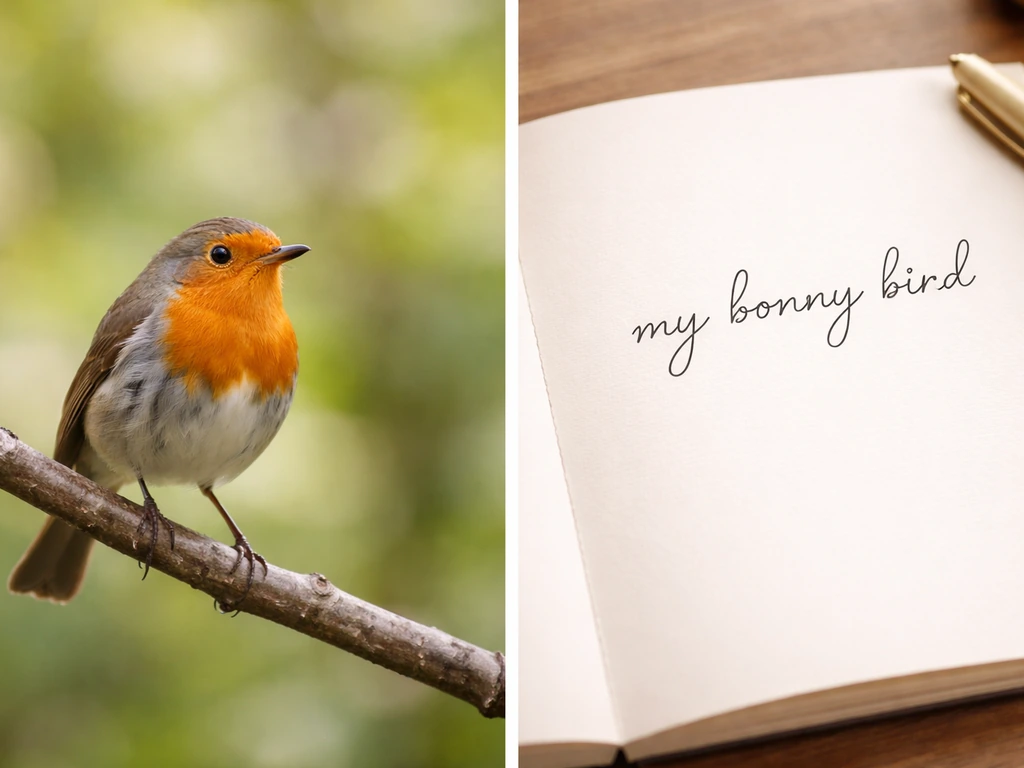
The most useful thing you can do is look at whether the phrase takes the form "my bonny bird" or just "a bonny bird." The possessive "my" almost always signals an address to a person or a pet, with real emotional warmth behind it. The Scots National Dictionary gives this exact example: "Peggy, my bonny bird," used to address a girl of about twelve. The name, the direct address, and the child context all confirm this is a person-endearment. On the other hand, folk song lyrics like "The cuckoo's a bonny bird" use "a bonny bird" as straightforward description, and the surrounding text goes on to describe bird behaviors like singing and seasonal return. In the folk song text for "CUCKOO'S A BONNY BIRD," the cuckoo is explicitly described as "a bonny bird," showing "bonny bird" can function as a literal modifier of an animal folk song lyrics like "The cuckoo's a bonny bird". If a species name appears nearby, you're almost certainly in literal territory.
| Signal in the text | Likely meaning of "bonny bird" |
|---|---|
| Uses "my bonny bird" as a direct address | Term of endearment for a person (girl, woman, or child) |
| Names a person nearby (e.g., "Peggy, my bonny bird") | Definitely a person-endearment |
| Names a bird species nearby (cuckoo, blackbird, etc.) | Literal pretty bird description |
| Describes bird behaviors (singing, nesting, seasonal return) | Literal bird |
| Romantic or family context with human pronouns (she, you) | Person-endearment |
| Folkloric nature poem with no human characters | Literal bird, possibly with symbolic weight |
Tone and context: romantic, lyrical, and regional
"Bonny bird" carries a distinctly lyrical and affectionate tone regardless of which meaning is in play. When it's used as an endearment, it sits in the same emotional register as "my love" or "my darling" but with a more folk-poetry, Celtic flavor. You encounter it most in ballads, folk songs, and older verse, especially from Scotland and Northern England. The phrase turns up in English and Scottish ballad collections with lines like "Come down, come down, my bonny bird" and "Sing on, sing on, my bonny bird," where the context blends tenderness with a kind of enchanted, fairytale quality.
Regionally, the phrase feels most at home in a Scottish or Northern English linguistic setting, though ballad traditions spread the usage widely enough that readers across Britain and Ireland would recognize it. Modern Scottish speakers still use "bonny" in everyday conversation, so the adjective hasn't become archaic in the way some dialect words have. The phrase feels romantic when applied to a person, admiring when applied to an actual bird, and in either case it has a warmth that a neutral word like "nice" simply doesn't deliver.
Real examples of how people actually use it
Looking at documented uses across folk song, poetry, and dialect literature gives you a clear picture of how the phrase actually functions in practice. Here are some representative examples:
- "The cuckoo's a bonny bird, he sings as he flies" — a folk song where "bonny bird" describes the cuckoo literally, framing its song as bringing good tidings and heralding spring.
- "The blackbird is a bonny bird" — from a poem that contrasts the blackbird's dark, mourning-colored plumage with its beautiful song. "Bonny" here means admirable or pleasing, not just visually pretty.
- "Peggy, my bonny bird" — documented in Scots dialect literature, addressed directly to a girl of about twelve. A clear person-endearment.
- "Come down, come down, my bonny bird" — from a ballad collection, used in a romantic or magical context where a speaker calls to someone (or something) with deep affection.
- "Sing on, sing on, my bonny bird" — another ballad line in the Child Ballads tradition, with the same tender, enchanted register.
Notice how the "my" versions immediately feel more intimate and personal, while the "a/the bonny bird" versions are more descriptive and observational. That pattern is consistent across dozens of texts, and it's your most reliable guide when you're trying to interpret the phrase quickly.
Bird symbolism and what it adds to this phrase
You don't need to go deep into bird symbolism to understand "bonny bird," but a little background does enrich it. In many love-and-fate traditions, that symbolism is closely tied to what a bohemian bird meaning is said to represent bird symbolism. In British and Scottish folk tradition, birds carry consistent associations with messages, freedom, and seasonal hope. The cuckoo's song, for instance, is traditionally read as good news, a herald of spring and renewal. When the folk lyric frames the cuckoo as "a bonny bird" that "brings us good tidings" and "tells us no lies," it's layering prettiness with trustworthiness and hope. That's part of why "bonny bird" as an endearment works so well: calling someone your bonny bird implies they bring you joy and lightness, not just that they look nice.
The blackbird example adds another dimension. Praising a blank" rel="noopener noreferrer">blackbird as "bonny" despite its dark, "mourning" color suggests that "bonny" reaches past appearance toward something more holistic: a beautiful voice, an admirable presence. When you apply that to a person-endearment, it suggests the term is generous rather than strictly based on looks. It's a compliment to someone's whole effect on you, not a checklist of physical features. This overlaps with themes you'll find in related terms like "bohemian bird," where the bird reference carries a sense of spirit and freedom rather than mere appearance. The phrase “buxom bird meaning” is often used online to mean a playful, flirtatious compliment tied to a “bird” term of endearment.
Common misreadings and how to clear them up
There are a few ways readers consistently trip over this phrase, and they're worth knowing about so you can spot them.
- Assuming it always means a literal bird. This is the most common error. Because the animal meaning of "bird" is the default in modern standard English, readers often miss the Scots person-endearment meaning entirely. If the surrounding text involves a human relationship, family setting, or direct address by name, the person-meaning is almost certainly correct.
- Confusing "bonny" with "bony" or "bunny." These look similar in quick reading but mean completely different things. "Bony" means thin or skeletal. "Bunny" is a rabbit. Neither has anything to do with the Scottish "bonny" (beautiful). If you're unsure, check whether the surrounding sentiment is complimentary.
- Treating "Bonny" as a proper name rather than an adjective. "Bonnie" is a real given name in Scottish folk culture and popular usage, and some readers encountering "Bonny bird" may wonder if "Bonny" is the bird's name. Check the grammar: if "bonny" comes before "bird" and functions as a modifier ("a bonny bird," "my bonny bird"), it's an adjective. If it's capitalized mid-sentence with no noun following it, it's more likely a name.
- Expecting it to refer to a single specific bird species. Unlike terms such as "booby bird" (which names a specific seabird) or "boobrie" (a mythological Scottish water-bird), "bonny bird" is not the name of any species. It's a descriptive phrase that can be applied to any bird, or to a person. If you're reading a natural history text and expecting a species ID, you're in the wrong genre.
- Missing the dialect register entirely. If you're not familiar with Scottish or Northern English dialect, "bonny" might not even register as meaningful. Knowing it's equivalent to "pretty" or "lovely" immediately clarifies the emotional weight of the phrase.
The simplest verification method is to read the sentence immediately before and after "bonny bird" and ask two questions: Is there a human being being addressed or described nearby? And is there a bird species, bird behavior, or nature description nearby? Whichever answer is yes tells you the intended meaning. When both are present, which does happen in folk ballads with magical or transformative narratives, the ambiguity is often intentional, and you can hold both meanings at once.
FAQ
How can I tell whether “bonny bird” means a person or a real bird in a poem or song?
Use sentence framing to decide: if “bonny bird” is preceded by a name and followed by something like “come down,” “sing on,” or a direct form of address, it is almost certainly an endearment to a person. If a species, habitat, or behavior is mentioned (for example, singing, nesting, seasonal return), it is more likely literal.
If I translate “bonny bird,” what equivalent phrases keep the same tone?
When it is an endearment, you can usually swap in “my darling” or “my love” and keep the emotional tone, because the “my” signals relationship and affection. If it is descriptive, swapping to “my darling” will sound off because the line will stop making observational sense.
Does “bonnie bird” mean something different from “bonny bird”?
The spelling “bonny” vs “bonnie” does not reliably change meaning, it mainly reflects regional preference and personal or literary style. Context still matters most, especially the presence of possessives like “my” and nearby bird-specific imagery.
What does “bonny bird meaning” look like in modern everyday use?
If the phrase appears in modern social media with no Scots context, many readers will still default to “pretty bird” unless the writer uses it like a nickname (for example, addressing a partner, child, or pet). If you see it in a message thread as a greeting or compliment, assume person-endearment.
Why do people get confused about the word “bird” in “bonny bird”?
A common mistake is treating “bird” as always animal. In Scots usage, “bird” can mean a girl or young woman, so “bonny bird” can be a respectful, affectionate label rather than a literal description of feathers.
What should I do if a line includes both a bird and a person, so the meaning feels intentionally ambiguous?
If both people and animals are present in the same passage, some ballads intentionally create layered meaning. In that case, read it as a double compliment, you get tenderness toward a person and an atmosphere of nature, hope, or fate.
Is “bonny” only about looks, or does it include personality in poetic usage?
“Bonny” typically functions as a broad compliment (beautiful, pretty, attractive, sometimes handsome). It is not the same as describing intelligence or character directly, though in poetry it can drift into admiration for someone’s overall presence and voice.
How can I use “bonny bird” correctly if I want to write my own line?
If you are writing it, match the structure: for a person, “my bonny bird” plus a name or a direct-address verb usually sounds natural. For an animal, keep it article-based like “a bonny bird” and add a concrete detail (song, color, season) to avoid sounding like a nickname.
Next Article
Boobrie Bird Meaning: What It Refers to and How to Tell
Boobrie bird meaning explained with likely sources, variant spellings, and tips to identify the real bird reference and