
When people search 'shoebill bird meaning,' they're usually after one of three things: what the bird actually is, what it symbolizes in spiritual or metaphorical contexts, or why it keeps showing up in their social media feed looking like it wants to fight. If you're also curious about the potoo bird meaning, it's a different bird with its own folklore and symbolism shoebill bird meaning. The shoebill (Balaeniceps rex) is a real, living bird native to the swamps of central and east Africa, and its 'meaning' in any symbolic sense comes almost entirely from its extraordinary, unsettling appearance and its habit of standing completely motionless for long stretches while hunting. There's no ancient folklore tradition here the way there is with ravens or cranes, but the shoebill has picked up a vivid set of modern symbolic associations that are worth understanding on their own terms.
Shoebill Bird Meaning: Symbolism, Myths, and Context


What people actually mean when they ask about shoebill meaning
The word 'meaning' does a lot of different work depending on who's asking. Some people genuinely want to know what kind of bird this is, they've seen the name, they're curious, and 'meaning' is just how they phrased a bird-identification question. If you're specifically looking for the khope bird meaning, it helps to compare the context where you saw the term to the broader symbolism people attach to similar birds bird-identification question.
Others are looking for spiritual symbolism: what does it mean if I dreamed about a shoebill, or if this bird 'came to me' as a sign? A third group is using 'meaning' in a more cultural-linguistic sense, why is this bird everywhere online, what does referencing a shoebill communicate, what's the vibe? All three are legitimate questions. This article covers all three, starting with the basics that actually drive the symbolism.
The bird itself: why the shoebill looks the way it does
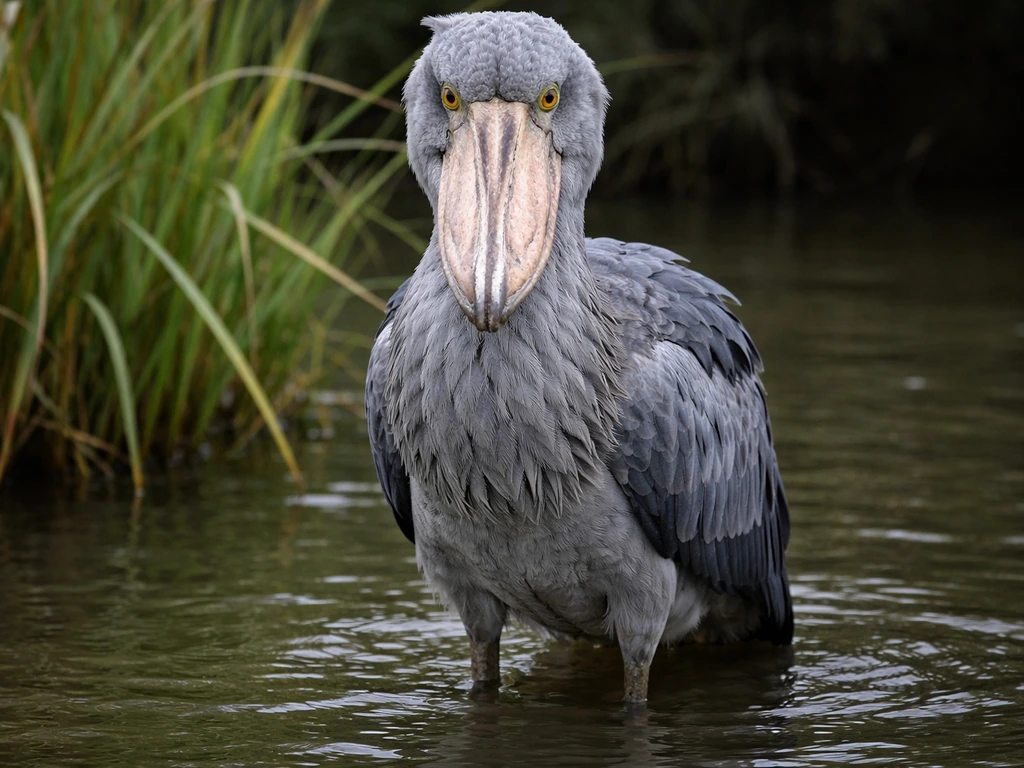
Balaeniceps rex is a large wading bird, standing up to 1. 4 meters (about 4. 5 feet) tall, with slate-gray plumage, a stiff upright posture, and a bill that genuinely looks like a worn-out wooden shoe or a small Dutch clog attached to a bird's face. The English name 'shoebill' comes directly from that bill shape, and its scientific genus name Balaeniceps translates roughly as 'whale-headed,' which also tells you everything.
It's a solitary bird, hunts by standing still in shallow papyrus swamps for extraordinary periods, then striking with a fast, violent lunge at lungfish, catfish, and occasionally baby crocodiles. National Geographic describes it as 'prehistoric-looking,' and that framing is almost universal in mainstream wildlife coverage, it genuinely resembles something from a different geological era.
The bill shape that gave the bird its name is functional, not decorative. It's broad, hooked at the tip, and powerful enough to decapitate prey. Combined with the bird's fixed, wide-eyed forward-facing gaze (unusual in birds, which typically have eyes on the sides of their heads), it creates the impression of something intensely, almost intelligently, watching you. That's not just an impression people project onto it, the forward-facing eyes do give the shoebill better binocular depth perception than most birds, making its stare functionally different from a heron or stork.
The symbolic meanings people connect to the shoebill
The shoebill's symbolism is almost entirely earned from observation rather than inherited from old folklore. Here's what people consistently associate with it, and why each one holds up:
- Patience and stillness: The shoebill's primary hunting strategy is to stand motionless for long periods — sometimes up to an hour — before striking. This makes it a natural symbol for patient, disciplined waiting and the idea that stillness itself is a form of power.
- Watchfulness and presence: The forward-facing eyes and fixed expression give the shoebill a quality of deep, unbroken attention. People associate it with heightened awareness, observation, and a kind of meditative focus.
- Ancient or primal energy: Its appearance genuinely evokes the Mesozoic era. The 'living dinosaur' description comes up constantly in wildlife media and casual commentary, making it a symbol for primordial continuity — something ancient that outlasted extinction.
- Danger and power: This is not a gentle wading bird. It hunts crocodiles. Its strike is fast and decisive. The combination of stillness followed by explosive action is widely read as a symbol of controlled, concentrated force.
- Mystery and solitude: Shoebills are rare, hard to find, and live deep in papyrus swamps that are difficult for humans to navigate. That inaccessibility feeds a sense of mystery — it's a creature that exists largely out of human sight.
- Intimidation: Online, the shoebill has become almost a meme for sheer unnerving presence. Reddit threads describe it as 'a living machine' and a 'calm predator' — the vibe of something that has no natural fear of you, which translates into a kind of symbolic authority.
Why the appearance and behavior create such strong associations
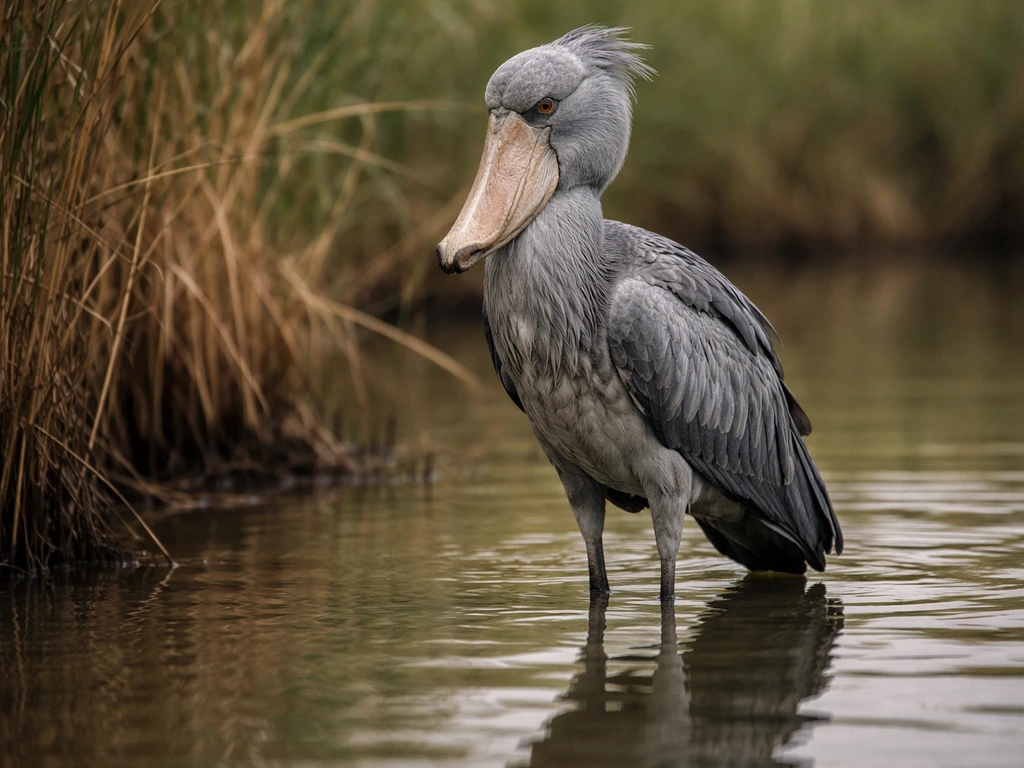
Bird symbolism almost always traces back to real observable behavior, and the shoebill is a textbook case of that. Compare it to a bird like the hoopoe, whose symbolism in Persian and Egyptian traditions connects to specific colors, sounds, and migratory behavior, those meanings accrued over centuries of human-bird contact. If you’re comparing it to the hoopoe bird meaning, that tradition tends to focus on specific colors, sounds, and migration patterns. The shoebill lacks that long record of cross-cultural folklore because it lives in remote African swamps and was only formally described by Western science in the 1850s. But the behavioral cues are so striking that modern observers converge on the same symbolic readings regardless of cultural background.
The stillness is the core of it. In bird symbolism broadly, birds that move fast (swifts, hummingbirds) tend to symbolize speed and fleeting opportunity. Birds that stand still tend to carry meanings around patience, wisdom, and observation, herons and cranes are classic examples across multiple cultures. The shoebill takes that quality to an extreme. It doesn't just wait; it becomes part of the landscape while waiting. That earns it stronger associations with stillness as strategy rather than passivity.
The bill and gaze add the layer of power and intimidation that differentiates the shoebill from, say, a peaceful heron. The weapon-like bill and forward gaze signal predatory intent in a way that is legible across cultures. People who have never read a word about shoebill symbolism look at a photo of one and immediately report feeling watched. That's not coincidence, it's the same perceptual cue that makes front-facing predatory animals feel more threatening than side-profile prey animals.
Where you'll actually encounter shoebill references
The shoebill shows up in a specific cluster of contexts, and knowing which one you're in helps you figure out what meaning is being used:
| Context | How the shoebill appears | What meaning is usually intended |
|---|---|---|
| Wildlife documentaries and nature media | Featured for dramatic hunting footage and prehistoric look | Biological wonder, apex-predator energy, ancient continuity |
| Social media and internet culture | Viral photos, memes, 'intimidating bird' threads | Humor + genuine awe at the bird's unnerving stillness and gaze |
| Spiritual/symbolism websites | Listed as spirit animal or totem | Patience, watchfulness, solitary power — but framing is modern, not ancient |
| Art and illustration | Used as design motif or character reference | Mystery, prehistoric aesthetics, gothic or surreal atmosphere |
| Nicknames and usernames | As a personal identifier | Projecting qualities of calm, intimidating watchfulness onto self-image |
| Storytelling and fiction | As a creature appearing at significant moments | Omen of change, ancient force, something powerful and inscrutable |
Real folklore versus modern internet symbolism: what's solid

Here's where you need to be honest with yourself about where the symbolism is coming from. There is no deep, ancient cross-cultural folklore tradition around the shoebill the way there is with the raven in Norse mythology, the crane in Japanese culture, or even the hoopoe in Islamic tradition. The shoebill was largely unknown to most of the world until relatively recently, and the communities that have lived near it in Uganda, Sudan, and the Congo basin have practical relationships with it (it shares fishing grounds, it's sometimes called 'abu markub' meaning 'father of the shoe' in Arabic-speaking regions of Sudan) but that hasn't generated a widely documented mythological tradition. If you are also checking older folklore or word-meaning angles, the peasant meaning bird idea is a related place to look for how meanings get stretched.
What you will find on spiritual symbolism websites is a set of meanings that are essentially modern interpretations built from the bird's observable traits. Sites that list the shoebill as a spirit animal and describe it as a symbol of patience, focus, and 'seeing through illusion' are working from the bird's behavior and projecting symbolic meaning onto it.
That's not dishonest, it's how a lot of folk symbolism works, but it's worth knowing that you're reading a contemporary interpretive layer, not an inherited cultural tradition. Compare this to the potoo bird, another strange-looking species that has more direct roots in local Latin American folklore, or the phoebe, which has a documented etymology and history in American folk naming.
In the same way, a phoebe bird meaning is usually a modern interpretation built from that bird's traits and cultural naming history. The shoebill's symbolism is younger and more crowd-sourced.
The one solid anchor is the name itself. If you are looking for the papiha bird meaning in English, the key is to start with how the name is used in everyday language. 'Shoebill' is a purely descriptive English common name, and the Arabic 'abu markub' (father of the shoe) confirms that the bill shape was the primary identifying feature across different language communities. The English common-name etymology of Shoebill is explained as coming from the bird's shoe-like bill shape Shoebill's English common-name etymology. The Latin genus name Balaeniceps rex adds 'king' (rex) to 'whale-headed,' which is the closest thing to a built-in symbolic statement the bird has, and even that's a scientific classification, not a folk epithet.
How to interpret a shoebill 'sign' or reference in real life
If you're asking what it means because you saw a shoebill, dreamed about one, or had someone send you a shoebill image, the most useful approach is to identify the context first rather than reach for a universal meaning. You may also see the “opaline bird meaning” idea discussed in the same way, but it depends on the context and symbolism being used universal meaning. Here's a practical way to work through it:
- Ask where the reference appeared. A shoebill in a wildlife documentary means something different from a shoebill in a piece of gothic art versus a shoebill someone texted you as a joke. The context is doing most of the interpretive work.
- Check whether patience or stillness is relevant to your current situation. If the shoebill's core symbolic quality is disciplined waiting before decisive action, and that resonates with where you are right now, that's a meaningful personal connection — even if it's not coming from a thousand years of folklore.
- Look at what the shoebill is doing in the reference. Is it standing still and watching? Is it striking? Is it depicted alone or among other creatures? Behavior in the image matters more than the bird's identity alone.
- Be skeptical of very specific 'messages.' Some symbolic sites assign very particular meanings (e.g., 'a shoebill means your career is about to change'). That level of specificity has no cultural foundation — it's invented interpretation. Broad thematic meanings (patience, power, solitude, ancient energy) are on firmer ground because they trace directly to the animal's actual traits.
- Use it as a prompt, not a prescription. Even if you decide the shoebill has no particular message for you, engaging with what it actually is — a rare, ancient-looking, extraordinarily patient predator — is a good prompt for reflection on those qualities in your own life.
The shoebill in everyday language: is there a real idiom here?
Unlike 'early bird,' 'bird's eye view,' or the slang use of 'bird' in British English, the shoebill has not made it into established idiom or formal metaphor in the English language. It's not in dictionaries as anything other than the bird itself. What you do see is informal, contextual metaphor, calling someone a 'shoebill' to mean they are unsettlingly still, intensely watchful, or calmly terrifying. People sometimes use “opila bird” in the same way, so the “meaning” usually comes from that shared idea of an intensely watchful, unsettling stillness shoebill. That's more of an emerging internet-era nickname register than a fixed linguistic expression, and it's worth noting because it's still being formed rather than settled.
If someone uses 'shoebill' as a descriptor or nickname, the intended qualities are almost always drawn from that core cluster: patience, stillness, an unnerving gaze, and a kind of ancient, unhurried authority. It's a compliment in most contexts, a way of saying someone is not easily rattled and sees more than they let on. That's a consistent enough meaning at this point that you can use it as a working interpretation when you see it used informally, while keeping in mind it's a living usage that hasn't fully settled into fixed definition the way phrases around more mythologized birds have.
FAQ
Is there one single “shoebill bird meaning” that applies to dreams, signs, and social media posts?
Not really. In practice, the meaning changes with context, most people are borrowing from the same observable cues (stillness, forward gaze, predatory power). If you want the closest match, focus on what you were doing or feeling when you noticed the shoebill image, dream scene, or nickname, because those details determine whether the interpretation lands on patience, focus, intimidation, or “watching closely.”
What should I look for to interpret a shoebill dream more accurately?
Check the action, not just the presence. A shoebill standing motionless can lean toward “pause and observe,” while a sudden lunge or capture can read as timing, escalation, or a need to act decisively. Also note where it appears (water, swamp, home, workplace), because location often shifts the interpretation from personal mindset to a specific life area.
If someone calls me a “shoebill,” is that usually a compliment or an insult?
Usually it is a compliment, meaning you are steady, unbothered, and intensely attentive. It becomes negative when paired with phrases about being “cold,” “creepy,” or “threatening,” in which case the person is leaning on the intimidating bill-and-gaze impression rather than the patient, strategic angle.
Why does the shoebill come up online as “opila/opila bird” or similar variations?
Those spellings are typically internet-era nickname drift, people are reusing the same idea of intensely still, watchful energy and applying it in different communities. Treat it as the same core symbolism cluster unless the post explicitly defines a separate concept, because there is no widely standardized dictionary meaning for those variants.
Is it appropriate to treat shoebill symbolism as a spiritual tradition like Norse or Japanese folklore?
Be cautious. The article’s main distinction is that shoebill interpretations are largely modern, crowdsourced meanings projected from the bird’s behavior, not an inherited mythic system with deep historical continuity. You can still use the symbolism personally, just avoid claiming it is an ancient, cross-cultural spiritual teaching.
Does the Arabic name “abu markub” change the meaning people should assign to the shoebill?
It mostly reinforces the identification basis, the bill shape as the defining trait. That can make the symbolism feel more grounded in “what you can see,” rather than abstract metaphors. If you are using name-based interpretation, prioritize the physical cue the names point to, the intense, shoe-like bill and the unmistakable still gaze.
Can I use shoebill meaning to describe someone’s personality in a relationship or workplace?
Yes, but keep it behavior-based. Use traits the bird reliably suggests in the symbolism discussion: calm under pressure, deliberate timing, strong attention to detail, and willingness to act when the moment is right. Avoid diagnoses like “dangerous” or “manipulative” unless the person’s behavior in your story supports that, since the intimidation vibe is a perception layered onto an animal hunting strategy.
What common mistake do people make when searching “shoebill bird meaning”?
They look for a universal, dictionary-style meaning and ignore that English idiom coverage is limited. The most useful approach is to interpret the term as either (1) a direct reference to the bird, or (2) a contextual nickname built from stillness and being watched. If you cannot identify which context you are in, you will get inconsistent “meanings.”},{
Khope Bird Meaning: What It Refers to and How to Verify
Learn what khope bird meaning refers to, check spelling and region, and confirm the exact bird or slang use.