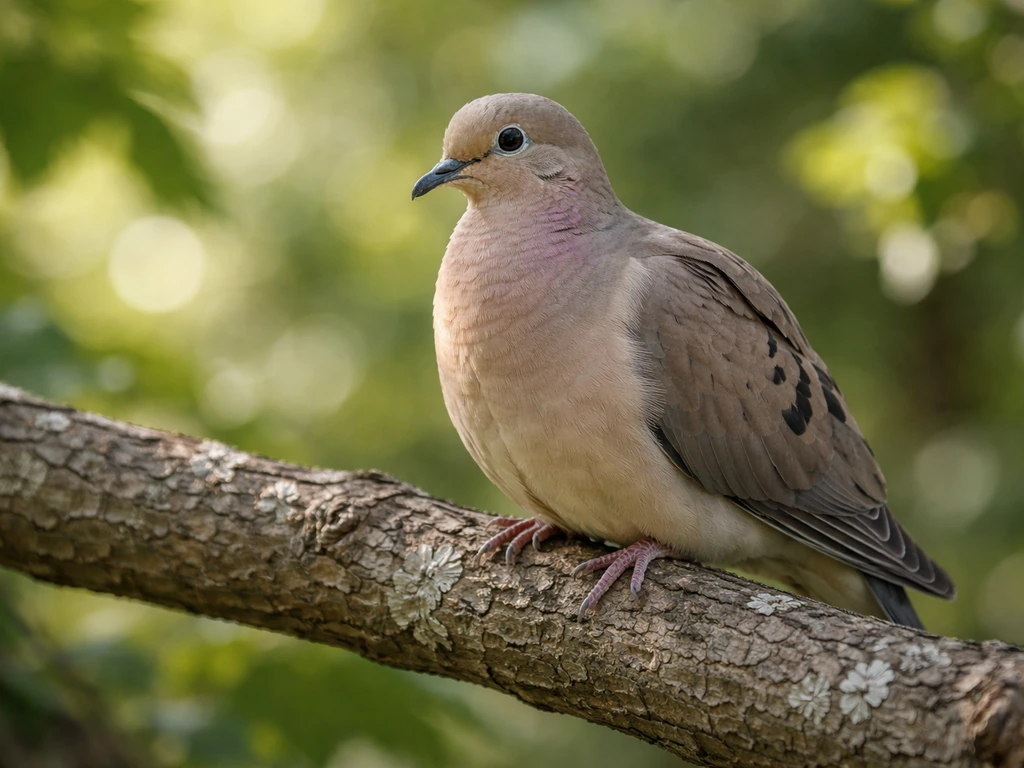
A mourning dove typically signals one of four things in symbolism and everyday language: grief, peace, love, or hope. Which one applies to your situation depends heavily on context, and the honest answer is that the mourning dove carries all four meanings at once in most cultural traditions. The name alone does a lot of work here.
Mourning Dove Bird Meaning: Symbolism, Signs, and Practical Steps

Marcus Whitley
27 Apr 2026
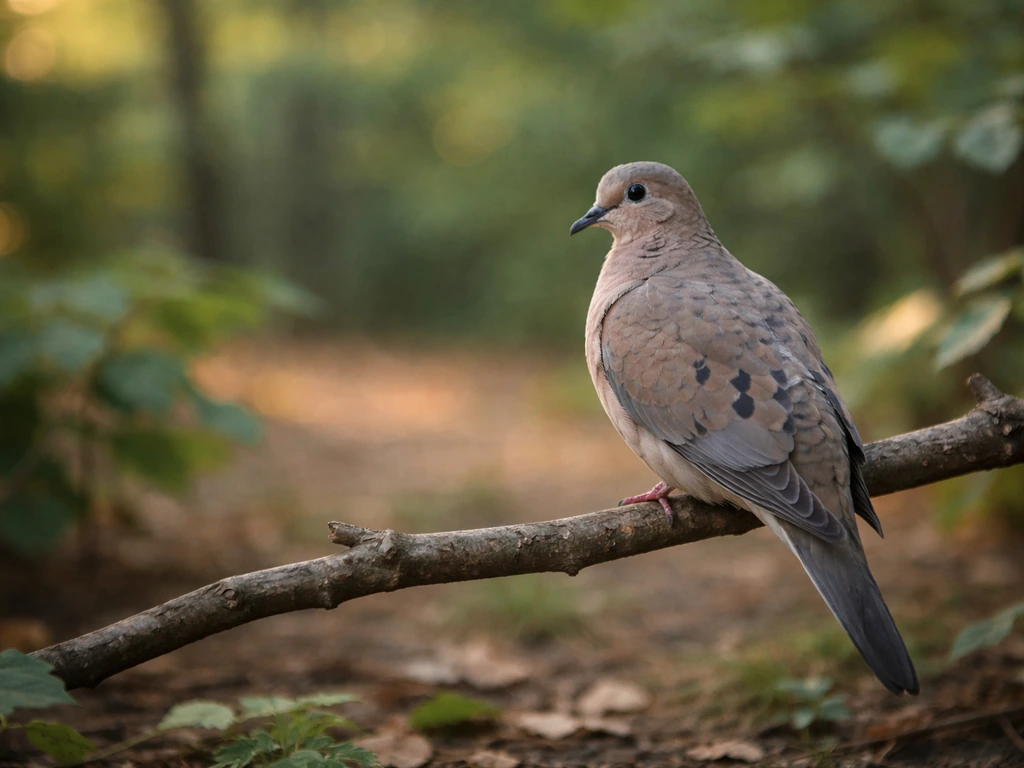
That soft, low, drawn-out coo sounds genuinely mournful to human ears, and that auditory cue is almost certainly why this particular dove ended up so tightly bound to themes of loss and comfort, rather than just generic dove symbolism. The Pennsylvania Game Commission describes the mourning dove call as a distinctive hollow, plaintive “ooah, cooo, coo, coo. ” [That soft, low, drawn-out coo sounds genuinely mournful to human ears](https://www. pa.
gov/agencies/pgc/wildlife/discover-pa-wildlife/mourning-dove).
What the mourning dove actually is
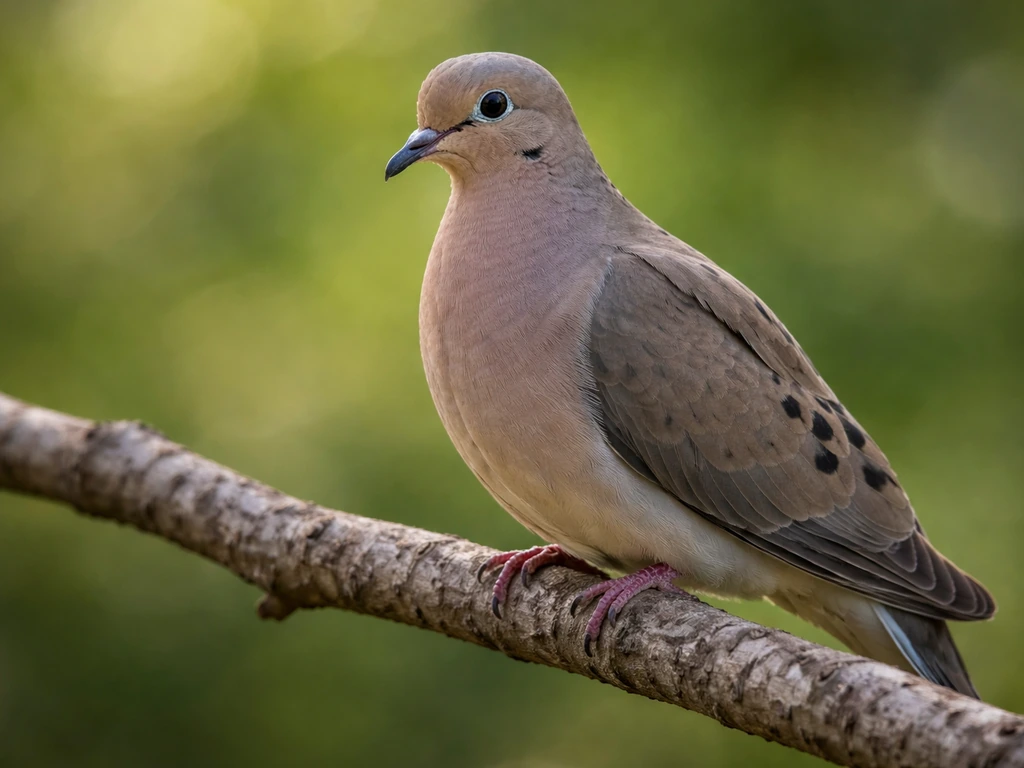
The mourning dove (Zenaida macroura) is one of the most common birds in North America. It breeds across the continent and into central Panama and the Caribbean, and it thrives in almost any open or semi-open habitat: farmland, forest clearings, suburbs, prairies, and deserts. Because it adapts so well to human-modified landscapes, most people in North America have seen one, even if they didn't know what they were looking at.
It's a slender, warm brown bird with a long pointed tail and a slightly iridescent neck. Northern populations migrate south in fall, but across much of its range the mourning dove is a year-round presence. That matters symbolically because seeing one isn't rare or extraordinary. It's an everyday bird, which is part of why its meanings have spread so widely into ordinary language and folk belief.
It's worth briefly separating the mourning dove from its broader family. The word 'dove' in everyday language often conjures up a pure white bird, a peace symbol, or a biblical image. Those associations belong partly to white doves and pigeons used in ceremony, and partly to the general cultural weight the word 'dove' carries in English. Linguistically, the term “dove” itself functions as a symbol-loaded word in addition to denoting a bird species the word 'dove' carries in English.
The mourning dove is its own thing: a wild, common, brown bird whose symbolic power comes specifically from its call and its name, not from ceremony or religious staging. If you're wondering about doves as a broader category, that's a slightly different conversation from what the mourning dove specifically means.
Why it's called 'mourning'
The name comes directly from the sound. The mourning dove's call is a low, drawn-out 'coo-OO-oo, coo-coo-coo,' and ornithologists and bird guides consistently describe it as doleful or mournful. blank" rel="noopener noreferrer">New Hampshire Audubon calls it 'a low drawn out and mournful coo-oo coo coo coo coo.' The word 'mourning' in English is itself tied to grief, lamentation, and the period following a death. When early naturalists named this bird, they heard that call and reached for the most apt emotional descriptor they had. The word 'doleful' (meaning full of grief, or expressing sadness) captures exactly what they were hearing.
There's also a subtle throat-rattling sound that can precede the first coo, which adds to the slightly unsettled, searching quality of the call. If you've ever heard a mourning dove on a still morning, you probably understand why someone landed on 'mourning' as the name. It genuinely sounds like something grieving. That's not mythology. It's an auditory reality that then gets layered with cultural and spiritual meaning over time. The name and the sound together are the engine behind almost all of the bird's symbolic associations.
The four main meanings: grief, peace, love, and hope
These four meanings coexist and often blend, but they're worth separating out so you can figure out which one is resonating with you.
Grief and loss
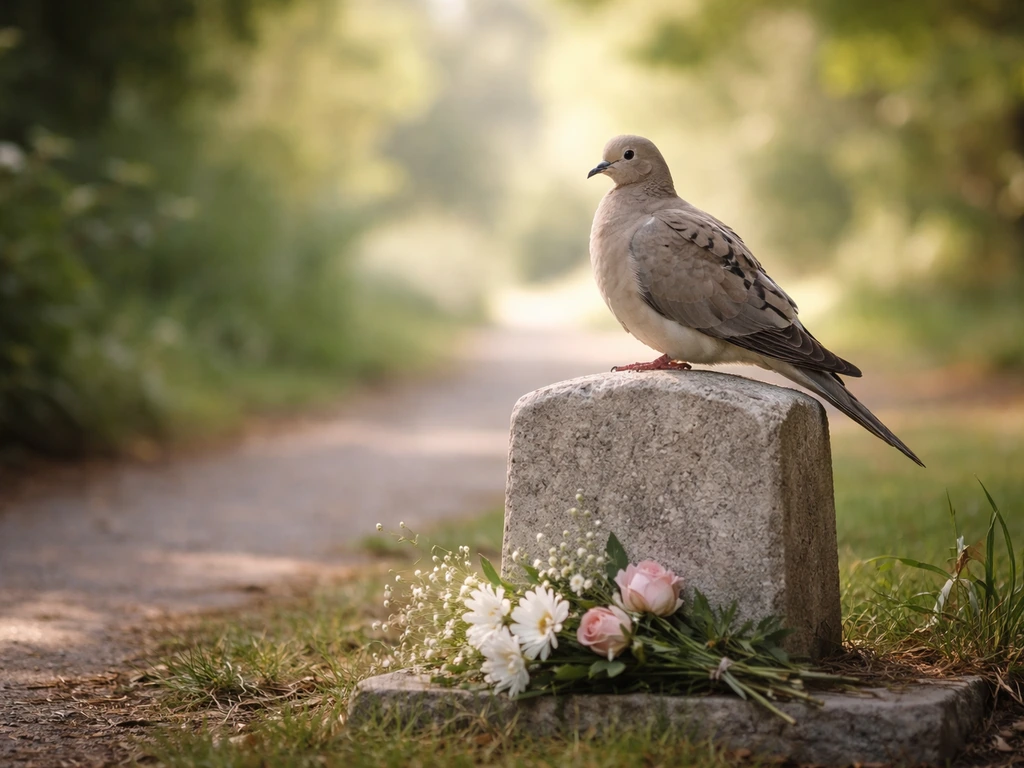
Grief is the most literal connection, and it runs through the mourning dove's symbolism more than any other theme. The name itself references mourning. In bereavement contexts, mourning doves frequently appear in memorial programs, sympathy cards, and funeral imagery. Folklore researchers at USC have documented the mourning dove as an interpretive sign specifically for those coping with a death in the family.
In folk research, the mourning dove is often discussed specifically in relation to coping with death in the family coping with a death in the family. People who are grieving often notice the dove's call with unusual intensity, and grief psychologists explain this partly through the lens of meaning-making: after a loss, the brain becomes more attuned to patterns and symbols that feel like connection or message. That's not dismissing the experience.
It's recognizing that grief sharpens attention, and the mourning dove's call is exactly the kind of thing that cuts through.
Peace
Peace is probably the most universal meaning attached to doves in general, and the mourning dove shares it fully. The Atlanta Journal-Constitution describes mourning doves as 'universally regarded as a symbol of hope, peace and love. ' In folk belief and spiritual traditions, a mourning dove landing near you or calling repeatedly is often read as a sign that peace is possible, even in the middle of difficulty.
This meaning has deep roots in the Noah's ark narrative (where a dove returning with an olive branch signaled the end of the flood), and that image has been absorbed so thoroughly into Western culture that 'peace dove' is now a lexicalized phrase in English, appearing in standard dictionaries. You don't have to be religious to feel the resonance of a quiet bird settling near you during a hard time.
Love and romance
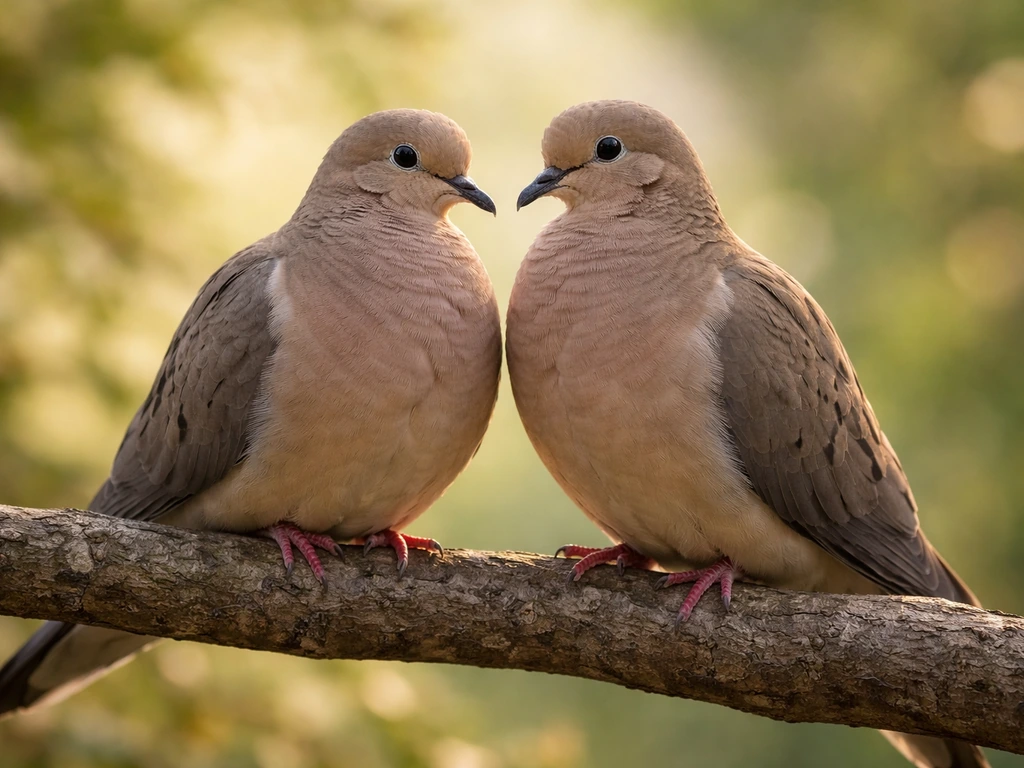
Doves have been tied to love and partnership across cultures for a long time, partly because they mate for life (or at least for a season, behaviorally speaking) and are often seen in pairs. The mourning dove inherits this meaning. In everyday language, describing a pair of people as 'lovebirds' or using dove imagery in romantic contexts draws on this tradition.
In some folk traditions, hearing a mourning dove call at dawn is taken as a good omen for love or reunion. In early mornings during late January and early February, NC Wildlife notes that mourning doves in North Carolina begin cooing and perform courtship or circling-flight behavior hearing a mourning dove call at dawn.
This romantic thread runs alongside the grief meaning without contradiction. In many traditions, love and mourning are understood as two sides of the same attachment.
Hope and renewal
USC folklore documentation explicitly frames the mourning dove as a symbol of 'life, hope, renewal and peace.' This is the meaning that tends to show up when someone encounters a dove during or after a difficult period and experiences it as reassuring rather than sad. The idea is that mourning itself is not the end of the story. Grief moves, and where grief moves, something like hope follows. The mourning dove sits at that threshold symbolically. Its call sounds sorrowful, but the bird itself is alive, common, and persistent, and that combination carries a message about continuation. Renewal matters here especially in spring, when mourning doves call most actively and people associate their sound with mornings and new beginnings.
Mourning dove meanings across cultures and religions
The dove's symbolic range is unusually wide because multiple major traditions have independently developed similar associations, and those traditions have overlapped and reinforced each other over centuries.
| Tradition / Context | Primary mourning dove or dove meaning | Notes |
|---|---|---|
| Christianity | Holy Spirit, peace, divine presence | Dove descending at the baptism of Jesus; peace linked to Noah's dove with olive branch |
| Hebrew/Biblical tradition | Mourning, lament, offering | Turtledoves used as offerings; dove's cry associated with grief in Psalms and Isaiah |
| Native American traditions | Varies by nation; often peace, love, or spiritual messenger | Some nations see the dove call as a message from the spirit world; mourning dove specifically tied to maternal love in some traditions |
| General Western folklore | Hope, peace, love, romantic fidelity | Common in sympathy cards, memorials, wedding imagery |
| Contemporary popular culture | Peace symbol, emoji, condolence | The dove emoji and 'peace dove' phrase are now standard in everyday digital communication |
| Grief and bereavement contexts | Comfort, presence of a lost loved one | Documented in USC folklore archive; common in bereavement support communities |
One culturally specific note worth mentioning: 'Mourning Dove' was also the pen name of a Native American author (Cristal Quintasket), one of the first published Native American women novelists. That usage layers another dimension onto the name: mourning and dove together as an identity, a literary voice, and a cultural bridge. It's a reminder that the phrase 'mourning dove' carries weight beyond ornithology in multiple directions.
The Biblical Archaeology Society notes that dove symbolism in the ancient world was connected to mournful sounds in scriptural texts as well as to peace and divine presence, which explains why the mourning dove's specific call resonates so broadly across religious traditions. The sound isn't just a biological signal to other doves. It's been heard by humans for millennia and woven into stories about loss, comfort, and the presence of something larger.
Spiritual and omen interpretations vs grounded emotional meaning
Here's where you need to decide what kind of interpretation you're looking for, because there are genuinely two different frameworks operating when people talk about what a mourning dove 'means.'
The spiritual or omen interpretation treats the dove sighting as a message or sign, often from a deceased loved one, a spiritual guide, or the universe. This is a documented folk practice. USC's folklore archive confirms it. People who subscribe to this framework find real comfort in it, and grief counselors and psychologists note that meaning-making after loss (including interpreting signs and synchronicities) can genuinely support healing. Research cited by grief-education organizations suggests that people who find meaning after loss are less likely to get stuck in prolonged grief. So if a mourning dove appearing after your mother's death feels like a message from her, that feeling has both cultural legitimacy and psychological support.
The grounded emotional interpretation doesn't require a supernatural framework. In this view, the mourning dove's call is an auditory cue that naturally evokes feelings of grief, peace, or longing because of how the sound is processed by the human brain and how the bird has been culturally coded. You hear it, it touches something, and your mind reaches for language to describe that touch. That language is already loaded with symbolism because you've grown up in a culture that uses dove imagery constantly. So the 'meaning' isn't a message from outside. It's your own emotional state finding an external shape.
Both interpretations are legitimate. The one that fits you depends on your worldview and what you're actually trying to figure out. What matters practically is whether the interpretation helps you or keeps you spinning. If sitting with the dove's meaning brings comfort or moves you toward something, it's working. If it becomes a loop of looking for signs and never landing anywhere, that's worth noticing.
One sighting vs repeated encounters: what the pattern tells you
A single mourning dove sighting doesn't mean much on its own, practically speaking, because mourning doves are extremely common. If you want a clearer baseline for what a mourning dove is in the first place, see the dove bird definition as a related option before you focus on meaning mourning doves are extremely common. They're in suburbs, parks, roadsides, and backyards across almost all of North America year-round. If you live in a temperate climate, you've probably walked past a dozen mourning doves this week without registering them. One appearing in your yard or near a window is ornithologically unremarkable.
What shifts the experience is the context and the pattern. If you notice a mourning dove on the morning of a difficult anniversary, right after a hard conversation, or repeatedly in a way that cuts through your normal awareness, that's different. The noticing itself is the data. Grief psychologists point out that during bereavement, people experience heightened attunement to patterns and symbols. The dove was probably always there. Grief (or love, or transition) brought it into focus.
Repeated sightings in a short window, or sightings in unusual places, are what most people in spiritual traditions treat as significant. A mourning dove appearing at a window every morning for a week after a death, or landing on a fence post at a moment of decision, carries more interpretive weight in folk belief than a random encounter. You get to decide what weight to assign it. The tradition just says: notice the pattern, and sit with what it stirs up.
What to actually do after you encounter a mourning dove

Whether your encounter was spiritual, emotional, or just a bird in a tree, there are a few genuinely useful things you can do with it.
- Pause and notice what you felt in the moment. Before you look anything up or reach for an interpretation, what was your immediate emotional response? Sadness, calm, longing, warmth? That first reaction is your own data, and it matters more than any external meaning list.
- Write it down if the encounter felt significant. Note the date, the context, what you were thinking about beforehand, and what the bird did. If you're in a grief period, journaling this kind of experience is a documented part of healthy meaning-making after loss.
- Choose an intention. If you want to take something practical from the encounter, decide consciously what meaning resonates with you right now: peace, hope, love, or permission to grieve. Then carry that one forward, rather than holding all four meanings in unresolved tension.
- If the mourning theme connects to real grief you're carrying, treat that seriously. A bird isn't a substitute for support. Organizations like TAPS frame meaning-making as one part of how grievers survive and grow, but they're clear that it works alongside human connection and real-world support, not instead of it.
- Avoid the rumination trap. If you find yourself compulsively watching for doves or needing the signs to keep coming to feel okay, that's worth discussing with a counselor. Symbolism should be stabilizing, not a dependency.
Sorting out your situation: a quick framework
If you're trying to figure out what your specific mourning dove encounter means, run it through these questions:
- Are you currently grieving or approaching an anniversary of a loss? If yes, the grief and comfort meanings are most likely in play, both emotionally and culturally.
- Did the encounter happen at a quiet, still moment when you were already reflective? Then the peace meaning is probably resonating.
- Did it happen alongside thoughts of someone you love or miss? Love and longing are the frame here.
- Was it a repeated pattern rather than a one-off? Spiritual traditions read repetition as signal. Emotional interpretation reads it as your attention being drawn to something unresolved.
- Did it feel like a message or like an observation? Your gut answer tells you which interpretive framework you're actually working in.
The mourning dove's meaning isn't fixed. It shifts depending on who's looking, what they're going through, and which cultural tradition they're drawing from. What's consistent across almost all frameworks is that the bird shows up at the intersection of sorrow and comfort, and that intersection is exactly where a lot of life happens. Whether you read it as a spiritual sign, an emotional mirror, or just a beautifully named wild creature that happens to sound like grief, you're engaging with something real. That's enough to work with.
FAQ
If I hear a mourning dove but don’t know the context, how can I tell which “meaning” is strongest for me?
Check what emotion spikes first when you hear it. If you feel pulled toward memories or loss, grief is likely the dominant theme. If you feel steadier or your thoughts soften, peace or hope is more prominent. If the feeling is warmth toward a person or desire for reconnection, love may be the clearest fit.
Does seeing one mourning dove mean something bigger, or is it often just coincidence?
In most regions, it is usually coincidence. A single sighting is common because the species is abundant year-round. Meaning becomes more plausible when it repeats in a short span, shows up in a spot you don’t usually notice, or lands at a specific emotional moment for you.
What counts as a “pattern” that people in spiritual or omen frameworks treat as significant?
Common examples include repeated sightings over several days (like at the same time of day), consistent locations (window, porch, specific fence post), or timing around a specific event (a conversation, an anniversary, a memorial service). If the encounters happen but don’t change your emotional state, many people interpret that as a sign to let go of the search.
Is it normal if the dove meaning feels painful, not comforting?
Yes. Some people experience the call as grief resurfacing rather than reassurance, especially around anniversaries or fresh losses. If it intensifies rumination, consider using it as a cue to do something grounding (write a few lines, talk to someone, or take a walk) rather than repeatedly checking for another sign.
How do I avoid getting stuck in “looking for signs” repeatedly?
Set a limit for how long you will seek meaning, for example one short reflection or prayer/meditation period. Then decide on an action that helps you in the real world (rest, support, a task you’ve been postponing). If the dove becomes a trigger for compulsive searching, it’s reasonable to step back.
Can mourning dove meaning differ by season or time of day?
Yes. In spring and early mornings, their calling is often more frequent, which can make people associate the sound with renewal or new beginnings. During late fall or winter, the same call may feel more like longing or grief because the environment and your memories at that time influence the emotional read.
Does it matter whether the bird lands near me versus I only hear it from far away?
It can. A close landing or repeated appearance is often experienced as more “personal” in spiritual and emotional frameworks, while distant calls may be processed as a general atmosphere cue. If your meaning changes depending on distance, that usually reflects how your attention and expectations are being shaped.
What should I do if I want a more grounded interpretation but still feel the symbolism strongly?
Use a two-step check. First, name the feeling the call brings (grief, comfort, love, hope). Second, translate it into a manageable next move (send a message to a loved one, visit a place connected to your loss, start a small self-care routine). This keeps the meaning connected to action rather than mystery.
Are there safe, practical steps I should take for the bird itself when it visits my yard?
If you’re offering a welcome environment, focus on non-intrusive help like keeping feeders or water clean and avoiding disruptive handling. If you suspect the bird is injured, contact local wildlife rehabilitation. For most visits, the best “next step” is simply to observe without interfering.
If I interpret the dove as a message from someone who passed, how can I do it without harming my healing?
Try to treat it as comfort, not a directive. A helpful approach is to ask yourself what the message, if any, is encouraging you to do now (rest, remember with less pain, reach out). If the interpretation increases guilt, fear, or delays normal grieving, consider shifting toward the emotional mirror framework or speaking with a grief counselor.
Next Article
Dove Bird Definition: What a Dove Is and How to Identify It
Dove bird definition with quick ID traits, habitat, dove vs pigeon differences, and peace or love symbolism meaning.