"Wood bird" (also written "wood-bird" or "woodbird") most commonly means a bird that lives in or is associated with woodland and forest environments. It is not a single species name but a broad descriptive term that can refer to dozens of forest-dwelling birds depending on context. Beyond the literal sense, the phrase carries a long history of poetic and symbolic use in English literature, and individual woodland species like the woodpecker, wood thrush, nuthatch, jay, and owl each carry their own distinct symbolic weight across multiple cultures.
Wood Bird Meaning: Definitions, Species, Symbolism Guide

Marcus Whitley
19 Jul 2026
What "wood bird" can mean: the quick breakdown
The term is genuinely flexible, and the meaning shifts depending on whether you encountered it in a field guide, a Victorian poem, a folklore text, or a casual conversation. Before diving into specifics, it helps to see the full range of uses laid out clearly.
All the definitions in one place
- Literal (ornithological): any bird whose primary habitat is woodland or forest. This is the standard dictionary sense recorded by Wiktionary, the Century Dictionary ("a bird that lives in the woods"), and Dictionary.com, which explicitly lists "wood bird" as an example of "wood" used as an adjective meaning "dwelling in woods."
- Literary and poetic: in 19th- and early 20th-century English writing, "wood-bird" (hyphenated) appeared frequently in poetry and fiction as an evocative, romanticized image of the wild forest. H. Rider Haggard and other Victorian writers used it this way. The hyphenated form is largely a historical stylistic choice now.
- Symbolic and folkloric: woodland birds as a category carry collective symbolism (messengers, forest guardians, seasonal markers) in multiple traditions. Individual species within the group each carry additional, species-specific meanings.
- Practical (field identification context): in modern birding conversation, "wood bird" often simply means "a bird I saw/heard in the woods" — informal shorthand without symbolic intent.
- Compound species names: some birds have "wood" built into their official common names — Wood Thrush, Wood Duck, Wood Stork — so a reference to "wood bird" might be pointing specifically at one of these named species rather than the category as a whole.
The spelling also tells you something about intent. "Wood-bird" (hyphenated) almost always signals a literary or older source. "Woodbird" (closed) is rarer but follows the same literary tradition. "Wood bird" (open compound) is the form you will see in modern dictionaries and casual writing. Merriam‑Webster's entry for “woodland” includes the example phrase “a woodland bird,” confirming this modern dictionary usage Merriam‑Webster's entry for “woodland” includes the example phrase “a woodland bird,” confirming this modern dictionary usage.. All three refer to the same broad idea.
How broad is the literal meaning, really?
The ornithological scope is genuinely wide. When researchers and field guides use the term "woodland bird" (of which "wood bird" is simply a compressed variant), they mean any species that depends on trees and forest understory for nesting, foraging, shelter, or breeding. Cornell Lab's All About Birds and the Peterson Field Guide series organize many species under forest or woodland habitat categories. In North America alone, that covers well over 100 species, ranging from tiny kinglets to ravens. In European birding, the term maps onto a similarly large group including nuthatches, treecreepers, tits, and woodpeckers. So "wood bird" does not narrow things down to one or two species, it names a whole ecological guild.
The phrase becomes more specific only when context forces it. A poet writing about the "wood-bird's song" in a New England forest almost certainly means a thrush or wood warbler. A wildlife manager describing "woodland bird decline" is talking about a documented conservation trend affecting dozens of interior forest species. A child calling something a "wood bird" probably just means any bird seen among trees. Context is everything.
The species most commonly meant by "wood bird"
While the term covers many birds, a handful of species come up consistently when people use the phrase with any real specificity. Here is a concise look at each one.
Woodpecker
Woodpeckers are probably the most instinctively "wood" bird of all, they excavate nest cavities directly into tree trunks, forage by drilling into bark, and communicate by drumming on resonant wood. The Pileated Woodpecker (Dryocopus pileatus), documented by the National Park Service and Cornell Lab as a large-forest specialist, is the most dramatic North American example: nearly crow-sized, with a fire-red crest and a hammering call that carries deep into old-growth stands. The smaller Downy Woodpecker appears in backyards and suburban woodlots. Both species are quintessential representatives of the "wood bird" idea.
Wood Thrush
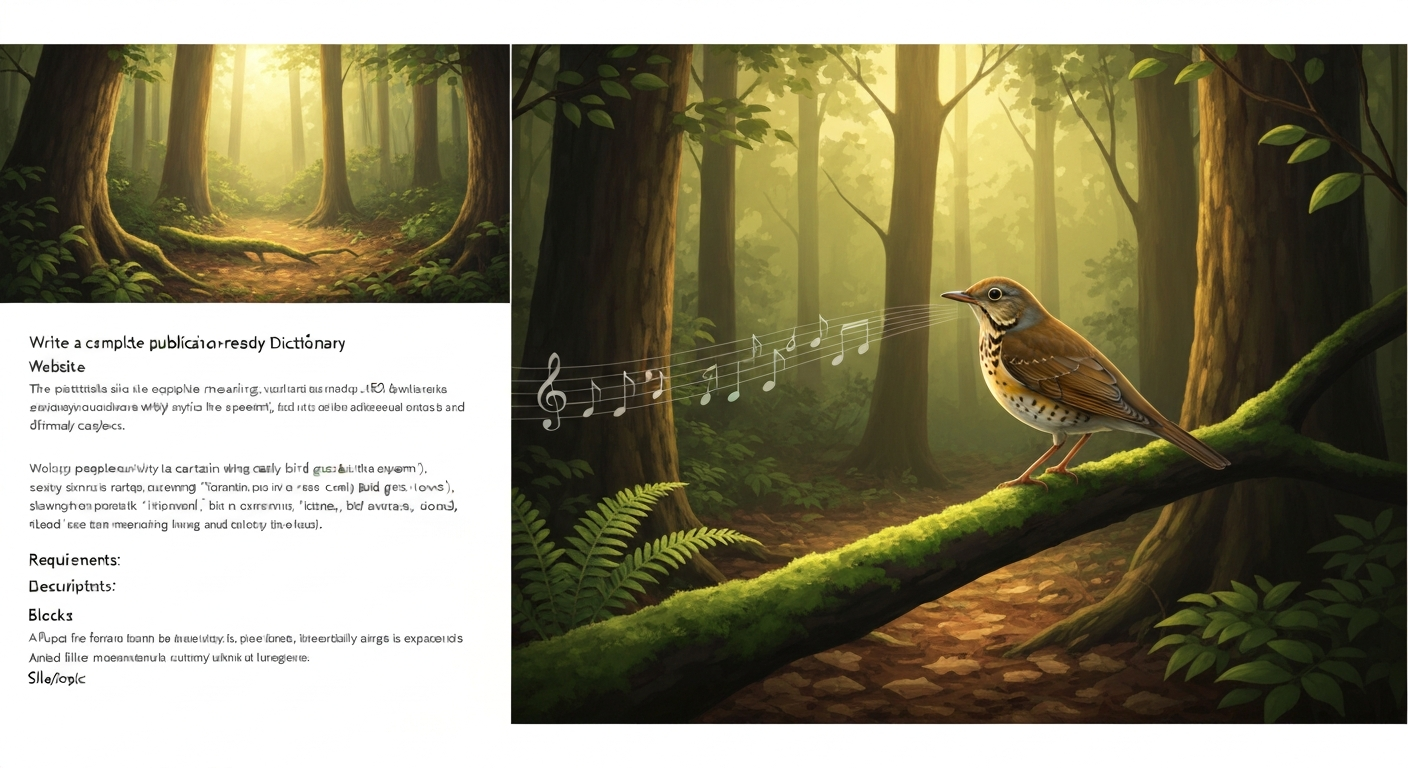
The Wood Thrush (Hylocichla mustelina) is arguably the species most strongly associated with the literary "wood-bird" tradition. Cornell Lab's All About Birds describes it as a deep-forest interior species with a flute-like, spiraling song that is widely regarded as one of the most beautiful bird calls in North America. It breeds in mature deciduous forest with a closed canopy and moist understory, and it winters in Central American forests. The Wood Thrush is currently classified as Near Threatened due to habitat loss, both its North American breeding forests and its Central American wintering habitat are under pressure.
White-breasted Nuthatch
The White-breasted Nuthatch is a compact, bold little bird that travels headfirst down tree trunks, probing bark for insects and cached seeds. It is a year-round resident in deciduous and mixed woodlands across most of North America. Its nasal "yank yank" call is a familiar sound in mature forest. Nuthatches are cavity nesters that depend on large, old trees, making them a reliable indicator of healthy woodland.
Blue Jay
The Blue Jay (Cyanocitta cristata) is one of the most recognizable woodland birds in eastern North America, with a bold blue-and-white plumage and a loud, varied voice. It is an oak-woodland specialist in many respects: Blue Jays are prolific acorn cachers, burying thousands of acorns per season and playing a documented role in forest regeneration. They are highly intelligent, social, and vocally complex, qualities that have made them prominent in both folklore and modern bird-watching culture.
Owl (various species)
Several owl species, including the Barred Owl, the Great Horned Owl, and the diminutive Eastern Screech-Owl, are prototypical woodland birds. They nest in tree cavities or old stick nests, hunt at night through forest edges and interiors, and are most often heard rather than seen. The Barred Owl's hooting call (often rendered as "who cooks for you") is one of the defining nocturnal sounds of eastern North American forests. Owls as a group occupy a special symbolic category that extends far beyond their ecological role.
What woodland birds have in common (ecologically)
- Habitat: mature or semi-mature forest and woodland, often with a mix of canopy, understory, and decaying wood. Interior-forest specialists (like the Wood Thrush) avoid forest edges; generalists (like the Blue Jay) tolerate them.
- Diet: highly varied across the group — insects in bark (woodpeckers, nuthatches), berries and worms in leaf litter (thrushes), cached nuts and seeds (jays), small mammals and birds (owls).
- Nesting: the majority use tree cavities, either self-excavated (woodpeckers) or pre-existing holes (nuthatches, owls, some jays). Cup nesters like the Wood Thrush place nests in shrubs or low tree forks.
- Sound: woodland birds are often detected by ear before eye. Songs and calls carry well through dense vegetation, and many species (thrushes, wrens, owls) have especially complex or far-carrying vocalizations.
- Seasonal behavior: some woodland birds are year-round residents (woodpeckers, nuthatches, jays); others are long-distance migrants (Wood Thrush travels to Central America each winter).
- Conservation pressure: interior forest birds are among the most affected by habitat fragmentation. Forest fragmentation increases nest predation and cowbird parasitism, and Wood Thrush population declines are well-documented in ornithological literature.
What each major woodland species symbolizes
Woodland birds as a group share some symbolic territory, but species-level symbolism can differ sharply. Here is a concise summary of the most common readings.
| Species | Core symbolic associations | Common in which traditions |
|---|---|---|
| Woodpecker | Persistence, determination, communication, drumming as a bridge between worlds, protective of trees | Native American (many nations), European folklore, Roman augury |
| Wood Thrush | Beauty, the soul of the forest, spiritual longing, pure wildness, summer and return | American Transcendentalist literature, general Anglo-American poetic tradition |
| Nuthatch | Resourcefulness, unconventional thinking (goes against the grain, literally), self-reliance | Primarily European and North American folk observation; less prominent in formal symbolism |
| Blue Jay | Boldness, intelligence, cunning, loyalty to community, a warning signal, trickster energy | Eastern Woodlands Native American traditions, contemporary North American folk symbolism |
| Owl | Wisdom, death, transition, the night, hidden knowledge, prophecy | Extremely widespread: European, Asian, Indigenous American, African, and Classical traditions |
What woodland birds mean as a collective symbol
Beyond individual species, woodland birds as a category carry a set of shared symbolic meanings across many cultures. Edward A. Armstrong's foundational study "The Folklore of Birds" (1958) documents how birds of the deep forest consistently occupy a liminal symbolic position: they inhabit a space between the human world and the wild, between the surface of the earth and the canopy above it.
The forest itself has long been coded as a threshold space in folklore and mythology, a place where normal rules shift, where you can receive messages from other realms, or where transformations occur. Birds that live there share that threshold quality. This is why wood birds so often appear in stories as messengers: they move freely through a space humans cannot fully navigate, and they carry information (a song, a drumming, a call in the night) from that unknown interior to the edge of the familiar world.
Woodland birds also function as seasonal signals. The return of the Wood Thrush to a northeastern American forest signals late spring. The drumming of a woodpecker in late winter signals the approach of nesting season. The first Barred Owl call of autumn feels, to many people in forested regions, like the forest announcing something. These seasonal cues have been read as meaningful messages by human cultures for as long as people have lived near forests.
- Messenger: carries communication between the human world and the wild or spirit realm.
- Guardian of the woods: a protector or representative of the forest itself, especially woodpeckers who physically maintain its structure by excavating cavities other species depend on.
- Seasonal herald: marks turning points in the year — arrival of spring migrants, start of autumn, onset of nesting season.
- Soul symbol: in multiple traditions, woodland bird songs (especially the thrush) represent the human soul, longing, or spiritual aspiration.
- Warning signal: a sudden silence of woodland birds, or an unusual call, is widely read in both folk tradition and practical wildlife observation as a sign of danger.
Woodland birds in Native American traditions
It is important to approach this area with care. Native American traditions are not a single unified system, they represent hundreds of distinct nations, languages, and cosmologies, each with their own specific relationships to birds and the forest. What a woodpecker means to the Ojibwe is not necessarily what it means to the Cherokee or the Haudenosaunee. Generalizations here should always be understood as introductory pointers, not authoritative summaries of any specific nation's teachings.
With that framing in place: woodpeckers appear in Eastern Woodlands traditions as beings connected to trees, the heartbeat of the forest, and protective energy. The drumming of the woodpecker is sometimes described as a form of prayer or communication with the spiritual dimension of the living forest. Blue Jays appear in several traditions as bold, sometimes trickster-adjacent figures, smart, loud, and not above a bit of deception, but also genuinely watchful and communally protective. Owls carry complex meanings that vary widely: in some nations they are associated with death and the spirit world, while in others they are protective figures or messengers of specific kinds of knowledge.
Regional variation matters enormously here. Forest-dependent nations of the Northeast and Great Lakes region developed deep relationships with interior woodland birds like the woodpecker and the thrush. Nations of the Pacific Northwest had their own woodland bird traditions centered on species like the Pileated Woodpecker and Steller's Jay. If you are researching the meaning of a specific woodland bird in a specific tradition, primary sources from within that nation are far more reliable than general summaries. The sibling article on native american water bird meaning covers analogous territory for aquatic species and handles the cultural framing in more depth.
Woodland birds in European and Asian traditions
European traditions have their own deep well of woodland bird symbolism. In ancient Rome, woodpeckers (picus) were sacred to Mars, the god of war, and were associated with protective forest spirits. The word "picus" is preserved in the scientific genus name for several woodpecker species today. Armstrong's "The Folklore of Birds" notes that woodpecker lore in Europe frequently connects the bird to thunder, rain, and the cyclical renewal of the forest.
The thrush family has an especially rich literary history in the British Isles. The Song Thrush and Mistle Thrush appear in English and Celtic poetry as emblems of wild song, seasonal return, and the ineffable beauty of the natural world. Thomas Hardy and Edward Thomas both wrote about thrushes as bearers of meaning in a landscape that humans can feel but not fully articulate. The Nightingale, though not strictly a "wood bird" in its common name, occupies this same symbolic niche in southern European and Persian literary traditions: a forest-edge bird whose song represents longing, beauty, and the gap between aspiration and reality.
In Japanese and Chinese traditions, the forest bird (broadly construed) appears frequently in painting, poetry, and garden design as a symbol of naturalness, transience, and the value of the wild. The Bush Warbler (Horornis diphone) in Japan, known as the uguisu, is the paradigmatic woodland songbird: its first call each spring is a culturally celebrated signal of the season's arrival. The cuckoo, a woodland species in European and Asian contexts, is deeply woven into poetry in both traditions as a messenger of longing and seasonal change.
Etymology and literary usage: how the phrase evolved
The compound "wood bird" follows a simple and very old pattern in English: "wood" used as an adjective meaning "of or belonging to the woods" joined with "bird." The Century Dictionary (late 19th to early 20th century) records the headword "wood-bird" with the definition "a bird that lives in the woods", clean, direct, and without elaboration. Wordnik, wood‑bird (Century Dictionary examples) reproduces Century Dictionary and literary citations (19th–early 20th century), showing the hyphenated form “wood‑bird” was commonly used in period literature Wordnik — wood‑bird (Century Dictionary examples). Dictionary.com similarly treats "wood" as an adjective in this use, with "wood bird" as a standard example of the pattern.
The hyphenated form "wood-bird" was standard in Victorian and Edwardian literary writing, following the convention of hyphenating adjective-noun compounds. By the mid-20th century, the open compound "wood bird" became more common in prose, and the closed form "woodbird" remained primarily poetic. Google Books and historical periodicals show the hyphenated form peaking in frequency roughly between 1850 and 1920, then declining as naturalness-writing shifted toward scientific naming. Today, "wood bird" in casual writing typically signals an informal or poetic register rather than a field-guide one.
In American Transcendentalist literature, the figure of the wood-bird was almost a shorthand for untouched nature and spiritual authenticity. Thoreau's journals are full of careful observations of woodland birds that carry implicit symbolic weight without the author needing to make the symbolism explicit. Ralph Waldo Emerson and John Burroughs both used woodland birds as touchstones for their arguments about the relationship between humans and wild nature. This literary tradition is part of why the phrase carries a certain poetic resonance even today, when someone uses it outside a technical context.
How "wood bird" compares to related terms
Understanding what "wood bird" means is also clarified by seeing what it is not. The phrase occupies a specific ecological and symbolic niche that sits differently from several related terms.
| Term | Habitat focus | Symbolic register | Typical context of use |
|---|---|---|---|
| Wood bird / wood-bird | Forest and woodland interior | Nature, liminality, forest spirits, seasonal signals | Literary, poetic, casual observation, folklore |
| Wild bird | Any natural (non-domesticated) habitat | Freedom, wildness, the untamed natural world broadly | Casual speech, conservation discourse, idiom ("wild bird" as opposed to pet) |
| Water bird | Aquatic and wetland environments | Transition, depth, emotion, fertility in many traditions | Field guides, folklore (especially Native American and Asian traditions) |
| Duck (bird) | Freshwater and coastal wetlands | Common, everyday, often comic or humble in symbolic use | Common name, idiom ("duck" in English slang), folklore |
| Native American water bird | Aquatic habitats in Indigenous contexts | Spiritual transit, ceremony, life force, clan symbols | Cultural and ceremonial contexts, Indigenous storytelling |
The wild bird meaning covers a broader and less habitat-specific category than wood bird. A wild bird is simply any non-domestic bird; a wood bird is specifically a creature of the trees and forest. For meanings related to water-associated species, see the article on duck bird meaning. This distinction matters when interpreting a phrase: "I heard a wild bird" could mean almost anything, while "I heard a wood bird" implies the forest context, and that context shapes the symbolic reading.
How to interpret a "wood bird" reference in practice
If you have come across "wood bird" or "wood-bird" in something you are reading, or you are trying to interpret a sighting or a dream, here is a practical framework.
- Check the context first. Is this a field guide, a poem, a novel, a folklore text, or casual speech? The register tells you whether the term is ornithological, symbolic, or informal.
- Look for species clues. If the text describes a song, a behavior, or a size, those details can narrow down which woodland species is being referenced. A flute-like spiraling song points to a thrush; loud drumming points to a woodpecker; a nighttime hoot points to an owl.
- Consider the region. Woodland bird species vary by continent and country. A Victorian English "wood-bird" is likely a thrush or a nuthatch. A 19th-century American one is more likely a Wood Thrush or a woodpecker. A Japanese reference to a forest bird probably means the uguisu or a cuckoo species.
- For symbolic readings, match the species to the tradition. Woodpecker symbolism in a Roman context is different from woodpecker symbolism in an Ojibwe context. Do not assume cross-cultural uniformity.
- For actual sightings: if you saw a bird in the woods and are wondering what it means, start by identifying the species (Cornell Lab's All About Birds is excellent for this), then look up that species' symbolic history specifically. The general "wood bird" meaning gives you a starting framework, but species-specific symbolism is always richer and more accurate.
- When in doubt, lean on the collective meaning: messenger, threshold-crosser, seasonal herald, forest guardian. These are the most broadly attested symbolic readings for woodland birds across cultures, and they hold up as a general interpretive lens even when the specific species is unclear.
A note on conservation and why it matters for meaning
The Wood Thrush is listed as Near Threatened by NatureServe and BirdLife International, with long-term population declines driven by forest fragmentation and loss of wintering habitat in Central America. Several other woodland interior birds show similar trends. This conservation dimension adds a layer to the symbolic meaning that would not have existed for a Victorian reader using the phrase "wood-bird." Today, calling something a "wood bird" or referencing the woodland bird as a symbol also evokes, consciously or not, a category of creature under real pressure. The forest guardian who was once taken for granted is now, in many regions, a species whose presence in a woodland signals that the habitat is still intact and healthy enough to support it. That is itself a kind of meaning. See the related article erosion bird meaning for how habitat erosion specifically alters woodland-bird symbolism.
FAQ
What does the term “wood bird” or “wood‑bird” literally mean?
Literally, “wood bird” (or hyphenated “wood‑bird”) denotes a bird that inhabits woods, woodlands, or forests. Usage appears in modern dictionaries as an open compound (e.g., “woodland bird”) and historically as a hyphenated/poetic form. Authoritative lexicographic support: Merriam‑Webster (woodland), Wiktionary (woodbird), The Century Dictionary (historical).
Which species are commonly meant by the phrase “wood bird” and why?
Commonly referenced species include woodpeckers (e.g., Pileated, Downy), wood thrush, nuthatch (e.g., White‑breasted), jays (e.g., Blue Jay), and owls (various forest species). These species are archetypal because they depend on wooded habitats, show characteristic behaviors tied to trees (drumming, foraging on trunks, canopy song), and are frequent in field guides and citizen‑science records for forests (Cornell All About Birds, National Geographic, eBird).
Can you give concise natural‑history notes for a few prototypical “wood birds”?
- Wood Thrush (Hylocichla mustelina): interior‑forest specialist; clear flute‑like song; breeds in mature deciduous/mesic forests (Cornell All About Birds). - Pileated Woodpecker (Dryocopus pileatus): large forest woodpecker; excavates large cavities and distinctive drumming; favors mature forests (NPS, Cornell). - White‑breasted Nuthatch (Sitta carolinensis): climbs tree trunks/branches headfirst while foraging; common in mixed/deciduous woods (Audubon/Cornell). - Blue Jay (Cyanocitta cristata): canopy/edge species of forests and woodlots; vocal, social, sometimes mimics raptors (Audubon). - Typical forest owl (e.g., Barred Owl): nocturnal predator of wooded habitats; distinctive hoots and territorial calls (Cornell/National Geographic).
What symbolic meanings are associated with woodland birds collectively?
Collectively, woodland birds often symbolize: - Liminality and the hidden (woods as threshold between settlement and wild). - Messengers or omens (movement between canopy and ground). - Natural wisdom, stealth, or secrecy (quiet forest life). These are generalized motifs found in folklore and literature where forest birds represent the mysterious or guiding aspects of nature (see Armstrong’s The Folklore of Birds).
What species‑specific symbolic readings exist for common “wood birds”?
- Woodpecker: persistence, rhythm, contact with the spirit of trees; sometimes a harbinger or messenger in Eurasian/North American folklore. - Thrush (e.g., Wood Thrush): poetic song, melancholy or pastoral beauty; often linked to spring/renewal. - Nuthatch: industriousness, cleverness (due to acrobatic foraging). - Jay: boldness, gossip, trickster qualities (noted in European and Native American stories). - Owl: wisdom, night‑watcher, but also omen of death in some cultures; ambivalent symbolism across regions. Sources: Armstrong (folklore), regional ethnographies, encyclopedic symbolism surveys.
How do cultural and folkloric traditions use woodland birds (examples from Native American and European/Asian contexts)?
- Native American: Woodland birds appear in clan systems, trickster narratives (e.g., corvids), and as spirit‑helpers or omen birds; meanings are nation‑specific and require consultation of tribal sources and ethnographies. - European: Thrushes and woodpeckers occur in pastoral poetry and medieval bestiaries; owls bear mixed omens. - Asian: Forest birds feature in Buddhist and Shinto symbolism (messengers, souls) and in folktales. Authoritative sources: Armstrong, ethnographic monographs, tribal oral histories and published cultural resources (consult tribe‑approved materials for accuracy). Context and local cultural authority are essential; meanings vary by group and time period.},{
Next Article
Native American Water Bird Meaning: Symbolism by Species
Native American water bird meaning: symbols of loon, heron, duck, swan, crane & tribal examples