The search phrase 'cuntimal bird' most likely refers to the razorbill (Alca torda), a striking black-and-white seabird of the North Atlantic. 'Cuntimal' is not a historical bird name or a regional dialect word, it is a 2025 internet slang portmanteau that went viral on X (formerly Twitter) and attached itself to the razorbill after wildlife photos of the bird spread widely online. If you landed here expecting a traditional folk name or a cultural symbol, the honest answer is: the word is brand new, intentionally crude, and entirely a product of internet meme culture.
Cuntimal Bird Meaning: Identification, Origins & Symbolism

Marcus Whitley
17 Jul 2026
What 'Cuntimal Bird' Likely Means
The word 'cuntimal' is a portmanteau, a word built by blending two existing words together. In this case: 'cunt' plus 'animal.' The resulting label was applied to the razorbill by social media users who found the bird's blunt, heavy-beaked appearance and deadpan facial expression darkly funny. The phrase 'New cuntimal just dropped' became a recognizable meme format on X in April 2025, with users posting wildlife photos of birds (and occasionally other animals) they found hilariously unimpressed-looking or aggressively ugly-cute. The razorbill became the mascot of this format.
KnowYourMeme formally documented the entry 'Razorbill (Cuntimal),' tracing its viral spread to wildlife photographer posts and a breakout tweet by user @SeeDaviGo in mid-April 2025. Within days, 'cuntimal' was being used as a broad category label, less a specific name for the razorbill and more a shorthand for any animal that looks like it has an attitude problem. But the razorbill remains the species most commonly associated with the term.
Misspelling, Dialect, or Neologism? How to Tell
When an unfamiliar bird term crosses your desk, it usually falls into one of three categories: a genuine historical name in another language or dialect (like 'surkhab' or 'kaur'), a phonetic misspelling of a real word (like 'coo bird' being a mishearing of 'coucal' or 'dove'), or a very recent internet coinage. 'Cuntimal' falls firmly in the third category. There is no ornithological record, no regional bird name registry, no folk taxonomy from any culture that uses this word. A search of Avibase, eBird, and Cornell Lab's All About Birds turns up zero results. The only attested uses are social media posts, meme galleries, GIF tags on Tenor, and a Solana cryptocurrency token minted under the same name, all of them from 2025.
It is also worth ruling out common misspellings. Could 'cuntimal' be a mistype of 'cantimal,' 'cunimal,' or something similar? Probably not, those aren't real bird names either. Could it be a phonetic rendering of a non-English word? Possibly, but no convincing match exists in any language's bird vocabulary. The most parsimonious explanation, backed by the evidence, is that someone on the internet coined it deliberately and the internet ran with it.
The Real Bird: Razorbill (Alca torda)
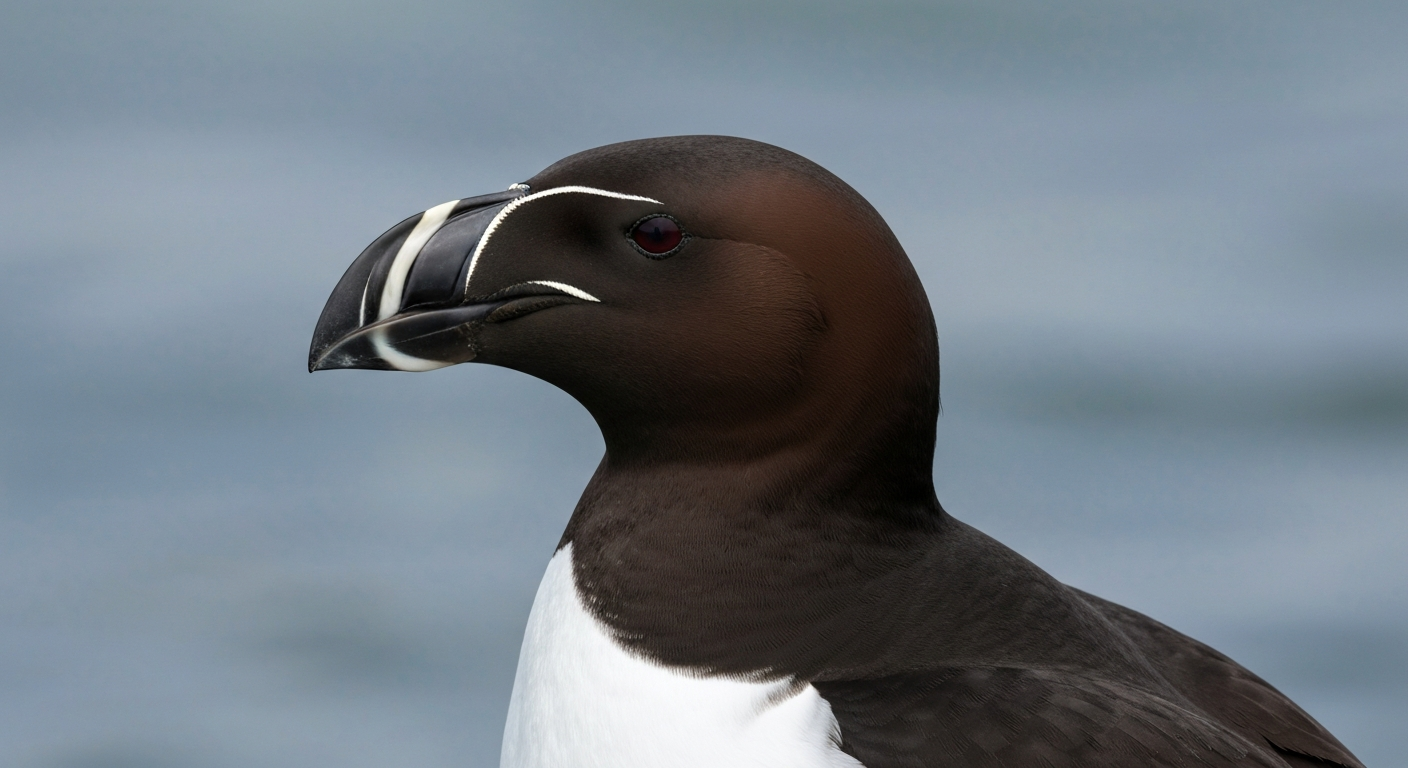
Set the slang aside for a moment and you have a genuinely fascinating bird underneath. The razorbill (Alca torda) is a medium-to-large seabird in the auk family (Alcidae), closely related to murres and the extinct great auk. For range, identification, and status information see Razorbill (Alca torda), eBird species overview Razorbill (Alca torda) — eBird species overview. Adults reach about 37 to 39 centimeters in length with a wingspan of roughly 63 to 68 centimeters. Their plumage is sharply divided: glossy black on the head, neck, back, and wings; bright white on the underparts. The feature that defines them, and that probably attracted meme-makers, is the bill, blunt, deep, laterally compressed, and marked with a distinctive white vertical stripe. They look, frankly, like they are not interested in your opinion.
Razorbills breed along rocky coastlines and sea cliffs of the North Atlantic, from eastern Canada and Maine across Iceland, the British Isles, Scandinavia, and into the Baltic. Outside of breeding season they spend their time entirely at sea, diving for fish (particularly sand eels, herring, and sprats) using their wings to 'fly' underwater. In the UK they are a familiar cliff-nesting bird; in North America they are more likely to be spotted offshore during winter. They are classified as Near Threatened by the IUCN, with populations facing pressure from overfishing and bycatch.
How to Pronounce 'Cuntimal' (and Nearby Terms)
There is no official pronunciation record for 'cuntimal' because it has never appeared in a dictionary. Based on standard English phonics and the way speakers use it in video clips and audio posts online, the most natural rendering is cun-TI-mal, with stress on the second syllable. The first syllable rhymes with 'sun' or 'fun,' the second is a short 'i' as in 'tip,' and the third is 'mal' as in the prefix meaning bad (though no such meaning is intended here). For reference: razorbill is straightforwardly RAY-zor-bill, and Alca torda is typically rendered AL-kuh TOR-duh in English ornithological usage.
A note for readers who are sensitive to offensive language: the first syllable of 'cuntimal' is intentional and explicit, it is the word 'cunt.' This article covers the term in its linguistic and cultural context without endorsing it. If you are reading this in a professional or family-friendly setting, it is worth knowing that the term is considered vulgar in American and Canadian English contexts, though its edge has softened in some online communities and in parts of British, Irish, and Australian English where the root word has a longer and more complex social history.
Etymology and Linguistic Origin
The word 'cuntimal' follows a well-worn meme-language formula: take a taboo or charged word, glue it to a neutral word, and produce something that is funny precisely because of the collision. The 'animal' half is obvious. The 'cunt' half carries more linguistic history than most people expect. In Old and Middle English, the word was anatomical and unremarkable, it appears in medical texts and place names without shame. Over centuries of social policing it became one of the most taboo words in American English, while in British, Irish, and Australian English it retained casual use as a general intensifier or even a term of affection between friends.
More recently, academic and journalistic writers have documented a reclamation process, particularly in queer and feminist online spaces, where the word is deliberately redeployed as an assertion of power or irreverence. Portmanteaus like 'cuntimal' sit in this tradition: they use the shock value of the word as part of the humor while simultaneously defanging it through absurdity. Applying it to a seabird is, linguistically, a way of saying 'this creature has an unbothered, unapologetic energy.' The meme format 'New cuntimal just dropped' plays on the consumer-culture trope of product launches, which adds another layer of ironic distance.
Cultural Symbolism and Folklore Around the Razorbill
Here is the honest truth: the razorbill does not carry the weight of mythological symbolism that ravens, crows, or cranes do. Razorbill (Alca torda), Wikipedia (species summary and names) lists common names such as razorbill, razor‑billed auk, and lesser auk, and treats the species primarily in ecological and taxonomic terms rather than as a widespread cultural symbol Razorbill (Alca torda) — Wikipedia (species summary and names). It is a seabird of rocky Northern Atlantic coasts, and the cultures that lived alongside it tended to regard it in practical rather than metaphysical terms. Icelandic and Norse coastal communities knew auks as food sources and indicators of fish-rich waters. In the British Isles, razorbills were part of the general category of seabirds associated with storms and the sea's unpredictability, but no specific, well-documented razorbill folklore is widely recorded in the way that albatross omens or robin superstitions are.
The bird's close relative, the great auk (Pinguinus impennis), carried more cultural resonance, it was hunted to extinction by the mid-19th century and has since become a symbol of human-caused species loss in conservation writing. The razorbill, as the great auk's nearest living relative, sometimes inherits a shadow of that symbolism in environmental circles. But as far as traditional folk beliefs go, it is not a bird you will find at the center of ritual, prophecy, or deep spiritual meaning the way some of its sibling-topic birds are.
Language, Idiom, and Slang Usage
In practice, 'cuntimal' functions as a category noun in internet slang, a label for any animal that projects a kind of aggressive indifference or looks aggressively unimpressed. The razorbill triggered the meme partly because of how it holds itself: upright, deadpan, bill jutting forward like it has somewhere to be and you are in its way. Social media users began applying the same label to other birds and animals with similar energy: puffins, capybaras, certain owls. The word has not crossed into spoken everyday language outside of very online communities, and it has not appeared in any published literary or journalistic text as of mid-2026.
Content warning, stated plainly: 'cuntimal' contains a word that is considered highly offensive in many contexts, particularly in American English. Use it in any formal, professional, or mixed-audience setting and expect a strong reaction. In online spaces where internet humor is the currency, it reads as irreverent rather than hostile, but context is everything. Readers who encounter this term in the wild should understand both the humor intended and the genuine offense it can cause depending on audience.
Modern Examples: Memes, Tokens, and Online Life
The clearest real-world examples of 'cuntimal' in use all come from digital culture. The viral moment was a tweet by @SeeDaviGo in April 2025 pairing a photo of a razorbill with the caption in the 'New cuntimal just dropped' format, this post was widely screenshot and reshared. Wildlife photographer account @roggio.wildlife was cited in connection with early images used in the meme's spread. On KnowYourMeme, the entry 'Razorbill (Cuntimal)' documents the meme's image gallery and spread timeline. GIF platform Tenor hosts animated clips tagged with the word. A Solana blockchain token was minted under the name 'Cuntimal,' representing the kind of meme-to-crypto pipeline that became common in 2024 and 2025 for viral internet labels. None of these constitute literary, artistic, or tattoo traditions, the term is too new and too niche for that kind of permanence yet.
How 'Cuntimal' Compares to Related Bird Terms
It is worth putting 'cuntimal' alongside some of the other unusual or unfamiliar bird terms that readers of this site search for, because the contrast reveals a lot about how bird language actually works. For a culturally rooted example, see the sankofa bird meaning, a mythic Akan bird symbolizing the wisdom of learning from the past. Terms like sankofa, surkhab, kaur, and sak yant bird all come from specific cultural and linguistic traditions, they carry centuries of meaning. For a detailed explanation of the kaur bird meaning, see the kaur bird meaning entry. 'Cuntimal' came from one viral tweet in April 2025. That does not make it uninteresting, but it puts it in a very different category.
| Term | Bird (if identified) | Origin | Type of Term | Cultural Weight |
|---|---|---|---|---|
| Cuntimal | Razorbill (Alca torda) | English internet slang portmanteau, 2025 | Viral meme neologism | Minimal; very recent, online only |
| Cuckoo / Kuku | Cuckoo (Cuculus canorus and relatives) | Old English / Onomatopoeia across many languages | Common name and idiom | High; symbol of madness, cuckoldry, spring, time |
| Coo bird | Dove / Coucal (context-dependent) | Phonetic / onomatopoeic | Folk / informal name | Moderate; peace, mourning, calm |
| Sankofa bird | Mythic Adinkra bird (linked to African grey heron) | Akan (Ghana/Ivory Coast) cultural symbol | Cultural/symbolic motif | Very high; wisdom, reflection, reclaiming heritage |
| Kaur bird | Uncertain; possibly dialectal South Asian name | Punjabi / South Asian linguistic heritage | Dialectal / folk name | Moderate; spiritual and cultural resonance |
| Surkhab bird | Ruddy shelduck (Tadorna ferruginea) | Persian / Urdu (surkhab = red water) | Classical literary/poetic name | High; Sufi poetry, beauty, dignity, loyalty |
| Sak yant bird | Phoenix-like sacred bird in Thai tattooing tradition | Thai / Southeast Asian Buddhist and animist tradition | Sacred motif / tattoo symbol | Very high; protection, power, spiritual blessing |
| Thick-knee / Dikkop | Thick-knee (Burhinus species) | Afrikaans (dikkop = thick head) | Common name with folk name layer | Moderate; omen of bad luck in southern African superstition |
The comparison makes one thing clear: most bird terms in this site's orbit carry real cultural depth built over generations. 'Cuntimal' is the outlier, a pure product of internet speed and humor. It is no less real as a linguistic phenomenon, but readers who arrive expecting ancient symbolism will find instead a bird that went viral for its face.
Practical Usage Examples
Here is what 'cuntimal' looks like in actual use, drawn from documented social media examples and the broader meme format:
- 'New cuntimal just dropped' — used as a caption under a photo of a razorbill or similarly dour-looking animal, mimicking consumer product launch announcements.
- 'Absolute cuntimal behavior' — applied to a clip of an animal acting aggressively or ignoring humans entirely.
- 'The razorbill is genuinely the original cuntimal. Look at that face.' — a typical explanatory post for followers unfamiliar with the term.
- On meme platforms, image galleries titled 'Best cuntimals' collect photos of animals deemed to have the required energy — stiff posture, unreadable expression, apparent contempt for the camera.
- In crypto communities: 'Just bought some $CUNTIMAL' — referring to the Solana token, entirely divorced from any ornithological meaning.
Image Suggestions for Editorial Use
If you are illustrating an article about the 'cuntimal bird,' the most useful images focus on the razorbill's distinctive appearance and the contrast between its formal-looking plumage and its deadpan expression. Suggested photo subjects and motifs include:
- A close-up portrait of a razorbill showing the full bill profile — the white vertical stripe and deep lateral compression are what gave the meme its visual hook.
- A razorbill colony on a sea cliff (Bempton Cliffs in Yorkshire and Látrabjarg in Iceland are well-photographed locations), showing the birds' upright, almost penguin-like posture.
- A razorbill in flight over grey Atlantic water, demonstrating the sharp black-and-white contrast of the plumage.
- A side-by-side comparison image of the razorbill and the extinct great auk (historic illustration), useful for context on the species' history.
- A screenshot-style graphic showing the meme format 'New cuntimal just dropped' with a blurred or stylized razorbill photo, if editorial policy allows meme-format imagery with appropriate content warnings.
Where to Go Next on This Site
If your curiosity about 'cuntimal' is actually curiosity about unusual bird names and what they reveal about language and culture, there are several rich directions to follow. The sankofa bird is one of the most symbolically loaded bird concepts on this site, a mythic Akan bird whose name literally means 'go back and get it,' representing the wisdom of learning from the past. The surkhab bird is a Persian and Urdu name for the ruddy shelduck, deeply embedded in Sufi poetry as a symbol of beauty and fidelity. For onomatopoeic bird names and how they work across languages, the cuckoo and kuku bird entries cover the same bird through different linguistic lenses. If superstition is what interests you, the thick-knee or dikkop bird entry explores southern African folk beliefs about a bird widely considered a bad omen. See the entry on superstition around the thick-knee bird, also known as the dikkop, for traditional meanings and local omens associated with it superstition around thick-knee bird also known as dikkop meaning. And the sak yant bird entry is a good starting point for understanding how birds function as sacred protective symbols in Thai tattooing tradition, about as far from a viral meme as you can get, and all the more fascinating for it. See the kuku bird meaning entry for an example of a regional bird name with cultural significance.
The Short Version
If someone searches 'cuntimal bird meaning,' they are almost certainly looking for the razorbill, a real, ecologically important North Atlantic seabird that became a viral internet meme in April 2025 when the portmanteau 'cuntimal' (cunt + animal) was applied to it on X/Twitter. The word is not a historical folk name, not a dialect term, and not a cross-cultural symbol. It is a piece of internet slang that reflects a broader online humor tradition of applying irreverent, taboo-adjacent language to animals perceived as having an attitude. The razorbill is a genuinely interesting bird that deserves attention on its own terms, and now, apparently, it also has a meme.
FAQ
What does “cuntimal bird” likely mean — is it a real bird name or a mistake?
Most evidence shows “cuntimal” is not an established ornithological name but a recent internet neologism / meme (2024–2025) applied to the razorbill (Alca torda). Major bird authorities (Avibase, eBird, Cornell All About Birds) do not list it; attestations come from social media and meme archives, so treat it as slang rather than a historical common name.
How should a Bird Meanings Dictionary entry identify the bird behind the term?
Identify the species first using authoritative sources: razorbill (Alca torda), also called razorbill auk or razor‑billed auk. Explain that “cuntimal” is an internet coinage frequently attached to photos/gifs of razorbills and flag it as slang/meme usage rather than a taxonomic name.
What is the etymology of the coinage “cuntimal”?
Reportedly a portmanteau of the slang word “cunt” + “animal.” Meme trackers (KnowYourMeme) and social posts indicate the term arose online as a deliberately coarse, humorous label. Because it uses an offensive/slur element, include a content warning and note that this is recent slang, not a traditional name.
How should pronunciation be presented in an editorial entry?
No authoritative pronunciation exists. Record an inferred English‑orthography pronunciation (e.g., cun‑TI‑mal or /kʌnˈtɪməl/) and clearly label it as reconstructed from spelling and social‑media attestations. Add a note advising readers the term is slang and potentially offensive.
Does “cuntimal” have cultural symbolism, folklore, or traditional meanings?
No traditional cultural symbolism is attested for the coinage. The razorbill itself has limited cross‑cultural folklore compared with species like ravens or albatrosses; most references are ecological/natural‑history. Any symbolic readings of “cuntimal” arise from meme culture, humor, and online identity play, not folk tradition.
Are there idiom, slang, or reclaimed‑language considerations to note?
Yes. The coinage leverages the slang word “cunt,” which has documented processes of reclamation in some queer/feminist contexts. Explain that use of the root is culturally charged: in some online subcultures it’s reclaimed/affectionate, while in many contexts it remains offensive. Editors should flag context and audience sensitivity.
Next Article
Coo Bird Meaning: What Cooing Bird Usually Refers To
What coo bird meaning means, which birds coo, and how its symbolism in love, peace, and homecoming shows up in speech.