
When people search 'hoopoe bird meaning,' they're usually asking one of two things: what does this bird symbolize culturally, or what does it mean that they just saw or heard one? If you are also curious about shoebill bird meaning, use the same two-step approach of cultural symbolism plus real-world sighting context.
Hoopoe Bird Meaning: Sound, Symbolism, and How to Identify It

Marcus Whitley
4 Jul 2026
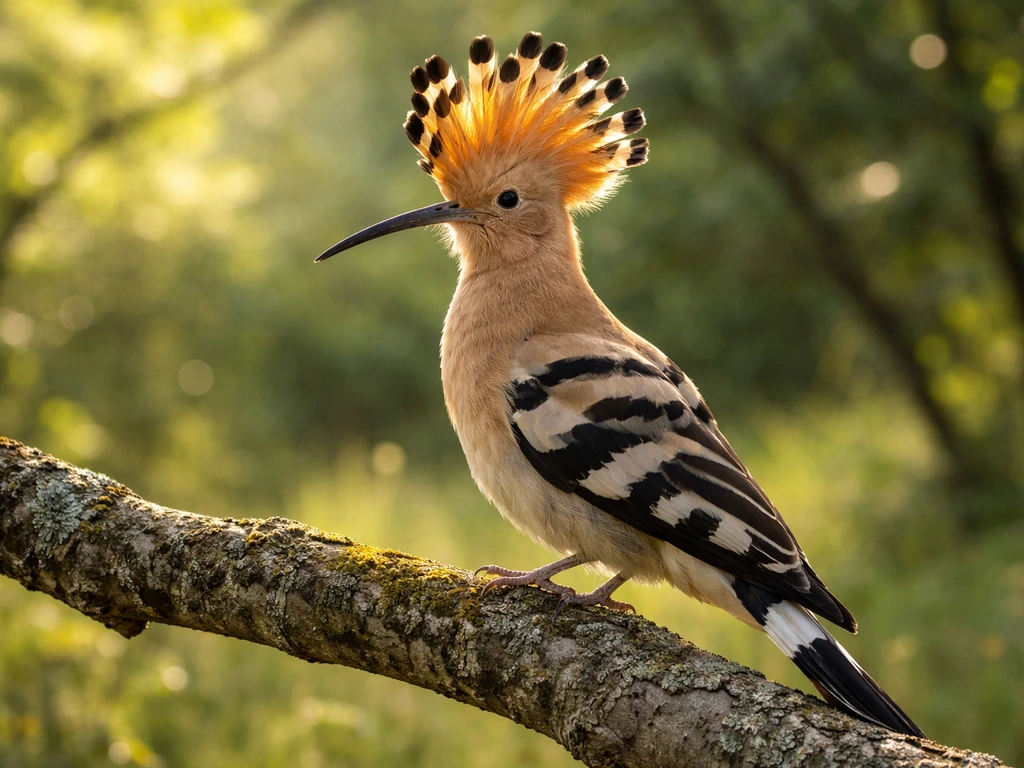
The honest answer is that the hoopoe is one of the most symbolically loaded birds on the planet, carrying meanings that range from divine messenger to herald of death depending on where you are in the world. Across Islamic tradition, Persian poetry, Jewish texts, and European folklore, the hoopoe consistently shows up as something more than just a bird.
At the same time, if you heard a strange rhythmic 'hoop-hoop-hoop' in your garden this morning, the sound itself is just the hoopoe's call, not a prophecy. This guide covers both angles: the rich symbolic meaning people assign to the hoopoe, and the practical tools you need to confirm you're actually looking at one before you start interpreting anything.
What 'hoopoe bird meaning' usually refers to

Most people searching this phrase fall into one of three camps. First, there are readers who spotted an unfamiliar bird with a spectacular fan-shaped crest and want to know what it is and what it 'means. ' Second, there are people who came across the hoopoe in a religious or literary context, such as the Quran, Persian poetry, or a fairy tale, and want to understand why this particular bird keeps showing up in important stories.
Third, some people heard a distinctive three-note call they couldn't place and found their way here through 'hoopoe bird sound meaning. If you're specifically trying to understand the potoo bird meaning, look for traditions or descriptions that use that exact bird name rather than hoopoe references hoopoe bird sound meaning. '
All three of these are legitimate entry points into hoopoe symbolism, and they're genuinely connected. [The hoopoe's name in English is itself onomatopoeic: it comes directly from the bird's call. ](https://tips. translation.
bible/tip_term/hoopoe/) Opaline bird meaning is similar in that people often connect these birds to symbolism, but the exact interpretation depends on the tradition and context hoopoe. Its scientific name, Upupa epops, does the same thing. So even the language around this bird is wrapped up in the sound it makes. The hoopoe is the only species in its family, Upupidae, which makes it unique in the bird world and probably contributes to its outsized cultural presence.
You can't confuse it with a cousin species the way you can with many birds.
Hoopoe symbolism across cultures and meanings in everyday language
No other bird in this size range carries quite as much symbolic freight across as many different traditions. The hoopoe's most prominent role in religious literature is in the Quran, where it appears as Hudhud, the messenger of the Prophet Solomon. In that story, the hoopoe carries reports between Solomon and the Queen of Sheba, functioning as a trusted communicator between rulers. This gives the hoopoe a core meaning of messenger, loyalty, and trusted intelligence that echoes through centuries of Islamic tradition and art.
Persian Sufi poetry took that messenger role and elevated it. In Farid ud-Din Attar's 12th-century epic 'The Conference of the Birds,' the hoopoe acts as the guide and leader for all the birds on a spiritual journey. It instructs the birds to cross seven valleys to reach the mythical Simurgh, making the hoopoe a symbol of wisdom, spiritual leadership, and the guide who has already traveled the path. This is where 'hoopoe meaning' gets deeply layered: the bird isn't just a messenger passing information from A to B. It's a figure who knows the way and can lead others toward enlightenment.
Jewish tradition has its own relationship with the hoopoe. The Talmud refers to the bird as 'the wild cock' (Gittin 68b), a name attributed to its distinctive erectile crest. And in ancient Egypt, the hoopoe was associated with gratitude and filial piety, believed to care for its aging parents, which made it a symbol of loyalty and family devotion in that cultural context.
European folklore tells a more complicated story. In Estonia, the hoopoe's song is considered an omen of death, either for people or cattle. This stands in sharp contrast to the messenger-of-wisdom reading from the Middle East and Central Asia. It's a good reminder that bird symbolism is intensely regional: the same bird can mean divine guidance in one tradition and bad luck in another. Neither meaning is the 'correct' one; they're cultural readings layered onto a bird that happens to be striking enough to attract attention.
In contemporary everyday language, the hoopoe pops up in a few practical ways. There's a German expression, 'Du stinkst wie ein Wiedehopf' (you smell like a hoopoe), which references the bird's real biological trait of producing a foul-smelling secretion as a defense mechanism. That's a case where the hoopoe's biology became idiom, not unlike how other birds have entered everyday speech in specific cultures. The bird is also a national symbol of Israel, chosen in 2008 in a public vote, which gives it contemporary civic meaning beyond folklore.
Hoopoe identity: how to confirm you're seeing a hoopoe
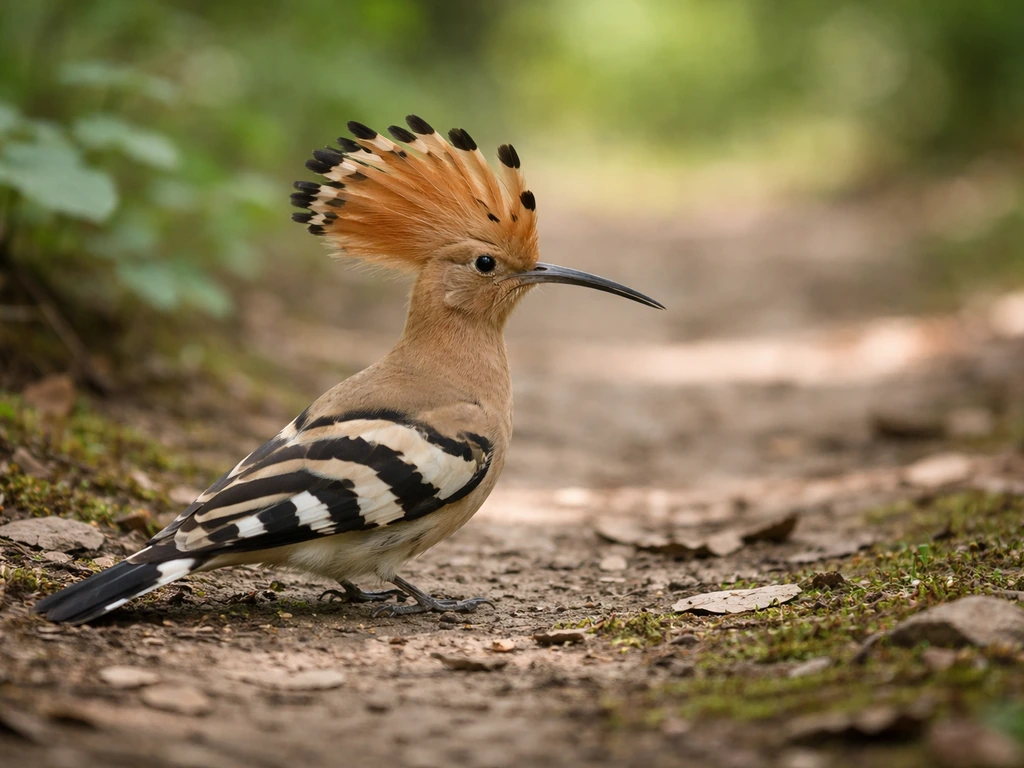
Before you run with any symbolic interpretation, it's worth making sure you're actually looking at a hoopoe. The good news is that the RSPB and BTO both describe this bird as 'unmistakable,' which is a rare word in birding. RSPB provides key field marks for hoopoes, including a black downcurved bill, striking black-and-white wings, and a pinkish-brown crest raised when excited. The field marks are distinctive enough that if you're seeing all of them together, there's very little chance of a mix-up.
- Size: roughly that of a Mistle Thrush, about 12 inches (30 cm) in body length
- Crest: a large, fan-shaped crest of cinnamon-pink feathers tipped in black, which the bird raises when excited and lowers at rest
- Bill: long, thin, and slightly downward-curving, used for probing the ground
- Wings and tail: striking black-and-white zebra striping on the wings and tail, visible in flight and at rest
- Body color: warm pinkish-brown or rufous on the head and breast, contrasting with the bold wing pattern
The crest is the clincher. No other bird in Europe, the Middle East, or South Asia has that specific combination of a fan-shaped erectile crest, black-and-white barred wings, and a long downcurved bill. Wikipedia notes that the crest can be raised or lowered at will, and you'll often see it fanned out fully when the bird lands or when it's alarmed. Reddit birding threads are full of people posting photos and asking 'is this a hoopoe?' and the answer is almost always yes once the crest is visible, because the identification is genuinely that clean.
In terms of where to find one: hoopoes breed across northwestern Africa, Madagascar, the Middle East, southern Europe, and southern Asia. They favor open land for foraging and nest in cavities, whether in trees, walls, buildings, or even termite mounds. In the UK and other parts of northern Europe, they show up primarily as migrants during spring and autumn passage, with the highest numbers recorded in April and September. If you're in one of these areas during those windows and you see an extraordinary-looking crested bird probing the ground, there's a strong chance it's a hoopoe.
One note on naming: 'wood hoopoe' refers to a completely different group of birds in Africa. The common hoopoe (Upupa epops) is its own unique species with no close relatives, so if someone mentions a 'wood hoopoe' or another variation, they're talking about something entirely distinct in terms of biology and symbolism.
Hoopoe calls and 'sound meanings': what people interpret from hearing it
The hoopoe's call is one of the most distinctive sounds in European and Asian birding. It's a soft, rhythmic, low-pitched 'hoop-hoop-hoop' (sometimes written as 'oop-oop-oop'), repeated in sequences of two to four notes. If you've never heard it, think of a hollow, slightly muffled quality, carrying well across open ground. Reddit birders consistently describe it as 'Hoop hoop hoop,' which matches the research literature closely. Peer-reviewed work on hoopoe vocalizations identifies this call primarily as a male advertisement song used during breeding and social contexts.
Here's the thing about 'hoopoe sound meaning' as a search query: most people asking this question are either trying to identify the call they just heard, or they've encountered the folkloric idea that hearing a hoopoe has supernatural significance. If you also meant Phoebe bird meaning, the idea can shift depending on tradition and context hoopoe sound meaning. Both are reasonable things to be curious about.
The practical answer to the first question is straightforward: if you heard a soft, repetitive three-note call near open farmland or woodland edge, especially between spring and autumn, there's a real chance it was a hoopoe. The call is directly linked to the bird's name in virtually every language, because humans noticed the connection between the sound and the name long before scientific ornithology existed.
As for the folkloric meanings attached to hearing the call: these vary enormously by region. In Estonian tradition, the hoopoe's song is considered an ill omen. In Islamic tradition, the hoopoe as Hudhud is a trusted carrier of important messages, so hearing one could be framed symbolically as receiving a communication. In Attar's poem, the hoopoe's voice is the voice of the guide calling the community forward. Which meaning you encounter depends almost entirely on which cultural tradition you're reading within, and none of these symbolic meanings are built into the sound itself. The bird is calling for practical, biological reasons.
Common misconceptions and how to interpret the meaning responsibly

The biggest misconception I run into around the hoopoe is treating one cultural reading as the universal meaning. The hoopoe is simultaneously a divine messenger in Islamic tradition, a symbol of wisdom and spiritual guidance in Persian Sufi poetry, a death omen in Estonian folklore, and a comic figure of bad smell in German idiom. These are not contradictions to resolve; they're evidence that a conspicuous, widely distributed bird gets noticed and interpreted by different communities in different ways. If someone tells you 'the hoopoe always means good luck' or 'it always means death,' they're flattening a much richer and more variable tradition.
A second misconception is treating the call as inherently meaningful rather than biological. Research on hoopoe vocalization frames the 'hoop-hoop-hoop' call as a communication tool used by males in social and breeding contexts. It's not random noise, but it's also not a forecast. When you hear a hoopoe calling, the bird is most likely broadcasting its presence to other hoopoes, not delivering a message to you. The symbolic layer people add to that sound is a cultural product, not a natural-history fact.
Third, be careful about name-based confusion. Searching 'hoopoe bird meaning' sometimes pulls up results about the khope bird, which is a related topic with its own distinct set of associations in certain regional traditions. Once you locate the correct cultural tradition, you can look up the specific khope bird meaning tied to that usage. Similarly, terms like 'papiha bird' in Urdu and Hindi poetry refer to a different species entirely, even though they're sometimes discussed in similar symbolic contexts involving longing and separation. If you're researching a specific literary or cultural reference and the name sounds like hoopoe but isn't spelled that way, it may be worth cross-checking before assuming the symbolism is identical.
Where to apply the meaning: sayings, metaphors, and practical examples
In literary and metaphorical usage, the hoopoe most often appears in one of these roles: If you are also trying to decode a peasant meaning bird claim, it helps to start with the exact wording and source before assigning symbolism.
| Context | Role of the hoopoe | Key source tradition |
|---|---|---|
| Islamic religious literature | Hudhud: trusted messenger between rulers | Quran (Surah An-Naml) |
| Persian Sufi poetry | Spiritual guide leading birds through seven valleys | Attar's 'Conference of the Birds' |
| Jewish/Talmudic texts | 'Wild cock': distinctive crested figure | Talmud (Gittin 68b) |
| Estonian folk tradition | Omen of death for people or livestock | European folklore |
| German idiom | Byword for bad smell ('stinkst wie ein Wiedehopf') | German language tradition |
| Modern civic symbolism | National bird of Israel (elected 2008) | Contemporary cultural identity |
In practical conversation, if you're reading a text that references a hoopoe, the most useful question to ask is: what tradition is this text coming from? A hoopoe in a Persian poem is almost certainly invoking Attar's framework of spiritual guidance. A hoopoe in an Islamic narrative context is almost certainly Hudhud, the messenger. A hoopoe in a Central European folk story might be carrying the opposite valence entirely. Opila bird meaning is another example of how people assign symbolic interpretations to a specific bird carries the opposite valence. The bird's meaning shifts with the cultural context, and knowing that upfront saves a lot of interpretive confusion.
If you're writing or speaking metaphorically and want to invoke the hoopoe, the most broadly recognized meaning across traditions is some version of 'trusted messenger' or 'guide who knows the way.' That reading crosses Islamic, Persian, and Egyptian traditions and is less likely to land badly than leaning into the Estonian death-omen angle, unless you're specifically working within that tradition.
Next steps: how to look up the right cultural meaning for your region
If you want to go deeper on the specific hoopoe meaning relevant to your context, here's a practical approach. Start by identifying where the reference comes from: is it a religious text, a poem, a folk saying, a sighting in the wild, or a dream? Each of those entry points has a different best research path.
- For Islamic or Quranic references: search 'Hudhud Quran meaning' alongside the surah (An-Naml, chapter 27). Most Islamic studies resources will give you the specific narrative and its interpretive tradition.
- For Persian literature: look up Attar's 'Conference of the Birds' (Mantiq al-Tayr) in translation. The hoopoe's role as guide is central to the whole poem, and reading even a summary gives you the context you need.
- For European folklore: specify the country or region. Estonian, German, and Mediterranean traditions all differ significantly. Search 'hoopoe folklore [country name]' and cross-reference at least two sources.
- For a live sighting or heard call: use eBird's range maps to check whether hoopoes are recorded in your region during the current season, then compare your observation against the field marks listed above. If you're in the UK, BTO Birdfacts has the most useful migration timing data.
- For literary or metaphorical usage in another language: check whether the word being used (Hudhud in Arabic, Wiedehopf in German, Upupa in Italian) carries specific cultural weight in that language, since the symbolism sometimes differs even when the bird is the same species.
- For dream or spiritual interpretation: be aware that these meanings are almost entirely tradition-specific and not universal. Find a source grounded in your own cultural or religious background rather than relying on generic 'bird meaning' sites that blend traditions without flagging the differences.
The hoopoe is one of those rare birds where the practical identification and the symbolic meaning reinforce each other beautifully. A bird this distinctive, with a call this memorable, was always going to attract stories. The key is knowing which story you're inside before you start interpreting what you saw or heard. Get the identification right first, locate the cultural tradition that's relevant to your context, and the meaning will follow cleanly from there.
FAQ
If I hear a hoopoe in my area, does it automatically mean something supernatural?
In most daily-life contexts, the safest approach is to treat a hoopoe as a natural event unless you can tie the story to a specific tradition you are explicitly using (for example, Estonian folklore for the death omen, Islamic Hudhud for messenger meaning). The bird call itself is not predictive, it is primarily a communication signal during breeding and social interactions.
How can I tell whether a “hoop-hoop-hoop” call is really a hoopoe if I never see the bird?
Yes, if you rely on sound alone you can get misled by other low, repetitive calls. Use the crest and bill shape to confirm: hoopoes have a fan-shaped erectile crest plus barred black-and-white wings and a long downcurved bill. If you do not clearly see the crest, wait for better light or a moment when the bird lands and raises it.
What does “hoopoe bird meaning” mean in dreams?
For symbolism, dreams are usually interpreted through the same cultural lens as literature, not through biology. If your dream context echoes a specific tradition (for example, Hudhud-style messenger stories), then that tradition’s “meaning” is more relevant than generic internet claims. Also note that many “prophetic dream” interpretations are speculative, so it helps to pair dream interpretation with real-world context.
What are the most common visual mix-ups when people try to identify a hoopoe?
If you see a crested bird with a similar silhouette, the “crest plus barred wings plus downcurved bill” combination is the quick check. Hoopoes also commonly probe the ground for food and nest in cavities, including walls and buildings. If the bird is acting like a different ground specialist, or the patterning does not match, pause before adopting hoopoe symbolism.
Does the hoopoe call mean the same thing year-round, or does it change by season?
Not always, because the call you hear can vary by season and by the bird’s role. A male advertisement song is common during breeding and social periods, so if you hear more frequent calling in spring and early autumn, that fits the breeding and passage context rather than a special “message.”
Why do different sources give the hoopoe opposite meanings?
Avoid “universal meaning” statements like “the hoopoe always means death” or “it always means good luck.” The article highlights that regional traditions assign opposite valences to the same species. A good decision aid is to write down where the claim came from (country, language, story source) before you decide which hoopoe interpretation to use.
Is “wood hoopoe” the same as the hoopoe in hoopoe bird meaning stories?
No. “Wood hoopoe” refers to a different group of African birds, so symbolism and identification details do not reliably carry over to the common hoopoe (Upupa epops). If your source uses “wood hoopoe” specifically, treat it as a separate subject rather than a synonym.
What should I do if the text I’m researching spells the bird name differently than “hoopoe”?
Yes, name-similar birds can derail research. The article mentions spelling and name confusion such as “khope” or “papiha,” which may point to different species and different literary associations. When researching a quoted text, match the exact bird name as spelled and as used in that language or region.
Can location and season help confirm hoopoe meaning during a real sighting?
In most real sightings, the strongest practical clue is location and timing: hoopoes breed across parts of North Africa, the Middle East, southern Europe, and southern Asia, and in many northern regions they show up mainly during spring and autumn passage. If the sighting is far outside expected migration or habitat, recheck the ID before applying symbolism.
If I want to use hoopoe symbolism in writing, which interpretation is safest to use without offending the “wrong” tradition?
If you want a “safe” symbolic angle for writing or conversation, use the broadly shared themes of trusted messenger or guide who knows the way, because those show up across multiple traditions. If you need the death-omen valence, do not generalize it, instead choose a context that clearly draws from the relevant regional folklore.
Next Article
Shoebill Bird Meaning: Symbolism, Myths, and Context
Explore shoebill bird meaning in symbolism, myths, and everyday metaphor, plus how to interpret context in art or wildli