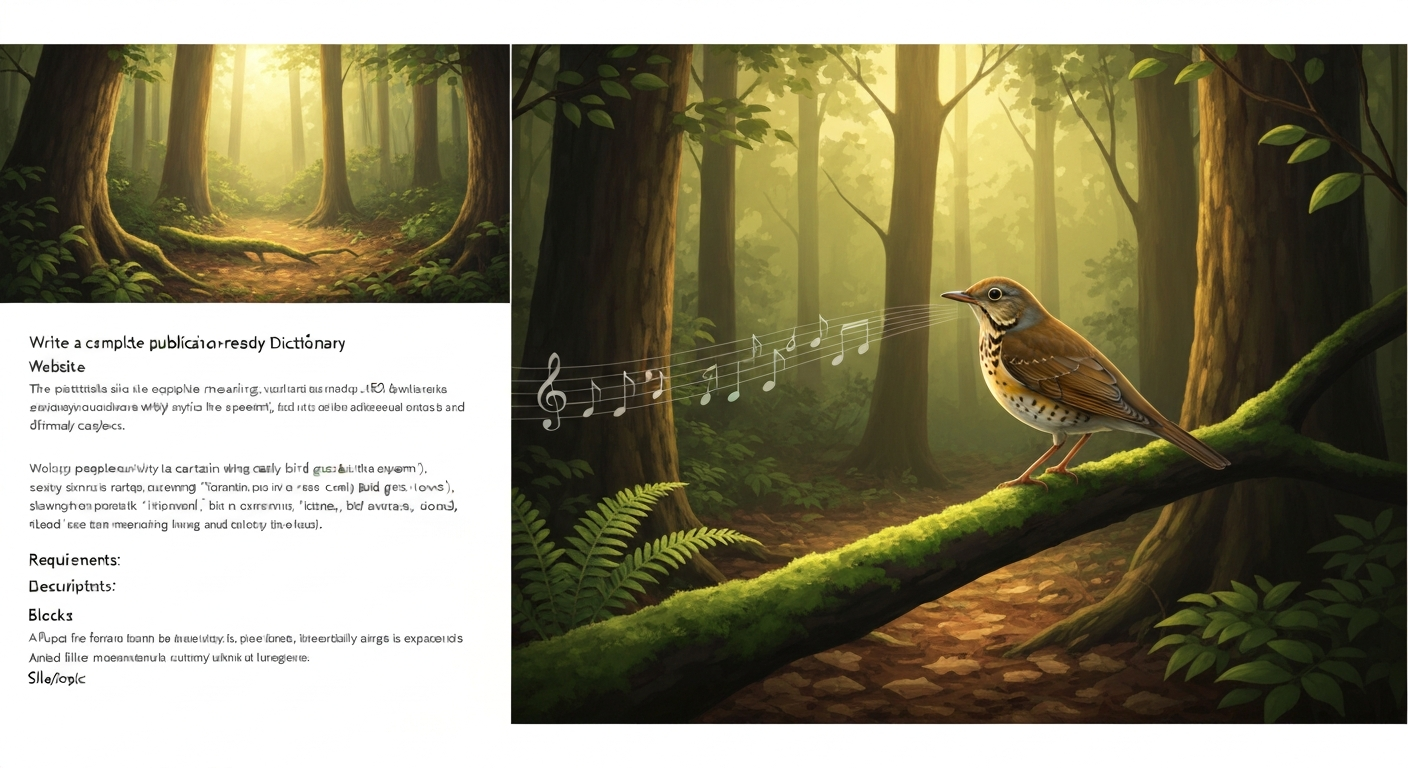
"Erosion bird" does not have one fixed meaning. Most people searching this phrase right now have encountered the Erosion Bird meme: an AI-generated creature that first went viral on TikTok in September 2023, created by @drevfx, and sometimes called the Opium Bird or 2027 Bird. That is genuinely the dominant use of the phrase today. But the two words can also be read literally, pointing to real ecological science about seabirds that physically cause or accelerate erosion through burrowing, guano, and colony activity. Understanding which meaning applies in your context is the whole job of this article.
Erosion Bird Meaning: Literal, Symbolic, and Origins

Marcus Whitley
22 Jul 2026
Where you might encounter the phrase
The phrase turns up in very different places, and the setting tells you almost everything about which meaning is intended. Here are the main contexts you are likely to bump into it.
- TikTok, Reddit, and social media: this is where the meme lives. Posts tagged #erosionbird or #opiumbird typically feature the original AI images or user-made variations, faux nature documentary voiceovers, or fan art. If you saw a strange-looking, vaguely decayed or melting bird image with a cryptic caption, you are in meme territory.
- Gaming and fan communities: Minecraft skins, Roblox Creator Store assets, Newgrounds uploads, and print-on-demand merch (Redbubble, for example) all carry the Erosion Bird label. Here it functions as a brand or character name borrowed from the meme.
- Ecology, conservation, or environmental writing: a paper, report, or article discussing how seabird colonies destabilize cliff faces, accelerate soil loss, or alter island geomorphology may use the phrase descriptively. This is the literal ecological reading, and it comes loaded with scientific specifics.
- Poetry, fiction, or song lyrics: a writer may use 'erosion bird' as a metaphor for gradual loss, decay, or the passage of time. Context clues like figurative language, emotional tone, or a clearly invented setting signal this use.
- Place names, project nicknames, or local slang: occasionally a restoration project, a geographic feature, or a community nickname gets tagged 'Erosion Bird.' These are one-offs, and the only way to confirm meaning is to check the local source directly.
The literal side: birds that actually cause erosion
Before the meme existed, the two words 'erosion' and 'bird' had a perfectly real relationship in ecology. Burrowing seabirds, cliff-nesting colonies, and heavy guano producers all alter the physical landscape around them in measurable ways, and researchers have been documenting this for decades.
Burrowing seabirds and topsoil loss
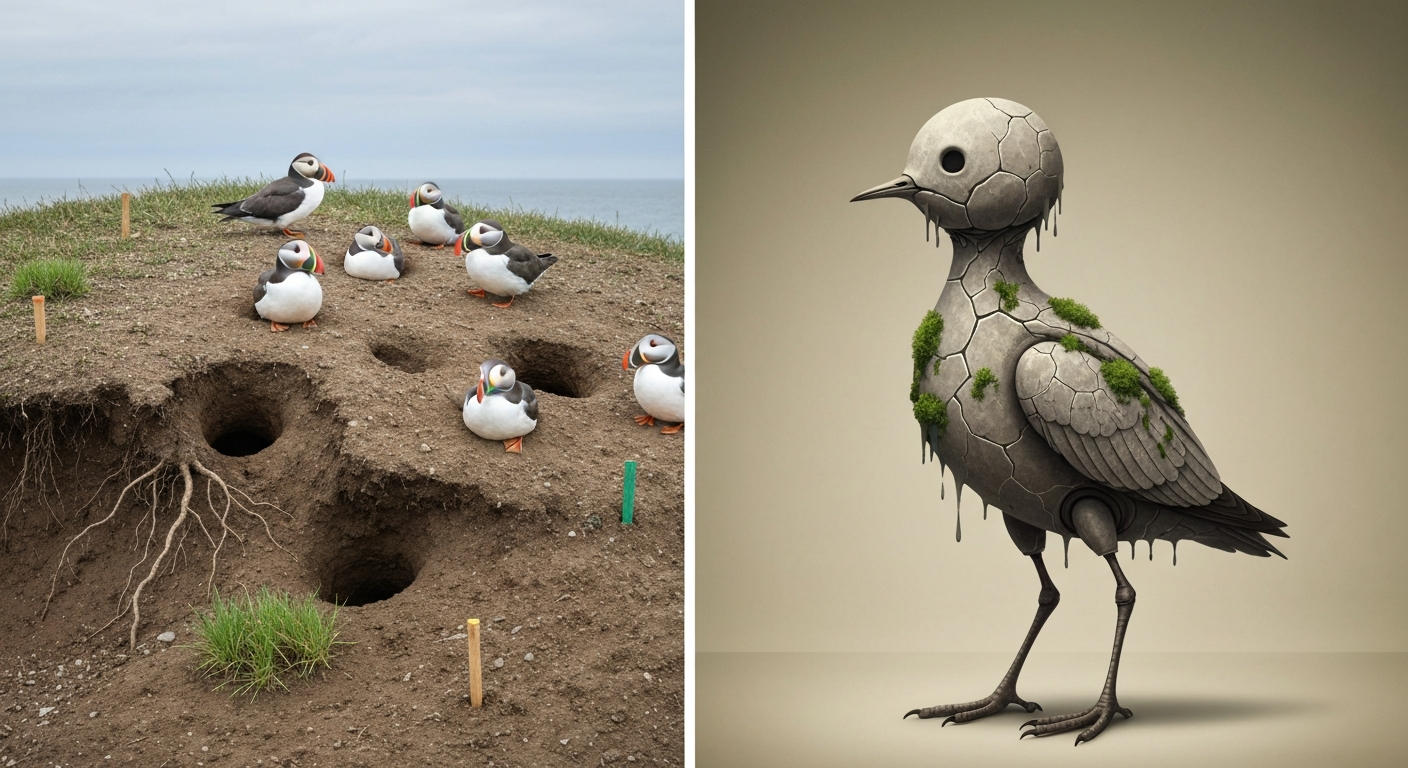
Species like puffins, shearwaters, petrels, and storm petrels dig nesting burrows that can riddle an island's topsoil so densely that the surface becomes structurally unstable. At Año Nuevo Island off the California coast, land managers have documented burrow collapse and measurable topsoil loss linked directly to intense burrowing activity. Restoration projects there have used native plant re-establishment and sea lion exclusion to stabilize soil and reduce ongoing burrow collapse. The USGS has similarly tracked cyclical fluctuations in burrowing seabird habitat on the Oregon coast tied to marine-driven erosion and recovery cycles, treating bird-driven substrate change as a legitimate geomorphic variable.
Guano, chemistry, and soil degradation
Dense seabird colonies produce enormous quantities of guano, which loads soil with nitrogen and phosphorus at concentrations that can acidify the substrate, kill off stabilizing vegetation, and leave bare soil exposed to wind and rain erosion. A 2017 study in Nature Communications established seabird colonies as significant global drivers of nitrogen and phosphorus cycling. Follow-up research published on ScienceDirect examined how protected colonial birds actually degrade soil microbial communities over time, a finding that cuts against the intuition that bird presence is always ecologically positive. Chemically altered soils without plant cover erode faster, so the guano effect is a genuine pathway from birds to accelerated erosion.
Penguins as a case study in bioerosion
A 2024 PubMed study on Magellanic penguins at Martillo Island (Argentina) directly measured bioerosion at burrow sites across different colony zones and linked erosion levels to local population trends. The finding matters because it shows erosion is not just a side effect of bird presence but can feed back into the birds' own breeding success: heavily eroded burrow sites become unusable, influencing where colonies concentrate over time. That feedback loop, bird causing erosion, erosion affecting bird, is what makes these species genuinely ecological agents of landscape change.
Cliff-nesting colonies and slope instability
Colonial nesters on sea cliffs, including kittiwakes, guillemots, and razorbills, contribute to cliff erosion through physical disturbance, root damage from nesting activity, and concentrated guano that chemically weathers rock faces. Conservation agencies including NatureScot and the RSPB monitor cliff instability at major seabird colonies as part of standard habitat management. Erosion at these sites is treated as both a threat to the birds and, in some cases, a consequence of the birds themselves. It is worth noting that this topic connects naturally to discussions of wild bird behavior and habitat, since colony-scale landscape effects are part of what makes wild seabird populations ecologically significant. See wild bird meaning for a concise glossary entry on how 'wild bird' is used in ecology and common language.
The metaphorical and literary side
Birds have carried symbolic weight for thousands of years, and erosion as a metaphor for gradual loss, memory fading, identity wearing away, or time doing its quiet damage is a staple of poetry and literary prose. When a writer brings the two together, the result is usually intentional and layered. For a related figurative use of avian imagery, see wood bird meaning for how 'bird' metaphors map onto landscape and decay.
In this symbolic register, an 'erosion bird' might represent something beautiful that diminishes over time, a relationship, a landscape, a version of yourself. The bird, usually associated with freedom, flight, and ephemerality, becomes a vehicle for the idea that even free things are not permanent. You see this kind of construction in elegies and environmental writing, where birds are used to personify ecosystems in decline. A poem about a coastline disappearing might feature a bird that returns year after year to a shrinking shore. The bird is not literally causing erosion; it witnesses it, embodies it, or is consumed by it.
The metaphorical reading also connects to broader bird symbolism traditions. Cultures from Norse to Native American to East Asian have used birds to represent the soul, the passage of time, or the boundary between the living world and whatever lies beyond it. A bird associated with erosion in this context could easily carry connotations of transformation, endings, and the inevitability of change, things that wear away rather than break suddenly. If you are reading a poem or a piece of literary fiction that uses the phrase, that is almost certainly the register in play.
Etymology, origins, and common mix-ups
The word 'erosion' comes from the Latin erosio, from erodere (to eat away), itself from ex- (out) and rodere (to gnaw). 'Bird' is Old English, bridd in its earliest form, originally meaning a young bird or nestling before it generalized to all birds. As a compound, 'erosion bird' has no dictionary headword in any major printed lexicon. It did not appear in books or formal writing before the 2023 meme, and searches of historical corpora turn up nothing. A Google Books search for the exact phrase 'erosion bird' returns no matches in scanned books, supporting the lack of prior printed‑book attestation Google Books (search negative result for phrase 'erosion bird'). The phrase is genuinely new, which is part of why it generates so much search traffic: people encounter it and have nowhere obvious to look it up.
A common confusion worth flagging: people searching for an unfamiliar bird name sometimes mishear or misread 'Eurasian' as something else entirely. 'Eurasian' bird names (Eurasian Jay, Eurasian Wigeon, Eurasian Kestrel) are genuinely common in field guides and birding content. If you heard 'erosion bird' in spoken conversation and are wondering whether it might be a real species name you misheard, the honest answer is: probably not. There is no widely documented species whose common name is 'Erosion Bird.' What you most likely heard was either the meme reference or, possibly, a colloquial nickname for a locally notable burrowing or cliff-nesting species. Checking a regional field guide or asking in a local birding forum is the fastest way to resolve that kind of mishearing.
The meme in depth: TikTok's Erosion Bird
The specific Erosion Bird that most people are searching for originated on TikTok on or around September 12, 2023. A creator going by @drevfx (also known as Dre) posted AI-generated images of a strange, unsettling bird with a texture that looked crumbling or decayed, somewhere between a living creature and a deteriorating sculpture. Daily Dot documented that the first viral TikTok posts appeared in mid‑September 2023 and identified @Drevfx (Dre) as the creator of the AI images later called 'Erosion Bird' Daily Dot documented that the first viral TikTok posts appeared in mid‑September 2023 and identified @Drevfx (Dre) as the creator of the AI images later called 'Erosion Bird'.. The images spread rapidly under hashtags including #erosionbird, #opiumbird, and references to '2027' (the latter playing on a broader TikTok meme imagining what a surreal 2027 might look like).
KnowYourMeme and the Daily Dot both documented the origin and spread within weeks. What made the Erosion Bird specifically sticky was its visual ambiguity: the images looked like something that should exist in a nature documentary but clearly did not. Arts and culture outlet Hyperallergic described the phenomenon as Rorschach-like, meaning users projected their own associations onto it, decay, dread, absurdist humor, melancholy. That interpretive openness is a hallmark of effective memes, and it explains why the Erosion Bird spawned so many variations.
Reddit communities, particularly r/midjourney, picked up the concept quickly. Users shared AI generation prompts, created faux nature documentary videos with authoritative-sounding voiceovers describing the Erosion Bird as though it were a real species, and posted galleries of variations. Social and grassroots evidence: Reddit threads (including r/midjourney) from October 2023–2024 document users sharing AI prompts, generated images, and faux nature-documentary videos of the 'Erosion/Opium Bird' meme Reddit threads from October 2023–2024 show users creating AI variations, prompts, and faux documentary videos of 'Erosion/Opium Bird'.. This mock-documentary format gave the meme a second life and blurred the lines between digital art, creature fiction, and internet absurdism. By late 2023 and into 2024, the Erosion Bird had become a recognizable meme character with its own visual canon.
Niche and jargon uses beyond the main contexts
Once a meme reaches a certain scale, it gets repurposed in ways its creator never anticipated. The Erosion Bird is a good example. It has moved into gaming (Minecraft skins on PlanetMinecraft, assets on the Roblox Creator Store), commercial merch (Redbubble listings), and fan art communities on Newgrounds. In each of these contexts, 'Erosion Bird' functions as a character name or brand identifier rather than a description or a symbol. Someone selling an Erosion Bird t-shirt is not making a statement about coastal geomorphology or literary decay; they are referencing a shared cultural object that their audience will recognize.
Outside the meme world, you might also encounter 'erosion bird' as a project nickname. Environmental restoration projects, particularly those involving seabird habitat recovery, sometimes acquire informal names from local communities or field teams. A conservation initiative focused on stabilizing burrow-nesting habitat might be nicknamed 'the erosion bird project' in internal communications. These uses are hyper-local and context-specific. If you encounter this in a professional or community document, the document itself will almost always contain enough surrounding context to clarify the intent. It is also worth mentioning that bird terms with strong ecological specificity, like those you find in discussions of native American water bird meaning or wood bird meaning, often carry their own distinct regional and cultural layers that are worth exploring separately.
Real-world examples across contexts
Here are concrete examples of how 'erosion bird' or the concept it describes has appeared in real sources, across the different meaning categories.
- TikTok/@drevfx (September 12, 2023): the original AI images that launched the meme, documented by KnowYourMeme as the first attestation of the phrase in internet culture.
- Daily Dot (2023): published an explainer titled 'Erosion Bird: What Is It And Where Did It Come From?' identifying @drevfx as the creator and tracing the spread across platforms.
- Hyperallergic (2023): covered the Erosion Bird as an AI art and cultural phenomenon, describing its Rorschach-like quality and situating it within broader TikTok weirdcore aesthetics.
- Reddit/r/midjourney (October 2023 onward): users shared generation prompts for Erosion Bird variations and posted faux nature documentary videos, extending the meme's visual and narrative vocabulary.
- PubMed (2024): a study on Magellanic penguins (Spheniscus magellanicus) at Martillo Island quantified bioerosion at burrow sites and linked erosion levels to population implications, an example of the literal scientific relationship between birds and erosion.
- USGS: published field research on cyclical burrow-nesting seabird habitat change on the Oregon coast, treating bird-driven erosion and recovery as a documented geomorphic process.
- Nature Communications (2017): established seabird colonies as major global drivers in nitrogen and phosphorus cycles, foundational context for understanding how guano affects soil stability and erosion susceptibility.
- Año Nuevo Island restoration report (ResearchGate): documented burrow collapse and topsoil loss from burrowing seabirds and described native plant restoration as an intervention to reduce ongoing erosion.
Literal vs. metaphorical vs. jargon: how to tell them apart
The table below breaks down the three main readings of 'erosion bird' so you can quickly identify which one applies in your source.
| Meaning type | What it refers to | Typical indicators | How to confirm in context |
|---|---|---|---|
| Literal / ecological | A real bird species or colony (puffins, penguins, petrels, cliff nesters) that physically causes or accelerates soil/rock erosion through burrowing, guano, or colony activity | Scientific or environmental writing; species names mentioned; measurable data (erosion rates, soil chemistry, colony density) | Look for peer-reviewed citations, species binomials, conservation agency reports, or field study language |
| Meme / cultural | The AI-generated TikTok creature created by @drevfx in September 2023, also called Opium Bird or 2027 Bird | Social media context; AI art aesthetic; hashtags like #erosionbird or #opiumbird; faux documentary framing; gaming/merch platforms | Search the image or phrase on KnowYourMeme, TikTok, or Reddit; cross-reference with Daily Dot or Hyperallergic coverage |
| Metaphorical / literary | A bird used symbolically to represent erosion, decay, gradual loss, or transformation in poetry, fiction, or song | Figurative language surrounding the phrase; emotional or elegiac tone; clearly invented or narrative setting; no species specifics | Read surrounding lines or paragraphs for figurative intent; check whether the author uses the bird as a symbol rather than a real animal |
| Niche / jargon | A project nickname, local place name, game asset, or community slang term specific to a particular group or location | Appears in internal documents, local community content, gaming forums, or merch platforms without broader explanation | Check the source document for a definition or context note; ask in the relevant community; search the term alongside the specific platform or location name |
How to figure out which meaning you are dealing with
The fastest diagnostic is to look at the medium and the surrounding words. If you are on TikTok, Reddit, or a gaming platform and the bird looks strange or AI-generated, you are almost certainly looking at the meme. If you are reading a scientific paper, a conservation report, or a nature magazine and the text discusses soil, cliffs, guano, or colony density, you are in ecological territory. If you are reading a poem or novel and the bird is described through feeling rather than biology, the metaphorical reading applies. And if none of those fit, you may have a niche or local use on your hands, in which case the source itself is your best guide.
It is also worth knowing that the absence of a dictionary headword for 'erosion bird' is not unusual for a phrase this new and this context-dependent. The Bird Meanings Dictionary covers many terms that sit exactly in this space: phrases that carry real cultural weight but have not yet been codified in formal lexicons. If you are curious about how similar dynamics play out with other bird terms, the entries on duck bird meaning and wild bird meaning both show how a seemingly simple bird label can accumulate layers of literal, symbolic, and colloquial meaning depending on who is using it and where.
FAQ
Short answer: What does 'erosion bird' mean?
Concise definition: 'Erosion bird' most plausibly refers to an internet meme—an AI‑generated cryptid/visual motif that circulated on TikTok in 2023–24—rather than an established biological species. Literally it can also be parsed as “a bird associated with erosion” (i.e., seabirds or burrow‑nesters that cause or indicate erosion), and in literary contexts it may be used metaphorically to suggest decay, change, or slow loss. (See viral‑culture coverage: KnowYourMeme, DailyDot, Hyperallergic.)
How should I read 'erosion bird' in a literal/ecological sense?
Literal reading: treat it as the two words 'erosion' + 'bird' meaning a bird that influences or signals erosion processes. That interpretation is supported by ecological literature showing seabird colonies and burrow‑nesting birds alter soils and coastal geomorphology via burrowing and guano deposition (e.g., Nature Communications 2017; USGS reports; peer‑reviewed studies of bioerosion). Such usage is descriptive, not a taxonomic name—authors should cite geomorphology/ecology papers or management reports when claiming ecological causation.
What ecological processes link birds and erosion?
Key processes (with research evidence): burrowing/bioturbation causing soil instability and collapse; guano deposition altering soil chemistry and plant communities, changing erosion susceptibility; trampling and colony denudation that expose substrate. Peer‑reviewed examples include seabird nutrient/biogeochemical effects (Nature Communications 2017), guano‑driven soil changes (ScienceDirect studies), and case studies on burrow‑related erosion (Año Nuevo restoration reports; Magellanic penguin bioerosion—PubMed 2024). These show birds can accelerate or indicate localized erosion but do not create a single species called 'erosion bird.'
What is the cultural/origin story of the term?
Internet‑culture origin: 'Erosion Bird' (also called 'Opium Bird' or '2027 Bird') emerged as an AI‑art meme on TikTok in September 2023, credited to creators like @Drevfx/@Dre and spread through hashtags, prompts, and faux nature clips. Meme trackers and culture outlets (KnowYourMeme, Daily Dot, Hyperallergic) document its viral rise and interpretive, Rorschach‑style appeal, establishing it primarily as a visual/affective motif rather than a scientific term.
How is 'erosion bird' used metaphorically or in literature?
Metaphorical uses: readers/creators can use 'erosion bird' as a symbolic image of slow loss, decay, transformation, or an uncanny agent of change—especially in poetry, short fiction, or lyrics that favor surreal or weirdcore imagery. Support for metaphorical readings comes from primary cultural artifacts (TikTok videos, user captions) and arts commentary noting how viewers project meaning onto the AI images (Hyperallergic). Contextual cues (tone, surrounding metaphors, genre) determine whether a metaphorical reading is intended.
Could 'erosion bird' be a typo or mishearing of another term?
Yes. Common mishearings/mistypings to check: 'Eurasian bird,' specific bird names (e.g., 'erosion' vs. 'Euryon' or local place names), or autocorrected phrases. Because 'erosion bird' lacks printed‑book history prior to 2023, if you find it in older texts investigate OCR/typo errors or look for similar orthography/names. Google Books and lexica searches show no authoritative pre‑meme attestations, supporting the possibility of misreads in non‑digital sources.
Next Article
Wood Bird Meaning: Definitions, Species, Symbolism Guide
Explore meanings of “wood bird”: literal woodland species, symbolic readings, cultural contexts, etymology, and ID tips.