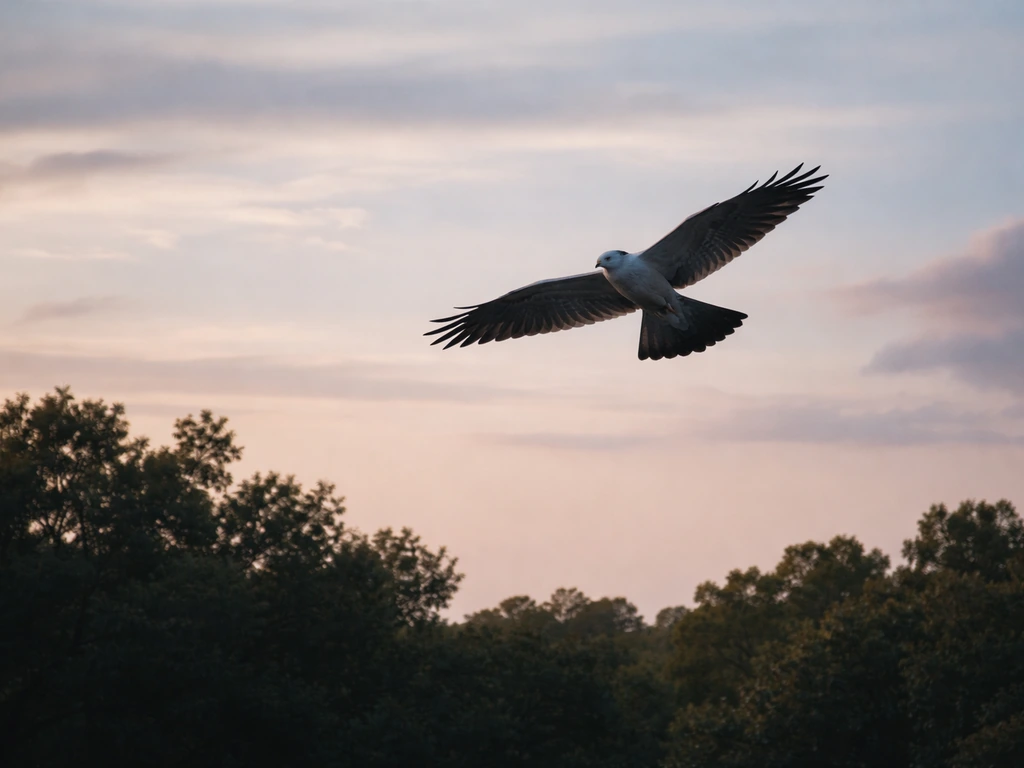
In bird anatomy, the keel is a blade-like ridge of bone that runs along the underside of the breastbone (sternum). It sticks out vertically like the keel of a boat, which is exactly where the name comes from, and it gives the massive flight muscles something solid to anchor onto. Birds with big, prominent keels are almost always strong fliers. Birds with tiny or absent keels, like ostriches and emus, are the flightless ones.
Keel Bird Meaning: What the Keel Is and Why It Matters

Marcus Whitley
26 Jul 2026
What 'keel' actually means for birds (the plain-language version)
When birdwatchers, vets, or biology teachers say 'keel,' they mean that protruding ridge on the front of a bird's chest. You can sometimes feel it when you hold a bird: run your finger down the centre of its breast and there's a bony edge sitting between the two pectoral muscle masses. That's the keel. The word is borrowed directly from the nautical term for the structural spine along the bottom of a ship's hull, and the analogy is a good one, both are central stabilising ridges that everything else is built around.
The keel also shows up in species names. The keel-billed toucan, for instance, gets its name from the boat-keel shape of its enormous bill, not from its sternum, but the same root word is doing the same visual work: a sharp, projecting ridge. See the meaning of kingfisher bird for another example of how common names encode appearance and behaviour. If you see 'keel' anywhere in a field guide, it is almost always pointing to something ridge-like or sharply crested, whether that's a bill, a head shape, or a bone.
The anatomy basics: where the keel lives and what it looks like
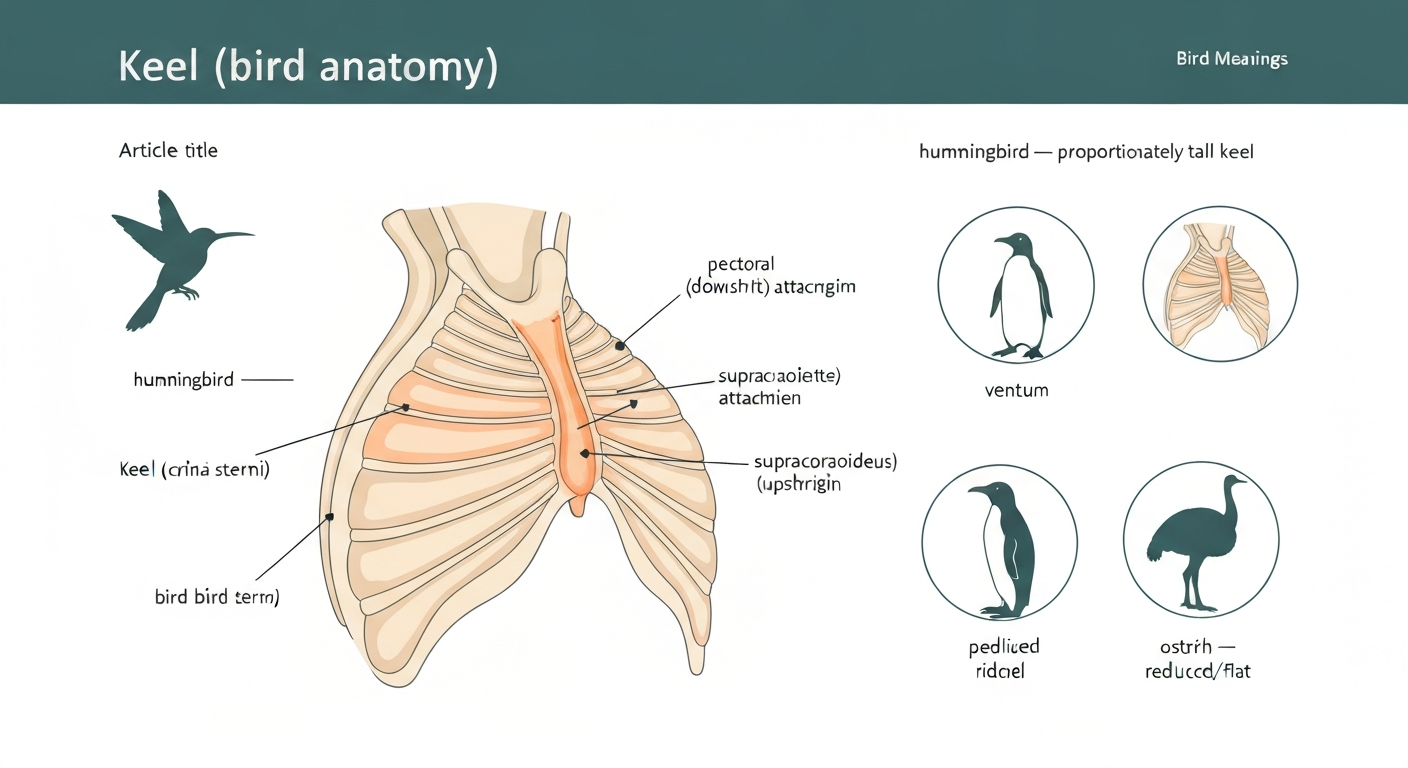
The formal anatomical name is carina sterni, sometimes shortened to carina (Latin for 'keel' or 'hull'). You will also see it written as crista sterni or sternal carina in older texts. All of these terms refer to the same structure: the midline, downward-projecting crest of the sternum. The sternum itself is the flat breastplate sitting at the front of the chest. In most birds it is a broad, roughly oval or rectangular plate of bone. The keel extends from its ventral (belly-facing) surface as a vertical plate, like a shark fin attached to a surfboard, but pointing downward.
If you look at a bird skeleton from the side, the keel is unmistakeable: it hangs below the main sternum plate and can be nearly as tall as the sternum is wide. From the front, it looks like an inverted ridge running down the centre of the chest. Ornithological atlases and museum skeleton displays label it clearly, and once you have spotted it on one skeleton you will recognise it in every subsequent one.
What the keel actually does: flight muscles and mechanical leverage
The keel's job is to provide attachment surface for the two biggest muscles in a flying bird's body. The first is the pectoralis, the large chest muscle responsible for the powerful downstroke that generates most of the lift and thrust in flapping flight. The second is the supracoracoideus, a deeper muscle that runs through a pulley-like arrangement of bones at the shoulder (the triosseal canal) and pulls the wing back up for the upstroke. Both muscles originate on the sternum and carina. The larger and more projecting the keel, the greater the surface area available for these muscles to attach, and the more leverage the muscles can generate.
Think of it this way: if you tried to bolt a heavy car engine to a thin sheet of metal, the metal would flex and fail. The keel is the thick, rigid mounting plate that lets the engine, in this case the flight muscles, transmit force efficiently. A deeper keel also increases the moment arm of the muscle attachments, which improves mechanical advantage. This is why researchers measure keel height, keel depth, and total keel surface area when they want to understand how powerful or efficient a particular bird's flight is.
How keel size and shape vary across species
Keel morphology is not one-size-fits-all. It ranges from dramatically developed to completely absent depending on how (and whether) a bird flies. Four broad patterns cover most of what you will encounter.
- Well-developed and deep: strong, sustained fliers with large pectoral muscles. The keel is tall, prominent, and runs most of the sternum's length.
- Disproportionately tall relative to sternum length: hovering specialists like hummingbirds need unusually large muscle attachment areas for their high-energy wingbeat, so the keel is exceptionally tall compared to body size.
- Large but functionally repurposed: penguins and other wing-propelled divers are flightless in air but still need massive flipper muscles. They retain a large keel, often with a cranial (forward) extension, dedicated to powering their underwater 'flight.'
- Reduced or absent: ratites and strongly flightless birds have a flat or nearly flat sternum, sometimes with only a slight median ridge or none at all. Without the need for powerful flight muscles, the keel has been reduced by evolution.
Researchers quantify these differences using measurements like keel height divided by sternum length, or keel surface area normalised to body mass. A 2025 large-scale comparative analysis (Lowi-Merri et al., Nature Ecology and Evolution) confirmed that enlargement of sternal traits, including the keel, was a key step in the evolution of powered flight in birds. The correlation is robust: bigger keel, more powerful flight style.
Real birds, real keels: examples across the spectrum
Looking at specific species helps make the variation concrete. Swifts and falcons sit at one extreme: they are among the most aerodynamically demanding fliers on Earth, and their keels reflect that. Hummingbirds are a fascinating outlier within strong fliers, because their keel is disproportionately tall relative to their tiny sternum, a direct result of the metabolic demands of sustained hovering. At the other extreme, ostriches, emus, and rheas have sterna that are nearly flat, with little more than a low median ridge where a keel would be. The kiwi, another ratite relative of the emu, is similarly keel-deficient, which fits its entirely terrestrial, nocturnal lifestyle. (The meaning of kiwi bird as a cultural symbol in New Zealand is a separate and interesting story, quite disconnected from its skeletal anatomy.)
Penguins sit in their own category and deserve a mention here. They have lost aerial flight but evolved powerful flipper-based 'flight' through water, and their keels remain large and structurally important. Research on Magellanic penguins has even documented keel curvature and torsion that accumulates over a penguin's lifetime, shaped by which flipper the individual tends to favour, a kind of skeletal handedness. Auks and loons also retain functional keels linked to their wing-propelled diving.
Tinamous are worth a special mention because they complicate the simple 'ratite equals no keel' rule. Tinamous are palaeognaths (the same ancient bird lineage as ostriches and kiwis) but they can actually fly, and they have a keeled sternum to prove it. They are the exception that shows the rule is really about function, not just ancestry.
| Bird group | Flight style | Keel development | Notes |
|---|---|---|---|
| Swifts, falcons, raptors | Powerful sustained flapping or high-speed soaring | Large, deep, prominent | Some of the largest keel-to-body ratios among flighted birds |
| Hummingbirds (Trochilidae) | Sustained hovering | Very tall relative to sternum length | Exceptionally large supracoracoideus for upstroke power |
| Penguins (Sphenisciformes) | Flightless in air; wing-propelled underwater | Large, often cranially extended | Keel remodels with dominant-flipper use over lifetime |
| Auks and loons | Capable fliers; strong divers | Well-developed | Supports both aerial and underwater wing use |
| Ostriches, emus, rheas | Flightless ratites | Reduced to absent | Flat sternum; flight muscles vestigial |
| Kiwi (Apteryx) | Flightless ratite | Absent or near-absent | Fully terrestrial; sternum essentially flat |
| Tinamous | Weak but functional fliers | Keeled | Palaeognath exception; demonstrates function drives keel presence |
| Cassowary | Flightless | Reduced or absent | NAA documents absent carina in Casuarius |
How to tell whether a bird has a keel, without dissection
You cannot see the keel through feathers, but you can make a reasonable educated guess from external signs. The most direct method on a live or freshly deceased bird is gentle palpation: run a finger down the centre of the breast and feel for a bony ridge between the two muscle masses. In a healthy, well-muscled flying bird, the pectoral muscles on either side should be full and rounded, meeting at that central ridge. If the bird is emaciated, the keel may feel sharp and prominent because the muscles have wasted, which is actually a warning sign in avian medicine rather than evidence of a larger keel.
Behavioural and morphological clues are useful for birds you can only observe at a distance. Strong, sustained flappers with deep, full-looking chests and large wing surface areas almost certainly have well-developed keels. Flightless birds, or birds that rely primarily on running and swimming, are likely to have reduced keels. Wing shape is a helpful proxy: long, pointed wings built for speed or endurance go with big keels; tiny vestigial wings on ratites go with little or no keel.
Body posture at rest offers another indirect clue. Strong-flying birds often sit with an upright, barrel-chested posture that reflects the bulk of the pectoral muscle mass. Flightless birds tend to have a more horizontal, ground-hugging carriage with no pronounced chest projection. These are rough guides, not certainties, but they are useful starting points for students and curious observers.
Confirming a keel on a skeleton or museum specimen
If you have access to a prepared bird skeleton, identifying the keel is straightforward. Hold the skeleton in lateral (side) view and look at the underside of the chest: the keel is the vertical crest hanging down from the sternum plate. In ventral view (looking up at the belly of the skeleton), it appears as the central midline ridge. In well-developed specimens, it can be nearly as deep as the sternum is broad. Museum osteology collections typically orient sterna in standard views precisely to make this comparison easy.
On museum study skins (the flat-packed or round-bodied prepared specimens common in ornithological collections), you cannot directly see the keel, but the shape of the breast, how full or flat the specimen's chest appears, can sometimes hint at the underlying structure. Skeletons and dry-prepared sterna are far more informative. Nomina Anatomica Avium, the standard reference for avian anatomical terminology, contains labeled sternum diagrams showing the carina in multiple species and is the go-to source for anyone building a comparative collection or teaching avian anatomy. Three-dimensional sternum models from CT scans are increasingly available on open repositories like MorphoSource, where researchers have archived pectoral girdle and sternum scans for dozens of species, making remote study of keel shape genuinely accessible.
What to look for on a skeletal specimen
- Lateral view: look for a downward-projecting crest along the lower edge of the sternum — that is the keel/carina.
- Ventral view: the keel appears as a central ridge running front to back along the belly surface of the sternum.
- Height and depth: a tall, deep keel signals a powerful flier; a flat or barely raised ridge suggests flightlessness.
- Shape variations: keels can be straight, slightly curved, notched at the tip, or cranially extended (jutting forward) — all of these are described in anatomical literature and visible in specimens.
- Bilateral muscle scars: on either side of the carina you can sometimes see the roughened bone surface where the pectoralis and supracoracoideus attached during life.
Radiographs and X-rays: seeing the keel without picking up a bone
In a standard lateral X-ray of a bird, the keel shows up as a dense, bright vertical line projecting from the underside of the sternum, standing out clearly against the softer tissue of the breast. In a ventro-dorsal (front-to-back) view, it appears as a bright midline stripe running the length of the sternum. Even if you have never looked at a bird radiograph before, once you know what you are looking for the keel is one of the easier structures to pick out.
Avian vets use X-rays routinely to assess the keel in live birds: they can check for fractures (keel fractures are not uncommon in birds that crash into obstacles), assess bone density and development in young birds, and evaluate whether the sternum and keel are developing normally. In research and teaching contexts, radiographs let students see the relationship between the keel, the sternum, and the surrounding pectoral girdle without needing to handle a skeleton. The keel-to-sternum ratio, even estimated roughly from a radiograph, gives a quick read on how much attachment area is available for flight muscles.
For birders and non-specialists, the practical takeaway is this: if you ever see a radiograph of a bird, lateral view, look for that vertical bright line at the front of the chest. Its presence, size, and sharpness will tell you immediately whether you are looking at a strong flier, a diver with repurposed wing muscles, or a flightless bird that has largely given the whole structure up.
Etymology and how 'keel' appears in bird names and field guides
The English word 'keel' comes from Old Norse kjolr and Old English ceol, both meaning the spine or structural base of a boat. Sailors used it for centuries before ornithologists borrowed it for the breastbone crest, and the visual logic is identical: a projecting ridge that runs centrally and gives structural integrity to everything above it. The Latin equivalent, carina, has the same nautical origin (Latin for the keel or hull of a ship) and is the term used in formal anatomical nomenclature.
In species names and common names, 'keel' almost always refers to a visible ridge shape somewhere on the bird's body, not the sternum. The keel-billed toucan is named for the lateral ridge along its outsized bill. Keel-billed motmots and other 'keel-billed' species follow the same logic. In field guide descriptions, you will also encounter 'keeled' as a descriptor for any sharply ridged structure: a keeled culmen (the ridge along the top of the bill), a keeled tail, or a keeled back in turtles and lizards (the term travels freely between zoological groups). When field guides say a species has a 'prominent keel' in an anatomy or physiology section, they almost certainly mean the sternal carina. For a related explanation of the name 'kite' in bird names and what that common name means, see what is the meaning of kite bird. See killdeer bird meaning for the origin and meaning of the name 'killdeer'.
Why the keel matters beyond anatomy class
Understanding the keel gives you a useful interpretive tool whenever you are watching birds. A bird working hard to get airborne, churning its wings in a deep, powerful stroke, is demonstrating what a well-developed keel makes possible. A cassowary or ostrich walking calmly across a field, with no need to generate lift, has traded that bony structure away over millions of years of evolution. The keel is essentially a physical record of how a lineage has chosen, through natural selection, to get around its world. For cultural or symbolic interpretations related to seeing a kite bird, see the article on "seeing a kite bird meaning" for context beyond anatomy. For interpreting specific vocal behaviours, see kiskadee bird singing meaning which explains how calls and songs can signal territory, alarm, and mating intent.
For students and educators, the keel is also a memorable teaching anchor because it connects three things that are easy to observe independently: flight behaviour, body shape, and skeletal structure. Once you have held a swift and felt the sharp central ridge, watched a hummingbird hover and understood what kind of muscular infrastructure that requires, or seen an ostrich skeleton laid flat with its nearly featureless sternum, the keel stops being an abstract anatomical term and becomes a story about how form follows function. That is a story worth knowing, whether you are a birder, a biology student, or just someone who finds birds genuinely fascinating.
FAQ
What is the keel (sternum carina) in birds in plain language?
The keel is a ridge or crest running down the middle of a bird’s breastbone (sternum) that sticks out toward the belly. It’s often called the carina or carina sterni. In simple terms, it’s a raised plate on the sternum that gives extra surface for the big flight muscles to attach.
Why do birds have a keel — what does it do?
The keel provides a broad, sturdy surface where the pectoralis (powerful downstroke) and supracoracoideus (upstroke) flight muscles attach. By projecting out from the sternum it increases the muscle attachment area and mechanical leverage, helping birds produce the strong wing strokes needed for flight (or, in some species, underwater ‘flight’).
How does keel size and shape vary among bird species?
Keel size and shape vary a lot with flight needs and lifestyle. Strong fliers and hovering species (e.g., hummingbirds) have deep, tall keels for large flight muscles. Wing‑propelled divers (e.g., penguins) have large, often elongated keels used for powerful swimming strokes. Strongly flightless birds (many ratites such as ostrich, emu, rhea, cassowary, kiwi) have a reduced or absent keel. Tinamous are an exception among palaeognaths: they can fly and have a keel. Shape also varies (straight, notched, cranially extended, curved) and can remodel with use.
Are there measurements or indices for comparing keels across species?
Yes. Researchers quantify keels using measures such as keel height (depth), keel length (rostrocaudal extent), keel surface area, and normalized indices (keel height or area divided by sternum length, thorax length, or body mass). These metrics allow comparison of keel development relative to body size and locomotor mode.
How can birdwatchers or educators tell whether a bird has a well‑developed keel in the field without X‑rays or skeletons?
External cues are indirect but useful: a full, rounded breast (large pectoral muscles) and visibly powerful, sustained flapping flight suggest a well‑developed keel. Palpation of the breast (during banding or handling by trained personnel) can reveal a pronounced central ridge between the muscles. However, fat, age, sex, and molt can change breast shape, so external signs are not definitive.
How is the keel seen on skeletons, museum specimens, or X‑rays?
On an isolated sternum or skeleton the keel is obvious as the ventral midline crest—the carina—visible in ventral or lateral views. In X‑rays and CT scans the carina appears as the projecting plate on the sternum; museum CT/µCT and 3‑D scans let researchers measure keel height, length, and area precisely from digital models.
Next Article
Seeing a Kite Bird Meaning: Literal and Symbolic Interpretations
Interpret seeing a kite bird literally and symbolically, with context tips, folklore links, and journaling prompts.