
The thick-knee (genus Burhinus) is a family of ground-dwelling wading birds found across Africa, Europe, Asia, and Australia, and in South Africa the most familiar species goes by the Afrikaans name 'dikkop,' which literally means 'thick head.' That name captures exactly what you see: a stocky bird with a conspicuously broad, domed skull, huge yellow eyes, and a habit of standing absolutely motionless in the dark while emitting one of the eeriest calls in the bird world. Across multiple documented traditions, from Zulu oral narrative in southern Africa to Aboriginal Australian story cycles, that nighttime wailing has earned the bird a reputation as a messenger of trouble, death, or impending conflict.
Superstition Around the Thick-knee (Dikkop): Meanings & Folklore

Marcus Whitley
4 Aug 2026
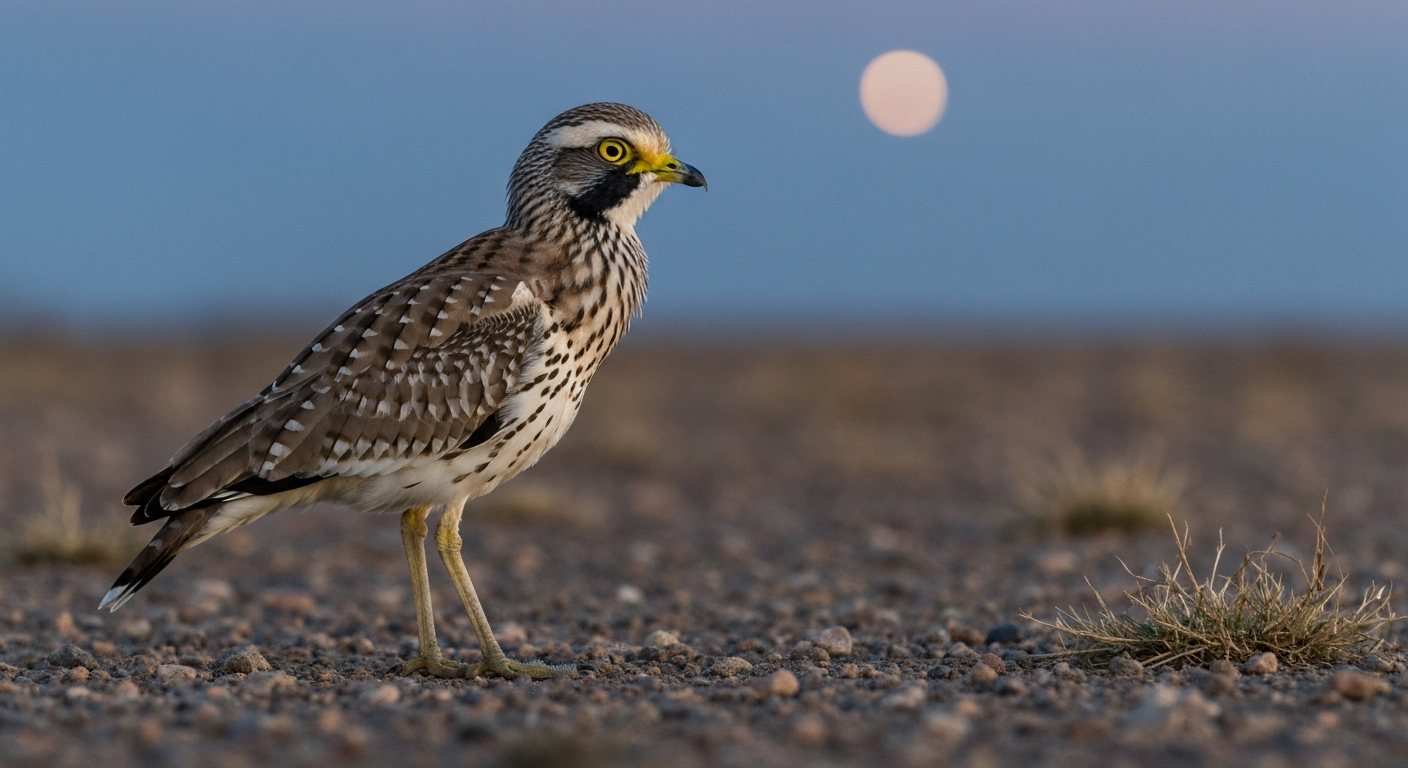
What 'dikkop' actually means and where the name comes from
The word 'dikkop' is Afrikaans, built from two Dutch roots: dik ('thick') and kop ('head'). Merriam-Webster records it as a borrowing from Afrikaans and Dutch with the plain literal translation 'thick-head,' and the Algemeen Nederlands Woordenboek (the authoritative general Dutch dictionary) confirms the term as the South African name specifically applied to the stone-curlew of the genus Burhinus. Nineteenth and early twentieth-century South African colonial glossaries, including the historical archive compilation 'Africanderisms,' record 'dikkop' and the diminutive 'dikkopje' as established Boer-English usage for these birds, so the name has been in documented circulation for well over a century.
English speakers in South Africa sometimes use 'thick-knee' and 'dikkop' interchangeably, though 'dikkop' remains the more colloquial, affectionate term locally. Beyond South Africa, the broader English name 'thick-knee' applies to all members of the family Burhinidae, while 'stone-curlew' is used more commonly for the Eurasian species (Burhinus oedicnemus) despite stone-curlews not being true curlews at all. In Australia, the Bush Stone-curlew (Burhinus grallarius) is also called 'weeloo' or 'weerlo' in some Aboriginal languages, a name that directly mimics its haunting call. These regional variants matter when you are tracking folklore, because the omen-beliefs attached to the bird are often recorded under whichever local name a community used.
| Common Name | Scientific Name | Region | Local or Alternative Name |
|---|---|---|---|
| Spotted (Cape) Thick-knee | Burhinus capensis | Southern Africa | Dikkop (Afrikaans); umbangaqhwa (Zulu) |
| Water Thick-knee | Burhinus vermiculatus | Sub-Saharan Africa | Water dikkop |
| Senegal Thick-knee | Burhinus senegalensis | West & Central Africa | Senegal stone-curlew |
| Eurasian Stone-curlew | Burhinus oedicnemus | Europe, Middle East, Central Asia | Stone-curlew; thick-knee |
| Indian Stone-curlew | Burhinus indicus | South Asia | Indian thick-knee |
| Bush Stone-curlew | Burhinus grallarius | Australia | Weeloo; bush curlew |
What the bird actually looks like and how it behaves
Spotted Thick-knees (Burhinus capensis) are roughly the size of a small chicken, measuring around 45 cm from bill to tail. Their plumage is heavily streaked and spotted brown and white, which provides near-perfect camouflage against stony ground, dry grass, and gravel. The head is proportionally large and rounded, and the eyes are strikingly big and yellow, adapted for low-light foraging. When alarmed they drop flat against the ground, extend their necks, and freeze, becoming almost invisible. The 'thick knee' in the English name refers to the prominently swollen tibiotarsal joint visible on the long, pale legs, a feature shared across the genus.
All Burhinus species are primarily crepuscular and nocturnal. By day they rest quietly, often in pairs or small groups, and are easy to overlook entirely. After dark they become vocal and active, and it is the call that makes them unforgettable. The Spotted Thick-knee produces a loud, repetitive, rising and falling whistle, sometimes described as a wailing or piping shriek, that carries far across open ground. The British Trust for Ornithology notes the same intensity for the Eurasian Stone-curlew, whose nocturnal calling is a defining feature of its natural history. Sound archives at Cornell Lab's Macaulay Library and xeno-canto both host extensive recordings and sonograms of Burhinus species that illustrate just how penetrating and otherworldly these calls sound in the dark.
Why this bird keeps ending up in folklore
Before examining specific traditions, it helps to understand what about the thick-knee repeatedly catches human attention and nudges people toward supernatural explanations. The triggers are not mysterious once you list them: the bird is common in scrubland, farmland edges, and even suburban gardens; it nests directly on open ground with almost no nest structure at all; it calls loudly at night for extended periods; it freezes and stares at you with enormous glowing eyes when you approach; and it becomes invisible the moment it stops moving. That combination of visibility-then-disappearance, nighttime sound, ground-level presence near human dwellings, and an unsettling gaze makes almost every culture that lives alongside these birds inclined to read meaning into them.
- Ground nesting near human paths and gardens makes encounters frequent and intimate
- The freeze-and-stare posture feels deliberate, like the bird is watching you
- Loud nocturnal calls interrupt sleep and feel like announcements
- Cryptic disappearance after freezing creates a sense of supernatural vanishing
- Large yellow eyes appear to glow in torchlight or moonlight
- Tendency to return persistently to the same nest site, year after year, near homes
These are behavioral and ecological triggers, not coincidences. Every culture that has developed beliefs around the thick-knee has done so for reasons rooted in these very real, observable characteristics. That is worth keeping in mind as we move through the regional traditions below, where I have tried to separate what is documented in primary or peer-reviewed secondary sources from what circulates more loosely as hearsay or unverified online folklore.
How to read the folklore catalog below: verified vs. unverified
Bird superstitions travel fast on the internet and often shed their original cultural context along the way. For this entry I am distinguishing between three tiers: (1) beliefs documented in primary ethnographic sources, folklore compilations, or peer-reviewed studies that explicitly cite those primary sources; (2) beliefs reported in reputable natural-history or regional press with some traceable origin; and (3) beliefs that circulate in general discussion but have not been traced to a specific community or documented record. I will flag tier-3 claims clearly. A claim being unverified does not make it false, but it means you should treat it as folklore-in-progress rather than established tradition.
African beliefs: the documented picture
The clearest, most thoroughly documented omen-beliefs associated with the thick-knee in Africa come from southern African Zulu oral tradition. The primary ethnographic record here is C.T. Msimang's 1975 work 'Kusadliwa Ngoludala,' a compilation of Zulu oral narratives that has been cited repeatedly by later scholars, including in UKZN theses and in a 2022 peer-reviewed urban ecology study on spotted thick-knees in South African landscapes. Msimang documents the Zulu name 'umbangaqhwa' for Burhinus capensis and associates the bird's call with warnings of trouble, conflict, frost, and general ill-omen. The word 'umbangaqhwa' itself encodes meaning: it is generally interpreted as relating to frost or a cold harbinger, suggesting the bird's call was linked with cold-season hardship or the arrival of difficult conditions.
Beyond the Zulu material, the published ethnographic record for specific thick-knee omen motifs in West and East Africa is sparse. Ethnographic literature searches and folklore collections covering these regions do not currently yield direct documented records of thick-knee-specific beliefs comparable to the Zulu material. That is absence of evidence in what has been surveyed so far, not necessarily absence of tradition, but it means any claim that 'across Africa the dikkop is universally considered a bad omen' would be overstated. What we can say with confidence is that the bird is noticed, named, and remarked upon across its African range, and that in southern Africa specifically the documented beliefs are rich and detailed.
South Africa (dikkop): the local traditions in detail
In South Africa the dikkop occupies a peculiar cultural position: it is common enough to be familiar, loud enough to be impossible to ignore, and persistent enough in suburban gardens and road verges that it has become part of ordinary life. The urban ecology study published in 2022 on spotted thick-knees across a South African mosaic landscape notes that local people's attitudes toward nesting dikkops range from protective affection to anxiety, often depending on cultural background and personal experience with the bird's call. A 2022 urban ecology study ('Facets of the nesting ecology of a ground‑nesting bird, the Spotted Thick‑knee, in an urban mosaic landscape') documents regional variation in local people's attitudes toward nesting Spotted Thick‑knees Facets of the nesting ecology of a ground‑nesting bird, the Spotted Thick‑knee, in an urban mosaic landscape — ScienceDirect (recent study noting regional variation in attitudes).
The core documented tradition, as recorded by Msimang (1975) and cited in later scholarship, is the Zulu omen reading: the call of 'umbangaqhwa' at night signals trouble ahead. This could mean conflict, death, frost damage to crops, or general misfortune. Importantly, the belief is not simply that the bird is bad luck by presence alone; it is specifically the nocturnal call that functions as the warning signal. A dikkop sitting quietly in your garden is not necessarily an omen. A dikkop crying loudly through the night is a message worth attending to, within this tradition.
There are also accounts, less formally documented but reported across South African birding communities and local press, of Afrikaans-speaking farming communities treating the persistent return of a dikkop pair to nest near a homestead as a sign of the farm's good health or stability. This reading is essentially the inverse of the omen motif: the bird's loyalty to a place reflects well on that place. I treat this as tier-2 material, plausible and widely reported, but not yet anchored in a cited primary ethnographic source.
Australia, South Asia, and other regions where thick-knees live
Australia has some of the most thoroughly documented thick-knee folklore outside of southern Africa. The Bush Stone-curlew (Burhinus grallarius) is widespread across mainland Australia and has deep roots in Aboriginal Australian oral tradition. Philip A. Clarke's scholarly work on birds and the spirit world of the Lower Murray in South Australia documents curlew-call motifs in which the bird's cry functions as a warning, a boundary signal, or a harbinger of sickness and death. Clarke (2016), in Birds and the Spirit World of the Lower Murray, South Australia, Philip A. Clarke (journal article; discusses curlew motifs), documents curlew-call motifs where the bird's cry functions as a warning, boundary signal, or harbinger of sickness and death Birds and the Spirit World of the Lower Murray, South Australia — Philip A. Clarke (journal article; discusses curlew motifs). Multiple Aboriginal groups across Australia share variations of this belief, though the specific interpretation varies by community. Clarke's work (2016) and related academic syntheses confirm this as a well-documented tradition, making it tier-1 material.
In South Asia, Burhinus indicus (the Indian Stone-curlew) is present across the subcontinent, and its nocturnal calls are noted in natural-history literature. However, I have not found peer-reviewed ethnographic documentation of specific omen motifs in South Asian traditions comparable to the Zulu or Aboriginal Australian records. There are anecdotal references in regional natural-history writing to the bird being considered inauspicious, but these have not been traced to primary folkloric sources in my research. Treat South Asian thick-knee beliefs as tier-3 for now.
In Europe, the historical folklore record around the Eurasian Stone-curlew (Burhinus oedicnemus) and its relatives is documented in 19th-century collections. Welsh and British folklore materials, including records preserved in 'Welsh Folk-Lore' (available via Project Gutenberg), associate the eerie night whistle of curlew-type birds with death omens and ill-fortune. The 'whistler' as a bad-omen bird is a recurring motif in northern and western European folk tradition. While the stone-curlew and the true curlew (Numenius) sometimes blur in these older accounts, the nocturnal whistle-as-death-omen pattern clearly extends to Burhinus in the European record.
The symbolic themes: what the dikkop represents across cultures
Stepping back from specific regions, several symbolic themes recur wherever thick-knee folklore is documented. The most consistent is the call as warning or announcement, functioning like a herald rather than simply a bad-luck token. See Sak Yant bird meaning for related symbolic interpretations of birds used in ritual tattoo traditions. In this reading, the bird is not causing misfortune; it is telling you that misfortune is coming, which is a subtly different cultural role. See coo bird meaning for a related discussion of how simple bird calls are interpreted as omens in other traditions. That distinction matters: a warning bird can potentially be heeded, placated, or thanked for the information, whereas a pure bad-luck bird is simply to be avoided.
| Symbolic Theme | Region/Tradition | Verification Tier | Notes |
|---|---|---|---|
| Nocturnal call as death or conflict omen | Zulu / South Africa | Tier 1 (Msimang 1975, cited in peer review) | Call specifically, not presence alone |
| Nocturnal call as harbinger of sickness/death | Aboriginal Australia (multiple groups) | Tier 1 (Clarke 2016 and syntheses) | Bush Stone-curlew; varies by community |
| Night whistle as ill-omen | Historical Europe (Welsh, British) | Tier 1 (19th-c folklore collections) | Stone-curlew and true curlew sometimes blurred |
| Persistent nesting as sign of household stability | Afrikaans farming communities, S. Africa | Tier 2 (widely reported, not primary-cited) | Protective/positive reading |
| Call as inauspicious sign | South Asia (anecdotal) | Tier 3 (no primary ethnographic source found) | Treat with caution |
| Bird as frost/cold-season harbinger | Zulu ('umbangaqhwa' etymology) | Tier 1 (Msimang 1975) | Name itself encodes cold-warning meaning |
One recurring pattern worth noting is that the positive and protective readings of the dikkop tend to come from communities with a longer, more domesticated relationship with the bird: farmers who have watched dikkop pairs nest near the same barn for generations are more likely to see them as loyal companions than as omens. Communities for whom the bird is an occasional, sudden nighttime intrusion are more likely to read the call as alarming. The bird's meaning, in other words, is partly a function of how well you know it.
Household lore and the nesting dikkop
The dikkop's habit of nesting on open ground near human habitation creates a specific category of household folklore that does not appear as often in other bird traditions. Because the bird nests so close to people, often right on a lawn, a driveway, or a garden path, there is a direct, daily interaction between the bird's domestic life and human domestic life. In South African communities this has generated a body of informal household advice: do not disturb a nesting dikkop pair; mark the nest so the lawnmower avoids it; let the bird complete its cycle undisturbed and the household will prosper. Whether or not these instructions are framed explicitly as superstition, they function as superstition, translating an observed ecological reality (the bird is loyal to a site and returns if unmolested) into a behavioral rule with a symbolic reward attached.
The dikkop in language, literature, and everyday use
As a word, 'dikkop' has had some interesting life outside strict ornithology. See kaur bird meaning for a related discussion of how personal and bird names intersect and carry cultural meaning. In South African English slang, calling someone a 'dikkop' means calling them a thickhead, a dullard, or a stubborn person who will not take a hint. The usage is affectionate as often as it is critical, much the same way 'bird-brained' operates in English broadly. It is a living example of how a bird name migrates from field identification into casual human characterization. Sample sentence: 'Don't be such a dikkop, just apologize already.'
In South African literature and nature writing, the dikkop appears regularly as shorthand for the uncanny edge of domesticated wilderness: the bird that is always there, always watching, always just beyond easy interpretation. Naturalists writing about South African garden birds frequently use the dikkop as an entry point for discussing how wild behavior persists in suburban settings. The bird's freeze-and-stare response has been described in popular natural-history writing as 'the garden's silent alarm,' a phrase that perfectly captures the tension between the bird as familiar presence and the bird as unsettling watcher.
The Zulu name 'umbangaqhwa' does not appear commonly in general literary circulation, but it surfaces in academic ethnobotanical and ethnozoological writing wherever authors are cataloging indigenous names and associations for southern African fauna. For readers interested in how indigenous naming systems encode ecological and symbolic knowledge, this term is a compact example worth examining alongside names from other traditions. Comparable naming patterns appear in other bird entries on this site, including the sankofa bird, where the name itself carries a philosophical instruction.
Comparing the dikkop to similar symbolic birds
The dikkop shares symbolic territory with several other birds covered on this site. The most obvious parallel is with the cuckoo, another bird whose call functions as an omen-announcement across multiple cultures. Like the dikkop, the cuckoo is heard before it is seen, its call carries over distance, and that auditory presence is loaded with predictive meaning in folk tradition. See kuku bird meaning for a discussion of similar auditory-based bird symbolism. The difference is that cuckoo symbolism tends to be calendrical (spring, luck, timing) whereas dikkop symbolism is more immediately threatening or cautionary.
The surkhab bird, covered elsewhere on this site, offers another interesting comparison: like the dikkop, it is a bird whose symbolic weight comes in part from its conspicuous call and its association with waterside habitats where liminal, between-worlds thinking is common in folk belief. See the site's entry on 'cuntimal bird meaning' for a related treatment of how call-centered symbolism operates in a different cultural context. The broader pattern of nocturnal or crepuscular birds attracting omen-beliefs is consistent across cultures, and the dikkop fits neatly into that pattern alongside owls, nightjars, and various curlew species.
How to think about a dikkop sighting today
If you are encountering the thick-knee as a symbolic or folkloric reference today, whether in a text you are editing, a cultural context you are researching, or an actual bird in your garden, a few practical notes apply. First, identify which species you are dealing with, because the documented folklore is mostly attached to Burhinus capensis in South Africa and Burhinus grallarius in Australia; applying the Zulu or Aboriginal omen tradition wholesale to a European stone-curlew or an Indian thick-knee sighting would be a category error. Second, the nocturnal call is the key folkloric trigger: a dikkop calling loudly at night is the omen-object in Zulu tradition, not the bird in daylight. Third, context and community matter enormously: the same bird, in the same garden, carries opposite meanings depending on who is reading it and within what cultural tradition.
For writers and editors working on texts that reference the dikkop symbolically, the most defensible framing is: 'In Zulu oral tradition, documented by Msimang (1975), the dikkop's nocturnal call is associated with warnings of trouble or conflict.' That phrasing is specific, attributed, and honest about the cultural location of the belief. It avoids the flattening move of saying 'in African tradition, the dikkop means bad luck,' which erases the specificity of the documented record and misrepresents the diversity of African cultural practices.
Images and sounds worth knowing
For anyone illustrating or discussing this bird, the most useful visual is a Spotted Thick-knee in its freeze posture on open ground, which makes the camouflage, the posture, and the large yellow eye simultaneously visible. Close-up photographs that show the swollen tibiotarsal joint (the 'thick knee' itself) are also instructive for explaining the English name. For audio, the Macaulay Library at Cornell Lab hosts a well-documented recording of the Spotted Thick-knee (ML201991241) with a sonogram showing the repetitive wailing whistle structure; xeno-canto hosts additional recordings and community annotations for multiple Burhinus species including the Water Thick-knee and Senegal Thick-knee. Listening to even one recording makes it immediately obvious why communities living alongside this bird at night would hear it as an announcement rather than background noise.
Reliable sources if you want to go further
- Msimang, C.T. (1975) 'Kusadliwa Ngoludala' — primary Zulu ethnographic/folkloric source for 'umbangaqhwa' and omen beliefs; cited in UKZN scholarship and in peer-reviewed ecology studies
- Clarke, Philip A. (2016) 'Birds and the Spirit World of the Lower Murray, South Australia' — peer-reviewed journal article documenting Bush Stone-curlew call motifs in Aboriginal Australian tradition
- Human-wildlife interactions: presence of the ground-nesting Spotted Thick-knee across a South African mosaic urban landscape (2022, ScienceDirect) — peer-reviewed ecology study citing local attitudes and Msimang
- Merriam-Webster entry for 'dikkop' — confirms etymology (dik + kop, Afrikaans/Dutch borrowing) and English dictionary status
- Algemeen Nederlands Woordenboek (ANW) — Dutch lexical authority confirming 'dikkop' as South African name for Burhinus
- Africanderisms: a glossary of South African colloquial words and phrases (historical, available at archive.org) — 19th-20th century South African usage record
- Welsh Folk-Lore (Project Gutenberg) — source for European curlew-as-death-omen tradition
- BirdLife DataZone species factsheets (birdlife.org) — authoritative species accounts for Burhinus capensis, B. senegalensis, and related species
- Macaulay Library, Cornell Lab of Ornithology — call recordings and sonograms (ML201991241 for Spotted Thick-knee)
- xeno-canto (xeno-canto.org) — community sound archive with recordings of multiple Burhinus species
FAQ
What does the name “dikkop” mean and where does it come from?
Verified: “dikkop” is borrowed from Afrikaans/Dutch: dik = “thick” + kop = “head,” literally “thick‑head.” Dutch/Afrikaans lexica and English dictionaries record the usage as the South African name for the stone‑curlew/thick‑knee (see Merriam‑Webster and ANW). Sources: https://www.merriam-webster.com/dictionary/dikkop ; https://anw.ivdnt.org/article/dikkop ; historical South African glossaries show colonial use (e.g., Africanderisms).
Which species are commonly called thick‑knees or dikkops?
Verified: The genus Burhinus contains the principal “thick‑knees” referred to as dikkop in southern Africa and related names elsewhere: B. capensis (Spotted/Cape Thick‑knee), B. vermiculatus (Water Thick‑knee), B. senegalensis (Senegal Thick‑knee), B. oedicnemus (Eurasian/Stone‑curlew), B. indicus (Indian stone‑curlew), and B. grallarius (Bush Stone‑curlew). Taxonomic lists and major checklists corroborate these species. Source: https://en.wikipedia.org/wiki/Burhinus ; BirdLife/IUCN species pages.
What are the key natural‑history facts readers need to understand why people noticed these birds?
Verified summary: Thick‑knees are medium‑large, ground‑nesting waders with cryptic, spotted plumage and a broad domed head (explaining the Afrikaans name); they have large yellow eyes, sit camouflaged on stony or grassy ground, and are primarily crepuscular/nocturnal. Their loud, piercing nighttime calls make them highly noticeable and culturally salient. Sources: species accounts and field studies (e.g., Spotted Thick‑knee overview; BTO stone‑curlew notes; urban ecology study). See: https://en.wikipedia.org/wiki/Spotted_thick-knee ; https://www.bto.org/learn/about-birds/birdfacts/stone-curlew ; https://pmc.ncbi.nlm.nih.gov/articles/PMC9207825/ .
What kinds of sounds do thick‑knees make and where can I hear them?
Verified: Burhinus calls are typically repetitive whistles, wails or “piercing” cries at night. Reliable audio archives include the Macaulay Library (Cornell Lab) and xeno‑canto, which host multiple recordings and sonograms for Burhinus species. Example: Macaulay Library Spotted Thick‑knee recording. Sources: https://macaulaylibrary.org/asset/201991241 ; https://xeno-canto.org/set/2242 .
What regional superstitions and folk‑beliefs are documented for the thick‑knee/dikkop?
Verified regional summary: - Southern Africa (Zulu/South Africa): Oral tradition records the name umbangaqhwa for the Spotted Thick‑knee and associates its presence or night call with warnings, trouble, frost or conflict; Msimang (1975) is a primary folkloric citation (also referenced in modern studies). - Aboriginal Australia: Bush Stone‑curlew (B. grallarius) calls are interpreted in multiple groups as warnings, boundary signals, or harbingers of sickness/death (documented in ethno‑ornithological literature). - Europe: Historical folklore and 19th‑century collections record night‑calling curlew/whistler birds as death omens or ill fortune. - Other African regions: ethnographic records are sparse; published surveys show absence of extensive omen motifs in many West/East African folk sources (i.e., lack of documented tradition is common). Sources: https://pmc.ncbi.nlm.nih.gov/articles/PMC9207825/ ; Msimang (cited in that article); Clarke (Australian ethno‑ornithology); historical folklore collections (e.g., Project Gutenberg Welsh Folk‑Lore).
What symbolic meanings are reliably attested, and how do they vary between cultures?
Verified motifs and cultural variation: - Common verified motif: the nocturnal call as an omen of death, warning, or ill‑fortune—attested in Zulu southern African tradition, multiple Aboriginal Australian traditions, and historical European folklore. - Variability: some cultures treat the call as a protective warning (alerting people to danger) rather than a direct curse; others interpret presence near a homestead as a household omen (either protective or inauspicious). - Caution: meanings are culture‑specific; do not generalize a single “bad luck” meaning worldwide. Sources: https://pmc.ncbi.nlm.nih.gov/articles/PMC9207825/ ; Clarke (Australian paper); historical folklore sources. {
Next Article
Cuntimal Bird Meaning: Identification, Origins & Symbolism
Discover what 'cuntimal' likely means, misspelling, possible bird ID, etymology, symbolism, pronunciation, and examples.