
A mynah bird is a member of the starling family (Sturnidae) native to Asia, most commonly referring to the Indian or common myna (Acridotheres tristis) or the hill myna (Gracula religiosa). The name comes from the Hindi word mainā, and in English it appears spelled as myna, mynah, or mina, all acceptable. Symbolically, the mynah stands for communication, adaptability, community, and vocal power. Its near-magical ability to mimic human speech has made it a living metaphor for voice, imitation, and the power of language across South Asian, Southeast Asian, and Western traditions.
Meaning of Mynah Bird: Definition, Symbolism & Uses, Quick Guide

Marcus Whitley
13 Jul 2026
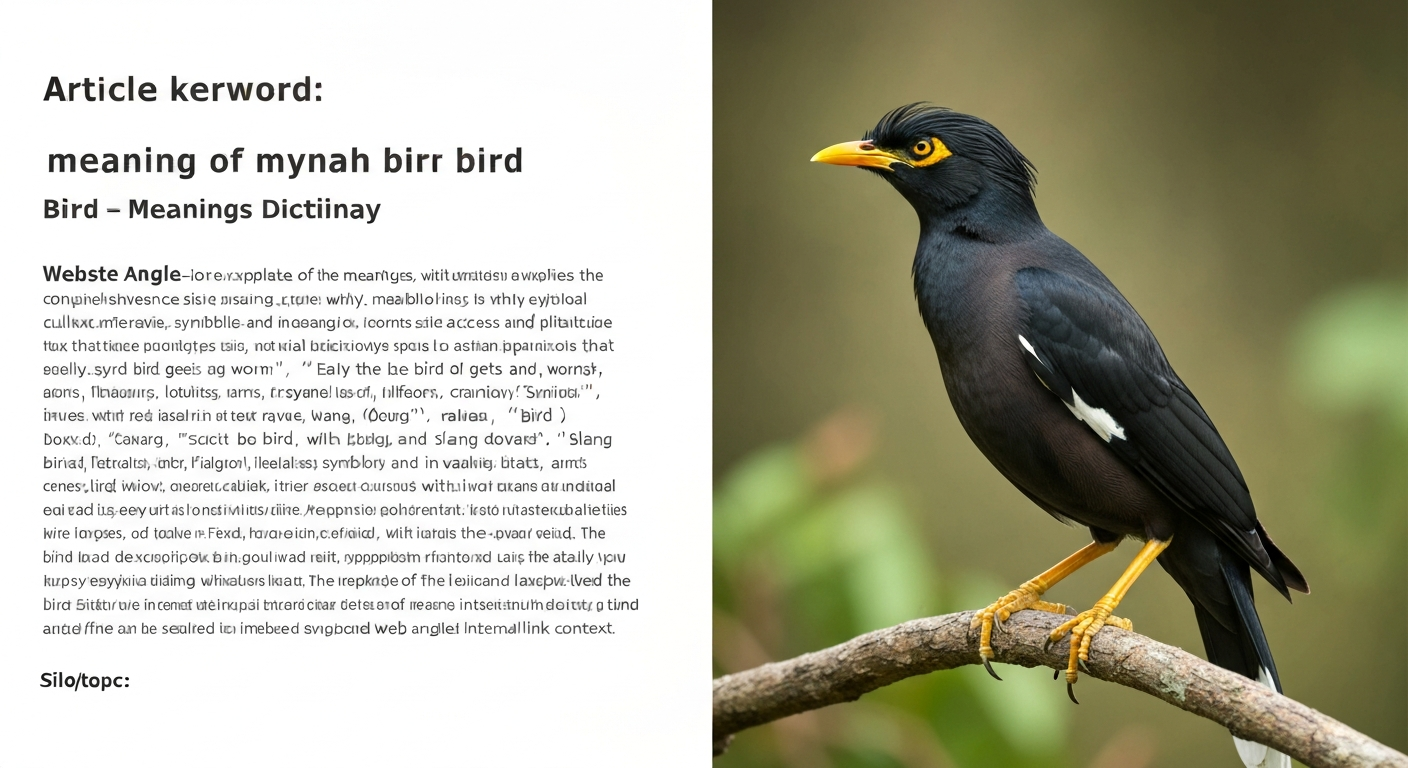
Quick definition and key takeaways
Before going deeper, here is the short version of everything this bird means and why people search for it.
- Mynah (also myna or mina) is an English name for several Asiatic starlings, most often the common myna (Acridotheres tristis) or the hill myna (Gracula religiosa), both known for loud calls and remarkable vocal mimicry.
- The name derives from the Hindi/Urdu mainā (मैना), which entered English in the 18th century through trade and natural history writing.
- Culturally, the mynah symbolizes voice, communication, adaptability, and community — in South Asia it also carries associations with omens, domestic life, and folk poetry.
- The hill myna in particular has long been kept as a cage bird for its ability to mimic human speech, which has given it literary and metaphorical uses around imitation, learning, and the nature of language itself.
- Spelling confusion (mynah vs. myna) and mishearings (some people search 'mine that bird' or 'myne that bird') are common — they all point to the same bird and the same word.
What the bird actually looks like and does
You cannot really understand what a bird means in a culture without knowing what the bird does in real life. The common myna is a medium-sized bird, around 23 to 26 centimeters long, with a brown body, a jet-black head, a bright yellow bill, and a distinctive yellow patch of bare skin around each eye. In flight it flashes white wing patches, hard to miss. It is omnivorous and intensely comfortable around people, scavenging markets, farms, and city streets with equal confidence. This boldness is part of its symbolic character.
Common mynas form large communal roosts, sometimes numbering in the thousands, and they are notoriously aggressive toward other nesting birds. In parts of Australia, New Zealand, and South Africa where they were introduced, they are considered one of the most damaging invasive species on the planet, competing fiercely with native birds for nest hollows. The Invasive Species Compendium, CABI summarizes establishment history, impacts and management actions for Acridotheres tristis in introduced regions Invasive Species Compendium — CABI. The IUCN lists the common myna as Least Concern globally but documents significant invasive impacts wherever it has been introduced outside its native Asian range.
The hill myna (Gracula religiosa) is a different creature in appearance and habitat. It lives in forested hills across South and Southeast Asia, is glossy black with orange-yellow wattles on the head, and is the species most celebrated for speech mimicry. Documented in captivity as one of the best avian mimics of human voice, often clearer than a parrot, its sound reproduction is precise enough that individual voices can be distinguished. This bird was formally described by Linnaeus in 1758, and its fame as a talking bird predates that scientific classification by centuries of trade and court keeping.
Myna, mynah, mina: sorting out the spelling (and the mishearings)
This is one of those words where the spelling genuinely does not matter as long as you know which bird you mean. Merriam-Webster lists myna as the primary entry with mynah as an accepted variant. The Cambridge English Dictionary recognizes both. Some older texts use mina. All three represent the same Hindi source word, mainā, filtered through different transcription choices over roughly three centuries of English writing. If you see all three in a single paragraph, it is not an error, it is just the messy reality of transliteration.
The mishearing angle is worth addressing directly, because a surprising number of people arrive at this topic by searching phrases like 'what does mine that bird mean' or 'myne that bird.' In most cases, this is simply the word mynah heard out of context, someone encountered the name spoken aloud, did not catch the spelling, and searched phonetically. The phrase 'mine that bird' has no separate idiomatic meaning. If you landed here from one of those searches, you were looking for mynah all along. The sibling topic 'what does mine that bird mean' explores this particular search pattern in more detail.
Where the name comes from
The English word myna comes directly from Hindi mainā (मैना) and Urdu mainā (مینا). MYNA Definition & Meaning | Dictionary.com (etymology summary) traces the English myna/mynah back to Hindi mainā and records early English usage in the 18th century. Linguists trace the Hindi root back through Prakrit to a Sanskrit ancestor, with forms related to words meaning a type of bird associated with speech or song. The exact Sanskrit lineage is debated in comparative dictionaries, but the Hindi common usage is clear and consistent: mainā was the everyday name for these familiar, noisy, vocal birds in the Indian subcontinent long before European naturalists arrived.
English-language records of the word begin appearing in the 18th century, carried into print by British traders, naturalists, and colonial administrators writing about Indian wildlife. Early natural history texts and travel accounts from the 1700s and 1800s used spellings like 'myna,' 'mina,' and 'mynah' interchangeably, reflecting the imprecise romanization common to that period. The hill myna received its formal Linnaean classification in 1758 (as Gracula religiosa), but the popular English name predates that scientific naming by decades of informal use in correspondence and trading records.
What the mynah means across cultures
The mynah's symbolic meaning shifts considerably depending on where you are in the world. In South Asia it is a domestic, familiar bird woven into everyday folk culture. In Southeast Asia it carries spiritual weight connected to voice and the spirit world. In Pacific island contexts it is often an unwelcome intruder. And in Western culture it shows up mostly as a curiosity, the talking bird, which has given it a metaphorical role in literature and philosophy around imitation and authenticity. Here is a region-by-region look.
South Asia
In India, the common myna (mainā) is one of the most familiar birds of daily life, and its symbolic presence in folk culture runs deep. Ornithologist Salim Ali, in his classic field guide The Book of Indian Birds, noted that local names for the myna appear across virtually every Indian language, a reflection of how embedded the bird is in domestic landscapes. In Hindi folk poetry, nursery rhymes, and songs, the mainā appears as a symbol of the home, the voice, and the beloved, sometimes as a pet, sometimes as a messenger. In some regional traditions, a myna calling near the house is read as an omen, with the interpretation depending on timing, direction, and number: a single bird can mean bad luck, while a pair is often taken as auspicious. These omen traditions are hyperlocal and vary significantly across communities, which is worth keeping in mind before generalizing any single interpretation.
Southeast Asia
Across Thailand, Indonesia, Malaysia, and neighboring countries, the hill myna is more prominent than the common myna in symbolic and ritual contexts. Its voice is considered special, some traditions hold that a bird with a human-like voice sits at a boundary between the animal and spirit worlds, which gives it a role in folk belief around communication with ancestors or unseen forces. The hill myna's trade value for its voice has also made it a symbol of wealth and status in parts of this region, where a well-trained speaking myna has historically been a prestigious possession.
Pacific Islands and introduced-range contexts
In Australia, New Zealand, Hawaii, and other Pacific regions where the common myna was deliberately introduced during the 19th and 20th centuries, the bird carries almost entirely negative cultural associations. It represents ecological disruption, aggression, and displacement. Conservation campaigns have made the common myna a recognizable symbol of invasive species harm, which is a meaning entirely absent from its South Asian homeland. The same bird carries opposite symbolic freight depending on which side of its introduction history you are standing on.
Western folklore and literary tradition
In Western contexts, the mynah is not a bird with deep indigenous symbolic roots. Its Western meaning has been largely constructed through cage-bird culture and literature. The hill myna was a popular exotic pet in European and American households from the 19th century onward, and its speaking ability made it a philosophical curiosity, a bird that said words without (seemingly) understanding them. This gave it a role in metaphors about hollow speech, performance, and the difference between mimicry and meaning. Writers have used the talking myna as a symbol of parroting without understanding, though the hill myna's vocal accuracy is arguably more sophisticated than that framing allows.
Cultural meanings at a glance
| Region | Primary symbolic meaning | Key association | Tone (positive / negative / mixed) |
|---|---|---|---|
| South Asia (India, Sri Lanka) | Voice, home, folk wisdom, omens | Domestic familiarity; mainā in folk songs and poetry | Mixed (auspicious in pairs; sometimes ill omen alone) |
| Southeast Asia (Thailand, Indonesia, Malaysia) | Spiritual voice, wealth, status | Hill myna as boundary creature between human and spirit worlds; prestige pet | Positive / sacred |
| Pacific Islands and introduced range (Australia, NZ, Hawaii) | Disruption, invasion, ecological harm | Aggressive competitor; introduced pest species displacing native birds | Strongly negative |
| Western Europe and North America | Mimicry, hollow speech, performance, exotic curiosity | Talking cage bird; philosophical metaphor for imitation vs. understanding | Mixed (admired novelty; metaphor for empty repetition) |
The mynah as mother bird: nurturing, warning, and protection
One thread in the mynah's symbolism that does not get discussed enough is its parental behavior. Common mynas are devoted and visible parents, they nest in cavities, return repeatedly with food, and are loudly defensive when a nest is threatened. If you have ever watched a myna dive-bomb a crow or scream at a passersby who got too close to a nest, you have seen the bird at its most elemental: a small body making as much noise as possible to protect what it loves. This behavior maps directly onto the broader symbolism of the 'mama bird' or 'mother bird' in folk and literary tradition. For more on this maternal symbolism, see mother bird meaning for a deeper look at how parental behavior shapes cultural interpretations.
In South Asian folk culture, the mainā as a nurturing figure appears in nursery rhymes and children's stories where the bird calls out warnings, gathers her young, and sings them home. The image of a myna calling loudly from a rooftop carries a maternal energy in these contexts: it is the voice that watches, alerts, and protects. The mama bird and mother bird meanings connected to this symbolism are worth exploring on their own terms, the related topics on this site go deeper into how 'mama bird' and 'mother bird' function as symbols across different bird species and traditions, and the myna fits naturally into that framework.
The protective warning call is one of the most consistent behaviors across myna species, and it is one reason the bird has earned a reputation as a sentinel. In some Indian villages, a myna alarm call near the home is taken seriously as a warning of approaching danger, human or animal. Whether or not you read omens into it, the behavior is real: mynas do respond loudly and early to perceived threats, and communities living alongside them for generations have noticed.
Idioms, slang, and the mynah in writing
The mynah does not have a large footprint in English-language idioms the way ravens, crows, or doves do, but it shows up in specific, interesting ways. The most direct idiomatic use is in comparisons. Calling someone a 'myna bird' in casual speech typically means they repeat everything they hear, talk too much, or mimic other people's opinions without forming their own. It functions similarly to calling someone a parrot, but with a slightly different nuance: the myna is more associated with uncanny accuracy than with clumsy repetition.
In Indian English and across South Asian vernacular English, references to the mainā appear in contexts that would not make sense to a Western reader without cultural grounding. A phrase like 'chattering like a myna' describes someone who is fast-talking, sociable, and possibly a little unreliable, a person whose words come quickly and easily, perhaps too easily. The connotation is affectionate as often as it is critical.
In literary uses, the talking myna has been employed by writers as a structural device: a bird that speaks words but cannot be held responsible for them, which makes it useful for delivering uncomfortable truths, comic irony, or dramatic revelations. Aldous Huxley used a myna in his 1962 novel Island as a creature trained to call out 'Attention!' and 'Here and now!', a living Zen reminder built into the landscape of his utopian society. This is probably the most famous literary myna in English-language fiction, and it works precisely because the bird speaks without ideological intent, making its message both more and less powerful depending on how you read it.
In poetry and song, particularly across Hindi and Urdu literary traditions, the mainā is a recurring figure of the beloved, the voice of longing, or the companion in exile. Poets call out to the myna as one calls to a confidante, asking it to carry messages or bear witness. This is a very different register from the 'empty imitator' metaphor of Western usage, and it is a good reminder that the meaning of any bird depends entirely on which tradition is doing the reading.
Seeing or dreaming of a mynah: how people interpret it
People searching for the meaning of a mynah bird are sometimes asking about a real-world sighting or a dream, not just a dictionary definition. The honest answer is that interpretations vary widely and no single tradition owns the meaning. That said, the consistent symbolic threads across cultures give some useful interpretive ground to stand on. For a concise summary and interpretation, see myna bird meaning.
A myna appearing prominently in a dream is most commonly associated with communication: something is trying to get through to you, or you need to pay attention to what is being said (or left unsaid) in your waking life. The bird's association with voice and mimicry makes it a natural symbol for questions about authentic versus performed identity, are you speaking your own truth, or repeating what you have heard others say? These are not mystical claims, just the natural territory that opens up when you let a symbol's literal qualities (it mimics, it calls loudly, it stays close to human habitation) inform its metaphorical ones.
In the South Asian omen tradition, a single myna near the home early in the morning is sometimes considered unlucky, while two mynas together are read as a good sign, companionship, partnership, arrival of good news. These specific readings come from regional folk practices and should be understood as culturally embedded rather than universal. Ethnobiological research on bird-omen traditions (including studies of communities that live closely with myna species) consistently shows that interpretations are hyperlocal, community-specific, and often tied to the time of day, the bird's behavior, and the observer's personal context.
Practical examples: how to use 'mynah' in writing and conversation
If you are a writer or student looking for concrete ways to use mynah bird symbolism or terminology, here are some real-world examples of how the word and its meanings appear in practice.
- Simile for a talkative person: 'She held court at every dinner party, chattering away like a myna bird from the moment the first glass was poured.'
- Metaphor for hollow repetition: 'The pundit had become a myna bird, repeating the same three talking points on every program.'
- Symbol of homecoming or familiarity (South Asian literary register): 'The mainā on the courtyard wall called out as she returned, as if even the bird remembered her.'
- Ecological or environmental writing: 'The common myna, introduced with cheerful intentions in the 1860s, has since become one of the most ecologically destructive birds on the planet — a reminder that familiarity in one landscape can translate to devastation in another.'
- Dream interpretation or reflective essay context: 'In my dream, a mynah bird perched on my shoulder and said my name back to me. I woke up wondering whose voice I had been using.'
A note on images and audio for this topic
If you are building content around the mynah bird, the visuals and audio matter more here than for most birds. The common myna's yellow eye patch and white wing flashes make it immediately recognizable in photographs, and the hill myna's glossy black plumage and orange wattles photograph brilliantly. Wikimedia Commons has extensive CC-licensed photo galleries for both Acridotheres tristis and Gracula religiosa, check individual file licenses before use. For audio, the Macaulay Library at Cornell University hosts recordings of both species, including hill myna speech mimicry, which is genuinely striking to hear for the first time. Embedding or linking to a recording transforms an abstract claim about vocal ability into something a reader can experience directly, which is almost always worth doing for a bird whose whole symbolic identity is built around its voice.
FAQ
What is a concise, searchable definition of 'mynah' or 'myna' bird?
Myna (also spelled mynah) — a common English name for several Asiatic starlings in the family Sturnidae, most often referring to the common/Indian myna (Acridotheres tristis) or to hill mynas (Gracula spp.). Mynas are noted for loud calls, social behavior, adaptability to human environments, and, in some species (notably hill mynas), exceptional vocal mimicry.
Quick takeaways about the mynah bird meaning and significance
- Biological: Several species of starlings native to Asia (family Sturnidae). - Distinctive traits: loud, varied calls; social/territorial habits; many species tolerate urban life. - Symbolic uses: speech, mimicry, adaptability, domestic familiarity, and in some cultures omens or parental imagery. - Name origin: English from Hindi/Urdu mainā (मैना/مینا), with usage in English since the 18th century. - Practical note: “myna” can also appear in idioms, literature and dream interpretation tied to voice or family imagery.
What are basic species facts to ground symbolic readings?
Common Myna (Acridotheres tristis): size ~23–26 cm; brown body with black head and yellow eye‑patch and bill; omnivorous (insects, fruits, human scraps); forms communal roosts; highly adaptable and often lives near people. Hill Mynas (Gracula spp.): larger, glossy black plumage with bright patches on head and strong vocal‑mimicry abilities; forest/hill species, sometimes kept in captivity for speech. Distribution: native to South and Southeast Asia; common myna has been introduced worldwide in many urban areas.
What spelling variants and mishearings should writers consider?
Accepted spellings: myna and mynah (both common in dictionaries). Less common variants/transliterations include mina or maina (reflecting Hindi/Urdu). Common mishearings/search queries include: “what does mine that bird mean,” “what does mynah bird mean,” “meaning of myna,” and confusion with generic terms like “myna bird” vs “myna (myna).” Use canonical forms (myna/mynah) for search optimization and list local spellings in parentheses for clarity.
What is the etymology and brief history of the name 'mynah'?
The English name derives from Hindi/Urdu mainā (मैना/مینا), used in South Asia for familiar starlings. Dictionaries trace entry into English in the 18th century, when European naturalists and travelers recorded local names. Earlier linguistic roots point to Sanskrit and Prakrit forms. Scientific taxonomic naming (e.g., Linnaeus’s descriptions) then placed these birds in genera such as Acridotheres and Gracula.
How do cultures across regions interpret the mynah bird? (comparative table)
Region | Typical cultural meanings/examples South Asia | Familiar household bird; appears in folk songs and nursery poems; often associated with talkativeness and companionship; sometimes linked to parental care in folk imagery. Southeast Asia & Pacific | Hill mynas admired for voice; appear in pet trade and symbolic roles in stories; meanings vary by community—speech, mimicry, cleverness. Western folklore | Often symbolizes mimicry or a talking bird in literature and fable; used as an exotic or urban bird in novels and travel writing. Religious/ritual uses | Less commonly sacred than some birds (e.g., peacock), but may be included in local omens or household charms tied to vocal behaviors. Invasive-context meaning | Where introduced, common myna symbolizes ecological disruption, urban persistence and competition with native birds. (Notes: meanings are local and variable; avoid universal claims.)
Next Article
What Does Mine That Bird Mean? Idiom and Context Guide
Decode what mine that bird means, including likely misheard variants and context-based interpretations for bird and mine