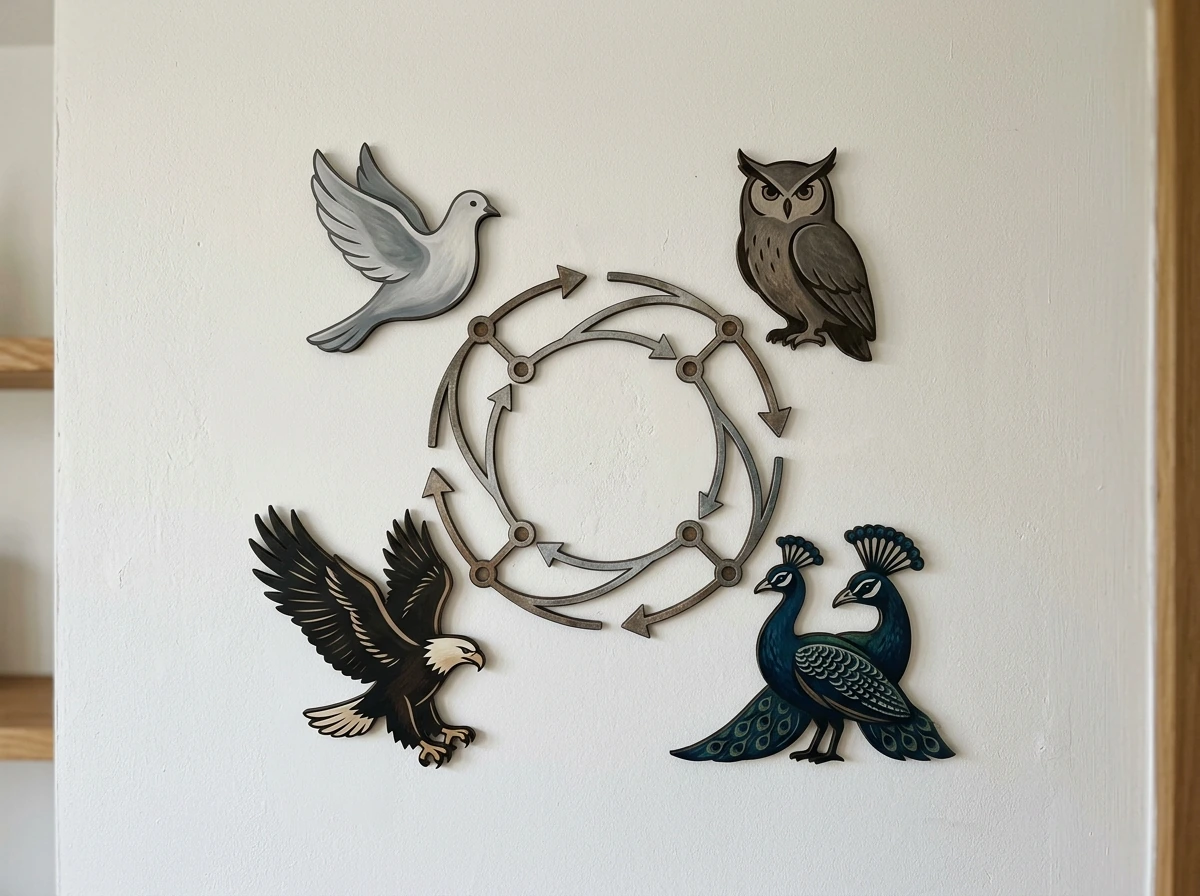
The 'Dope Bird 4 personality types' refers to the D.O.P.E. personality framework, where D.O.P.E. stands for Dove, Owl, Peacock, and Eagle. It is a four-type personality quiz system created by RichardStep, based on work theorized by Dr. Gary Couture and drawing on dimensions similar to William Marston's DiSC model. Each letter maps directly to one bird, and each bird represents a distinct way of thinking, communicating, and acting. If you've taken the test and got a result, or you're trying to understand what someone else's result means, this guide covers all four types in full, including how to spot each one, their real strengths and blind spots, how they work together, and how to figure out which one you actually are.
Dope Bird 4 Personality Types Meaning: Guide & Self-Check

Marcus Whitley
23 Mar 2026
What 'Dope Bird 4' Actually Is
Dope Bird 4 is not a video game or mobile app in the traditional sense. It is a personality assessment published by RichardStep (available in both a printable and an online version) that groups people into one of four personality types, each represented by a bird. The name comes from the acronym D.O.P.E., which stands for Dove, Owl, Peacock, and Eagle. The '4' simply refers to the four types in the system.
People sometimes land on this topic after searching in a gaming context, possibly confusing it with bird-themed mobile games or other 'DOPE' branded apps. To be clear: the People sometimes land on this topic after searching in a gaming context, possibly confusing it with bird-themed mobile games or other 'DOPE' branded apps. To be clear: the D.O.P. If you are also looking for the <a data-article-id="D4ED8889-65FD-4707-A0B3-33BD5D877F3D">dope bird test meaning, this article breaks down what each labeled bird type represents. E. Bird test</a> is a personality quiz, not a game level or in-app achievement. is a personality quiz, not a game level or in-app achievement. If you were looking for a game mechanic, this isn't it. But if you took a bird personality quiz and got a result labeled Dove, Owl, Peacock, or Eagle, you're in exactly the right place.
How the Personality Type System Works
The D.O.P.E. system is built on the idea that people have a dominant personality style that shows up consistently in how they make decisions, interact with others, handle pressure, and approach problems. The four bird types map to four broad behavioral tendencies. Most people have one dominant type and one secondary type, but the quiz results usually highlight the primary one.
The framework is designed to be practical and self-aware rather than clinical. It does not require a professional to administer and is intentionally accessible. The quiz asks a series of trait-based questions, and your answers cluster you toward the type that best matches your natural tendencies. The goal is not to box you in but to give you a useful lens for understanding how you show up by default and where you might need to flex.
What Each Bird Type Means
Dove: The Peaceful, People-First Type
Doves are defined by warmth, cooperation, and a genuine desire for harmony. They prioritize relationships over results and are the type most likely to check in on how everyone is feeling before pushing forward on a decision. Doves are supportive, loyal, and patient. They avoid conflict instinctively and tend to be excellent listeners. In a group setting, the Dove is usually the one keeping the peace, noticing when someone feels left out, and making sure the team stays connected emotionally.
Owl: The Logical, Detail-Oriented Type
Owls are analytical, careful, and precise. They like to gather information before acting and are uncomfortable making decisions without enough data. Owls tend to ask a lot of questions, take detailed notes, and want to understand the 'why' behind everything. They value accuracy and consistency and are natural researchers, planners, and quality-checkers. In a group, the Owl is usually the one asking 'but have we considered...' and making sure no important detail gets missed.
Peacock: The Enthusiastic, Expressive Type
Peacocks are optimistic, energetic, and love being around people. They are natural communicators who light up a room and tend to be persuasive, creative, and spontaneous. Peacocks are motivated by recognition and enjoy expressing their ideas out loud. They are the type most likely to pitch a bold idea, rally a group around a vision, or keep energy high during a tough stretch. In a group setting, the Peacock brings enthusiasm and keeps momentum going.
Eagle: The Bold, Results-Driven Type
Eagles are decisive, direct, and goal-oriented. They move fast, delegate readily, and focus on outcomes over process. Eagles are natural leaders who take charge in ambiguous situations and have little patience for inefficiency or over-analysis. They are competitive, confident, and often blunt. In a group, the Eagle is usually the one setting the direction, making the call when others hesitate, and pushing the team toward the finish line.
Strengths, Blind Spots, and Typical Behaviors by Type
| Type | Core Strengths | Common Blind Spots | Typical Behaviors Under Pressure |
|---|---|---|---|
| Dove | Empathy, loyalty, collaboration, patience | Avoids confrontation, struggles to say no, can be indecisive | Withdraws, over-accommodates, bottles up frustration |
| Owl | Accuracy, critical thinking, thoroughness, planning | Analysis paralysis, perfectionism, slow to decide | Over-researches, becomes rigid, nitpicks details |
| Peacock | Enthusiasm, creativity, persuasion, communication | Disorganized, impulsive, chases novelty over follow-through | Talks over others, overcommits, loses focus |
| Eagle | Decisiveness, leadership, efficiency, drive | Can be blunt or dismissive, overlooks feelings, impatient | Becomes controlling, steamrolls input, takes over |
Knowing your blind spots is honestly more useful than knowing your strengths. Most people already know what they are good at. The real growth comes from recognizing the automatic moves you make under pressure that actually slow things down or push people away.
Best Roles and How the Types Work Together
Where Each Type Fits Best
- Dove: Counseling, support roles, HR, customer service, mediation, teaching, any role where relationship quality drives success
- Owl: Research, data analysis, engineering, finance, quality assurance, compliance, any role requiring precision and systematic thinking
- Peacock: Sales, marketing, public speaking, event planning, creative direction, any role requiring energy and influence
- Eagle: Executive leadership, project management, entrepreneurship, operations, any role requiring fast decisions and accountability
How the Four Types Complement Each Other

The most effective teams typically have all four types represented. Eagles set direction but benefit from Owls who catch errors and Doves who keep the team's trust intact. Peacocks generate ideas and momentum but need Eagles to prioritize and Owls to pressure-test the plan before launching. Doves build the relational foundation that lets everyone feel safe enough to contribute honestly.
Where teams struggle is when one type dominates with no balance. An all-Eagle team makes fast decisions but burns people out and misses details. An all-Owl team produces thorough plans that never get executed. An all-Dove team gets along beautifully but avoids the hard conversations needed for real progress. An all-Peacock team has no shortage of ideas but struggles to ship anything. Balance is the point.
If you are pairing types intentionally (for a project team, a work partnership, or even a personal relationship), the most naturally complementary pairings are Eagle with Dove (results plus relationship), and Owl with Peacock (rigor plus energy). These pairings tend to cover each other's weaknesses without friction, as long as both people understand and respect the differences.
Figure Out Your Own Type Right Now
You do not need to take the full quiz to get a reasonable read on your type. Answer these four questions honestly and see which pattern fits:
- When a conflict comes up, what is your first instinct? Smooth it over and keep the peace (Dove), gather more information before reacting (Owl), talk it out loudly and expressively (Peacock), or take charge and resolve it directly (Eagle)?
- What do you care most about at work or in a team setting? That people feel good and supported (Dove), that the work is done correctly and thoroughly (Owl), that there is energy and excitement in what you are doing (Peacock), or that the goal gets hit on time (Eagle)?
- What frustrates you most? People being unkind or cold (Dove), people being careless or sloppy (Owl), people being boring or closed-minded (Peacock), people being slow or inefficient (Eagle)?
- How do others most often describe you? Warm and caring (Dove), smart and thorough (Owl), fun and energetic (Peacock), driven and confident (Eagle)?
If your answers cluster around one bird, that is likely your dominant type. If they split between two, you have a strong secondary type, which is common. Most people are a blend, but one type usually leads. For a more precise result, the full RichardStep D.O.P.E. quiz (available online and in a printable version) walks you through a scored set of questions that gives a clearer breakdown across all four dimensions.
Common Confusion and Misinformation to Avoid
The biggest source of confusion around 'Dope Bird 4' is the name itself. Because 'DOPE' reads as slang and 'Bird 4' sounds like it could be a game level or mobile app, people often search for it in a gaming context and land on completely unrelated content. To be clear: D.O.P.E. is a personality acronym, not a game title, and the '4' refers to the four types, not a version number or game stage.
Another common error is treating the bird types as rigid boxes. People take the quiz, get 'Eagle,' and start saying things like 'I am an Eagle, so I do not do empathy.' That is not how the system works. The types describe your default tendencies, not your ceiling. An Eagle can learn to slow down and listen. A Dove can learn to push back. The framework is a starting point for self-awareness, not a permanent label.
There is also frequent confusion between D.O.P.E. and other four-type personality systems. The DiSC model, the MBTI, the four temperaments, and other bird-based personality quizzes all share structural similarities, which leads people to mix up terminology across frameworks. If someone tells you they are a 'D type,' they are likely talking about DiSC, not D.O.P.E. The two systems overlap in spirit but use different labels and scoring. Stick to the Dove/Owl/Peacock/Eagle vocabulary when working within the D.O.P.E. framework specifically.
Finally, watch out for unofficial or modified versions of the quiz circulating on third-party sites. Some versions have been altered, shortened, or mislabeled in ways that produce less accurate results. The original RichardStep version is the reference point. If your results feel off or inconsistent across different sites, that is likely why. Related topics like the broader dope bird personality test meaning or doe doe bird meaning are worth exploring if you want to go deeper on the quiz mechanics and scoring. Related topics like the broader dope bird personality test meaning or doe doe bird meaning are worth exploring if you want to go deeper on the quiz mechanics and scoring dope bird test meaning. If you want the dope bird personality test meaning in plain terms, start by looking at what each bird type stands for. The doe doe bird meaning is often discussed as a related bird-based personality metaphor, so it can help to compare how the labels are used dope bird personality test meaning or doe doe bird meaning. If you are curious about the dodo bird emoji meaning, it can help to see how people interpret it as a personality or symbol metaphor. If you are also looking for the wave and bird emoji meaning, the context of how it is used in messages matters just as much as the symbol itself dodo bird emoji meaning. If you are specifically looking for the dodo bird meaning, you will want to compare that phrase’s origin and usage in the way people describe Dodo as a personality metaphor versus the Dope Bird 4 acronym. bird with leaf emoji meaning
FAQ
If I get a “Dove” result, does that mean I am conflict-avoidant by default?
Usually it means you tend to preserve harmony first, but it does not equal inability to handle conflict. A Dove can still make hard calls, the difference is that the “default path” is relationship repair and emotional clarity before speed or pressure.
Can one person realistically have two dominant types in the same season of life?
Yes. Stress, role changes, and new responsibilities can shift which tendency you use most. If your quiz results flip between two birds over time, treat both as usable modes, then note which one appears when you are under pressure versus when you are planning.
How should I interpret the result if my answers are split evenly across two birds?
An even split often suggests you are switching strategies depending on context, for example, analytical at work (Owl) but expressive in social settings (Peacock). To decide your primary, compare which bird shows up more often in high-stakes moments, not in comfortable routines.
What is the best way to talk to someone when their type feels “opposite” to mine?
Use one bridge language at a time. If you are an Eagle dealing with an Owl, lead with what you need from them (decision criteria, timeline, and what “done” means). If you are a Dove dealing with an Eagle, start with shared goals and then ask for a direct next step so the conversation does not get stalled by indirectness.
Are these types fixed traits or behaviors I can train?
They describe default tendencies, not permanent identity. The framework implies you can flex, for example, an Owl can practice making time-boxed decisions, and a Peacock can practice giving clearer structure. The key is to train the underused behavior in situations where it actually matters.
What should I do if I think the quiz result is wrong or doesn’t match how I behave at work?
Re-take the full quiz with a specific reference period in mind (like the last 4 to 6 weeks) and answer based on your most frequent reactions, not your ideal behavior. If you still get a mismatch, it may be role-driven, not personality-driven, and you should treat the result as a lens rather than a verdict.
How do I use D.O.P.E. for a team, without stereotyping people?
Assign behaviors, not labels. For example, define who checks for accuracy (often Owl), who owns the deadline and decisions (often Eagle), who monitors morale and buy-in (often Dove), and who proposes options and energy (often Peacock). Then let people rotate those responsibilities so the team benefits without locking anyone into a stereotype.
If I am pairing Eagle with Dove or Owl with Peacock, what is the common failure mode?
For Eagle and Dove, the failure mode is Eagle pushing too fast and Dove delaying for emotional safety, causing frustration both ways. For Owl and Peacock, it is the Owl over-analyzing and the Peacock skipping details. Agree upfront on a decision process (when to decide, how to validate, and what “good enough” means).
Does “Eagle” mean someone is always blunt and impatient?
Not necessarily. It usually means directness and outcome focus are easier for them than extended ambiguity. Some Eagles learn tact, but even tact often stays paired with fast decisions. If it bothers you, ask for the decision rationale and the expected next action in one message.
How can I tell the difference between confusion with DiSC or MBTI versus a true D.O.P.E. fit?
DiSC and MBTI categorize in different ways, so the easiest check is vocabulary and scoring consistency. If the person talks about Dove/Owl/Peacock/Eagle and behaviors like harmony-first or data-first, they are likely using D.O.P.E. If they refer to “D type” broadly or use DiSC terms, they may not be using the same framework.
What should I watch for when using shortened or unofficial versions of the D.O.P.E. quiz?
Shortened quizzes can over-weight one theme, so they may inflate results toward the most extreme or easiest-to-answer style. If your result feels inconsistent across different versions, default to the RichardStep full version or at least compare patterns, for example which two birds most consistently show up as top scores.
Next Article
Bird of Bad Omen Meaning: What It Signifies and Why
Discover bird of bad omen meaning, symbolism of ravens, crows, owls, vultures, and how to respond without panic.