The bobolink (Dolichonyx oryzivorus) carries meanings of joy, freedom, and seasonal renewal. It shows up in poetry, folk tradition, and nature writing as a symbol of summer's arrival and the unstoppable pull of migration. But before any of that symbolism sticks, it helps to actually know the bird: a small grassland songster that flies thousands of kilometres each year, sings one of the most otherworldly songs in North America, and has been called everything from 'rice-bird' to 'Robert of Lincoln' depending on who you ask and when.
Bobolink Bird Meaning: Symbolism, ID, Culture & Conservation

Marcus Whitley
7 Aug 2026
What this guide covers
This article gives you the full picture of bobolink bird meaning: natural-history facts you can actually use to recognise the bird, a breakdown of its name and where it comes from, documented symbolic associations drawn from literature and folk tradition, a look at Indigenous North American beliefs where they are verifiable and responsibly represented, and some honest notes on the bird's conservation status, because symbolism grounded in a real, living species deserves that context. Whether you're a writer hunting for the right metaphor, a birdwatcher curious about cultural meaning, or a spiritual seeker looking into bird omens, this is your reference.
What a bobolink looks like (and sounds like)
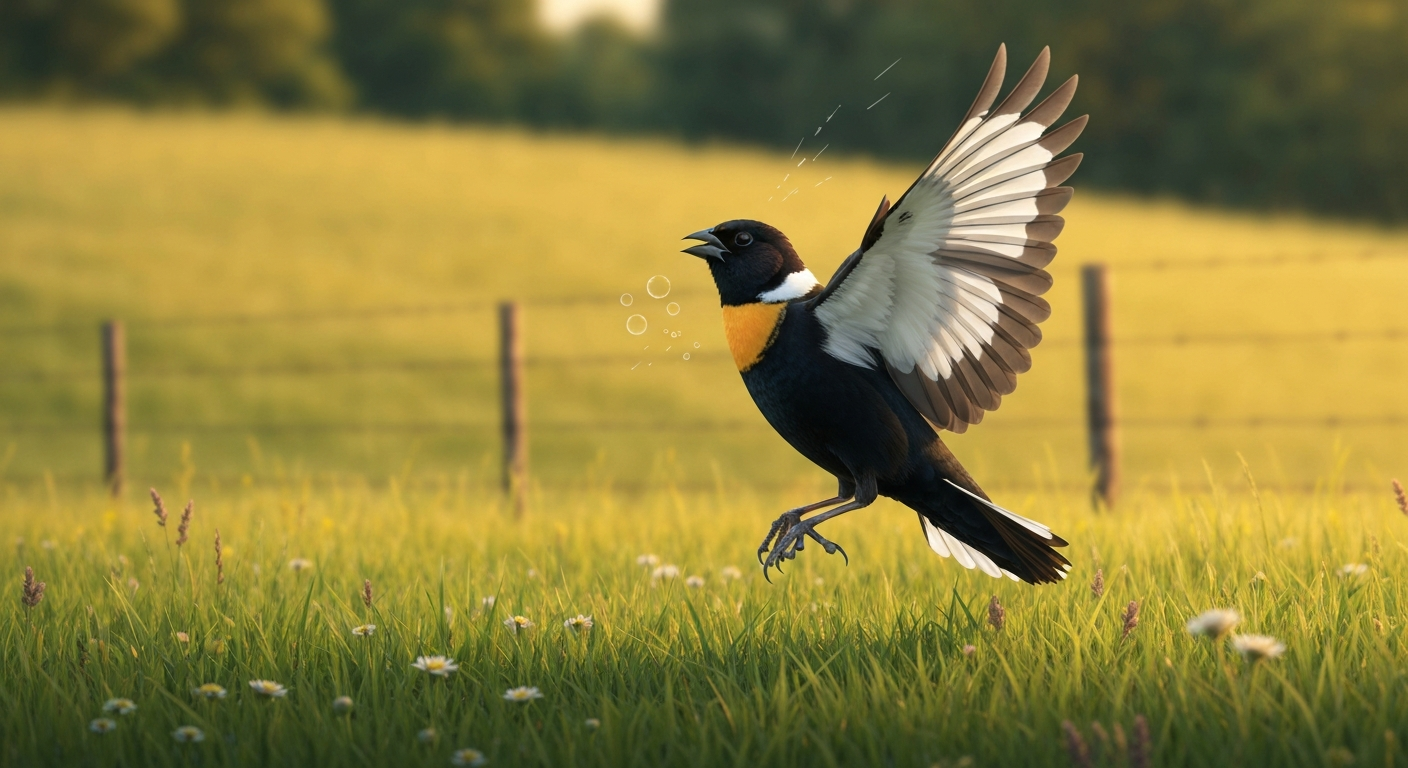
The adult breeding male bobolink is one of the most striking grassland birds in North America, and also one of the most unusual: he is black below and white above, which is the reverse of almost every other bird. The back and scapulars are white, the nape is a warm buffy yellow, and the rest of the plumage is jet black. He is small, roughly 16 cm from bill to tail, about the size of a large sparrow. Females and nonbreeding males look completely different: streaky brown and buffy, almost sparrow-like, with a striped crown. If you see a bobolink outside of breeding season you would be forgiven for not recognising it as the same species.
The song is the giveaway at any time of year, but you are most likely to hear it on breeding grounds. It is a bubbling, rambling cascade of tinkling, buzzy, and clear notes delivered at speed, almost electronic-sounding to modern ears. Males often sing during a distinctive hovering flight display over grassland, wings held stiffly downward. Once you hear it, you do not forget it. Ornithologists at the Cornell Lab of Ornithology describe it as one of the most complex songs of any North American bird, and recordings in the Macaulay Library make it easy to confirm for yourself.
Migration and habitat: when and where to find one
Bobolinks breed in grasslands and hayfields across southern Canada and the northern and mid-latitude United States, with peak breeding activity running from May through July. They nest on the ground, tucking nests into dense grass and vegetation where they are nearly impossible to spot. After breeding, they stage one of the most remarkable migrations of any North American songbird: the entire population flies to South America, primarily to Argentina, Paraguay, Bolivia, and parts of Brazil, a round trip that covers thousands of kilometres. Geolocator research published in The Auk has documented that some individuals take transoceanic fall migration routes across the Gulf of Mexico and Caribbean, an extraordinary feat for a 30-gram bird.
During migration, bobolinks pass through a wide swath of North America, and flocks were historically a familiar sight (and problem) in rice-growing regions of the southeastern United States and the Caribbean. On their wintering grounds in South America they are also known to feed in grain fields, which has made them both culturally prominent and, in some regions, a pest species targeted by farmers. eBird Status and Trends provides high-resolution seasonal abundance maps if you want to pinpoint when the species is likely to appear in your area. See eBird Status and Trends, Bobolink (Cornell Lab Analytics) for high‑resolution range maps, seasonal abundance surfaces, and timing data to pinpoint when and where bobolinks are likely to appear eBird Status and Trends — Bobolink (Cornell Lab Analytics).
Bobolink at a glance
| Quick ID Feature | Symbolic Theme It Echoes |
|---|---|
| Black-below, white-above breeding male plumage (reversed pattern) | Inversion, surprise, things that defy expectations |
| Bubbling, electronic-sounding song delivered in flight | Joy, exuberance, uncontained expression |
| Ground-nesting in hayfields and meadows | Rootedness, harvest, connection to the land |
| One of the longest migrations of any North American songbird | Freedom, endurance, the pull of distant places |
| Appears in summer, disappears in autumn | Seasonal change, impermanence, the passing of summer |
| Streaky brown nonbreeding plumage (almost unrecognisable) | Hidden identity, transformation, dual nature |
Where the name 'bobolink' actually comes from
The name is imitative, meaning it grew out of attempts to render the bird's song in words. Early American and English naturalists heard the bubbling call and wrote it down phonetically as 'bob-o'-lincoln' or 'Robert of Lincoln,' which is the form used by the poet William Cullen Bryant and later by William Bliss Carman. By the late 18th and early 19th centuries the spelling 'bobolink' had settled into common use, and Merriam-Webster and the Online Etymology Dictionary both trace this development. The name is a rare example of folk onomatopoeia becoming an official common name, and it still captures something real: if you listen to a male singing, you can hear syllables that loosely suggest 'bob-o-link' buried in the cascade.
The scientific name tells a different story. Linnaeus first described the species as Fringilla oryzivora in 1758, the specific epithet combining Latin oryza (rice) and -vorus (eating), meaning 'rice-eater.' That name reflected the bird's documented habit of feeding in rice paddies during migration. The genus Dolichonyx was introduced by William Swainson in 1827, derived from the Greek dolichos (long) and onyx or onyxos (nail or claw), referring to the species' notably elongated hind claw. So the official scientific name, unpacked, gives you a rice-eating, long-clawed bird, which is actually a pretty accurate natural-history description.
The historical nickname 'rice-bird' is worth pausing on because it shaped how the species was perceived for centuries. 18th-century naturalists including Mark Catesby documented flocks descending on rice plantations in the American Southeast, and the name appears in early Audubon accounts as well. The same pattern repeated in South America, where the species earned equivalents of 'rice-bird' in Spanish and Portuguese. This agricultural identity, the bird as both guest and pest of the harvest, runs all the way through its cultural symbolism.
How bobolinks behave and why farmers knew them well
On breeding grounds, male bobolinks are conspicuous and territorial, singing from fence posts and in hovering flight displays above meadows. They eat both seeds and insects during the breeding season, with insects being especially important as protein for nestlings. As migration begins and through the winter, the diet shifts heavily toward seeds and grain, which is exactly when their agricultural associations kick in. Flocks moving through rice and grain fields were large enough to cause measurable crop damage, making the bobolink a culturally loaded bird: simultaneously celebrated as a singing summer visitor and cursed as a grain thief.
This dual role, joyful songster of the meadow versus raider of the harvest, is not just an agricultural footnote. It feeds directly into the bird's symbolic range. You have a creature that arrives with summer, fills fields with music, and then disappears southward while also being associated with abundance, grain, cycles of planting and harvest, and the transience of good things. That is a genuinely rich symbolic profile, and it did not go unnoticed by writers or folk traditions.
What the bobolink symbolises: documented themes
Across the sources where bobolink symbolism appears, a few consistent themes emerge. The most prominent is joy and exuberance, driven almost entirely by the song. Emily Dickinson wrote about the bobolink repeatedly, using it as an emblem of unrestrained, almost reckless happiness. In her poems the bird's song represents the kind of joy that does not ask for permission, that simply erupts. William Cullen Bryant's 'Robert of Lincoln' (1855) takes this further, giving the male bird a bragging, self-satisfied personality ('Merrily bobolink, bobolink, spink, spank, spink') that made it a folk emblem of summer confidence.
Migration as a symbolic theme is equally well-documented. Because bobolinks arrive in summer and vanish completely in autumn, they became associated with the passing of warm seasons, with impermanence, and with the bittersweet quality of things that are wonderful precisely because they do not last. This is not a vague interpretation: writers consistently reached for the bobolink when they wanted to capture the feeling of summer slipping away. In that respect the bobolink functions similarly to how other migratory songbirds work symbolically in other traditions, the koel in South Asian poetry being a close parallel for its association with seasonal arrival and longing.
The harvest and field connection adds an earthier layer. The rice-bird identity places the bobolink squarely in agricultural symbolism: abundance, the grain harvest, the land's fertility, and the sometimes-complicated relationship between wild creatures and cultivated food. In regions where the bird was a pest, it was also a sign that the crop was ripe, making it a practical seasonal marker as well as a symbolic one.
- Joy and exuberance: the song as a symbol of uncontained, unselfconscious happiness (documented in Dickinson, Bryant, and 19th-century American poetry)
- Seasonal change and impermanence: arrival signals summer's peak; departure marks its end
- Freedom and long-distance travel: one of the longest migrations in North American birds, used in writing as a metaphor for the pull of distant places
- Harvest and abundance: the 'rice-bird' identity ties the species to grain, plenty, and agricultural cycles
- Transformation: the dramatic difference between breeding and nonbreeding plumage echoes themes of hidden identity and renewal
- Inversion and surprise: the reversed black-below/white-above pattern has occasionally been read as a symbol of things that defy convention
The bobolink in literature and music
The bobolink has an unusually strong literary footprint for a grassland bird. Emily Dickinson referenced it in at least a dozen poems, often pairing it with the image of summer abundance or using it to personify pure, wordless happiness. Bryant's 'Robert of Lincoln' gave the bird a distinct personality and was widely anthologised in 19th-century American schoolbooks, meaning generations of American children grew up with the bobolink as a named, characterful bird rather than just a generic songbird. Henry David Thoreau noted the bobolink's song in his journals with evident delight, connecting it to the wild character of open meadows.
In music, the bobolink's name and song have appeared in folk songs and popular tunes through the 19th and early 20th centuries, largely as shorthand for summer cheerfulness. The word itself, with its bright vowels and bouncing rhythm, lends itself to song titles and lyrics in a way that 'yellow-headed blackbird' simply does not. Contemporary writers and poets still reach for it when they want to evoke a specifically North American summer, a meadow in June, or the quality of joy that feels almost too good to last.
Indigenous North American and regional folk beliefs
Specific, well-documented Indigenous North American beliefs about the bobolink are not as extensively recorded in publicly available sources as the species' Western literary symbolism, and it is worth being honest about that rather than filling the gap with generalisation. What is clear is that the bobolink's summer breeding range overlaps with the territories of many Plains and Eastern Woodland nations for whom grassland birds and seasonal bird arrivals carried significance as ecological and calendar markers. The bird's dramatic song and distinctive appearance would have made it a noticed presence, and its arrival in late spring would have aligned with planting and growing seasons in agricultural communities.
In some regional folk traditions of the American Northeast and Midwest, the bobolink's appearance in hayfields was treated as a sign that the first cutting of hay was near, a practical seasonal indicator rather than a purely spiritual one. In parts of the Caribbean and South America where migrating flocks were well-known, the bird's arrival was similarly tied to seasonal and agricultural cycles, with local names and lore reflecting the grain-field association. If you are researching specific tribal or regional beliefs in depth, tribal cultural offices and Indigenous-led natural history resources are the appropriate primary sources, as oral traditions are not uniformly documented in written form and vary significantly between nations and regions.
It is also worth noting that for several Indigenous nations in the Great Plains and Northern Grasslands, grassland bird communities as a whole carry significance as indicators of healthy prairie ecosystems. The bobolink, as a characteristic grassland species in decline, sits within that broader ecological and cultural framework. Its disappearance from formerly abundant breeding areas is not just a conservation statistic: it represents a change in the soundscape and seasonal rhythm of places where the bird has long been a recognised presence.
Interpreting a bobolink sighting
If you use bird sightings as personal or creative prompts, the bobolink offers several reliable symbolic threads to pull. Seeing one in summer, especially a singing male in flight display, is a reasonable cue for joy, confidence, and the fullness of a season that will not last forever. Seeing one on migration, when it is in its streaky nonbreeding plumage and almost unrecognisable, is a different experience: quieter, more about the journey and the distance still to travel. If the bird appears in a creative project, a dream, or a passage of writing, those two registers, summer exuberance and the long migratory haul, are both well-supported by the bird's actual natural history, which is what makes them more than arbitrary associations.
For writers specifically: the bobolink is particularly useful when you want to evoke a specifically North American summer that feels both joyful and fleeting. It carries enough literary history that readers with any background in 19th-century American poetry will register it immediately, but it is not so overused as to feel cliched. The name itself has a phonetic playfulness, three syllables that actually sound like the bird, which gives it a natural musicality in prose or verse.
Conservation context: why the symbolism matters now
Bobolink populations have declined significantly across much of their breeding range. The North American Breeding Bird Survey documents long-term declines, and in Canada, COSEWIC has assessed the species as a conservation concern, with habitat loss in hayfields and grasslands (partly driven by changes in agricultural timing and land use) being a primary driver. See the USGS Breeding Bird Survey (BBS) site and Bobolink species account (Patuxent Wildlife Research Center) for BBS trend data showing long‑term population declines across much of the breeding range. BirdLife International and the IUCN have been reassessing the species' global status, with national assessments flagging the declines. As of the most recent data available in 2025-2026, the species was under review for potential uplisting from its historically 'Least Concern' IUCN category.
This matters symbolically as well as ecologically. A bird that has served for centuries as a cultural emblem of summer joy and abundance is becoming genuinely rarer in the places where that symbolism was forged. For readers who use bird symbolism seriously, knowing that context changes how the symbol reads. The bobolink is not just an abstract image of freedom and seasonal change: it is a real species whose extraordinary migrations and meadow songs are under pressure. That adds weight to the meaning, not just poetry.
Comparing bobolink meaning to other bird terms
If you are building out a broader understanding of bird symbolism, the bobolink sits interestingly alongside other songbirds whose meanings are tied to arrival, song, and seasonal change. The koel, explored in a related article on this site, carries remarkably similar themes in South Asian tradition: its arrival signals a season's turn, its song is associated with longing and joy, and its name is also imitative of its call. For a related discussion of similar themes in South Asia, see the article on koko bird meaning. The kolokolo bird from Swahili tradition offers another parallel worth exploring, where a bird's call serves as a cultural and seasonal marker in a completely different geographic and linguistic context. For a comparative perspective, see kolokolo bird meaning. The bobolink's North American literary prominence makes it a useful reference point for understanding how a single bird's song can anchor an entire cultural season. For a Pacific perspective on bird-call symbolism, see kahakos bird meaning for how similar themes play out in that tradition.
FAQ
What is a clear, quick species overview to help recognize the bobolink (Dolichonyx oryzivorus)?
Identification: - Adult breeding male: small (≈16 cm), black underparts and face, white back and scapulars, buffy/golden nape patch; chunky short tail and short conical bill. - Female and nonbreeding male: streaky brown and buffy overall, more inconspicuous. Song & display: - Male song: bubbling, rambling series of tinkling, buzzy and clear notes often given from a perch or on a hovering flight display above grasslands. Habitat & timing: - Breeds in native grasslands, meadows and hayfields across southern Canada and northern/mid‑latitude United States (peak breeding May–July). Nests are on the ground, concealed in tall vegetation. Migration: - Long‑distance migrant; winters in southern South America (Argentina, Paraguay, Bolivia, parts of Brazil) and undertakes multi‑thousand‑kilometre round trips, sometimes crossing open water. Quick ID cues (listen/look): small size, white back patch on male, bubbling tinkling song, presence in hayfields/grasslands in late spring/early summer. Sources to cite: Cornell Lab All About Birds, Audubon, Sibley field guides, Macaulay Library, eBird Status & Trends.
What is the etymology and name history of 'bobolink' and its scientific name?
Scientific name: - Dolichonyx oryzivorus — 'Dolichonyx' from Greek dolichos (‘long’) + onyx/onyxos (nail/claw); 'oryzivorus' (often seen as oryzivora) from Latin oryza (‘rice’) + -vorus (‘eating’) meaning 'rice‑eating', reflecting historic reports of feeding in rice fields. English common name: - 'Bobolink' is a folk/imitative name recorded in the late 18th/early 19th century, earlier rendered as 'bob‑o'‑Lincoln' or 'Robert of Lincoln' in dialectal song transcriptions; over time it settled as 'bobolink'. Historic vernacular: - 'Rice‑bird' and 'reedbird' appear in earlier agricultural and naturalist literature because of flocks feeding on rice and grains on migration/wintering grounds. Recommended references: Linnaeus Systema Naturae, Swainson (genus description), Merriam‑Webster, Online Etymology, All About Birds.
What documented symbolic meanings does the bobolink have across cultures and traditions?
Documented symbolic themes (avoid unverified claims): - Spring, renewal, and the joy of open grasslands: linked to its arrival and exuberant male song in temperate North American spring. - Transience and long journeys: long‑distance migration makes it a symbol of travel, endurance, and seasonal cycles. - Agricultural/harvest associations: historical 'rice‑bird' ties to grain fields link the species to themes of abundance, pest/benefit ambivalence, and human–bird agricultural relations. - Folk and rural motifs: in North American folk songs and oral lore the bobolink often signals haying season and rural life rhythms. - Indigenous North American motifs: where present, Indigenous meanings vary regionally and are best reported from specific tribal sources; published ethnographic material sometimes connects grassland birds to seasonal indicators and stewardship teachings—do not generalize without source attribution. Notes on responsible interpretation: - Use documented, cited cultural sources; avoid inventing spiritual claims that lack ethnographic or textual support.
How does the bobolink appear in literature, music, proverbs, and contemporary language?
Examples and documented appearances: - Folk song: 'Bobolink' features in 19th‑century and later North American folk songs and minstrel repertoire (often referencing rural scenes and haying). - Poetry & prose: poets and nature writers use the bobolink as an emblem of spring, open fields and fleeting beauty; consult major anthologies and 19th‑century nature essays for named examples. - Proverbs/colloquialisms: fewer fixed proverbs than metaphorical uses—more often invoked in pastoral imagery and as a marker of the haying season. - Contemporary language: used in birding and natural‑history writing as shorthand for grassland health or migratory spectacle; appears in place and product names (e.g., Bobolink Farm) reflecting cultural affection. Sources & research path: - Search historic newspapers, folk song archives, poetry anthologies, and databases (e.g., HathiTrust, Library of Congress, folk music collections) to cite specific textual examples.
Can you give a simple table pairing quick ID cues with symbolic meanings for use in the article?
| Quick ID cue | Common symbolic meaning | |--------------|-------------------------| | Male with white back and buffy nape, bubbly song | Spring, exuberance, arrival of the season | | Flocks in hayfields or rice paddies | Harvest, abundance, agricultural connection | | Long‑distance migration routes | Journey, endurance, transience | | Ground‑nesting in grasslands | Vulnerability, need for stewardship/protection | (Use field guides and migration studies—Cornell All About Birds, Renfrew et al., eBird—for citations.)
What practical guidance can readers use to interpret a bobolink sighting personally, creatively, or symbolically?
Practical suggestions: - Personal reflection: note context—time of year, behavior (singing, feeding, migrating), and emotions aroused; tie interpretation to concrete facts (e.g., 'I saw a male bobolink at dawn in a hayfield in late May: a symbol of seasonal renewal'). - Creative use (writing/poetry): use identifiable traits (white back, bubbling song, grassland setting, long migration) as concrete metaphors for arrival, fleeting joy, or journeys. - Spiritual or symbolic practice: prefer grounded metaphors (seasonal change, migration, stewardship) and consult local Indigenous sources before adopting cultural meanings from communities other than your own. - Ethical note: avoid claiming universal spiritual messages; place symbolic interpretations alongside natural‑history facts and conservation context.
Next Article
Kokok Bird Meaning: What Kokok Really Refers To
Discover what kokok bird meaning really refers to, from common call imitations to specific species and symbolism.