The koel bird is a cuckoo, specifically the Asian koel (Eudynamys scolopaceus), a species found across South and Southeast Asia, Australia, and the Pacific. When people search for the koel bird's meaning, they're usually after one of two things: what the bird actually is as a species, or what it represents culturally, particularly in South Asian poetry, folklore, and seasonal tradition. This is why many people also look up the kahakos bird meaning, since similar-sounding names can point to related cultural interpretations. The short version is this: the koel is both a real, identifiable bird with a distinctive call and a deeply symbolic figure tied to spring, love, the monsoon season, and renewal across Indian, Pakistani, Sri Lankan, and Australian cultures.
Koel Bird Meaning in English: Species, Symbolism, Origins

What is the koel bird, exactly?
The Asian koel belongs to the cuckoo family and carries the scientific name Eudynamys scolopaceus. It's a medium-to-large bird, and like many cuckoos, it's a brood parasite, meaning it lays its eggs in other birds' nests and lets the host raise its chicks. The common myna (Acridotheres tristis) is one of its frequent targets. The genus Eudynamys was formally introduced by English naturalists Nicholas Vigors and Thomas Horsfield in 1827, though the bird had been documented in English natural history much earlier. The naturalist George Edwards included an illustration and description of the Asian koel as far back as 1747 in his work A Natural History of Uncommon Birds.
The koel group (genus Eudynamys, or true koels) spans Asia, Australia, and the Pacific. Regional species and variants include the black-billed koel and the Pacific koel, which is especially familiar in northern and eastern Australia. The U.S. Fish and Wildlife Service also recognizes Eudynamys scolopaceus as a distinct species-level identity, separate from metaphorical or cultural usages of the name.
What 'koel' means in English
In English, 'koel' functions as a straightforward noun for this cuckoo species. Collins English Dictionary, Merriam-Webster, and Wiktionary all list it as a standard bird term borrowed from South Asian languages. Merriam-Webster includes variant spellings: 'koel' and 'koil' are both documented, with the former being the conventional spelling in most English dictionaries today. The Rekhta Dictionary, which tracks South Asian language usage, frames koel as meaning 'cuckoo' or 'small black bird,' which reflects how the term moves across Hindi and English registers.
In everyday English, 'koel' rarely functions as a metaphor on its own the way some bird terms do in idioms. You won't typically hear someone say 'she's a total koel' in a figurative sense the way you might hear 'she's a night owl.' Instead, when the word appears in English writing, it's usually in one of two contexts: ornithological description (identifying the actual bird) or literary/poetic reference (invoking its cultural symbolism, particularly in South Asian-inflected texts).
Where the name 'koel' actually comes from
The etymology is genuinely interesting and helps explain why the bird carries so much cultural weight. 'Koel' comes from the Hindi word 'koel' or 'koyal,' which itself traces back to the Sanskrit 'kokila.' Merriam-Webster traces exactly this path: Hindi koel/koil, from Sanskrit kokila. Wiktionary spells it out clearly: the English noun 'koel' derives from Hindi (कोयल, koyal) and Sanskrit (कोकिल, kokila).
What makes this etymology particularly satisfying is that 'kokila' is considered echoic in origin, meaning the word was formed in imitation of the bird's call. The koel's famous 'koo-Ooo' rising call essentially gave the bird its name across thousands of years and multiple language families. The Sanskrit 'kokila' became the standard literary name for the bird in classical Indian texts, and that same root fed into the common names used across Hindi, Urdu, Bengali, Sinhalese, and eventually into English. When you search 'kokila bird meaning' in cultural or Sanskrit texts, you're looking at the same bird as the koel.
Koel bird symbolism across different cultures
The koel is probably one of the most symbolically loaded birds in South Asian tradition, and what's fascinating is how consistently certain themes appear across different regions and time periods.
Spring, love, and the arrival of the monsoon
Across Indian, Pakistani, and Nepali poetry, the koel is strongly associated with spring and the pre-monsoon period. Its call, which intensifies during breeding season, is heard as a herald of seasonal change. The koel's call has been studied as a 'functionally rich signal' tied to the breeding season, which explains why cultures across the region came to associate its sound with themes of longing, love, and renewal.
In classical Sanskrit poetry and in Urdu ghazals, the koel's voice is frequently used as a metaphor for a lover's call, for yearning, or for the bittersweet ache of spring. Wikipedia specifically notes that the Asian koel is 'a widely used symbol in Indian, Pakistani and Nepali poetry,' which is about as clear a statement of cultural significance as you'll find.
New Year in Sri Lanka
In Sri Lanka, the koel's call carries a very specific cultural meaning tied to timing. Many Sri Lankans associate the koel's 'koo-Ooo' or 'ko-haa' call with the Sinhalese New Year (Aluth Awurudda), which is traditionally celebrated in mid-April. The bird's arrival and calling at that time of year effectively marks the new year season, making the koel a kind of living calendar cue deeply embedded in Sinhalese cultural memory.
The rainbird and stormbird of Australia
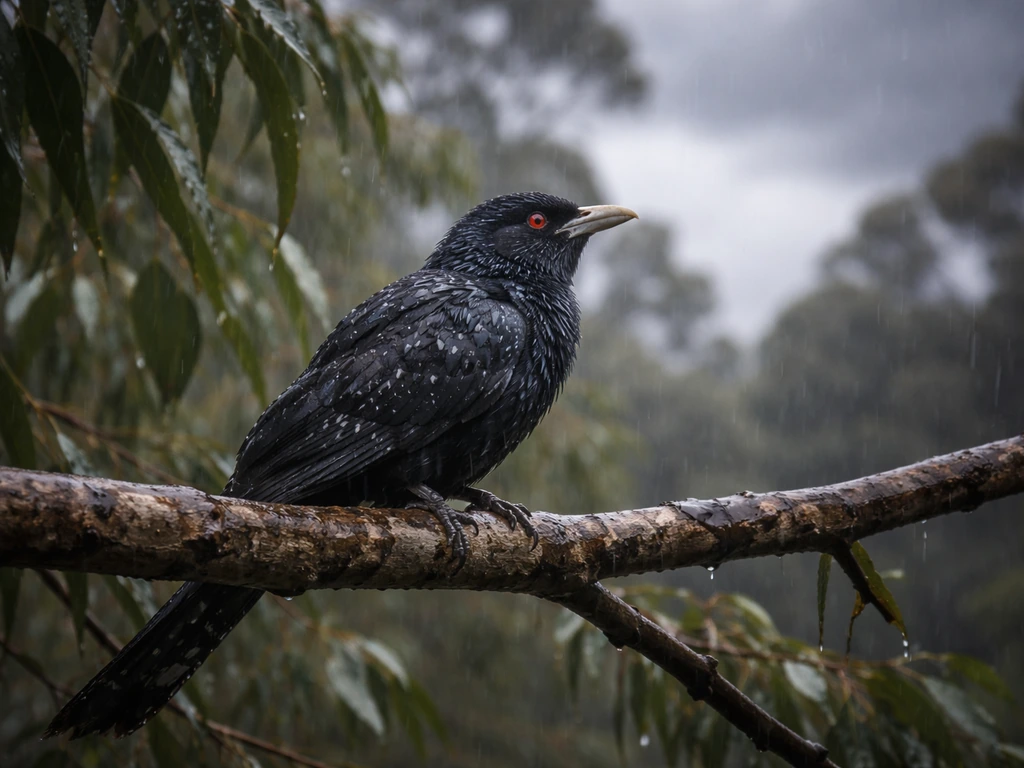
In Australia, the Pacific koel and the common koel are known by vivid colloquial names: 'rainbird,' 'stormbird,' and 'cooee bird.' The Queensland Government's own documentation of the common koel notes that when summer rain arrives, so does the koel's call. This has given the bird a folklore identity tied to storms and wet season, almost the inverse of South Asia's spring/monsoon association but rooted in the same fundamental observation: this bird calls loudly when the rains are coming. The 'cooee bird' nickname is a particularly Australian touch, linking the koel's call to the traditional 'cooee' shout used across the bush as a long-distance signal.
The koel in literature, poetry, and everyday references
The koel shows up in English-language writing in a few predictable but meaningful ways. In South Asian literature and poetry (whether originally in Hindi, Urdu, Bengali, or translated into English), the koel's call is frequently invoked to set a scene of spring or emotional longing. If you are looking up the koel bird meaning, this same cultural role is often why people connect the bird's call with themes of spring and longing. A character hears the koel and feels the pang of love or homesickness. This is such a consistent trope that readers familiar with Indian literature recognize the koel as a reliable emotional marker in the same way Western readers might associate the nightingale with love poetry.
In contemporary English-language poetry, 'koel' appears as a direct character and theme, with poems named directly after the bird (searchable on poetry databases like PoemHunter). Modern English-language journalism, particularly from South Asia, also uses 'koel' casually when discussing the bird's behavior or cultural timing, often noting that 'the singer is the cock bird' to clarify which sex produces the famous call.
One nuance worth knowing: when 'kokila' or 'kokilā' appears in cultural texts rather than 'koel,' it's the same bird. The Sanskrit name carries its own literary weight, particularly in classical contexts, but the symbolism is identical. If you're reading a Kalidasa poem or a classical text referencing the kokila singing in spring, that's your koel.
How to identify the koel (and avoid the common mix-ups)
The koel is genuinely easier to hear than to see, and that's where a lot of identification confusion starts. Here's what to look and listen for.
Visual identification
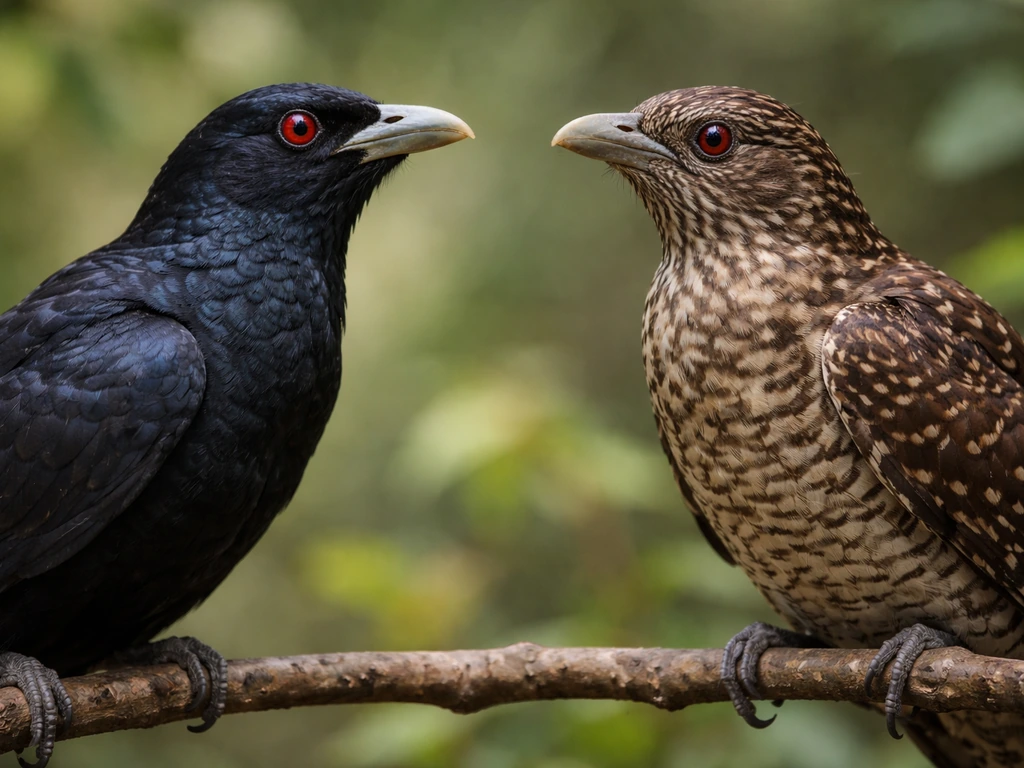
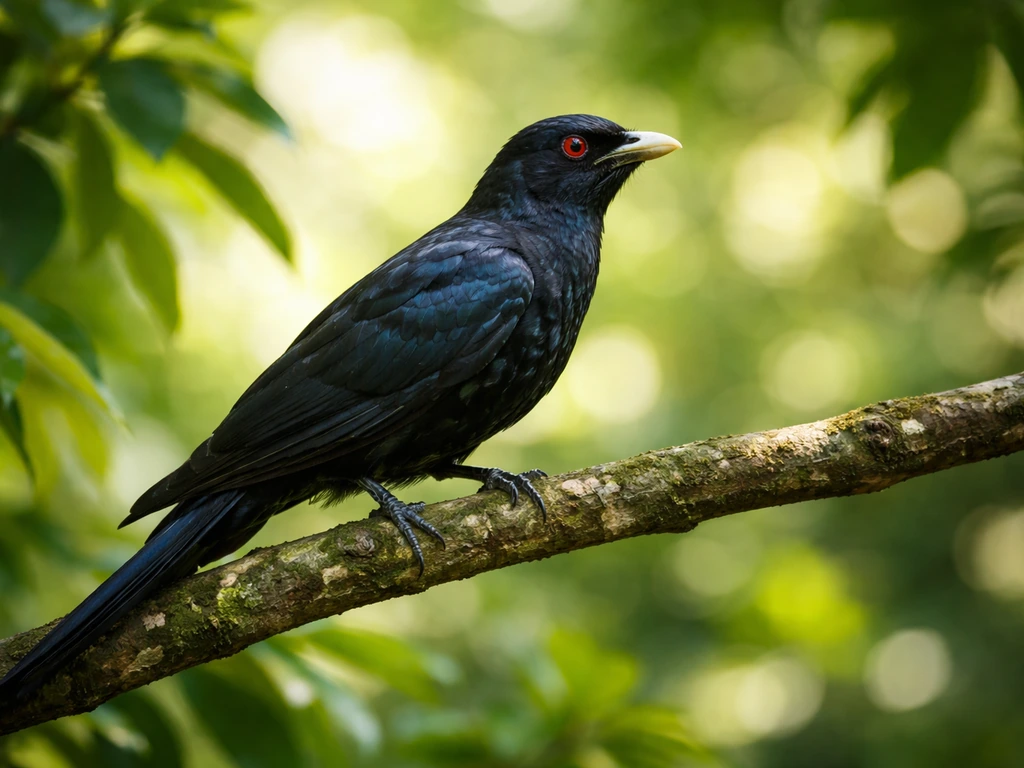
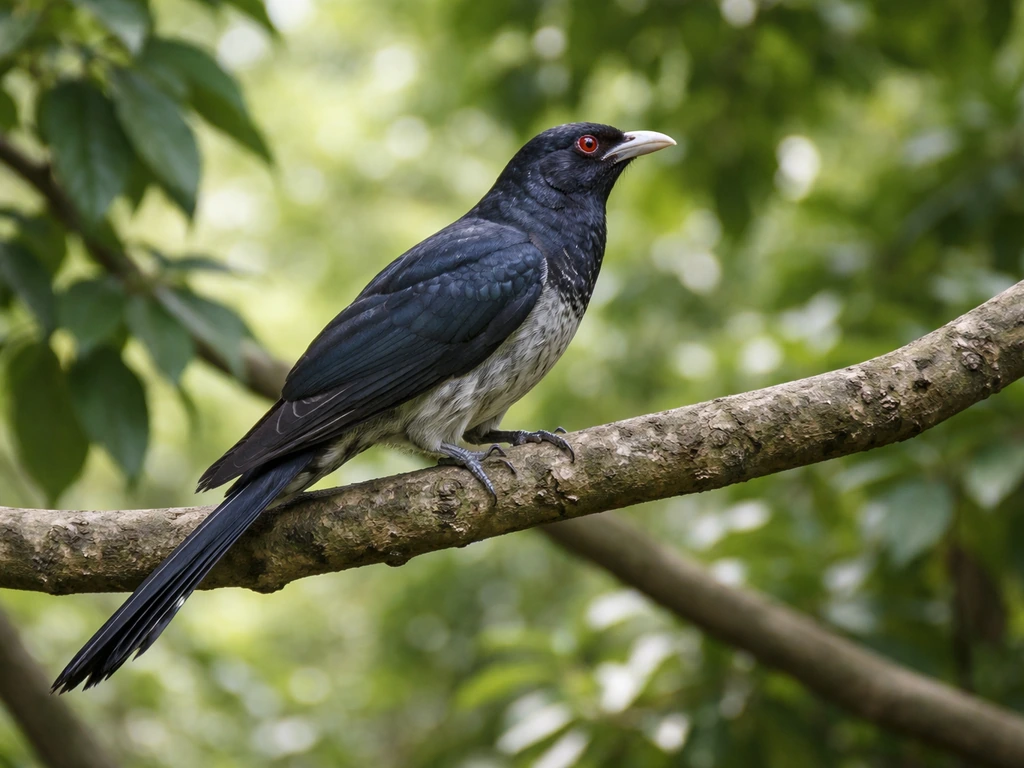
The Asian koel is strongly sexually dimorphic, meaning the male and female look completely different. The male is glossy blue-black all over, with striking red eyes and a stout greenish bill. At a glance, he can be mistaken for a crow or a drongo, but the red eyes and the shape of the bill are reliable giveaways. The female is almost unrecognizable as the same species: she's dark brownish with whitish spots on her upperparts and streaks or barring on her underparts, looking more like a heavily patterned cuckoo.
Call identification
The male's call is the famous one: a repeated 'koo-Ooo' that rises in pitch, often going through many repetitions in a crescendo. Once you've heard it, it's unmistakable. The female's call is completely different: a shrill, rapid 'kik-kik-kik' that sounds almost alarm-like. If you're in South Asia, Australia, or Southeast Asia and you hear that insistent rising call, especially in spring or before the monsoon, you're almost certainly hearing a male koel.
Common mix-ups to watch for
There are a few well-documented confusion points. First, the 'brain-fever bird,' which is the Indian hawk-cuckoo (Hierococcyx varius under older naming), has a loud, shrill, repetitive cry that has historically been confused with the koel's call. Douglas Dewar's classic Anglo-Indian natural history texts noted that Anglo-Indians 'frequently confound the koel with the brain-fever bird.' Both are noisy cuckoos, but the rising 'koo-Ooo' of the koel is distinct from the brain-fever bird's insistent 'brain fever, brain fever' pattern.
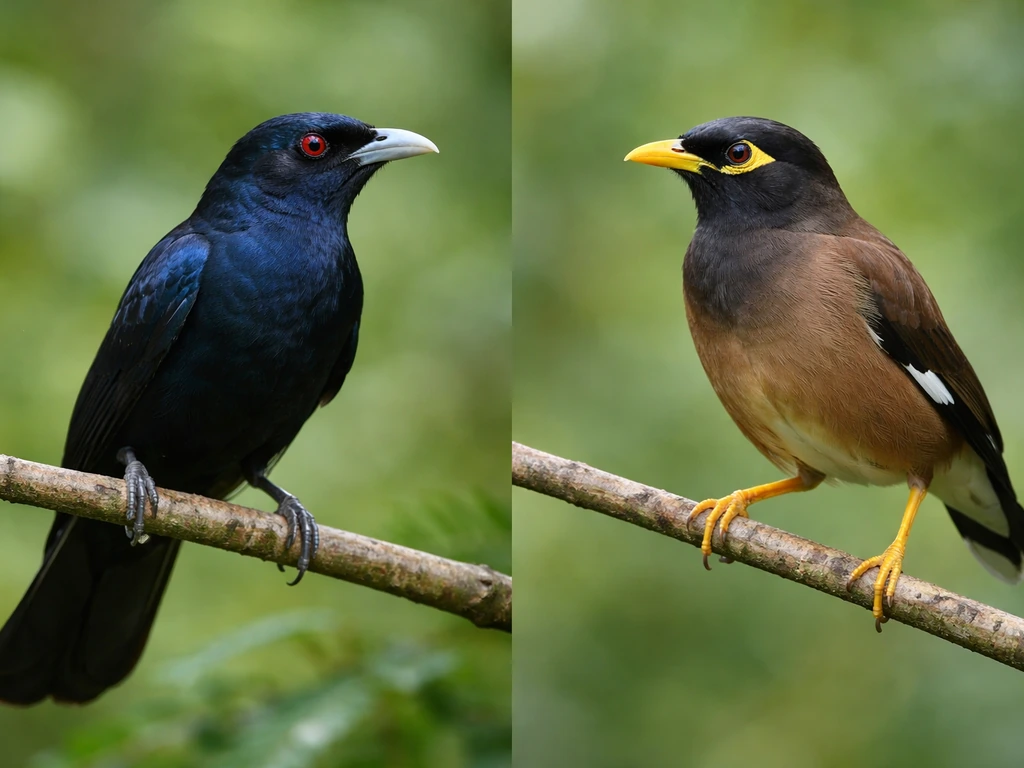
Second, don't confuse the male koel with the common myna. The myna has a brown body, black hooded head, and a bare yellow patch behind the eye: very different from the koel's all-over glossy blue-black plumage. The myna is actually one of the koel's host species, so you might see both in the same area, but they look nothing alike up close.
Third, the colloquial names 'rainbird' and 'stormbird' (used mainly in Australia) can cause mix-ups because both names are applied to multiple unrelated bird species. If someone refers to a 'rainbird' in an Australian context, they're probably talking about a koel, but you should confirm the species and range rather than assuming. Similarly, the 'long-tailed koel' (Urodynamis taitensis) is a different species in a different genus entirely, so any compound name with 'koel' doesn't automatically mean you're dealing with the Asian koel or the true Eudynamys koels.
| Bird | Key visual cue | Call | Common confusion reason |
|---|---|---|---|
| Asian koel (male) | Glossy blue-black, red eyes, greenish bill | Rising 'koo-Ooo' repeated | Looks crow-like at a distance |
| Asian koel (female) | Brown with whitish spots and streaks | Shrill 'kik-kik-kik' | Looks unlike the male — often unrecognized as same species |
| Brain-fever bird (Indian hawk-cuckoo) | Brown and streaked, hawk-like | Insistent rising 'brain fever' pattern | Also a loud, repetitive cuckoo call |
| Common myna | Brown body, black hooded head, yellow eye patch | Varied chattering calls | Dark head can suggest koel at a glance |
| Long-tailed koel | Long tail, different shape | Different from Asian koel | Shares 'koel' in the name but different genus |
Related bird names worth knowing
If you've come across similarly structured bird names in South Asian or Pacific contexts, it's worth knowing they each have their own distinct identity. Names like kokok, koko, and kolokolo come from different linguistic and geographic traditions and refer to different species with their own symbolism. If you're asking about the kokok bird meaning, those similar-sounding names point you toward a distinct bird and cultural context rather than the Asian koel's symbolism Names like kokok, koko, and kolokolo come from different linguistic and geographic traditions. The koel is specifically a cuckoo rooted in Sanskrit and Hindi naming traditions, and that origin story is what gives it its particular literary and cultural weight compared to other bird terms that sound superficially similar.
FAQ
Is “koel bird meaning” usually a metaphor in English, or is it about the real bird?
No. In English writing it is usually either a direct bird name (the Asian koel, or closely related true koels) or a literary reference to the bird’s call. If a text uses “koel” but also describes the sound as the rising “koo-Ooo,” spring timing, or cuckoo-like behavior, it is likely referring to the bird rather than using “koel” as a standalone metaphor.
When a poem mentions the koel, how can I tell if it is describing the male call or something else?
To narrow it down, treat the call as the key identifier. Male Asian koels give the famous repeated rising “koo-Ooo,” while females make a different, shrill rapid “kik-kik-kik” sound. If the description in a poem or story matches the male call pattern and seasonal timing, the cultural “meaning” is typically tied to spring or the pre-monsoon period.
If a story says a “koel” brought something, does it usually mean symbolism or the bird’s biology?
Look for host-context clues. Koels are brood parasites, so accounts that mention eggs or chicks in other birds’ nests often align with the real species. In contrast, purely emotional phrases like longing or lover’s call, especially around spring or New Year timing, usually point to symbolism rather than behavior.
Why do “rainbird” or “stormbird” sometimes not refer to the koel?
Regional nicknames can mislead. In Australia, “rainbird” and “stormbird” are sometimes applied to different species besides the Asian koel, even though people often use them for koels there. If you need accuracy, confirm by location and the “koo-Ooo” call rather than relying on the nickname alone.
What if I see “kokila” in a text instead of “koel”?
Yes, and it matters for the “meaning” you assign. “Kokila” or “kokilā” is the Sanskrit literary name, often used in classical contexts for the same bird. Modern translations may switch between “kokila,” “kokila bird,” and “koel,” but the intended seasonal symbolism is usually consistent.
How do I avoid confusing the koel with the “brain-fever bird”?
Beware of look-alike and “noise” confusion. The Indian hawk-cuckoo (often called the “brain-fever bird” in older English sources) can be mistaken due to a loud, repetitive cry. The easiest correction is the pattern: koel is the rising “koo-Ooo,” while the brain-fever bird’s is typically described as more insistent and different in phrasing.
Does spelling matter when searching, is “koel” ever spelled differently?
“Koel” in English is generally a borrowing used as a standard noun, and variant spellings like “koil” show up in some references. If you are searching or quoting, try both spellings, and also try “Asian koel” when you want species-level results instead of only cultural meaning.
How can I tell which country’s koel symbolism a poem is using?
If your goal is cultural meaning, focus on timing cues. Many South Asian references link the call to spring or the pre-monsoon lead-up, and Sri Lankan references can tie it to the Sinhalese New Year timeframe. In Australia, the folklore often links it to arriving summer rain. Those time markers usually tell you which tradition the writer is drawing from.
Why do some articles or poems clarify which sex “sings”?
In contemporary English, “koel” sometimes appears with clarifying notes like identifying which sex produces the famous call. If a source says “the singer is the cock bird,” that is pointing to the male’s “koo-Ooo,” which is the call most readers recognize in both nature writing and poetry.
If a bird name includes “koel” (like “long-tailed koel”), should I assume it has the same meaning as the Asian koel?
Not always. Some compound names that include “koel” refer to different genera or species, for example the long-tailed koel. If you see a separate scientific name or a different bird description, don’t assume it has the same symbolism or the same call pattern as the Asian koel.
Perched Bird Meaning, Literal, Symbolic, Usage, Examples
Perched bird meaning: clear literal and symbolic definitions, usage differences, examples, and quick reference.