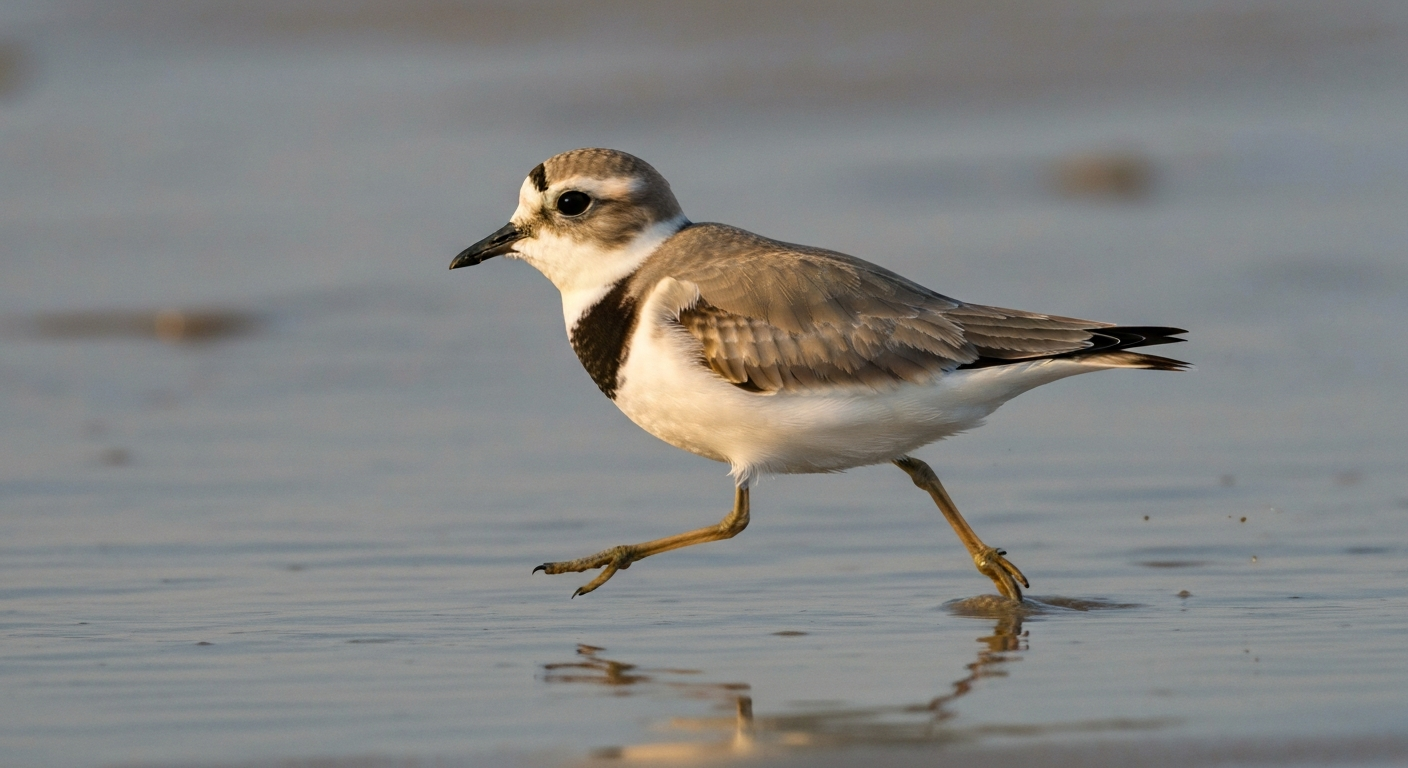
A plover is a small-to-medium shorebird in the family Charadriidae, recognized by its compact body, large rounded head, short straight bill, and habit of running a few quick steps then freezing to scan the ground. When people search 'plover bird meaning,' they are usually after one of three things: a plain biological definition, help identifying a plover in the field, or the cultural and symbolic weight that this unassuming beach bird has carried across languages and traditions for centuries. All three are worth unpacking.
Plover Bird Meaning: Natural History, Symbolism & Use

Marcus Whitley
12 Jul 2026
What plover bird meaning usually refers to
In everyday use, 'plover bird meaning' most often just means: what is a plover? The word is common enough in nature writing and poetry that readers encounter it without having seen one in person. In a narrower cultural sense, the plover carries associations with shorelines, rain, vigilance, and self-sacrifice, built up over centuries of observation and folklore. It shows up in classical writing, Japanese poetry, and modern conservation language, each context layering on a slightly different shade of meaning. The simplest way to put it: a plover is a watchful, nimble shore bird, and that watchfulness is exactly what gave it symbolic staying power.
The biology: what kind of bird is a plover, exactly
Plovers belong to the family Charadriidae, which sits within the large shorebird order Charadriiformes alongside sandpipers, snipes, and other waders. The Cornell Lab's family guide provides concise species accounts, range maps, and identification tips for Charadriidae See Plovers and Lapwings — Charadriidae | All About Birds (Cornell Lab of Ornithology) for an overview of the family's species, identification, and range.. The family covers plovers, dotterels, and lapwings. Most species you are likely to encounter range from sparrow-sized to slightly larger than a starling. The body is stocky and upright, the head noticeably large relative to the body, and the bill short and straight, which is one of the cleanest visual clues separating plovers from most other shorebirds.
Plumage tends toward sandy, buff, brown, and white tones with crisp dark markings, most notably one or two chest bands that wrap across the breast. These bands are species-diagnostic: how many bands, how complete they are, and how dark they appear all help narrow down which plover you are looking at. Eggs are laid in a simple ground scrape with no real nest structure, and the eggs themselves are cryptically patterned to blend into sand or gravel. If you have ever nearly stepped on a plover nest on a beach, you understand immediately why camouflage is this bird's first line of defense.
Where plovers live and when to look for them
Plovers are genuinely global. You find them on open coastal beaches, tidal mudflats, saltmarshes, grasslands, agricultural fields, and inland lakeshores across every continent except Antarctica. If you were actually searching for 'pelagic bird meaning', the term for birds that live primarily out on the open ocean rather than on shores, see the entry on pelagic bird meaning for that distinct habitat and lifestyle. Some species are year-round residents in mild climates. Others are long-distance migrants, with golden plovers in particular making impressive transoceanic flights. The American Golden-Plover, for instance, flies from Arctic breeding grounds to South American grasslands and back each year.
In North America, the best windows for seeing plovers on migration are late summer through fall and again in spring, when birds pass through on their way between nesting and wintering grounds. Resident breeders like the Killdeer and Snowy Plover are present on their home territories much of the year. Coastal beaches in spring are prime time if you want to watch the Piping Plover, which nests right on open sand and gravel, often in areas that also get heavy recreational use, which is a big part of why it is legally protected.
Common species, name variants, and likely misspellings
There are dozens of plover species worldwide. The ones that come up most in searches, field guides, and conservation news include:
- Piping Plover (Charadrius melodus) — sparrow-sized, sand-colored, nests on North American coastal beaches and some inland Great Lakes and river shorelines; Near Threatened on the IUCN Red List and federally protected in both the U.S. (Endangered Species Act) and Canada (Species at Risk Act)
- Killdeer (Charadrius vociferus) — the most widespread and familiar plover in North America, named for its loud 'kill-deer' call; has two distinct breast bands and is just as comfortable in lawns and parking lots as on shorelines
- Snowy Plover (Anarhynchus nivosus) — very pale, small, with incomplete or broken breast markings; nests on open sandy beaches and salt flats in western North America
- Common Ringed Plover (Charadrius hiaticula) — a single complete dark breast band; breeds across Arctic Eurasia and migrates to Africa
- American Golden-Plover and Pacific Golden-Plover (Pluvialis dominica and P. fulva) — larger, with spangled golden-buff back plumage; famous long-distance migrants
- Northern Lapwing (Vanellus vanellus) — technically in Charadriidae but usually called a lapwing rather than a plover; familiar across European farmland and wetlands
People searching for plover information frequently land on it via misspelled or phonetically close searches. Common variants include 'plover bird,' 'plovar bird,' 'ploover bird,' 'plover shorebird,' or 'piping plover bird meaning.' Searches for 'pip bird' or 'piping bird' also often relate to the Piping Plover, since 'piping' is part of the official common name and 'pip' is a shorthand some birders use informally. If you're specifically searching for 'pip bird meaning', that query most often refers to the Piping Plover and its common shorthand. If you arrived here after searching for something like 'picherie bird' or 'piecost bird,' those are almost certainly phonetic attempts at a plover species name or a regional bird name, and the plover is a likely candidate for what was actually meant.
Where the word 'plover' actually comes from
The English word 'plover' came in through Anglo-French as plover and Old French as pluvier or plovier. Behind that is Vulgar Latin pluviarius, meaning 'of the rain,' rooted in Latin pluvia, meaning 'rain.' The folk explanation is that plovers were associated with rainy seasons or wet weather, either because they were more active or more visible when rains came and brought invertebrates to the surface, or because their arrival in certain regions coincided with seasonal rains. The rain connection stuck, and variants of the word appear across Romance languages with similar watery undertones.
The Latin genus name Charadrius has classical roots, appearing in ancient Greek and Latin natural history texts to describe a yellowish nocturnal bird with various folk medicinal properties. Modern science reused the name for a much larger grouping. The golden plover genus Pluvialis is a direct Latin derivative meaning 'of rain' or 'rain bird,' keeping that same watery etymology alive in modern taxonomy. Then there is 'piping,' as in Piping Plover: that name refers to the bird's thin, piping whistle call rather than any linguistic connection to the word 'pip' as a seed or spot. Still, searches for 'pip bird meaning' often reflect curiosity about piping plovers or similarly small, call-named birds, so the connection is worth noting even if it is coincidental.
Field identification: how to tell a plover from other shorebirds
The single most useful identification trick for plovers is watching how they move. Plovers run, stop, tilt forward to pick something up, then run again. This run-and-pause foraging style is distinctly different from the steady, bill-in-mud probing that sandpipers and dowitchers do. If you see a small shorebird stopping every few seconds and looking around before darting forward, you are almost certainly looking at a plover.
Beyond behavior, use this quick checklist in the field:
- Bill shape: short, straight, and blunt (not long, curved, or probing)
- Head size: proportionally large and rounded relative to body
- Body posture: upright and alert, not hunched or horizontal
- Breast pattern: look for one or two dark chest bands; note if they are complete rings or broken
- Plumage tone: sandy, buff, pale grey, or white base color, often with a dark back or crown patch
- Leg color: can be yellow-orange, grey, pink, or black depending on species
- Movement: classic run-and-pause, not steady probing
- Habitat: open ground, beaches, mudflats, short-grass fields, not dense vegetation
The birds most likely to be confused with plovers in the field are sandpipers (family Scolopacidae), dunlins, and stints. Sandpipers generally have longer bills and probe continuously rather than pausing. Dunlins and stints are small and can share habitat but again probe more than they pause. The Killdeer specifically can be confused with other double-banded plovers in the Americas, but its loud, repetitive 'kill-deer' call and its double breast band make it one of the easier plovers to confirm once you know what to listen for.
Sorting out related searches and common confusions
Because 'plover' sits in a neighborhood of similar-sounding and thematically related bird terms, it pulls in a lot of adjacent searches. If you're comparing seabird symbolism, see puffin bird meaning for the Atlantic puffin's distinct cultural and biological associations. If you're also seeing searches for 'piecost bird meaning', check the piecost bird meaning topic for a related brief on naming confusions. Here is a plain breakdown of what connects and what does not:
| Search term | What it actually refers to | How it relates to plovers |
|---|---|---|
| pelagic bird meaning | Any seabird that lives primarily at sea: albatrosses, shearwaters, storm-petrels, some auks | Not plovers. Plovers are coastal and inland shorebirds, not open-ocean birds. The distinction is ecological: pelagic means 'of the open sea.' |
| puffin bird meaning | Puffins (genus Fratercula) are auks: stocky diving seabirds with thick, colorful bills that nest on cliff colonies | Not plovers. Puffins are seabirds related to murres; plovers are shorebirds. The only overlap is that both can appear on coastlines. |
| pip bird meaning | Often a phonetic search for Piping Plover or a query about small piping-call birds; 'pip' by itself is not a bird species | Directly related. The Piping Plover's name comes from its thin piping whistle, and 'pip bird' is a common informal shorthand. |
| plump bird meaning | Describes a bird's body condition or posture, not a species name; may also refer to a flock of waterfowl in older English | Loosely related. A plover can appear plump when it fluffs its feathers for warmth or display. The puffed-up plover and the 'plump' silhouette are the same observable behavior. |
| puffed up bird meaning | A bird erecting or fluffing its contour feathers, usually for thermoregulation or to appear larger in threat or courtship contexts | Directly observable in plovers. A puffed-up plover is almost always cold, sick, or displaying territorially. |
| picherie bird / piecost bird | Not standard ornithological terms; almost certainly phonetic misspellings or regional approximations of a species or place name | Possibly plover-related searches that arrived via mishearing or autocorrect. If you heard the word spoken, 'plover' (PLUH-ver) is the likely intended bird. |
| stuffed bird meaning | Either taxidermy (a preserved bird specimen) or a soft toy/decoy; 'stuffed bird' as metaphor can suggest something outwardly complete but inwardly hollow | Not species-specific, but decoy Piping Plovers and other plover decoys are used in conservation shorebird attraction programs. |
What plover behaviors actually mean, and how to describe them
The broken-wing display
This is the behavior that makes plovers genuinely remarkable. When a predator (or a person) approaches too close to a plover nest or chicks, the adult bird will drag itself along the ground with one wing drooping and spread, vocalizing in apparent distress. The goal is to convince the threat that the adult is injured and easy prey, drawing attention away from the nest. Once the predator follows far enough, the plover simply flies off. It is a calculated deception, and it works. In symbolic terms, this behavior has consistently been interpreted as devoted protection, self-sacrifice for offspring, and strategic courage rather than brute force. If you are a writer looking for a bird behavior that encodes the idea of protective sacrifice, the plover's broken-wing act is your image.
Territorial and courtship displays
Male plovers perform conspicuous scrape ceremonies, crouching and kicking backward at potential nest sites to demonstrate fitness and claim territory. They also run alongside rivals with wings partially raised, using their breast band markings as visual signals. The intensity and completeness of those breast band patterns matters: more complete, darker bands typically signal a more competitive individual. For writers and symbolists, the plover's display reads as vigilance made visible, the bird turning its own markings into a statement.
Puffing up: what it means when a plover looks plump or swollen
Birds erect their contour feathers to trap a layer of warm air close to the body, an insulation response to cold. A plover that looks noticeably round, fluffy, or swollen on a cold morning is almost always just thermoregulating. That same feather-erection posture also appears in threat contexts, where the bird makes itself look larger to a rival or predator, and during some courtship postures where visual size matters. If a plover looks puffed up and sluggish during warm weather and is not displaying, that is worth paying attention to: it can signal illness or injury, since sick birds often fluff up to conserve energy. So 'puffed-up plover' can mean cold and healthy, territorially assertive, or unwell, depending on context. Describing a bird as 'plump' in nature writing usually means it is in good condition with adequate fat reserves, which is a different reading from the temporary posture of feather-fluffing. For a short glossary entry on what 'plump' means when used of birds, see plump bird meaning.
Feeding behavior as metaphor
The plover's run-and-pause foraging is almost meditative to watch. It moves in short bursts, then goes completely still, scanning before committing to a peck. In a writing context, this behavior maps naturally onto ideas of patience, precision, and opportunism: not reckless, not passive, but acutely attentive. Several nature writers have used the plover's feeding style as a model for focused observation, and the imagery translates cleanly into essays about attention and stillness.
Symbolic meanings and cultural associations across traditions
The most persistent themes in plover symbolism are rain, vigilance, migration, and protection. The rain association is ancient and baked into the etymology: the Latin pluvia gives us the plover's name and the genus name Pluvialis for golden plovers. In traditional European agricultural communities, the arrival of golden plovers was read as a sign of changing weather, linking the bird to seasonal transition and the natural calendar. For a related cultural interpretation involving preserved specimens and their symbolism, see stuffed bird meaning.
In Japan, the plover, known as chidori (千鳥, literally 'thousand birds'), has a rich literary and poetic history. Chidori appear in classical waka and haiku as images of winter coastlines, loneliness, and transience. The word chidoriashi (千鳥足), meaning a staggering or zigzag walk, entered Japanese as an idiom for drunken walking, drawn from the plover's erratic, darting gait. It is a vivid example of how a bird's observable movement becomes embedded in everyday language.
There is also the famous classical story of the Egyptian Plover (sometimes called the Nile bird or Trochilus in ancient sources), which Herodotus described as entering a crocodile's open mouth to pick food from its teeth, a mutually beneficial arrangement. This story became a widely repeated image of unlikely symbiosis and courage. Modern biologists have found very little evidence that this behavior actually occurs routinely, but the story's durability says something about what people have wanted plovers to represent: a small, brave creature that operates safely in dangerous company through alertness rather than strength.
In contemporary conservation culture, the Piping Plover has become a symbol of coastal habitat fragility and the tension between recreational access and wildlife protection. Its federally threatened status in the U.S. and Canada has made it one of the most recognizable flagship species for beach nesting bird conservation, carrying associations of resilience in vulnerable landscapes. Global conservation assessments list the Piping Plover (Charadrius melodus) as Near Threatened, and regional protections vary; see Piping Plover (Charadrius melodus) | BirdLife Data Zone (IUCN partner) Global conservation assessments list the Piping Plover (Charadrius melodus) as Near Threatened, and regional protections vary; see Piping Plover (Charadrius melodus) | BirdLife Data Zone (IUCN partner)..
Plovers in literature, idioms, and everyday language
Plovers appear in English literature most often as landscape markers: a plover calling in the distance signals open moorland, shoreline, or approaching weather. In British and Irish writing, the lapwing (Vanellus vanellus, technically a plover-family member) is a recurring bird of open fields and early spring. Ted Hughes, Seamus Heaney, and various nature diarists have used lapwing and plover imagery as shorthand for wildness at the margins of cultivated land.
In older English, a 'plover' was also considered a prestigious game bird, appearing on medieval and Renaissance banquet menus alongside woodcock and snipe. That culinary status has faded, but it explains why plovers sometimes appear in historical texts in contexts that feel surprising to modern readers who think of them purely as conservation subjects.
The Japanese chidoriashi idiom mentioned above is a genuinely useful example for language learners: it shows how bird behavior, not just bird appearance or symbolism, can generate lasting idioms. The plover's gait, not its meaning as a rain bird or a protector, is what produced that particular piece of living language.
Practical guidance: if you encounter a plover
If you find a plover nest on a beach, the single most important thing is to give it a wide berth. Nests are just scrapes in the sand and almost invisible. The adult performing the broken-wing display is telling you in the clearest possible behavioral language that you are too close. Back away, move around the area, and the bird will return to the nest within minutes. For Piping Plovers and Snowy Plovers specifically, many beaches post seasonal nest markers: follow the posted boundaries, and treat any unmarked adult acting distressed on an open beach as a sign you may be near a nest.
For birdwatchers, a spotting scope or binoculars with at least 8x magnification will let you observe plovers without disturbing them. Early morning and late afternoon light are the best for seeing the breast band colors and head patterns clearly. Keep your profile low and move slowly; plovers are highly alert but will resume normal behavior quickly if you stay still.
For writers using plover imagery, the broken-wing display, the run-and-pause foraging, and the cryptic nest are all behaviors that carry inherent symbolic weight without requiring any cultural overlay. They do the work on their own. If you want to anchor a piece of writing in a sense of coastal vigilance, quiet courage, or the precariousness of small lives on open ground, the plover earns that imagery through what it actually does.
FAQ
What is a plover biologically — which birds are called plovers?
A plover is a common name for small-to-medium shorebirds in the family Charadriidae (plovers, dotterels and lapwings). Typical plovers are compact, with relatively large heads, short straight bills and medium-length legs. Many species are sand‑colored, nest in shallow scrapes on open ground, and are migratory to varying degrees. Well known species include the Piping Plover (Charadrius melodus), Ringed/Common Ringed Plover (Charadrius hiaticula), Killdeer (Charadrius vociferus) and several golden plovers (Pluvialis spp.).
How can I identify a plover in the field?
Key ID features: a stocky, compact body; short, straight bill; relatively large head; medium-length legs; cryptic, pale/sandy plumage; and often one or two breast bands or head markings. Plovers usually forage by sight using a run‑and‑pause pattern (run a short distance, stop to look, then peck), unlike probing sandpipers that feed by feel with long bills.
What habitats do plovers use?
Plovers are associated with open shorelines: sandy beaches, gravel spits, tidal flats, saltmarsh edges and lake shores. Some species also use inland habitats (river islands, alkaline lakeshores, short grasslands). They require exposed ground for foraging and open nesting scrapes with good visibility to detect predators.
Why do plovers run-and-pause when feeding?
Plovers are primarily visual foragers. The run‑and‑pause technique lets them scan for and then peck at surface prey (insects, marine worms, small crustaceans). This contrasts with probing species (Scolopacidae) that slowly probe the substrate with longer bills to find buried prey.
What does it mean when a plover puffs up or looks plump?
Feather fluffing (piloerection) serves several observable functions: thermoregulation (trapping insulating air to retain heat), appearing larger as an anti‑predator posture, and sometimes display during courtship or aggression. Context (cold weather, threat nearby, or courtship) helps interpret the behaviour.
What is the 'broken‑wing' or distraction display plovers perform?
Many plovers use distraction displays — most famously the 'broken‑wing' act — to lure predators away from nests or young. The adult feigns injury, running in a way that suggests it cannot fly, drawing the predator farther from vulnerable chicks or eggs. This behaviour is well documented across shorebirds and is an adaptive anti‑predator tactic.
Next Article
Picherie Bird Meaning: What Picherie Likely Refers To
Explains picherie bird meaning: likely misspelling, regional slang, or symbolism, plus how to confirm fast.