SEO Title: Polynesian Bird Meaning: Names, Symbols, and Cultural Significance | Description: Discover what Polynesian birds mean across Hawai'i, Samoa, Tonga, Tahiti, and Aotearoa, species, myths, navigation, tattoos, and local names explained.
Polynesian Bird Meaning: Symbols, Names, and Regional Uses

Marcus Whitley
14 Jul 2026
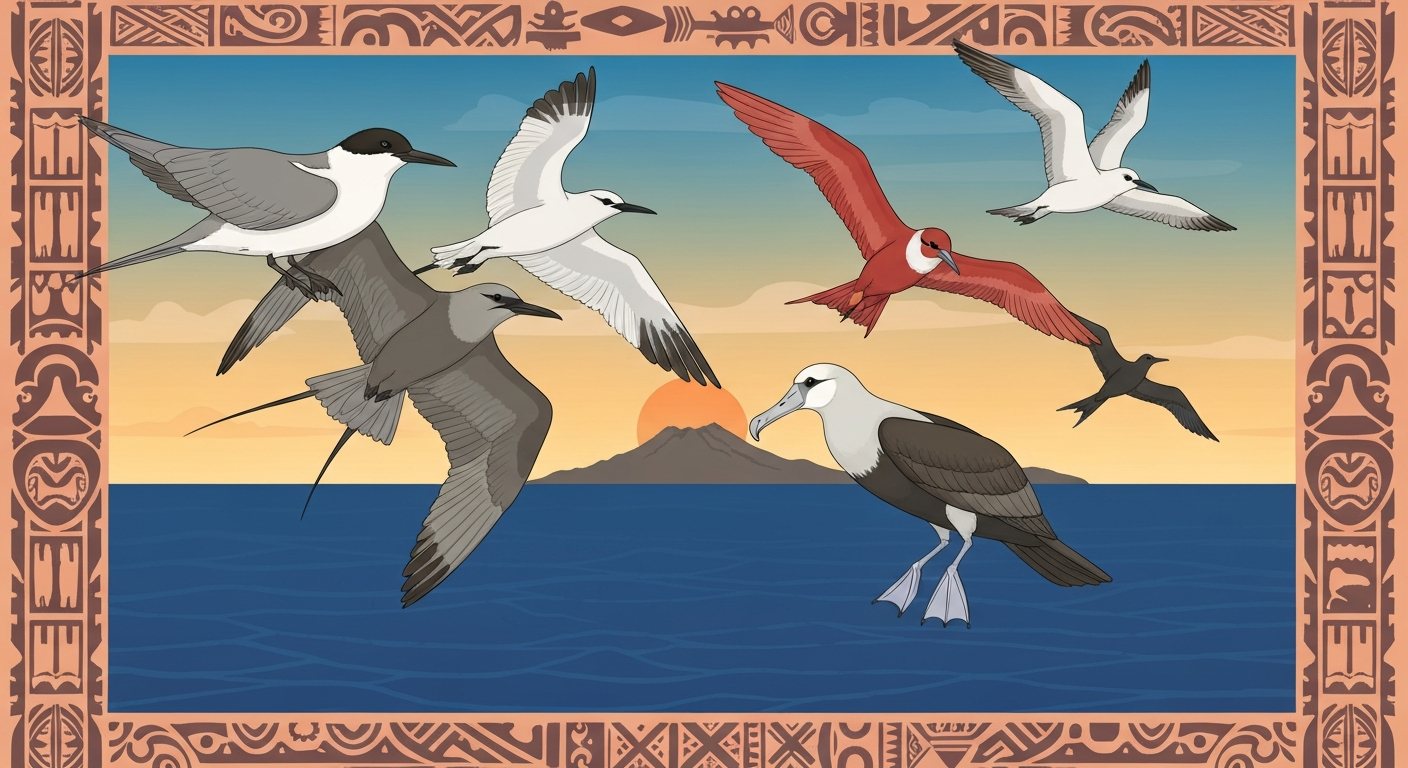
When someone talks about 'Polynesian bird meaning,' they are asking about one of the richest layers of Pacific culture there is. Across the Polynesian triangle, from Hawai'i in the north to Aotearoa (New Zealand) in the southwest and Rapa Nui (Easter Island) in the southeast, birds have served as gods, ancestors, navigational instruments, omens, clan symbols, and living proof that land is near. The phrase is less a single definition and more a doorway into dozens of distinct cultural relationships between Pacific peoples and specific species. Whether you are a traveler, a student, a writer, or someone researching tattoo symbolism, knowing which bird means what, in which island group, makes all the difference.
Why birds carry such weight across Polynesia
Polynesian peoples navigated the largest ocean on Earth in double-hulled canoes, often without instruments. In that context, a bird is never just a bird. It is information: direction, distance from land, season, and sometimes a message from the ancestral world. Almost every major island group has a dedicated vocabulary for birds, and in many Polynesian languages the base word is 'manu', used in te reo Māori, in the Rapa Nui language, and in related forms across Hawaiian and Tahitian dialects. That shared root alone tells you how central birds were to the culture long before the islands scattered.
For tattoo-seekers, this matters practically. A frigatebird and an albatross are not interchangeable symbols, one stands for speed and raiding, the other for endurance and grief. If you are writing about the Pacific or setting a story there, getting these distinctions right gives your work genuine texture. And if you are simply curious about why a sooty tern triggered an entire annual festival on Easter Island, read on, because the answer is genuinely surprising.
Key species and their Polynesian names
Manu, the base word for bird
In te reo Māori and across several Polynesian languages, 'manu' (pronounced MAH-noo) simply means 'bird.' It appears in compound names throughout the region, and understanding it as a root unlocks a lot of other terms. In Māori, it also extends metaphorically to kites (which were themselves bird-shaped objects flown in ceremony and play). When you see 'manu' as a prefix in a bird name anywhere in Polynesia, you are looking at the same ancient root.
Manu-tara / Manutara, the sooty tern
The sooty tern (Onychoprion fuscatus) is known as manutara or manu tara on Rapa Nui (Easter Island). Imaginarapanui, 'Manutara the sacred bird of Rapa Nui' (summarizes ethnographic tradition) notes manutara as the sacred sooty tern whose arrival signaled egg harvests and the Orongo Tangata Manu festivals Imaginarapanui — 'Manutara the sacred bird of Rapa Nui' (summarizes ethnographic tradition). The word 'tara' relates to a pointed or sharp quality, a reference to the bird's angular form and piercing call. Ethnographers Katherine Routledge (who documented the Orongo rituals in 1919) and Alfred Métraux (whose 1940 Bishop Museum study remains a primary source) both record this bird as the sacred center of the annual Tangata Manu, or bird-man, contest. Each spring, competitor-swimmers raced from the volcanic cliffs at Orongo to the offshore islet of Motu Nui to retrieve the first manutara egg of the season. The winner's patron became the 'tangata manu', a semi-divine human representative of the creator god Makemake, and held ritual authority for a year. The manutara's arrival was not just a seasonal marker: it was treated as a signal of divine favor and abundance. Métraux describes its common name as the 'luck bird,' and it remains a defining cultural symbol of Rapa Nui to this day.
Tropicbird, koaʻe kea and koaʻe ʻula
Hawai'i recognizes two tropicbird species with distinct local names. The white-tailed tropicbird (Phaethon lepturus) is called koaʻe kea, 'kea' meaning white, and the red-tailed tropicbird (Phaethon rubricauda) is koaʻe ʻula, where 'ʻula' means red. Both names come from verified state wildlife documents (DLNR and Papahānaumokuākea/NOAA records). The long, elegant tail feathers of the koaʻe kea were historically used in kahili, the feathered ceremonial standards that were symbols of Hawaiian chiefly rank. Red-tailed tropicbirds breed across French Polynesia, the Cook Islands, and Fijian waters as well, though the specific cultural names differ by region.
Frigatebird, ʻIwa
The great frigatebird (Fregata minor) is called ʻIwa in Hawaiian. The name is also the Hawaiian word for 'nine' and for 'thief,' a fitting double meaning for a bird famous for stealing fish from other seabirds mid-flight. ʻIwa appears in Hawaiian administrative rules and state wildlife exhibits as the verified local name. Across wider Polynesia, frigatebirds appear in oral traditions as fast, aggressive, and sometimes ominous birds, associated with warriors and raiding parties in ways that parallel their feeding behavior. In navigational practice, ʻIwa were watched closely because they do not land on water, so their direction of flight at dusk could indicate where land lay.
Albatross, toroa
In te reo Māori, the royal albatross is toroa (pronounced taw-ROH-ah). Te Ara, the New Zealand Encyclopedia, and the Department of Conservation both document toroa as a significant bird in Māori culture. It appears in waiata (songs), and the phrase 'roimata toroa', literally 'albatross tears', describes a specific weaving pattern associated with grief and the long ocean journeys of the dead. The albatross was not eaten lightly, and its appearance could be read as a tohu, a sign or omen, in certain contexts. Given the bird's real range across the Southern Ocean, it carries genuine associations with vast distance, endurance, and the unknown.
Petrel, tītī and related names
Several petrel and shearwater species hold cultural weight across Polynesia. In Aotearoa, the sooty shearwater is called tītī (tee-TEE), the same word used for 'muttonbird,' which refers to the harvesting practice. Tītī have been harvested sustainably by Māori (especially Ngāi Tahu) for centuries under a managed system called mātaitai. The bird's reliable seasonal migration made it both a food source and a seasonal calendar marker, which is itself a form of meaning-making. Note that 'petrel' covers many species; precise cultural names vary considerably between island groups.
Noddy, manu-o-Kū and the brown and black noddies
Noddies belong to the genus Anous. The brown noddy (Anous stolidus) and black noddy (Anous minutus) breed across Polynesian islands and were practical wayfinding birds: their short-range commutes between fishing grounds and nesting colonies made them reliable indicators of nearby land. In Hawai'i, the white tern (Gygis alba) holds the honored name manu-o-Kū, meaning 'bird of Kū,' linking it to the Hawaiian god Kū. This is a government-verified name confirmed in Papahānaumokuākea/NOAA documents. Honolulu officially named the white tern its official city bird in 2007.
Bird names, meanings, and regions at a glance
| Bird (common name) | Polynesian name(s) | Core meanings / associations | Primary region(s) |
|---|---|---|---|
| Sooty tern | Manutara / manu tara | Sacred luck bird; divine messenger; Tangata Manu ritual; seasonal abundance | Rapa Nui (Easter Island) |
| White tern | Manu-o-Kū | Bird of Kū (war god); purity; wayfinding; official bird of Honolulu | Hawai'i |
| White-tailed tropicbird | Koaʻe kea | Chiefly feather standards (kahili); elegance; high rank | Hawai'i; French Polynesia |
| Red-tailed tropicbird | Koaʻe ʻula | Beauty; spiritual presence; chiefly associations | Hawai'i; Cook Islands; French Polynesia |
| Great frigatebird | ʻIwa | Thief; speed; warrior spirit; omen of land | Hawai'i; broader Polynesia |
| Royal albatross | Toroa | Grief; endurance; ancestral journey; ocean vastness; omen | Aotearoa (New Zealand) |
| Sooty shearwater / petrel | Tītī | Seasonal calendar; sustainable harvest; migration; connection to sky and sea | Aotearoa; southern Polynesia |
| Brown / black noddy | Anou (var. by region) | Land proximity; wayfinding cue; practical navigation marker | Widespread tropical Polynesia |
| Huia (extinct) | Huia | Chiefly tapu; feathers as rank markers; mourning; extinction as cultural loss | Aotearoa (New Zealand) |
How meanings shift by island group
Hawai'i
Hawaiian bird symbolism is particularly rich because the archipelago developed an extraordinary endemic avifauna, honeycreepers, geese, rails, many now extinct. The surviving seabirds carry layered names tied to gods, chiefs, and navigation. The ʻIwa (frigatebird) is named for its thieving behavior and doubles as a metaphor for a certain kind of cunning. Manu-o-Kū (white tern) is both a practical wayfinding bird and a deity reference. Feathers of the koaʻe kea (white-tailed tropicbird) and the ʻōʻō (now extinct) were harvested for chiefly regalia, making birds literal markers of social hierarchy.
Samoa
In Samoan tradition, the manumea (tooth-billed pigeon, Didunculus strigirostris) is the national bird and carries deep cultural identity, its name literally means 'red bird.' It appears on official emblems and in oral tradition as a symbol of Samoa itself. Seabirds appear in Samoan proverbs and navigation lore, though Samoa's specific bird symbolism is less thoroughly documented in English-language scholarly sources than Hawaiian or Māori traditions. This is worth noting honestly: absence of documentation is not absence of meaning, and oral traditions in Samoa hold considerable depth that has not been fully translated.
Tonga
Tongan oral tradition includes birds as messengers between the human world and the spiritual realm, consistent with wider Polynesian patterns. The malau (megapode, Megapodius pritchardii) is endemic to Niuafoʻou island and features in local tradition as a culturally significant species. Tongan navigation practice also made use of seabird observations, particularly frigatebirds and tropicbirds, as land indicators, though specific omen traditions are less systematically recorded in widely available academic sources.
Tahiti and French Polynesia
In Tahitian and broader French Polynesian tradition, the 'ōtaha (swiftlet) and various seabirds feature in marae (sacred ceremonial platform) contexts. The frigatebird appears in Society Islands oral tradition as a powerful spiritual bird. Heiva festivals, large-scale cultural celebrations still held annually, include bird references in dance, song, and costume. The red-tailed tropicbird's feathers appear in traditional headdresses, carrying aesthetic and status meaning that parallels Hawaiian use.
Aotearoa / New Zealand
Māori bird symbolism is among the most deeply documented in Polynesia, thanks in large part to Te Ara (the New Zealand Encyclopedia) and extensive ethnographic work. See Te Ara, 'Ngā manu' (birds) and cultural meanings/omens in Māori tradition for documented examples of birds used as tohu (signs and omens) in Māori sources Te Ara — 'Ngā manu' (birds) and cultural meanings/omens in Māori tradition. Birds appear as tohu (signs and omens), as clan affiliations, and as narrative actors in creation stories. The kōkako (blue-wattled crow), kiwi, huia, and kea each carry specific cultural resonances. Te Aka, the Māori Dictionary, documents 'manu' both as 'bird' in the literal sense and in extended meanings including kites and metaphors for the human spirit. The roimata toroa weaving pattern (albatross tears) shows how bird associations encode emotion and cosmology simultaneously.
Cook Islands
The Cook Islands sit within the broader Eastern Polynesian cultural sphere, and bird traditions there overlap with both Hawaiian and Māori patterns. Red-tailed tropicbirds breed on the outer atolls and carry ceremonial feather significance. Navigation by seabird was practiced here as elsewhere. Specific Cook Islands bird names and their meanings are less thoroughly represented in English-language reference sources, and any claims made about very specific omen traditions should be treated with appropriate caution unless traced to a verified Cook Islands primary source.
Birds in Polynesian mythology and oral tradition
Across Polynesia, birds frequently appear as the physical form of gods or as vehicles for ancestral communication. On Rapa Nui, the creator god Makemake was directly linked to the manutara (sooty tern) through the Tangata Manu cult. The man who retrieved the first manutara egg did not just win a competition, he temporarily embodied divine authority, living in ritual seclusion as a representative of Makemake for the following year. Routledge's 1919 field documentation and Métraux's 1940 analysis remain the most cited primary sources for this, and they agree on the bird's central sacred role.
In Māori cosmology, some birds are described as hoa wairua, spiritual companions or messengers. The sighting of a particular manu at a critical moment, before a battle, at a birth, during a voyage, was interpreted as a tohu, a sign from the ancestors or from Atua (god/gods). Te Ara documents specific examples of this interpretive tradition. It is important to note that interpretations varied considerably by iwi (tribe) and by context: Māori bird omens were not a fixed universal code but a living, community-specific practice.
In Hawaiian tradition, certain birds were considered aumākua, personal or family ancestral spirits that took animal form. A family whose aumākua was a particular seabird would treat that species with reverence and would not harm or eat it. This is a fundamentally different relationship to birds than the ornamental or purely symbolic one: the bird is a relative. The ʻalala (Hawaiian crow), now critically endangered, was considered by some families to be a psychopomp, guiding the spirits of the dead. These traditions are still respected and active in Hawaiian communities.
Birds as navigational tools and omens at sea
The Polynesian Voyaging Society, whose 1976 Hōkūleʻa voyage and subsequent revivals demonstrated traditional Pacific navigation without instruments, documents bird observation as a core wayfinding technique. Master navigator Mau Piailug and Nainoa Thompson both taught and practiced reading seabirds as one of several land-proximity indicators. The principle is practical: land-nesting seabirds like noddies and white terns have a limited commuting range (roughly 30 to 40 miles from land), so their presence and flight direction at dusk reliably point toward a nesting island.
The ʻIwa (frigatebird) was particularly useful because it cannot land on water, so a large soaring frigatebird indicates nearby land almost certainly. The manu-o-Kū (white tern) was read similarly. Wayfinders also tracked species behavior: feeding frenzies, flight altitude, and the direction birds were flying as night approached all carried information. This is not mystical, it is applied natural history. The navigation tradition gives these birds a meaning that is simultaneously practical and sacred, which is characteristic of how Polynesian cultures tended not to separate the material from the spiritual.
A necessary caution: the specific omen meanings of birds, which species was a good sign, which was a warning, and in what context, varied significantly by island group, by navigator lineage, and by oral tradition. Some of what appears in tourist materials and even in general reference books is simplified or conflated across cultures that are genuinely distinct. If you are using bird omen lore for anything beyond general appreciation, tracing it to a specific island tradition and a verifiable source is worth the effort.
Birds in Polynesian art, tattoos, and clan symbols
Polynesian tattooing (tā moko in Māori, tatau in Samoan) uses geometric and natural motifs that encode identity, genealogy, and spiritual protection. Bird motifs appear regularly: frigatebird shapes are common in Marquesan and Tahitian tattoo traditions, often representing speed, power, or a warrior's spirit. The sooty tern and tropicbird appear in Rapa Nui petroglyphs at Orongo, carved directly into volcanic rock as part of the Tangata Manu ceremonial site, these are among the most dramatic examples of bird symbolism in Pacific art anywhere.
In Māori tā moko and carving (whakairo), bird imagery appears in meeting house panels and in personal adornment. The huia, a now-extinct bird whose black tail feathers with white tips were worn exclusively by high-ranking Māori, represents perhaps the most dramatic example of a bird's feathers as literal social currency. When the last known huia died in the early twentieth century, it was not just a biological loss. It was the disappearance of an irreplaceable symbol of rank, grief, and identity.
For anyone considering a Polynesian-style bird tattoo: the symbolism is specific, not generic. A frigatebird from Marquesan tradition means something different from an albatross in a Māori context, and both are different again from the manutara of Rapa Nui. Researching the specific tradition you are drawing from, and, ideally, consulting with an artist or community member from that tradition, makes the difference between a meaningful design and an accidental mishmash of symbols.
Common phrases and idioms involving birds in Polynesian languages
Māori proverbs (whakataukī) frequently use bird imagery. One well-known example is 'Ka manu ka kai hua o te rakau, ko te tangata ka kai i te krero o te tangata', roughly, 'The bird feeds on the fruit of the tree, the person feeds on the words of other people.' Here 'manu' anchors a meditation on how humans, like birds, are sustained by what others offer. The word 'manu' in te reo Māori also extends to kites, and flying a manu aute (paper kite) was historically a ritual act as well as a pastime, which tells you how fluidly birds and flight merged in Māori conceptual language.
In Hawaiian, the phrase 'nā manu o ke kai' (birds of the sea) is used in mele (songs) and poetry to evoke freedom, distance, and the open ocean. The frigatebird ʻIwa appears in metaphors for a clever, fast-moving person, someone who, like the bird, takes what they need with skill and speed. These usages are not formal idioms with locked-in definitions but rather living metaphors that speakers draw on situationally, which is true of bird metaphors in most languages.
Interpreting modern sightings and symbolic use
If you encounter bird symbolism in a modern Polynesian context, in a haka, a tattoo, a piece of contemporary Pacific art, or a place name, the most reliable approach is to identify the specific tradition (Māori, Hawaiian, Samoan, etc.) and then look at what that bird means within that tradition. Pan-Polynesian generalizations exist and have real value, but they can also flatten meaningful differences. A white tern in a Hawaiian song is not necessarily carrying the same meaning as a white tern in a Tahitian one, even if both cultures have navigational associations with the species.
The word 'manu' as a standalone term in a modern Pacific context almost always signals either 'bird' in the literal sense or a metaphorical extension to freedom, spirit, or flight. The Tangata Manu imagery from Rapa Nui is widely reproduced in Pacific art globally and tends to be understood broadly as a symbol of spiritual competition, courage, and divine connection, though readers steeped in Rapa Nui tradition will recognize far more specific meanings than general audiences typically do.
If you are exploring related bird meaning traditions from other Pacific and cross-cultural contexts, pigeon symbolism and paloma meanings (the Spanish-language term for dove used across Latin American and Philippine Pacific communities) offer interesting comparisons for how similar-looking birds accumulate entirely different cultural weight depending on geographic and linguistic context. For a focused discussion of pigeon and dove symbolism, see pigeon bird meaning. For a focused overview of dove symbolism in Spanish-speaking and Philippine-Pacific communities, see paloma bird meaning. Pelican and pheasant symbolism follow similar patterns of region-specific meaning. For regional details on pheasant bird meaning, see the pheasant bird meaning entry (internal ref 6781b7d1-46eb-4aaa-92bf-6e0f5011fa5c). For a focused discussion of pelican symbolism, see pelican bird meaning (526590d1-6373-4eda-b114-1e39062b0af3). And if you have come across the term 'pura' in connection with a bird meaning in English, that is a distinct Southeast Asian term worth exploring separately, a reminder that the Pacific's bird symbolism traditions are diverse enough to deserve their own careful attention. For a clear explanation of the Southeast Asian usage, see the article on pura bird meaning in English which outlines how that term differs from Polynesian bird symbolism.
FAQ
What does the phrase "Polynesian bird meaning" refer to in simple terms?
"Polynesian bird meaning" refers to the cultural, mythological, navigational and symbolic significance that seabirds and other birds hold across Polynesian societies. It includes local names (manu, manu‑tara, koaʻe, ʻiwa, toroa), species identifications (tropicbirds, noddies, sooty terns, frigatebirds, albatrosses, petrels), their roles in origin stories, omen systems, navigation, art and tattoo motifs, and how modern people interpret bird sightings and symbols.
SEO title and short description (≤160 characters)
Title: Polynesian Bird Meaning — Names, Myths, Navigation & Tattoo Symbols Description: Clear guide to Polynesian bird meanings: local names, myths, navigation uses, tattoo symbolism, regional variations, and sources.
Which key species and primary local names should readers know?
Common species and primary local names (examples): manu (generic bird), manu‑tara / manutara (sooty tern on Rapa Nui), koaʻe kea (white‑tailed tropicbird, Hawaiʻi), koaʻe ʻula (red‑tailed tropicbird, Hawaiʻi), ʻiwa (great frigatebird, Hawaiʻi), noddies (Anous spp.), toroa (albatross, Aotearoa/NZ), petrels and shearwaters (various local names). Pronunciations: manu ['mah‑nu], manu‑tara/ manutara [mah‑noo tah‑ra], koaʻe [ko‑ah‑eh], ʻiwa [ee‑vah], toroa [toh‑roh‑ah]. Note: pronunciations vary by language (Hawaiian, Māori, Rapanui, Samoan, Tahitian, Tongan, Cook Islands).
How are birds used in Polynesian mythology and oral tradition?
Birds appear as creators, messengers of gods, incarnation of ancestors, and ritual beings. Examples: the Rapa Nui Tangata Manu (bird‑man) cult centered on the manutara (sooty tern) and linked to the god Makemake; in Māori and other traditions, birds are tohu (signs) and carriers of spiritual knowledge. Interpretations differ by island—some birds are sacred, others are chiefly emblems. Citations: Routledge (1919), Métraux (1940), Te Ara (NZ).
How did Polynesian navigators use birds to find land?
Wayfinders observed species’ flight behavior, daily commuting range, direction to and from foraging (pelagic birds flying toward land at dusk/dawn), and specific species' habits. For example, white terns and noddies often commute to nearby atolls; sooty terns (manutara) and tropicbirds indicate nesting islets. Authorities: Mau Piailug, Nainoa Thompson, Polynesian Voyaging Society/Hōkūleʻa resources.
What meanings do birds have in Polynesian art and tattoos?
Birds represent lineage, rank, protection, navigation, freedom, and spiritual connection. Frigatebird motifs (ʻiwa) can signal leadership or far‑ranging voyaging; tropicbird tail feathers were prestige materials (kahili in Hawaiʻi). Tattoos (tā moko, tatau) may use stylized bird heads, wings, or footprints as clan marks or personal symbols. Meanings depend on context—consult local practitioners for accuracy and permission.
Next Article
Pura Bird Meaning in English: What It Likely Refers To
Meaning of pura bird in English, common interpretations, likely origin, how context changes it, and examples to spot it.