
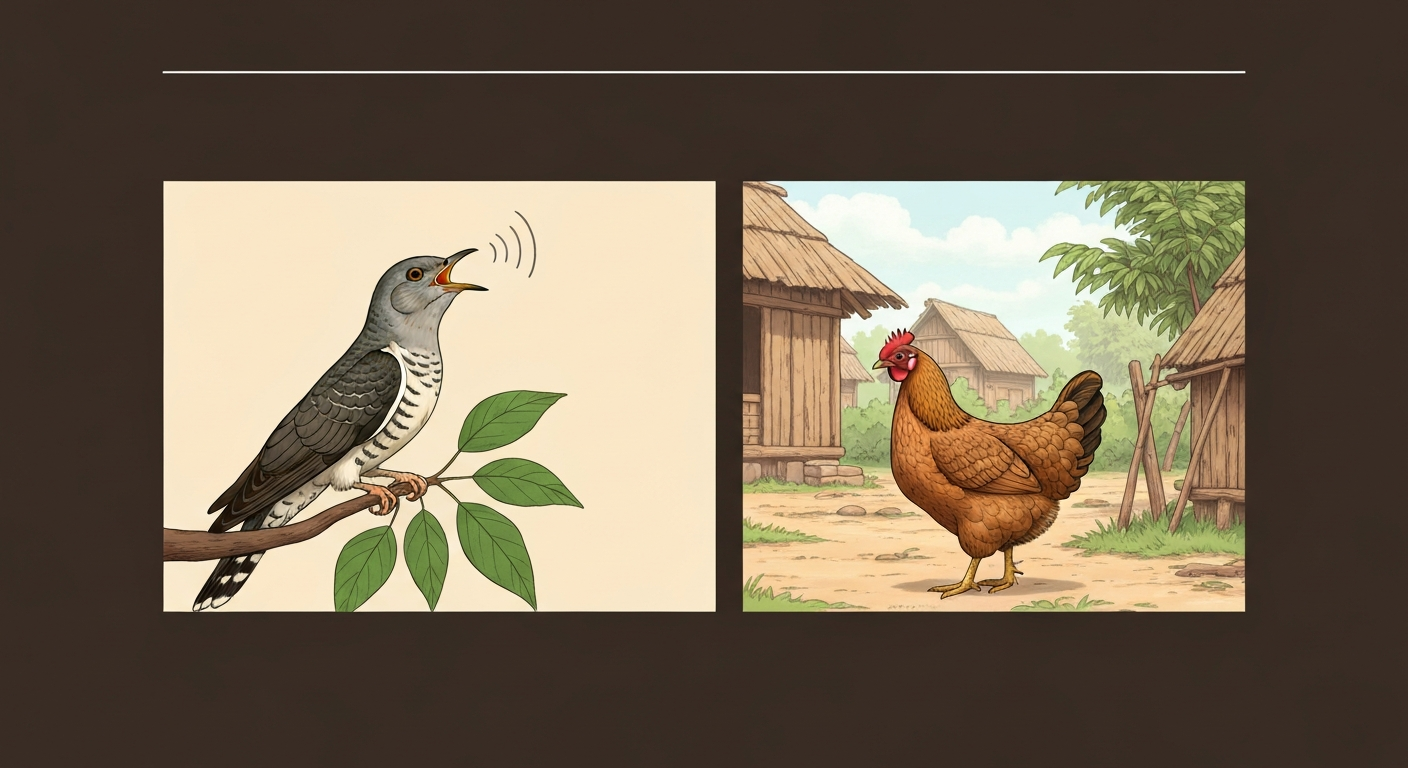
"Kuku bird" does not refer to a single, fixed species or symbol. Depending on where you encounter the word, "kuku" can mean a domestic chicken (standard Swahili), a cuckoo or cuckoo-type bird (Indonesian, Malay, and many Eurasian languages), or simply the sound a cuckoo makes rendered as text. The search intent behind "kuku bird meaning" almost always falls into one of those three buckets, and figuring out which one applies is mostly a matter of context: what language, what region, and what the person was reading or hearing when they came across the word.
Kuku Bird Meaning: Definition, Folklore, Tattoos & Uses

Marcus Whitley
9 Aug 2026
What "kuku" actually means: the core definition
At its most direct, "kuku" is an onomatopoeic word that mimics the two-note call of the cuckoo bird. That call, which sounds roughly like "ku-ku" or "coo-coo," has been transcribed almost identically across dozens of unrelated languages, which is why you find "kuku" meaning cuckoo in Polish, Slavic, Indonesian, and Baltic languages, while finding it used as a simple bird sound in English children's books and folk songs. Separately and importantly, in Swahili and related Bantu languages, "kuku" is the completely ordinary, everyday word for chicken, the domestic fowl. Those two meanings exist independently and collide only when you strip away the language context.
Why "kuku" is ambiguous: cuckoo, chicken, or just a sound?
The ambiguity here is genuine and worth taking seriously rather than glossing over. You have at least three distinct systems producing the same string of letters: (1) the Swahili-Bantu lexical root that names domestic fowl, (2) the onomatopoeic tradition in Eurasian and Austronesian languages that uses kuku or kukuk as the name for cuckoos because the birds literally sound that way, and (3) the informal use of "kuku" purely as a written representation of the sound itself, stripped of any species label. In Indonesian and Malay, the full phrase is usually "burung kukuk" (literally "cuckoo bird"), so the word "burung" (bird) is doing the disambiguation. In Swahili, "kuku" alone already means chicken, no modifier needed. When English-speaking readers see the phrase "kuku bird" in isolation, they are usually encountering a translation, a folk name, or a phonetic borrowing, and the actual meaning depends entirely on the source.
There is also a fourth, smaller use worth flagging: in some European folk and ritual contexts, particularly Albanian oral tradition, the word "kuku" or "qyqe" appears not just as a bird name but as a mourning sound, a kind of voiced lament that mimics the cuckoo's call. The bird and the cry blur into each other, which makes "kuku" in that context feel less like a noun and more like an expression of grief.
Etymology: where the word comes from across languages
The English word "cuckoo" traces back through Middle English "cuccu" and Old French "cucu" to a Proto-Germanic root reconstructed as *kuku, with the earliest written attestations appearing in the 12th to 14th centuries. Every major etymological source flags it as imitative in origin: the word was coined by people who heard the bird and wrote down what they heard. That same process happened independently, or nearly so, across Eurasia. Lithuanian and Latvian have kukutis or dzeguze with related phonetics. Russian and Polish use kukuška and kukuška-type forms. French has coucou, which doubles as an informal hello (think of French parents playing peekaboo with children). All of these converged on similar sounds not because they share a genetic ancestor word, but because the bird genuinely sounds that way and human ears across cultures transcribed it similarly.
The Swahili "kuku" for chicken has a separate etymology rooted in Bantu language family roots for domestic fowl, and linguists do not connect it to the onomatopoeic cuckoo tradition. The Zulu word "inkukhu" and related Bantu forms confirm that this is a distinct lexical lineage, not a borrowing from the bird-call tradition. So the phonetic similarity between "kuku" the chicken and "kuku" the cuckoo-sound is genuinely coincidental, which is exactly what makes the term so slippery.
Which birds actually get called "kuku" regionally?
In ornithological terms, the birds most frequently labeled "kuku" or "kukuk" in field guides and regional checklists belong to the family Cuculidae, the cuckoos. In Indonesian and Malay bird literature, several species carry "kukuk" as part of their common name. The Kamus Besar Bahasa Indonesia (KBBI) entry for "kukuk" lists it as the Indonesian name/onomatopoetic form for cuckoos, confirming its use in Malay/Indonesian bird names blank" rel="noopener noreferrer">Kamus Besar Bahasa Indonesia (KBBI) entry: 'kukuk'. The Plaintive Cuckoo (Cacomantis merulinus), for instance, appears in Indonesian checklists under local names including "blank" rel="noopener noreferrer">wiwik kelabu" and "kukuk." The broader Cuculidae family is regularly glossed as "kukuk" in Indonesian government biodiversity documents and national park guides. The IOC and BirdLife checklists confirm these local name assignments when cross-referenced with Indonesian field guides.
In the Swahili-speaking parts of East Africa, calling a bird "kuku" would most naturally land on the domestic chicken, not any wild species. If someone in Nairobi or Dar es Salaam says "kuku," they almost certainly mean the bird on their plate or in their yard, not a cuckoo in a tree. Wild cuckoos in East Africa do exist and are widespread, but they carry separate Swahili common names. The overlap exists only in the transliteration, not in how speakers actually use the word day to day.
| Region / Language | What "kuku" refers to | Bird species or type |
|---|---|---|
| Swahili (East Africa) | Domestic chicken / hen | Gallus gallus domesticus |
| Indonesian / Malay | Cuckoo (burung kukuk) | Cuculidae family, e.g. Cacomantis merulinus |
| Polish / Slavic | Cuckoo (kukuška / kuku) | Cuculus canorus (Common Cuckoo) |
| Albanian folk / ritual | Cuckoo or mourning cry (qyqe / kuku) | Cuculus canorus (symbolic) |
| French (coucou) | Cuckoo; informal greeting | Cuculus canorus |
| English (kuku as sound) | Written cuckoo call / children's onomatopoeia | No fixed species referent |
The sound is the name: how the call shaped the word
The Common Cuckoo (Cuculus canorus) produces one of the most recognizable two-note calls in the natural world. The male call drops slightly on the second note, creating that unmistakable "ku-koo" pattern. What is fascinating from a linguistics standpoint is that this single bird call has produced near-identical names in languages that had no historical contact with each other. Cross-linguistic studies of lexical iconicity, the technical term for words that sound like what they describe, consistently use cuckoo as a flagship example because the convergence is so striking. Scholars at the University of Southampton and elsewhere have documented this as a case of what linguists call convergent iconic formation: people independently arrived at "kuku" not because they borrowed the word from each other, but because the bird kept making the same sound.
This has a practical implication for anyone researching bird symbolism or translating texts: when you see "kuku" used as a bird name in an unfamiliar language, the first hypothesis should always be that it is referring to a cuckoo or cuckoo-like species, not a chicken, unless the Swahili or Bantu language context makes the chicken reading more plausible.
Cultural symbolism and folklore across the world
In most European folk traditions, the cuckoo (kuku) is a spring herald and a fortune-teller. Hearing the cuckoo call for the first time in spring while you have coins in your pocket is good luck in English and Central European folk belief. Counting the calls traditionally told you how many years you would live, how many years until you married, or how many coins you would earn. The bird's habit of laying eggs in other birds' nests also gave rise to the English word "cuckold" (a husband whose wife has been unfaithful), a metaphor that worked its way deep into English and European literary tradition by the 16th century.
In East Asian traditions, the cuckoo, sometimes called the "dujuan" in Chinese, carries heavier emotional weight. Chinese poetry frequently uses the cuckoo as a symbol of homesickness, unrequited longing, and the pain of separation, partly because its call was said to sound like crying blood. The Sichuan poet Du Fu and many Tang dynasty poets used the cuckoo this way, which is a very different emotional register from the playful European spring-herald version.
In the Swahili-speaking East African context, the chicken (kuku) carries its own rich symbolism, though it is domestic and practical rather than mystical. Chickens feature prominently in ceremonies, bride price negotiations, and ritual meals across much of East and Central Africa. Gifting a chicken is a gesture of respect and welcome. The chicken also appears in Swahili proverbs, though it rarely functions as a portent or omen the way wild birds do in many traditions.
Superstition, ritual, and religious uses of kuku
The cuckoo's role in superstition is remarkably widespread and surprisingly dark in some traditions. In Albanian folk ritual, the word "kuku" or the cry of the cuckoo is woven into mortuary lament practices. The cuckoo's call is treated as a voice from the threshold between living and dead, and ritual wailing in some communities deliberately mimics or invokes it. This makes "kuku" in Albanian ritual something more like a sacred sound than a bird name, blurring the line between natural call and human grief expression.
Across Europe more broadly, cuckoo superstitions cluster around thresholds and transitions: the first cuckoo of spring, heard at the right moment, blesses the year ahead. Heard at the wrong moment (while in bed, or before breakfast), it brings bad luck. In some Slavic traditions, if you hear the cuckoo and immediately ask how many years you have left to live, the number of calls that follow is your answer. Whether that tradition fills you with dread or amusement probably depends on your tolerance for ambiguity.
In Indonesian and broader Southeast Asian cultural contexts, the kukuk (cuckoo family birds) are less loaded with superstition than in Europe, but certain species, particularly those with mournful or unusual calls, are associated with bad omens in local village belief systems. The thick-knee bird (known as dikkop in some African contexts) occupies a similar omen role in a completely different tradition, and if you are researching omen-birds specifically, that is worth exploring as a separate entry.
The Swahili kuku (chicken) enters ritual space in a different way: in several East and Central African religious and ceremonial traditions, chickens are sacrificed or offered in healing ceremonies, divination rituals, and rites of passage. The chicken's role as ritual animal is pan-African and extends well beyond Swahili-speaking communities. What is notable here is that the bird's ordinariness, its domesticity, is actually what makes it powerful in ritual: it is accessible, sacrificeable, and present in every household.
Kuku in tattoos and body art: how to read the symbol
When people search "kuku bird meaning" in the context of tattoos, they are almost always looking at one of three things: a cuckoo bird tattoo (usually inspired by cuckoo clock imagery or European folk symbolism), a tattoo derived from a Swahili or East African cultural reference where "kuku" carries personal or familial meaning, or, more rarely, a tattoo using the word "kuku" as text alongside another bird motif. For related searches, see coo bird meaning for the separate topic of the coo sound and its symbolism. The cuckoo bird tattoo has a distinct visual vocabulary: cuckoo clocks, spring florals, woodland scenes, or simplified bird silhouettes. The Sak Yant tradition of Thai sacred tattoos, which also uses bird imagery with protective symbolism, is a separate system entirely and does not overlap with "kuku" iconography.
If you are a client considering a kuku-themed tattoo or a researcher trying to interpret one, the most important first step is identifying which tradition the image is drawing from. A cuckoo in a clock motif reads very differently from a cuckoo rendered in the style of East Asian brushwork poetry illustration. The Sankofa bird, for example, is a completely different symbolic tradition from West Africa, depicted as a bird looking backward while moving forward, representing wisdom and the importance of learning from the past. It is worth knowing that Sankofa and kuku/cuckoo exist in entirely separate symbolic systems, even though both involve birds and both appear in contemporary tattoo culture.
Checklist for clients and researchers interpreting a kuku bird tattoo or symbol
- Identify the language context first: is "kuku" appearing in a Swahili/East African source (likely chicken) or a Southeast Asian/European source (likely cuckoo)?
- Look at the visual style: a naturalistic bird in woodland foliage usually signals a European cuckoo tradition; a rooster or hen signals an East African domestic bird reference.
- Check whether the word "kuku" appears alone or as part of a compound ("burung kukuk" in Indonesian means cuckoo bird; "kuku" alone in Swahili means chicken).
- For tattoos, ask the artist or client directly what tradition they were drawing from. Do not assume a single meaning.
- If the tattoo includes a clock, springs, or Swiss-style decorative elements, you are almost certainly looking at a cuckoo clock reference from Central European folk culture.
- If the tattoo pairs the bird with mourning imagery, tears, or lament text, consider the Albanian or Eastern European omen tradition.
- If the bird is shown looking backward or in profile with exaggerated posture, research whether the artist was referencing Sankofa or a similar wisdom-bird motif rather than a literal cuckoo.
- For Sak Yant tattoos using bird imagery, those carry specific Buddhist and animist protective meanings that are entirely separate from any "kuku" tradition and require their own research path.
- Note whether the word "kuku" is stylized as text in the tattoo: in some tattoos, it functions as a word, a sound, or a name, not just a bird label.
- When in doubt, treat "kuku" as ambiguous and document the full context before assigning a single interpretation.
How kuku compares to related and commonly confused terms
Because "kuku" sits at the intersection of so many different traditions, it is easy to conflate it with related but distinct terms. The table below summarizes how "kuku" relates to the terms most frequently searched alongside it, including several that are separate entries worth exploring independently.
| Term | Origin / Tradition | Core meaning | Relation to "kuku" | Worth exploring separately? |
|---|---|---|---|---|
| Cuckoo | English (from Old French cucu, Proto-Germanic *kuku) | The cuckoo bird; also 'crazy' or 'foolish' informally | Direct equivalent in English; shares the onomatopoeic root | Yes — full etymology and slang senses |
| Sankofa bird | Akan/West African Adinkra symbol | Wisdom, returning to the past to move forward | Separate tradition entirely; not a vernacular bird name | Yes — rich symbolic and visual tradition |
| Coo bird | English onomatopoeia (dove/pigeon call) | The sound a dove or pigeon makes; sometimes the bird itself | Similar onomatopoeic origin but different bird and meaning | Yes — dove symbolism is its own topic |
| Surkhab | Persian/Urdu (likely 'red-water bird') | A poetic bird name in Persian literary tradition | Separate cultural and literary context | Yes — Persian literary symbolism |
| Sak Yant bird | Thai Buddhist / animist sacred tattoo tradition | Protective bird motifs in sacred Thai tattoo art | Relevant only in tattoo interpretation contexts | Yes — distinct sacred tattooing system |
| Thick-knee / Dikkop | South African / East African folk tradition | Omen bird associated with superstition and night calls | Similar omen-bird role to cuckoo in some traditions | Yes — African bird superstition entry |
| Kaur bird | Likely a misentry or phonetic variant | Uncertain; may reflect mishearing of 'koel' or regional name | Probably not a standard term; treat as ambiguous | Yes — clarification entry recommended |
| Cuntimal bird | Uncertain origin; possibly dialectal or misentry | Not a widely documented bird name; context needed | No clear relation to kuku | Yes — clarification entry recommended |
A few of those entries deserve a brief note. The surkhab bird appears in classical Persian poetry as a symbol of beauty and longing, pulling from a completely different literary tradition than the cuckoo. The Sankofa bird is a visual and philosophical symbol from Akan culture, not a species identification, and anyone researching it in the context of tattoos or jewelry will find a very different kind of meaning. The kaur bird entry appears to be either a regional name or a likely misentry, possibly a phonetic mishearing of another bird name, and should be approached with that uncertainty in mind.
Idioms, slang, and literary uses involving kuku
In English, the word "cuckoo" (descended from the same onomatopoeic root as "kuku") has generated a notable cluster of figurative meanings. The adjective use of "cuckoo" to mean crazy or eccentric is well-documented in American and British English and shows up in informal speech, film dialogue, and song lyrics. Merriam-Webster records it as a standard informal adjective. The cuckoo clock, a Central European folk invention, has become a universal metaphor for something charmingly old-fashioned or comically predictable. In French, "coucou" is used as a light, affectionate greeting between friends, roughly equivalent to "peek-a-boo" or a casual "hello there." Polish and Russian speakers use "kuku" in exactly that peekaboo register for children.
In Swahili-speaking communities, "kuku" does not carry those figurative senses. It stays grounded in the literal domestic bird. Swahili proverbs involving "kuku" tend to be practical and social, reflecting observations about community behavior and hierarchy drawn from watching chickens, rather than the portentous fortune-telling associated with the cuckoo call in European tradition.
- "Cuckoo" (English): informal adjective meaning crazy or foolish, derived from the bird's erratic behavior
- "Coucou" (French): informal greeting, also used in peekaboo games with children
- "Kuku" (Polish/Slavic): used in peekaboo games and children's rhymes, tied to the bird's call
- "Kuku" (Swahili proverbs): appears in sayings about domestic hierarchy and community pecking order, grounded in the chicken reference
- "Cuckold" (English): historical term for a deceived spouse, derived from the cuckoo's habit of using other birds' nests — one of the more durable figurative legacies of the cuckoo in European literary language
How to use this when you're researching or writing
If you have landed on "kuku bird meaning" because you read the word somewhere and want to know what it means, the single most useful thing you can do is note the language or country of origin of the text where you found it. That one piece of context resolves most of the ambiguity. Indonesian or Malay source: you are probably looking at a cuckoo. Swahili or East African source: you are looking at a chicken. European folk text, children's book, or poem: you are likely looking at a cuckoo call rendered as text. Ritual or mourning context in the Balkans: you may be looking at a grief-expression that happens to share the bird's name. If you're specifically searching for "cuntimal bird meaning", consult the related article entry on that phrase for focused information.
For writers, the word "kuku" is a genuinely evocative sound-word that can carry cultural weight, but it needs grounding. Drop it into a poem without context and readers will bring their own associations, which may not match yours. Anchor it to a language, a landscape, or a specific bird and the meaning sharpens considerably. For tattoo clients and artists, the same principle applies: know which tradition you are drawing from before the needle touches skin, because a cuckoo clock motif and an East African chicken carry very different cultural histories, even if the word "kuku" might appear in both.
FAQ
What is the concise definition of “kuku bird” as a search phrase?
“Kuku bird” is a reader query that usually asks what the word 'kuku' refers to when attached to a bird. Depending on language and region it can mean (a) an onomatopoeic name for the cuckoo family (Cuculidae), (b) a local or vernacular bird called 'kuku' (especially in Austronesian languages), or (c) an unrelated sense such as 'chicken' in languages like Swahili. The phrase therefore signals ambiguity between 'cuckoo‑type bird', regional bird names, and onomatopoeic uses.
What is the etymology and linguistic origin of 'kuku' in bird names?
The form 'kuku' (and close variants kukuk, kukū, coucou, cuckoo) is onomatopoeic: many languages imitate the two‑note call of cuckoos. English cuckoo derives from Middle English/Old French imitations; similar forms developed convergently across many Eurasian and Austronesian languages rather than from a single inherited root.
Which species might 'kuku bird' refer to?
Most often it points to cuckoo species (family Cuculidae) in a local language — e.g., common cuckoo or regional cuckoos listed as 'kukuk' in Indonesian/Malay guides. In other contexts the string 'kuku' could refer to domestic chicken (Gallus gallus domesticus) in languages such as Swahili. Identification therefore depends on geographic and linguistic context.
How does regional language create ambiguity for 'kuku'?
In Malay/Indonesian, kukuk (or kukuk forms) commonly names cuckoos. In Swahili and several Bantu languages, kuku means 'chicken' (meat/hen). European and Balkan languages use kuku/coucou as cuckoo‑imitations with cultural uses. So the same spelled string maps to different birds or meanings depending on the speaker's language and region.
What cultural symbolism and folklore are associated with 'kuku'/cuckoo‑type birds?
Cuckoos carry varied symbolism: in many European traditions they signal spring, time/season, and fertility; figuratively they can suggest foolishness or madness (hence 'cuckoo'='crazy'). In some cultures they are omens of love, transformation, or death (regional: mourning associations in parts of the Balkans). West African Sankofa is a separate symbolic bird motif—not the vernacular 'kuku'—and represents retrieval of the past.
Which idioms, slang, and literary uses are tied to 'kuku' or cuckoo?
Common English idioms: 'to be cuckoo' (crazy), 'cuckoo clock' (time device). In French coucou is a casual greeting or peek‑a‑boo. Cuckoo imagery appears in poetry and songs to mark seasonality or eccentricity. Local proverbs and laments in Balkan and Albanian contexts may use kuku/cuckoo in ritual or mourning language.
Next Article
Superstition Around the Thick-knee (Dikkop): Meanings & Folklore
Explore the thick-knee (dikkop): etymology, natural history, regional superstitions, symbols, examples, and sources.