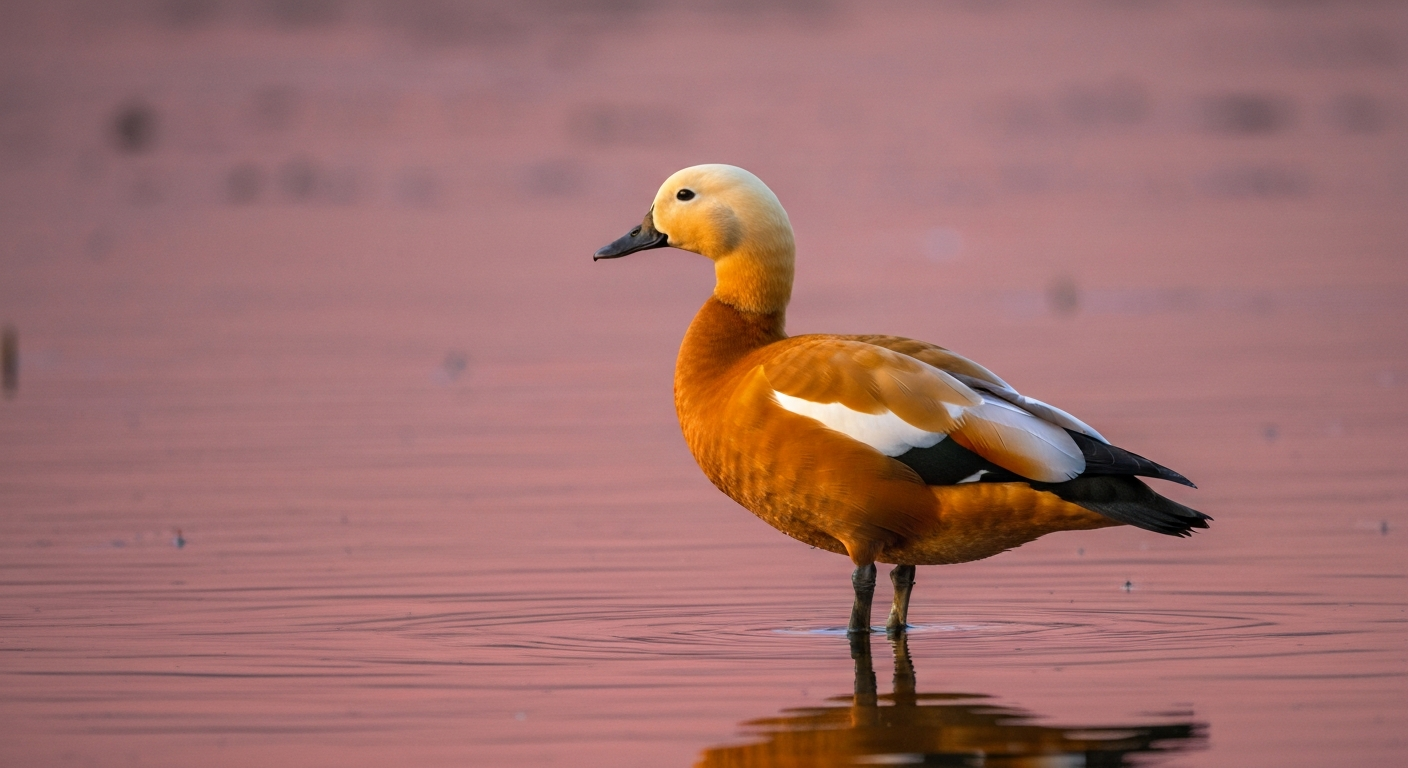
Surkhab (سُرخاب) is a Persian and Urdu word meaning 'red water,' used as the traditional South Asian name for the Ruddy Shelduck (Tadorna ferruginea), a distinctive orange-rufous waterfowl found across Central and South Asia. Beyond its ornithological identity, the word carries layers of meaning: it appears in classical poetry as an image of beauty and longing, in idioms about honour and distinction, and in personal and place names across Persian- and Urdu-speaking cultures. It also has a completely separate non-bird meaning in Persian, referring to a red cosmetic rouge, which is worth knowing upfront to avoid confusion.
Surkhab Bird Meaning: Definition, Origins, Symbolism & Uses.

Marcus Whitley
13 Aug 2026
Definition and Pronunciation
The word is spelled سُرخاب in Persian and Urdu script, and सुर्ख़ाब in Devanagari. The standard IPA transcription is /sʊr.xɑːb/ in Persian and /sʊr.kʰɑːb/ in Urdu and Hindi (the distinction reflects how the Persian 'kh' sound shifts slightly in the Hindi-Urdu phonological system). For English speakers who have not encountered these sounds before, a practical approximation is 'SOOR-khaab,' where the 'kh' is a soft, throaty sound like the 'ch' in the Scottish word 'loch,' and the final 'aab' rhymes with 'cab' but held slightly longer.
As a dictionary entry, surkhab functions as a noun (the bird; also the rouge cosmetic in Persian) and occasionally as an adjective in literary Urdu, where it can mean 'deeply red' or 'crimson.' Rekhta's Urdu dictionary, one of the most authoritative sources for classical and literary Urdu, lists the primary senses as: (1) the Ruddy Shelduck, (2) something of brilliant or deep red colour, and (3) pomp, splendour, or distinction, the last sense deriving directly from the bird's association with Mughal-era status symbols.
Etymology and Language Origins
The word is a compound of two Persian roots: surkh (سرخ), meaning 'red,' and ab (آب), meaning 'water.' Literally, surkhab means 'red water.' The naming logic is visual: the Ruddy Shelduck is a waterfowl with strikingly red-orange plumage, so calling it the 'red water bird' makes immediate, descriptive sense. Wiktionary and classical Persian lexica both confirm this etymology, tracing the word back into Classical Persian, from where it was borrowed into Urdu and Hindi during the Mughal period, when Persian was the literary and administrative language of the subcontinent.
The word surkh itself has deep roots in Iranian languages and appears across Persian vocabulary wherever redness is involved: surkhak (measles, literally 'the redness'), surkh-ru (red-faced, meaning honoured or triumphant), and of course, surkhab the rouge cosmetic. The ab element likewise appears throughout Persian compounds: gulab (rose water), sharab (wine, literally 'grape water'), and biryani's roots trace through similar water-plus-noun constructions. So surkhab sits within a well-established Persian word-building pattern.
Spelling variants you will encounter include: surkhaab, surKHaab (Rekhta's capitalisation convention to mark the aspirated 'kh'), surkhāb (academic romanisation), and in some romanised Hindi contexts, surkhaab or sookhab. Older English-language lexica such as John Platts' A Dictionary of Urdu, Classical Hindi and English (1884) record 'surḵẖāb' and cross-reference it with idioms, confirming the word was already well-established in literary and common usage by the nineteenth century.
Which Real Birds Are Called Surkhab?
The bird most consistently identified as the 'surkhab' across South Asian ornithological sources is the Ruddy Shelduck (Tadorna ferruginea). Regional bird checklists from Indian wetland sanctuaries, including published lists for sites like Lakh Bahosi Bird Sanctuary, explicitly list 'Tadorna ferruginea, Surkhab,' and the species accounts in authoritative field guides such as Grimmett, Inskipp and Inskipp's Birds of the Indian Subcontinent (Bloomsbury) treat Tadorna ferruginea as the species behind this vernacular name. Recommended field guide: Field Guide to Birds of the Indian Subcontinent, Richard Grimmett, Carol Inskipp & Tim Inskipp (Bloomsbury product page / recommended field guide) Field Guide to Birds of the Indian Subcontinent — Richard Grimmett, Carol Inskipp & Tim Inskipp (Bloomsbury product page / recommended field guide).
The Ruddy Shelduck is visually unmistakable, which helps explain why it attracted such a striking name. It is a large, goose-like duck with warm orange-brown to orange-rufous body plumage, a noticeably paler, creamy-buff head, and sharply contrasting black tail, flight feathers, and bill. In flight, bold white wing-coverts flash against the darker body. The male has a thin black neck ring during the breeding season. In wetland settings, especially at dawn or dusk, the bird's colouring can look genuinely reddish against water, making 'red water bird' a very apt description.
That said, the name is not used with strict ornithological consistency across all regions and speakers. Some online aggregator dictionaries (such as UrduPoint) have listed alternative translations including 'barnacle goose' or 'widgeon,' which are almost certainly errors introduced by automated or low-quality translation. The classical Persian Dehkhoda dictionary is clear that surkhab refers to a red-coloured waterfowl specifically associated with the shelduck family, and BirdLife International's and the IUCN's species data for Tadorna ferruginea confirm this as the standard ornithological identification. If you encounter 'barnacle goose' or 'widgeon' translations anywhere, treat them with scepticism. In South Asia, the Ruddy Shelduck is also regionally called Chakwa and Chakwi (male and female respectively), names that carry their own rich folklore, sometimes overlapping with surkhab's symbolism of devoted pairs.
Symbolic Meanings and Cultural Contexts
Devoted Love and Faithful Pairs
The most persistent symbolic meaning attached to the surkhab in Persian and South Asian tradition is faithful, devoted love, specifically the anguish of separation between bonded partners. The Dehkhoda dictionary, the most comprehensive classical Persian lexicon, records a folkloric belief that surkhab pairs separate at night and call out loudly to each other across the water, refusing to bond with any other partner. This image of two birds crying to each other across dark water became a natural metaphor for lovers separated by fate or circumstance.
This symbolism flows directly into Urdu and Persian poetry. The phrase 'shab-e-surkhaab' (the night of the surkhab) is used in some poetic contexts to evoke a night of longing and separation, the darkness in which devoted love calls out without being answered. Rekhta's literary corpus indexes ghazals and classical verses that use 'surkhaab' as an image of beauty, redness, and yearning. It is worth noting that these are poetic and attributed interpretations: the folkloric beliefs about the bird's mating behaviour are recorded in traditional dictionaries as folk belief, not verified ornithology.
Status, Honour, and Mughal Prestige
Alongside the love symbolism, surkhab carries a second major symbolic register: honour and distinction. Mughal nobles and aristocrats historically wore surkhab feathers as status symbols. This practice generated one of the most well-known Urdu idioms associated with the word: 'surkhab ka par lagna' (سُرخاب کا پر لگنا), literally 'to have a surkhab feather attached,' meaning to receive a mark of distinction or to be singled out for honour. John Platts' nineteenth-century dictionary records this idiom, and it remains understood in contemporary Urdu-speaking contexts, functioning similarly to the English 'feather in one's cap.' When someone says 'kya surkhab ka par laga hai usse,' they are asking, with some irony, 'what great distinction has been given to him?' The phrase can be used sincerely or sarcastically.
Sufi and Mystical Associations
In Sufi literary tradition, birds frequently stand in for the soul, divine longing, or the relationship between the seeker and the divine. The surkhab, with its existing associations with faithful devotion and the pain of separation, fits naturally into this symbolic vocabulary. While surkhab does not have the same dedicated allegorical role as the nightingale (bulbul) or the hoopoe (hudhud, central to Attar's Conference of the Birds), it appears in Sufi-inflected poetry and prose as a supporting symbol of beauty, longing, and unshakeable fidelity. Its red colouring also connects to the Sufi symbolic use of red for passion, love, and the intensity of spiritual feeling.
Surkhab in Names, Idioms, Art, Tattoos, and Branding
Surkhab is used as a personal name, particularly in Persian, Afghan, and Pakistani communities, where it is given to both boys and girls, though more commonly noted as a feminine name associated with beauty and brightness. Baby-name sites list it with meanings such as 'beautiful,' 'bright,' or 'red-feathered bird,' reflecting the word's poetic and ornamental associations rather than strict ornithological accuracy. As a place name, several locations in Iran and the broader Persian-speaking world carry 'Surkhab' as part of their name, typically in areas near waterways or wetlands where the bird historically appeared.
In visual art and manuscript traditions, the surkhab appears in Persian miniature paintings and Mughal-era illustrated manuscripts, usually depicted in wetland scenes with its characteristic orange-rufous plumage. These images reinforced the bird's association with nobility and natural splendour. Contemporary artists working in the Indo-Persian tradition continue to use the bird as a motif, particularly in works exploring themes of love, longing, and fidelity.
When it comes to tattoos, the surkhab's territory overlaps with a broader interest in South Asian and Persian bird symbolism in body art. People choosing a surkhab tattoo are typically drawn to its meaning of devoted love or distinction, much as others might choose a crane for longevity or a phoenix for renewal. It is worth noting here that the sak yant tradition, a Southeast Asian system of sacred tattoos that sometimes incorporates bird imagery, operates under a completely different symbolic framework from Persian and South Asian bird symbolism. A sak yant bird tattoo and a surkhab-inspired tattoo may both be bird tattoos, but their meanings, origins, and ritual contexts have nothing in common. See sak yant bird meaning for the distinct symbolism and ritual context of bird imagery in that tradition. If you are researching bird tattoo meanings, those two traditions need to be kept separate.
In contemporary branding, 'Surkhab' appears as a name for restaurants, textile brands, and cultural organisations, particularly in Pakistan, Afghanistan, and Iran, where the word's associations with beauty, warmth, and cultural heritage make it commercially attractive. The Ruddy Shelduck itself has also been used as a logo element by conservation and wildlife organisations operating in South Asian wetland regions.
Common Confusions and Quick Disambiguation
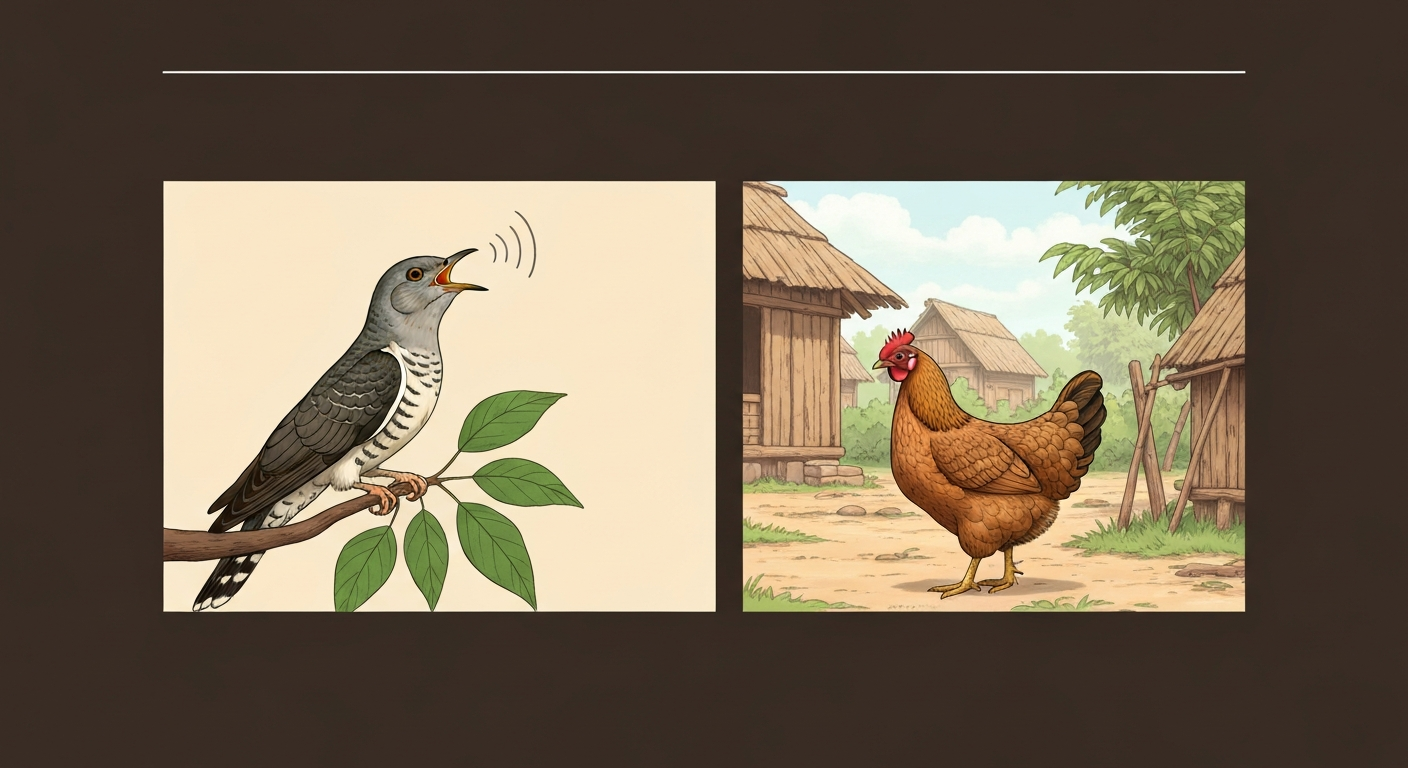
Because people searching for bird meanings often encounter multiple unfamiliar terms at once, it helps to know exactly how surkhab differs from other bird words you might come across in the same research session. For a related entry on the kuku bird meaning and its symbolism, see kuku bird meaning. For a related note on how simple bird calls carry symbolic meaning, see coo bird meaning. Here is a direct comparison: See also a note on the superstition around the thick-knee (dikkop) and its folk meaning.
| Term | Language/Origin | Likely Species or Referent | Core Symbolic Meaning |
|---|---|---|---|
| Surkhab | Persian/Urdu/Hindi | Ruddy Shelduck (Tadorna ferruginea) | Devoted love, longing, distinction/honour |
| Sankofa | Akan (West African/Ghanaian) | Stylised mythical bird (often depicted as a bird looking backward) | Return to roots, wisdom, reclaiming the past |
| Cuckoo bird meaning | English/cross-cultural | Common Cuckoo (Cuculus canorus) | Spring, time-keeping, madness (slang), parasitism/deception |
| Coo/Kuku bird | Onomatopoeic/East African and South Asian slang | Dove or pigeon family; also informal slang | Gentle love (coo); also fool/simpleton in some slang contexts |
| Kaur bird | Punjabi/Sikh tradition | Associated with falcon/hawk imagery in some readings | Sovereignty, nobility, identity (primarily a title/name, not a species term) |
| Cuntimal bird | South Indian/Tamil cultural contexts | Regional bird term, identity debated | Regional folklore meanings, culturally specific |
| Sak yant bird | Thai/Southeast Asian Buddhist tradition | Stylised bird forms in sacred tattoo geometry | Protection, power, spiritual merit through ritual tattooing |
| Thick-knee/Dikkop | South African English/Afrikaans | Burhinus capensis (Spotted Thick-knee) | Omen, vigilance, night superstitions in Southern African folklore |
The key thing to notice is that surkhab is a real, identifiable species name rooted in a specific linguistic tradition (Persian), while terms like sankofa and sak yant bird refer to stylised or symbolic bird forms that do not map onto a single real species. Surkhab's symbolism is literary and folkloric but anchored in an actual bird you can go and photograph in an Indian wetland. For a contrasting example of an unrelated bird-symbol term, see the Kaur bird meaning for its distinct cultural context and symbolism. That combination of real-world identity and rich cultural meaning is part of what makes it interesting.
Practical Examples and Short Quotations
The best way to see how a word actually works is to watch it in use. Here are several examples spanning idiom, poetry, and everyday speech:
- 'Surkhab ka par lagna' (سُرخاب کا پر لگنا): Urdu idiom meaning 'to receive a mark of distinction.' Example in context: 'Kya surkhab ka par laga hai tumhein ke tumhara hukum chalega?' — loosely, 'What great honour have you received that you think your word is law?' Recorded in Platts' dictionary and still used in contemporary Urdu speech, usually with an ironic edge.
- From classical Urdu ghazal tradition (traditional saying, as indexed in Rekhta's literary corpus): 'Surkhaab-sa rang hai tera, aur aankhon mein woh gehraai' — 'Your colour is like the surkhab's, and in your eyes that depth.' Used to praise a beloved's vivid, warm beauty.
- A traditional Persian folkloric saying recorded in Dehkhoda: the surkhab pair 'separate at night across the water and call out to each other without rest.' This motif is cited in poetry to describe lovers separated by circumstance who remain faithful despite distance.
- Contemporary usage in a Pakistani wedding context (illustrative example): a bride described as 'surkhab jaisi dulhan,' meaning 'a bride as radiant as the surkhab,' drawing on the bird's association with warm, deep-red beauty.
- In a South Asian birdwatcher's field notes: 'We spotted three surkhab at the reservoir edge at dawn — their orange-rufous plumage almost glowing in the early light.' This shows the word functioning straightforwardly as the vernacular species name.
Image Suggestions and Caption Guidance
If you are illustrating an article or educational resource on surkhab, the following image directions will give you the most useful and contextually accurate visuals:
- Primary species photo: A close-up or medium shot of a Ruddy Shelduck (Tadorna ferruginea) at a wetland site, ideally showing the orange-rufous body, pale head, and black-tipped wings. Early morning or late afternoon light brings out the warm reddish tones that explain the 'red water' name. Sample caption: 'The Ruddy Shelduck (Tadorna ferruginea), known as Surkhab in Urdu and Hindi, photographed at a North Indian wetland. Its distinctive orange-rufous plumage gives the bird its Persian name, meaning red water.'
- Pair behaviour shot: A photo showing two Ruddy Shelducks together on water or at a shoreline. This image supports the folkloric symbolism of faithful pairs. Sample caption: 'Ruddy Shelduck pairs are associated in Persian and South Asian folklore with devoted, faithful love — a symbolism embedded in classical Urdu and Persian poetry.'
- Manuscript or miniature painting: A reproduction of a Persian or Mughal-era miniature painting featuring waterfowl in a garden or river scene. These illustrations often appear in manuscripts of Layla-Majnun or similar romantic epics where bird symbolism is prominent. Sample caption: 'A detail from a Mughal-era illustrated manuscript showing waterfowl in a river garden setting. Birds with reddish plumage in such works may represent the surkhab as a symbol of beauty and longing.'
- Idiom illustration: A stylised or calligraphic rendering of the phrase 'surkhab ka par' (the surkhab feather) in Nastaliq script, suitable for explaining the idiom about honour and distinction. Sample caption: 'The Urdu idiom surkhab ka par lagna — to receive a surkhab feather — refers to being singled out for distinction or honour, a phrase documented as far back as Platts' nineteenth-century dictionary.'
- Range map: A distribution map for Tadorna ferruginea from BirdLife International or a similar authority, showing the species' breeding and wintering range across Central Asia, South Asia, and parts of North Africa. Sample caption: 'The Ruddy Shelduck breeds across Central Asia and winters widely across the Indian subcontinent, explaining the depth of its presence in South Asian vernacular language and folklore.'
Quick Reference: What You Need to Remember
- Surkhab (سُرخاب) means 'red water' in Persian, from surkh (red) + ab (water). It is the traditional South Asian name for the Ruddy Shelduck (Tadorna ferruginea).
- Pronounce it approximately 'SOOR-khaab,' with the 'kh' as a soft throat sound, IPA /sʊr.xɑːb/ (Persian) or /sʊr.kʰɑːb/ (Urdu/Hindi).
- The Ruddy Shelduck is a large, orange-rufous waterbird with a pale head and black flight feathers — visually distinctive and widespread across South Asian wetlands.
- In Persian, surkhab also means a red cosmetic rouge (used in the collocation surkhab-o-safidab, rouge and whitewash). This is a completely separate meaning from the bird.
- The main symbolic meanings are: faithful devoted love (from folkloric beliefs about the pair bond), longing and separation (in poetry), and honour/distinction (from the 'surkhab feather' idiom).
- The key idiom is 'surkhab ka par lagna,' meaning to receive a mark of distinction — it functions similarly to 'feather in one's cap' and can be used sincerely or ironically.
- Online aggregator sites sometimes give wrong species translations (barnacle goose, widgeon). Stick to Platts, Dehkhoda, Rekhta, and Grimmett's field guide for accurate information.
- In writing and research, specify the ornithological context (Tadorna ferruginea) when precision matters, and use the literary/idiomatic senses with appropriate attribution to classical sources.
Where to Go Next
If surkhab has caught your interest, there are several directions worth following depending on what drew you here in the first place. For the linguistic and literary angle, Rekhta's online Urdu dictionary and poetic corpus (rekhta. For a comparative entry on another bird-associated meaning, see the article titled 'cuntimal bird meaning' (entry ID 4f999b1b-8cba-410f-8291-3a778be29103). org) is genuinely excellent: you can search 'surkhaab' and read the actual classical verses that used the word, which brings the symbolism alive far better than any secondary explanation. For the Persian etymology and classical lexicography, the Dehkhoda dictionary accessed through Vajehyab gives you the full classical picture, and Platts' A Dictionary of Urdu, Classical Hindi and English is freely available online and remains one of the most reliable historical sources for Urdu idioms. For the ornithological side, Grimmett, Inskipp, and Inskipp's Birds of the Indian Subcontinent is the standard field reference, and BirdLife International's species factsheet for Tadorna ferruginea gives range maps, conservation status, and behavioural notes.
Within the broader world of bird meanings and symbolism, the surkhab sits in interesting company. The sankofa bird meaning offers a fascinating contrast: where surkhab is anchored in a real, identifiable species and Persian linguistic tradition, the sankofa is a stylised symbolic form from Akan tradition, focused on cultural memory and identity rather than natural history. If you are drawn to bird symbolism in South Asian or Islamic artistic traditions, exploring the cuckoo bird's meaning in Persian poetry (the cuckoo, or koel, carries its own complex symbolism of spring, longing, and separation in Urdu verse) adds useful context. And if the tattoo angle brought you here, the sak yant bird meaning explains how bird imagery functions in a very different symbolic and ritual system, one rooted in Southeast Asian Theravada Buddhist practice rather than Persianate literary culture.
FAQ
What is the concise dictionary-style definition and pronunciation of “Surkhab”?
Definition: Surkhab (Persian/Urdu/Hindi: سرخاب / सুরख़ाब, romanized surkhāb or surkhab) primarily denotes the ruddy shelduck (Tadorna ferruginea) and, secondarily, means rouge/rouge‑like red. Pronunciation: approx. /sʊr.kʰɑːb/ or /sʊr.xɑːb/ (IPA approximations from Wiktionary and regional lexica). Short usage note: in literary registers the word often functions as an adjective or poetic image for a deep red or ruddy colour.
Which real bird(s) are likely meant when people say “surkhab”? What visual clues help identify it?
Likely species identification: Ruddy Shelduck (Tadorna ferruginea) is the species most widely identified with the name surkhab in South Asia. Visual clues (field‑guide checklist): - Overall orange‑rufous / ruddy body colour - Paler, often pale‑orange to whitish head - Dark (black) flight feathers visible in flight - Bold white wing‑coverts and black trailing edges when wings spread - Large, stocky waterfowl silhouette (shelduck shape) For regional confirmation consult Grimmett, Inskipp & Inskipp (Birds of the Indian Subcontinent), BirdLife/IUCN species accounts, and local wetland checklists which list the common Hindi/Urdu name 'surkhab'.
What is the etymology and language origin of the word “surkhab”?
Etymology: Persian origin—surkh (سرخ) meaning 'red' + āb (آب) meaning 'water', historically forming سرخاب/surxāb. The word entered Urdu and Hindi via Persian literary and colloquial influence; standard Urdu/Hindi orthography records forms such as سُرْخاب / सुरख़ाब. Sources: classical Persian lexica (Dehkhoda) and modern lexica/registries (Wiktionary, Platts, McGregor) document this derivation and the borrowing path.
What symbolic meanings does “surkhab” carry in literature, poetry and folklore?
Symbolic meanings (attributed interpretations): - Fidelity and devoted pair bonds: folkloric accounts (Dehkhoda) describe surkhab pairs as devoted, informing poetic metaphors of faithful love. - Redness, beauty and splendour: used as an image for striking ruddy colour or splendour in Persian/Urdu poetry. - Longing and separation: poetic usage sometimes links the bird’s calls or habits to yearning and night‑long longing. - Honour/status: idioms historically link 'surkhab' feathers with distinction (Mughal court imagery). Note: meanings vary by context and era; present these as literarily attested readings (Rekhta, Dehkhoda, regional folklore studies).
How does the word appear in idioms, personal names, tattoos, art and branding?
Common appearances: - Idioms: classical idioms (e.g., 'surkhāb kā par lagna' — to receive honour/distinction) found in historical dictionaries and Platts. - Personal names & toponyms: used in poetic/stylized given names and place names in Persianate contexts. - Tattoos & sacred imagery: in contemporary tattooing (including some cross‑cultural practices like sak yant borrowings), surkhab imagery is used for themes of devotion, protection or beauty—verify local meanings with native informants before adopting. - Art & branding: used to evoke reddish elegance, heritage, or South Asian identity in logos/packaging. Caution: cultural meanings are varied; consult folklore or local community sources for authoritative interpretation.
What common confusions exist between “surkhab” and other bird terms, and how can they be disambiguated?
Common confusions and quick disambiguation (bullet list/table style): - Surkhab vs. 'cuckoo' (کُوکُو / cuckoo): cuckoos are small passerines with different calls and silhouette; not a shelduck. - Surkhab vs. 'sankofa' (Akan symbol): sankofa is an African cultural symbol meaning 'return and get it' and unrelated to surkhab. - Surkhab vs. 'coo / kuku' (onomatopoeic calls): these represent sounds; not specific to shelduck identity. - Surkhab vs. 'thick‑knee / dikkop' superstitions: different species (stone‑curlews); local superstitions may overlap but species and cultural meanings differ. - Surkhab vs. other waterfowl (e.g., wigeon, barnacle goose): some non‑specialist sites conflate names; authoritative field guides (Grimmett et al.), regional checklists and BirdLife/IUCN should be used to confirm species identification. Quick rule: consult a regional field guide or BirdLife species account to match plumage and size to the correct species.
Next Article
Kuku Bird Meaning: Definition, Folklore, Tattoos & Uses
Discover the 'kuku bird' meaning: definition, etymology, cultural symbolism, idioms, tattoos, and related terms.