A puffin is a small, stocky seabird belonging to the auk family (Alcidae), best known for its clown-like multicolored bill, black-and-white plumage, and remarkable ability to live both at sea and on rocky cliffs. In symbolic terms, it carries meanings of loyalty, playfulness, resilience, and maritime identity across the North Atlantic cultures that have lived alongside it for centuries. The word itself traces back to Middle English, and today the puffin turns up everywhere from Norse folklore and Faroese tradition to a beloved children's book imprint and postage stamps worldwide.
Puffin Bird Meaning: Symbolism, Nature, Etymology & Uses

Marcus Whitley
29 Jul 2026
Quick Definition: What a Puffin Actually Is
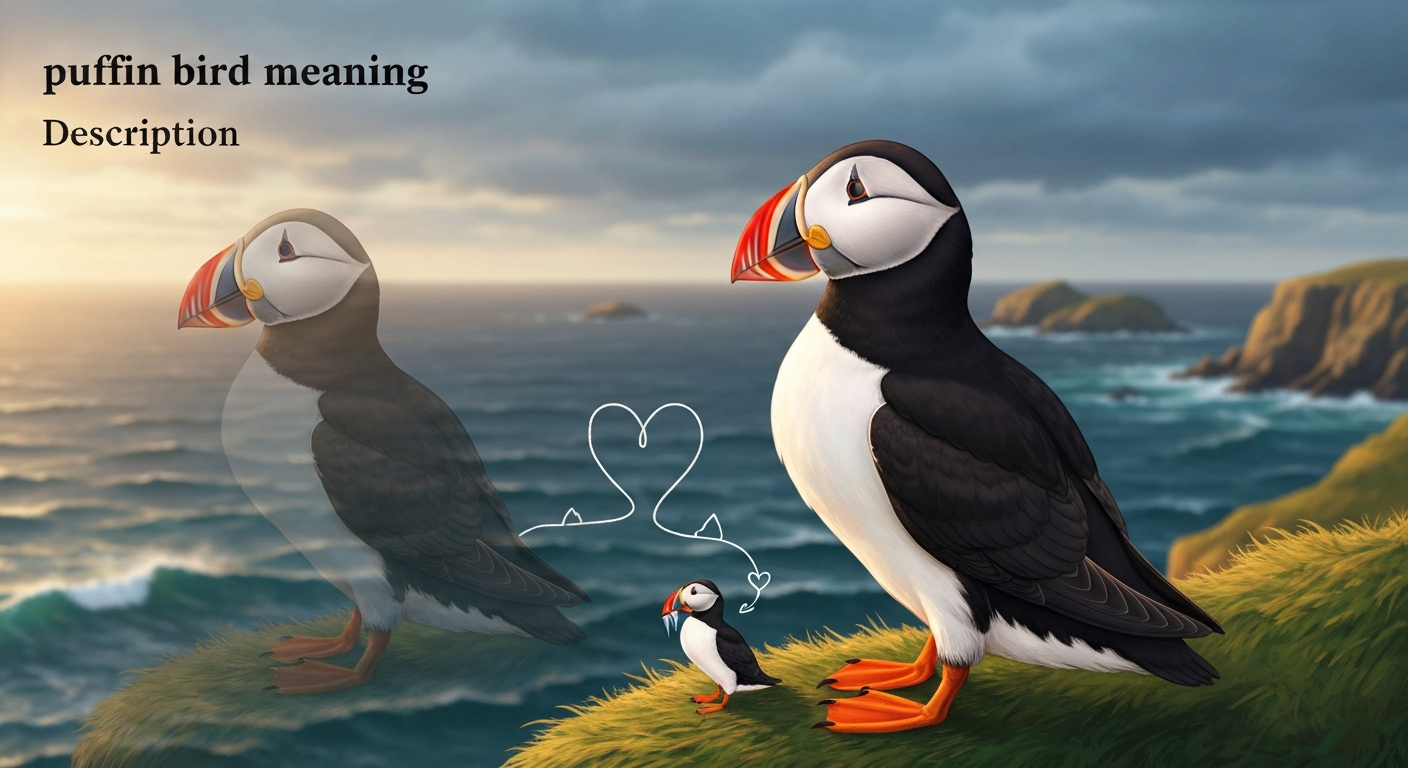
The Atlantic Puffin, scientific name Fratercula arctica, is the species most people picture when they hear the word. It is a member of the family Alcidae (the auks), which makes it more closely related to murres and razorbills than to any shorebird or gull. Adults measure roughly 26 to 29 cm in length, with a wingspan between 47 and 63 cm, and weigh in the range of 320 to 480 grams. That is roughly the size of a pigeon, though a puffin holds itself much more upright and carries itself with what can only be described as comic dignity. Its bill, vividly striped in red, orange, yellow, and blue-grey during the breeding season, is the feature that has made it genuinely famous. Outside the breeding season, the bill sheds its colourful outer plates and becomes considerably duller, which surprises many first-time observers who see puffins in winter photographs.
There are actually three puffin species worldwide: the Atlantic Puffin (Fratercula arctica), the Horned Puffin (Fratercula corniculata) of the North Pacific, and the Tufted Puffin (Fratercula cirrhata), also of the Pacific. When people say 'puffin' in a European or Atlantic cultural context, they almost always mean Fratercula arctica. The Atlantic Puffin is listed as Vulnerable on the IUCN Red List (2018 global assessment, BirdLife International), reflecting documented population declines linked to climate-driven changes in prey availability, alongside pressures from introduced predators at breeding colonies.
Appearance, Habitat, and Behavior
What a Puffin Looks Like
The puffin's black back and white underparts create a tuxedo-like silhouette that is instantly recognizable on a clifftop colony. In breeding plumage, the face is pale, the eye is framed by a small red and blue orbital ring, and those remarkable bill plates are fully developed. The feet are bright orange, another detail that turns up frequently in cultural imagery and illustrations. In flight, puffins beat their wings very rapidly (up to 400 beats per minute) and look slightly frantic compared to larger seabirds, which has contributed to their association with comic energy and cheerful effort. Their nickname in many natural-history accounts is 'clown of the sea,' and it is easy to see why.
Where Puffins Live: Pelagic vs. Shore
Puffins are seabirds with a split life. During the breeding season (roughly April through August in the UK and Iceland), they come ashore to nest in burrows on grassy clifftops and rocky islands. The UK's largest colony is on the Farne Islands, and Iceland hosts an enormous proportion of the world's Atlantic Puffin population, with colonies around Westman Islands (Vestmannaeyjar) particularly well documented. Outside the breeding season, puffins head to open water and live a genuinely pelagic existence, meaning they spend months far offshore on the open ocean, surfacing to dive and feed but never touching land. If you are exploring the term 'pelagic bird,' that open-ocean lifestyle is exactly what the word describes. For a concise definition, see pelagic bird meaning, which explains the open-ocean lifestyle and typical behaviors of seabirds that spend most of their lives offshore. Puffins are expert wing-propelled divers and can reach depths of around 60 metres to catch sand eels, herring, and sprats, often carrying several fish crosswise in their bill at once to bring back to their chick.
Nesting and Family Life
Puffins are monogamous and typically return to the same burrow and the same partner year after year. A mated pair raises a single chick, called a puffling, per breeding season. That dedication to one partner, combined with the spectacle of both parents working together to provision the burrow, is one of the main reasons puffins have come to symbolize loyalty and committed partnership in contemporary cultural writing, though it is worth noting that this interpretation is largely a modern reading rather than an ancient folklore tradition.
What the Puffin Symbolizes
The puffin's symbolism is rooted in observable behavior more than mythology, which makes it relatively easy to trace. Where cultural meanings do appear, they cluster around a handful of clear themes.
- Loyalty and partnership: Long-term monogamy and shared parenting duties have made the puffin a popular symbol for faithful companionship, especially in modern greeting cards, wedding iconography, and gift culture in Iceland and the UK.
- Playfulness and charm: The comic appearance and seemingly cheerful waddling gait make puffins a symbol of lightheartedness. The 'clown of the sea' nickname captures this well.
- Resilience and adaptation: Living months at a time on the open ocean, surviving North Atlantic storms, and raising young in burrows on exposed cliffs, the puffin models tenacity. This resonates in communities like the Faroe Islands where survival in a harsh maritime environment is central to cultural identity.
- Maritime identity: For coastal communities across Iceland, the Faroes, Orkney, Shetland, and Newfoundland, the puffin is simply part of the landscape. It appears in local crests, tourism imagery, and community storytelling as a marker of place and belonging.
- Duality and transition: The puffin's shift between land and sea, between vivid breeding plumage and dull winter dress, and between comical awkwardness on land and expert competence underwater has attracted writers and poets interested in themes of transformation.
It is worth being direct about evidence levels here. The loyalty and resilience associations are well supported by natural history and documented in cultural studies of North Atlantic communities, including university research from the University of Iceland on how puffins function in Icelandic material culture and tourism. The 'spirit animal' meaning that circulates on commercial symbolism websites (typically listing puffin alongside shamanic animal totems) is not rooted in documented Indigenous traditions and should be treated with appropriate skepticism.
Cultural Associations by Region
Iceland
Iceland is arguably the country where the puffin carries the most active cultural weight today. The Westman Islands host one of the largest Atlantic Puffin colonies in the world, and locals on Heimaey island have developed a celebrated tradition around pufflings (young puffins leaving the burrow for the first time) becoming disoriented by artificial lights and landing in the town. Children collect the confused birds each autumn and carry them down to the sea to release them safely. This practice, documented in Bruce McMillan's children's book Nights of the Pufflings (1995), has become a point of genuine local pride and a touchstone in international coverage of Icelandic wildlife culture. See Nights of the Pufflings | Worlds of Words (book catalog entry summarizing Bruce McMillan's book) for a catalogued summary of McMillan’s account of the Heimaey puffling-rescue tradition. University of Iceland research has explored how the puffin functions in Icelandic souvenir culture and tourism, describing it as a performative symbol through which visitors engage with an imagined Arctic landscape. Puffin imagery saturates Reykjavik gift shops, restaurant menus, and advertising.
Faroe Islands
In the Faroe Islands, puffins have historically been harvested for food, a practice that continues in limited form today and sits at the center of complex debates about cultural sustainability versus conservation. Faroese communities have lived alongside puffin colonies for over a millennium, and the bird is embedded in the texture of local material culture, appearing in food traditions, folk songs, and landscape descriptions. For Faroese people, the puffin is less a romantic symbol and more a practical neighbor, part of the natural economy of island life.
Norse and Celtic Traditions
Norse mythology does not feature the puffin prominently as a named mythological figure in the way ravens and eagles appear, but Scandinavian seafaring culture recognized the puffin as a marker of land and nesting grounds, useful to sailors navigating toward island colonies. In Celtic coastal traditions, particularly in the Scottish islands (Orkney, Shetland, the Outer Hebrides) and Ireland, the puffin shares the symbolic space of other seabirds as a spirit of the ocean margin, a creature that belongs fully neither to land nor sea. These associations are culturally documented but tend to be informal and local rather than codified in mythology.
Inuit and North American Arctic Contexts
Puffins are present in the range of Inuit and First Nations coastal communities in the North American Arctic and sub-Arctic, and seabirds including puffins have featured in material culture, hunting traditions, and oral histories across these communities. It is important to approach this subject carefully. Oral histories and traditional ecological knowledge belong to the communities that hold them, and reporting on Inuit symbolic or spiritual associations with puffins without direct community attribution risks misrepresentation. What can be said responsibly is that puffins are documented as part of subsistence hunting traditions and appear in material culture across Arctic coastal communities. Any deeper claims about specific symbolic meanings require direct sourcing from community members or community-authorized scholarship.
Etymology, Scientific Name, and Name Variants
Where the Word 'Puffin' Comes From
The word 'puffin' has a genuinely interesting etymology that catches most people off guard. The Middle English form was poffoun or poffin, and the name was originally applied not to the bird we now call a puffin, but to the cured, salted flesh of the Manx Shearwater's chick, which medieval English communities harvested from island colonies. The name likely refers to the fat, swollen or 'puffed up' appearance of the cured carcass, from the verb 'puff.' Over time, the name shifted to the Atlantic Puffin itself, probably because both birds were found in similar island breeding colonies and were similarly exploited. Merriam-Webster records the first known use in English from the 14th century. See PUFFIN Definition & Meaning - Merriam-Webster for the dictionary entry tracing the word's Middle English forms and early English usage.
The scientific genus name Fratercula comes from Medieval Latin meaning 'little brother' or 'little friar.' This was coined by the French zoologist Mathurin Jacques Brisson in 1760, and the reference is to the bird's black-and-white plumage, which resembles a friar's habit. The species name arctica simply refers to the Arctic and northern distribution. The Animal Diversity Web (University of Michigan) and other taxonomic databases confirm this etymology. So the full name translates, poetically, to something like 'the little friar of the north.'
Common Name Variants and Misspellings
English speakers occasionally write 'puffling' (the correct term for a young puffin, not a misspelling), and searches sometimes show 'puffing bird' or 'puffling bird' as lookup variants. For readers curious about the related search term 'pip bird' and its meaning, see pip bird meaning. 'Puffin bird' as a phrase (rather than just 'puffin') is a common search formulation used by people looking for a definition or species overview, which is exactly what this entry provides. In regional British dialects, puffins have been called 'sea parrots,' 'bottlenoses,' 'coulterneb' (from the old Scots word for 'coulter-neb,' meaning plough-nose, a reference to the bill shape), and 'Tammy Norrie' in parts of Shetland and Orkney. The Norwegian name is lunde; in Icelandic, it is lundi. French uses macareux moine, which echoes the 'friar' theme of the Latin.
| Language/Region | Common Name | Notes |
|---|---|---|
| English (standard) | Puffin / Atlantic Puffin | From Middle English poffoun |
| English (Shetland/Orkney) | Tammy Norrie | Regional dialect name |
| English (historical) | Sea Parrot / Bottlenose / Coulterneb | Descriptive dialect names referencing the bill |
| Icelandic | Lundi | National symbol in popular culture |
| Norwegian | Lunde | Same root as Icelandic |
| French | Macareux moine | Moine means 'monk,' echoing the friar theme |
| Latin (scientific) | Fratercula arctica | Little brother/friar of the north |
Puffins in Idioms and Figurative Language
Here is an honest answer: the puffin has not generated a body of established English idioms in the way that ravens, eagles, or even plovers have. Major English dictionaries, including the Oxford English Dictionary, Merriam-Webster, and Cambridge, do not record a conventional puffin-based idiom or proverb. This is partly a geographic question: idioms tend to arise from the everyday vocabulary of large language populations, and puffins were most familiar to small island communities rather than to mainstream English-speaking populations. What does exist are vivid descriptive nicknames ('clown of the sea' is the most widely used), figurative uses in travel writing and nature writing, and a growing presence in brand and marketing language.
In figurative use, calling someone 'a puffin' in informal British English tends to evoke something endearing and slightly absurd: a person who is cheerful, a little awkward, and genuinely trying their best. This usage is informal and conversational rather than codified. In modern lifestyle and wellness writing, puffins appear as metaphors for living fully in two worlds at once, spending time both in solitude (the pelagic sea) and in community (the breeding cliff), though this is contemporary literary metaphor rather than traditional idiom. Writers looking for a symbol of earnest effort, duality, or comic resilience will find the puffin a genuinely useful figure.
Puffins in Literature, Art, and Popular Culture
Literature and Children's Books
The most directly influential puffin-related literary work is Bruce McMillan's Nights of the Pufflings (1995), a non-fiction children's book documenting the Heimaey tradition of children rescuing disoriented pufflings during their first flight to sea. The book is catalogued widely in educational and children's literature databases and is frequently cited as a model of combining natural-history accuracy with genuine cultural warmth. Beyond that specific title, puffins appear in a long tradition of North Atlantic natural history writing: they feature in accounts by ornithologists from the Audubon era through to contemporary writers like Tim Dee and Robert Macfarlane, who have written about seabird colonies as places where wild and human worlds still genuinely intersect.
Puffin Books
Puffin Books is one of the most recognized children's publishing imprints in the English-speaking world. Founded in 1941 as a children's imprint of Penguin Books, Puffin has published works by Roald Dahl, Michael Morpurgo, Jacqueline Wilson, and hundreds of other major authors. The puffin was chosen as the imprint's symbol for reasons that overlap neatly with the bird's symbolic profile: it is distinctive, appealing to children, memorable, and carries associations of something small but robust making its way in a large world. The Puffin logo (a stylized puffin in profile) is one of the most recognized bird images in global publishing.
Stamps, Mascots, and Visual Art
Puffins have appeared on postage stamps across the North Atlantic region, including issues from Iceland, the Faroe Islands, the UK, Norway, and Canada. The Faroese stamps in particular are celebrated philatelically for their naturalistic illustration quality. In visual art, the puffin's graphic clarity (bold blacks, whites, and a dramatic bill) has made it a favorite subject for printmakers and illustrators. It functions as a semi-official mascot for several North Atlantic tourism campaigns, most prominently in Iceland, where it rivals the Northern Lights as the most photographed natural subject.
Film, Television, and Digital Culture
The puffin has appeared in BBC nature documentaries, most famously in sequences from David Attenborough's various series, where footage of puffins carrying multiple fish has become widely shared on social media. The combination of the bird's comic timing and genuine skill makes it unusually well suited to short-form video content, and puffin footage regularly goes viral on platforms like Instagram and TikTok. This contemporary digital presence has reinforced the puffin's cultural association with wholesome, cheerful competence.
Puffins vs. Related Birds Worth Knowing
A few comparisons help clarify what a puffin is and is not, which matters both for accurate identification and for understanding how symbolism differs across these birds.
| Bird | Family | Habitat | Bill Type | Cultural Association |
|---|---|---|---|---|
| Atlantic Puffin | Alcidae (auks) | Ocean + cliff colonies | Deep, multicolored, laterally compressed | Loyalty, playfulness, maritime identity |
| Plover | Charadriidae | Shorelines, grasslands, tundra | Short, straight | Vigilance, shore-life, migration |
| Razorbill | Alcidae (auks) | Ocean + cliff colonies | Deep, blunt, black and white | Seabird resilience; less culturally prominent |
| Manx Shearwater | Procellariidae | Pelagic / island breeding | Long, hooked | Historical: original 'puffin' before name shifted |
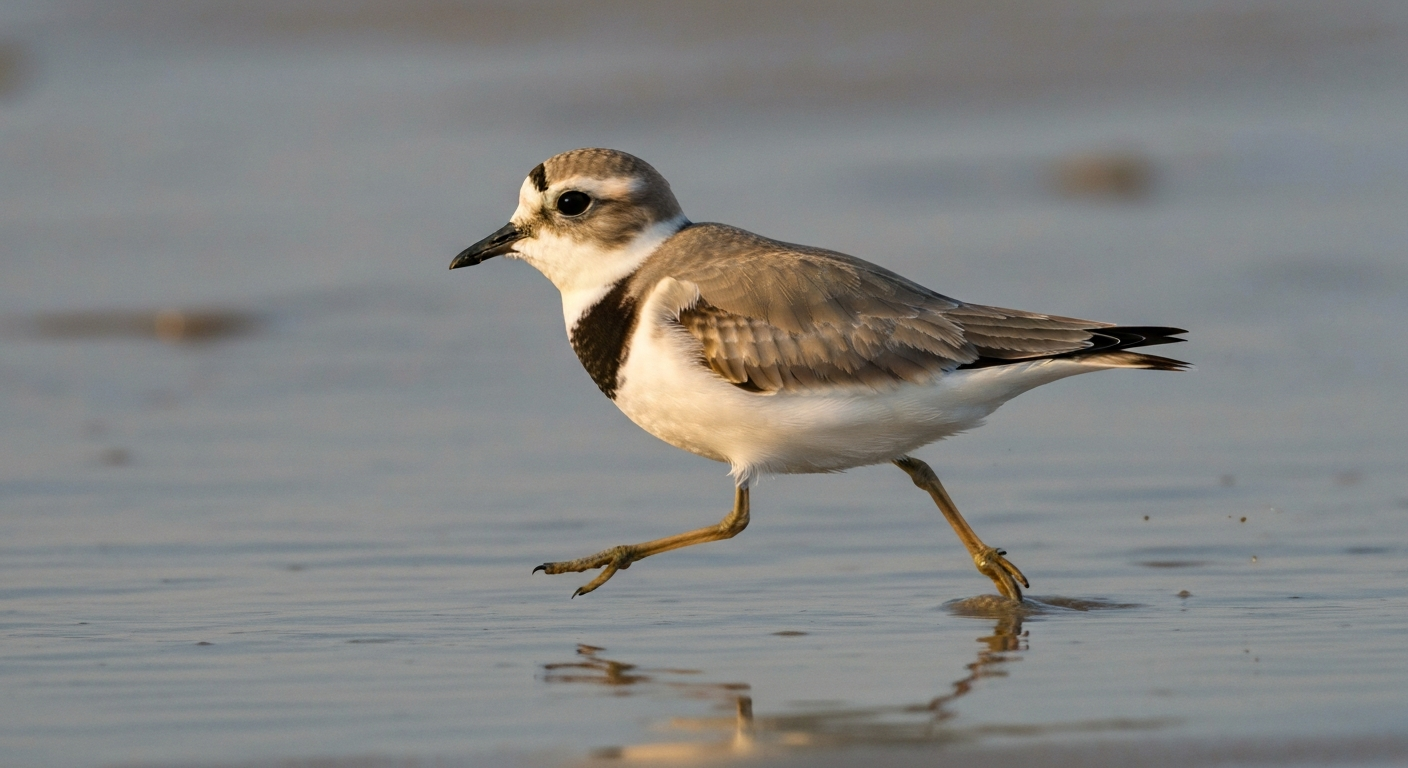
The puffin is sometimes loosely compared to the plover by readers who associate both birds with coastal settings, but they belong to entirely different bird families with very different body plans, diets, and behaviors. Plovers are waders that feed on invertebrates on beaches and mudflats; puffins are diving seabirds that hunt fish far offshore. If you are encountering the term 'plover' in a cultural or symbolic context, that entry explores a distinct set of associations. For a separate discussion of those associations, see the plover bird meaning entry for the plover's distinct cultural and symbolic profile. For readers interested in similar shorebird symbolism, see piecost bird meaning for a concise overview of that bird's cultural associations. Similarly, readers who arrive here through searches about 'puffed up bird meaning' may be looking at the physical posture of a bird that fluffs its feathers in cold weather or when ill, a behavior common to many species and not specific to puffins, though a puffin on a cold clifftop does present a notably round and ruffled profile. For a fuller explanation of why birds fluff their feathers and the common 'puffed up bird meaning', see puffed up bird meaning. For more on the symbolism of a rounded or 'plump' appearance in birds, see the entry on plump bird meaning. For a related inquiry, see the entry on picherie bird meaning for more on terms related to 'puffed up' or regional bird-name usages.
One more connection worth flagging: older readers or museum visitors may encounter puffins as mounted specimens in natural-history collections. The 'stuffed bird' in a display case is not a metaphor but a taxidermied specimen, a practice with its own set of meanings around preservation, scientific documentation, and the history of collecting. If that is the context you are working in, the entry on stuffed bird meaning covers that territory directly.
Using 'Puffin' as a Writer or Communicator
If you are writing and want to use puffin as a reference, metaphor, or symbol, here are practical notes on how the term tends to land with readers. In a naturalistic context ('the puffin colony on the Farne Islands'), the word carries clean, specific meaning: a documented seabird, a particular place, a genuine ecological relationship. In a figurative context ('she had a puffin's persistence, ungainly in the air but devastatingly effective once underwater'), it reads as a thoughtful, somewhat unusual choice that will reward readers who know the bird. In a brand or naming context (sports teams, businesses, publications), 'Puffin' evokes small-but-mighty resilience, approachability, and strong regional identity in North Atlantic settings.
One practical caution: because the puffin's cultural symbolism is still being actively constructed (it is, historically speaking, a relatively recent entrant into the gallery of heavily symbolic birds), claims about puffins in 'ancient mythology' or 'traditional shamanic practice' should be checked carefully. The bird's real cultural richness, which is substantial, lies in documented living traditions: the Heimaey puffling rescue, the Faroese relationship with the bird, the puffin as Icelandic national icon. Those are concrete, verifiable, and genuinely fascinating. They do not need embellishment.
FAQ
What authoritative natural-history information is required for the biological definition of 'puffin' and which sources should be used?
Questions: What is the accepted species identity (e.g., Atlantic Puffin, Fratercula arctica)? What are diagnostic field characters (size, plumage, bill color in breeding season, flight and diving behavior)? What are diet, breeding/nesting habits, and pelagic vs. colony-season behavior? Sources: Tier‑1 ornithological authorities and species accounts (Cornell Lab All About Birds, RSPB, BirdLife/IUCN, national field guides such as Sibley or regional checklists). Use species factsheets for up-to-date natural-history details and caution about regional variation.
What specific morphometrics and measurement ranges must be researched and how should regional variation be handled?
Questions: What are standard adult length, wingspan, and mass ranges commonly cited for Fratercula arctica? Are there regional size differences or measurement uncertainties to note? Sources: Species accounts, national monitoring reports, museum specimen databases, government species reports (e.g., RSPB, national conservation agencies). Report ranges with citations and flag regional or source discrepancies for publication accuracy.
What conservation-status information must be included and which sources are authoritative?
Questions: What is the global IUCN/BirdLife status for the Atlantic puffin? Are regional populations assessed differently (national red lists, local trends)? What are major threats and population trends? Sources: IUCN Red List/BirdLife species factsheet, national conservation agencies and recent peer‑reviewed monitoring studies. Cite dates of assessments and avoid overgeneralizing across regions.
How should the term 'pelagic' be defined and contextualized for puffin life history?
Answer":"Question: How to define 'pelagic' for non-specialist readers and explain puffins' at‑sea behavior outside breeding season? Sources: Standard English dictionaries (Cambridge/Merriam‑Webster) for lexical definition and ornithological factsheets for ecological context (All About Birds, field guides). Distinguish breeding-colony vs. pelagic at‑sea phases with cited examples.
What regional-range and habitat sources are needed to describe where puffins occur and their breeding habitats?
Questions: What breeding coasts and island colonies are characteristic (North Atlantic: Iceland, UK, Faroe Islands, Canada, Norway)? What habitat features do colonies require (burrows, cliffs)? Sources: National conservation bodies (RSPB, BTO, Icelandic/Faroese research institutions), peer‑reviewed range accounts, and authoritative field guides. Cite region-specific reports for local claims.
Which lexicographic and taxonomic authorities are required for etymology and name‑variant research?
Questions: What is the English etymology of 'puffin' and historical name-variants/misspellings? What is the origin/meaning of the genus name Fratercula? Sources: Merriam‑Webster, Online Etymology Dictionary, OED where accessible, and taxonomic accounts or museum databases (Animal Diversity Web, original taxonomic literature). Provide documented historical forms and meanings, citing authorities.
Next Article
Plover Bird Meaning: Natural History, Symbolism & Use
Discover plover bird meaning: biology, symbolism, idioms, ID tips, cultural uses and ethical viewing.